Dexamethasone Suppression Test (DST): Types, Preparation and Results

Updated: 2 days ago
Written and medically reviewed by Dr. Baraa Alnahhal, MD · Last reviewed: November 2026 · How we review
Quick Answer: What is a dexamethasone suppression test?
A dexamethasone suppression test (DST) measures how the cortisol level responds after you take dexamethasone, a man-made version of cortisol. In Cushing syndrome the level stays high. In the overnight test, you take a 1 mg pill at 11 p.m. and have blood drawn at 8 a.m. Below 1.8 mcg/dL is normal. [1]
What the research says
The overnight DST is one of the most sensitive screening tests for Cushing syndrome. A meta-analysis of 139 studies with 14,140 participants found the 1 mg overnight DST had 98.6% sensitivity and 90.6% specificity, the highest sensitivity of the first-line tests. (Galm et al., The Journal of Clinical Endocrinology & Metabolism, 2020) [2]
Cortisol that fails to suppress is linked with higher mortality. In 206 people with incidental benign adrenal adenomas, those with post-dexamethasone cortisol of 1.8 to 5 mcg/dL had a 12-fold higher risk of death, and above 5 mcg/dL a 22-fold higher risk, compared with those below 1.8 mcg/dL. (Debono et al., The Journal of Clinical Endocrinology & Metabolism, 2014) [3]
Key takeaways
The DST checks whether your body can lower its cortisol output after a dose of dexamethasone. [1]
It is mainly used to diagnose Cushing syndrome. [1]
There are low-dose and high-dose versions, each done overnight or over three days; the low-dose overnight test is most common. [1]
Some medicines, including birth control pills, corticosteroids and antiseizure drugs, can affect results. [1]
The test is safe; the only real risks come from the blood draw. [1]
What is a dexamethasone suppression test?
A dexamethasone suppression test measures how your cortisol level reacts to a medicine called dexamethasone. Providers use it mainly to diagnose Cushing syndrome, a condition caused by too much cortisol over a long time. [1]
Types of dexamethasone suppression test
There are low-dose and high-dose tests, and each can be done as an overnight test or a three-day (standard) test. The low-dose overnight test is the one most people have. [1]

Test type | What you do |
Low-dose overnight | Take 1 mg of dexamethasone at 11 p.m.; blood is drawn at 8 a.m. the next morning |
High-dose overnight | Morning blood test, then 8 mg of dexamethasone at 11 p.m.; blood is drawn again at 8 a.m. |
Low-dose standard | Collect urine for three days; on day two take 0.5 mg every six hours for 48 hours |
High-dose standard | Collect urine for three days; on day two take 2 mg every six hours for 48 hours |
Sources: [1]
For the standard tests, you bring the urine containers to the lab on the third day. [1]
How does the test work?
Cortisol is often called the stress hormone because your adrenal glands release it in response to stress. Cortisol levels that stay high for a long time can make you sick. [1]
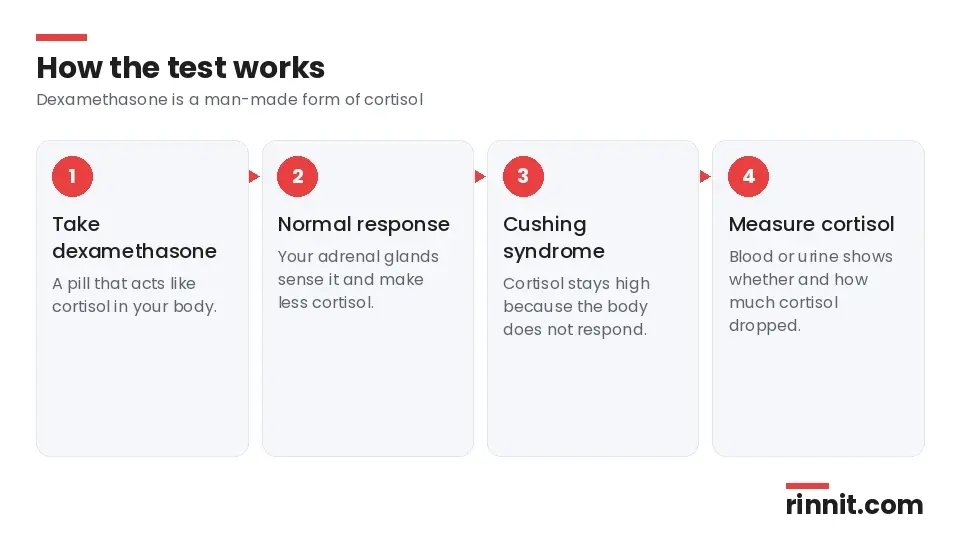
Dexamethasone acts like cortisol in your body. When you take it, healthy adrenal glands respond by making less of their own cortisol. In Cushing syndrome, the body doesn't respond to the medicine, so cortisol stays high. [1]
The test shows whether your cortisol drops after dexamethasone and by how much. It can also help show whether high cortisol is driven by too much adrenocorticotropic hormone (ACTH) from your pituitary gland. [1]
How do you prepare for the test?
Some medicines can change the results, so your provider may ask you to stop them for a time beforehand. These may include: [1]
Birth control pills
Medicines that contain corticosteroids
Antiseizure medicines
You may also be asked not to eat or drink before the test. The most helpful thing you can do is give your provider your full health history, including every medicine and supplement you take. [1]
What are the risks?
The test is safe and low risk. Because you take dexamethasone for only a short time, it is unlikely to cause side effects. The only other risks are rare bleeding or bruising from the blood draw. [1]
What do the results mean?
Results can take several days to come back. Your provider uses them to decide whether you have Cushing syndrome and what might be causing it. [1]
Normal results
Cortisol should fall after dexamethasone. These results are considered normal: [1]

Test type | Normal result |
Low-dose overnight | Fasting 8 a.m. cortisol below 1.8 mcg/dL |
High-dose overnight | Cortisol falls by more than 50% after dexamethasone |
Low-dose standard | Urine free cortisol below 10 mcg/day on day 3 |
High-dose standard | Urine free cortisol falls by more than 90% on day 3 |
Sources: [1]
Normal ranges can vary between labs, so ask your provider what your numbers mean. [1]
Abnormal results
Research also links failure to suppress cortisol with a higher risk of heart and other health problems in people with adrenal adenomas. [3]
When should you call your provider?
Contact your provider if you have questions about the test or the next steps. Depending on your results, you may need more tests. [1]
Conclusion
A dexamethasone suppression test is a simple, safe way to check whether your body is making too much cortisol. It is usually the first step toward confirming or ruling out Cushing syndrome. [1] [2]
Tell your provider about every medicine you take before the test, and talk through your results together, since they are often combined with other tests before a diagnosis is made.
Keep learning: Read our guide to Cushing syndrome or our article on corticosteroids. For more background, see StatPearls: Dexamethasone Suppression Test.
FAQ
What is a dexamethasone suppression test?
A test that measures how your cortisol level responds after taking dexamethasone, mainly to diagnose Cushing syndrome. [1]
Why is a dexamethasone suppression test done?
To find out whether your body makes too much cortisol and what may be causing it. [1]
What is the most common type of DST?
The low-dose overnight test: a 1 mg pill at 11 p.m. and a blood test at 8 a.m. [1]
What is a normal result on the overnight DST?
A fasting 8 a.m. cortisol below 1.8 mcg/dL. [1]
What does a high cortisol result mean?
Above 1.8 mcg/dL may mean hypercortisolism, and above 5 mcg/dL may mean significant hypercortisolism. [1]
Do I need to fast before the test?
Your provider may ask you to avoid eating and drinking before the test. [1]
Which medicines can affect the results?
Birth control pills, corticosteroids and antiseizure medicines, among others. [1]
Does dexamethasone cause side effects during the test?
It is taken for only a short time, so side effects are unlikely. [1]
How long do results take?
Usually several days. [1]
What happens after an abnormal result?
Your provider may order more tests to confirm Cushing syndrome and find the cause. [1]
Related Reading
Cushing Syndrome: What High Cortisol Does to Your Body and How It Is Treated explains the high-cortisol condition this test is used to diagnose.
Adrenal Adenoma: The Most Common Adrenal Gland Tumor — What It Is, What It Does, and When It Needs Treatment covers adrenal growths that may be checked for extra cortisol with this test.
Benign Adrenal Tumors: Symptoms, Causes, and Treatment describes noncancerous adrenal tumors that can make too much cortisol.
References
Cleveland Clinic. Dexamethasone Suppression Test. Cleveland Clinic. Last updated June 5, 2025. https://my.clevelandclinic.org/health/diagnostics/dexamethasone-suppression-test
Galm BP, Qiao N, Klibanski A, et al. Accuracy of Laboratory Tests for the Diagnosis of Cushing Syndrome. J Clin Endocrinol Metab. 2020;105(6):2081-2094. PMID 32133504. https://doi.org/10.1210/clinem/dgaa105
Debono M, Bradburn M, Bull M, et al. Cortisol as a marker for increased mortality in patients with incidental adrenocortical adenomas. J Clin Endocrinol Metab. 2014;99(12):4462-4470. PMID 25238207. https://doi.org/10.1210/jc.2014-3007
Medical disclaimer
This article is for general education only and does not replace advice from a qualified healthcare professional. Talk to your doctor about your own diagnosis and treatment, and seek emergency care right away for severe or sudden symptoms.



Comments