Benign Adrenal Tumors: Symptoms, Causes, and Treatment

Updated: 3 days ago
Medically reviewed by Dr. Baraa Alnahhal, MD · Last reviewed: October 2026
Quick Answer
A benign adrenal tumor is a non-cancerous mass in an adrenal gland, most commonly an adenoma or a pheochromocytoma. Many cause no symptoms, but hormone-making tumors can cause high blood pressure, weight gain or a fast heartbeat. They are often found by chance on imaging and confirmed with hormone tests. Many need only monitoring, while others require adrenalectomy.
What the research says
Adrenal tumors are fairly common in the general population, and most are nonfunctioning adenomas. In a screening study of 25,356 adults in China, 351 people (1.4%) had an adrenal tumor on CT, and prevalence rose from 0.2% in people aged 18 to 25 to 3.2% in those older than 65. Of the 351 tumors, 337 were adrenocortical adenomas, 14 were other benign nodules, and none were malignant. Among 212 adenomas that had hormone testing, 69.3% were nonfunctioning, 18.9% showed cortisol autonomy, 11.8% showed primary aldosteronism, and none were pheochromocytoma (Jing et al., Ann Intern Med, 2022) [3].
Over years of follow-up, nonfunctioning adrenal tumors rarely change. A meta-analysis of 32 studies (4,121 patients, mean follow-up about 50 months) found that clinically significant tumor enlargement (10 mm or more) occurred in 2.5% of patients, none developed adrenal cancer, clinically overt hormone excess developed in fewer than 0.1%, and only 4.3% of those with nonfunctioning tumors went on to develop mild autonomous cortisol excess. Hypertension (60.0%), obesity (42.0%), dyslipidemia (33.7%), and type 2 diabetes (18.1%) were common, and more likely to develop or worsen when mild cortisol excess was present (Elhassan et al., Ann Intern Med, 2019) [4].
Guideline advice: check hormones, grade the cancer risk on imaging, and avoid surgery for clearly benign, nonfunctioning masses. The European Society of Endocrinology and European Network for the Study of Adrenal Tumors guideline states that homogeneous lesions measuring 10 Hounsfield units or less on unenhanced CT are benign and need no additional imaging, recommends measuring plasma or urinary metanephrines and a 1-mg overnight dexamethasone suppression test in every patient, and notes that surgery is not usually indicated for an asymptomatic, nonfunctioning, unilateral mass with obvious benign imaging features (Fassnacht et al., Eur J Endocrinol, 2023) [5].
What are benign adrenal tumors?
Benign adrenal tumors are masses that form in the adrenal glands and are not cancer. Most cause no symptoms and don't need treatment. But some of these tumors make high levels of hormones, and those can cause problems such as high blood pressure, weight gain, fast heartbeat, and sweating. When a benign adrenal tumor is found, the main questions are whether it is making hormones and how likely it is to behave like cancer, since cancer in these glands is rare.
This guide explains what the adrenal glands do, the two main types of benign adrenal tumors and their symptoms, who is at higher risk, how these tumors are usually found and diagnosed, and the three main ways they are handled: watchful waiting, medicines, and surgery.
Benign adrenal tumors are masses that aren't cancer. They form in the adrenal glands. The adrenal glands are part of the endocrine system. These glands make hormones that send messages to nearly every organ and tissue in the body.
There are two adrenal glands, one above each kidney. Each gland has two types of tissue: the cortex and the medulla. Benign adrenal tumors that grow in the cortex are called adrenal adenomas. Those that grow in the medulla are called pheochromocytomas (fee-o-kroe-moe-sy-TOE-muhs).
The adrenal glands are small, but they control much of what happens in the body. Their hormones help regulate metabolism, the immune system, blood pressure, and other important functions. Hormones from the cortex control metabolism, blood pressure, and certain body features, such as hair growth. Hormones from the medulla control the body's response to stress.
Most benign adrenal tumors cause no symptoms and don't need treatment. But sometimes these tumors make high levels of some hormones that can cause problems.

What are the two types of benign adrenal tumors?
The type depends on which layer of the gland the tumor grows in. The table below summarizes both types.
Feature | Adenoma (cortex) | Pheochromocytoma (medulla) |
Where it grows | Outer layer of the gland (cortex) | Inner layer of the gland (medulla) |
How common | The most common type of benign adrenal tumor | Less common |
What it can make | Hormones that affect metabolism, blood pressure, and body features | Stress-response hormones |
Possible symptoms | Weight gain, easy bruising, high blood pressure, diabetes, depressed mood, tiredness, muscle weakness or cramping | High blood pressure, fast heartbeat, sweating, tremors, headache |

What are the symptoms of benign adrenal tumors?
Symptoms depend on whether the tumor makes hormones, what hormone it makes, and how much it makes. Many benign adrenal gland tumors don't cause symptoms because they don't make hormones.
The most common type of benign adrenal tumor, called adenoma, comes from the adrenal cortex. This type of tumor might cause symptoms such as weight gain, easy bruising, high blood pressure (hypertension), diabetes, depressed mood, tiredness, and muscle weakness or cramping.
A type of benign adrenal tumor from the medulla is called pheochromocytoma. It might cause the following symptoms: high blood pressure (hypertension), fast heartbeat, sweating, tremors, and headache.
Tumor type | Possible symptoms |
Adenoma (cortex) | Weight gain; easy bruising; high blood pressure; diabetes; depressed mood; tiredness; muscle weakness or cramping |
Pheochromocytoma (medulla) | High blood pressure; fast heartbeat; sweating; tremors; headache |
Non-hormone-making tumors | Often none |
What causes benign adrenal tumors?
The cause of benign adrenal tumors often is not known.
What raises the risk of a benign adrenal tumor?
A family history of benign adrenal tumors, certain inherited genetic syndromes and a past adrenal tumor removal might raise the risk of a benign adrenal tumor.
Risk factor | What it means |
Family history | Having relatives with benign adrenal tumors raises the odds |
Genetic syndromes | Certain family-passed syndromes make these tumors more likely |
Prior adrenal tumor removal | A history of having an adrenal tumor surgically removed raises the odds |
How are benign adrenal tumors found and diagnosed?
Benign adrenal tumors often are found by chance on imaging that is done for another reason. A health care professional then looks at how likely the tumor is to be cancer and whether it is making too much hormone.
Blood and urine tests
Along with a physical exam, a health care professional runs blood and urine tests to see if the tumor is making too much hormone. The tests also show which hormone the tumor is making.
Imaging tests
Imaging tests can give more details about the tumor. They can show whether the tumor is at high risk of being a cancer, which is rare.
A CT scan takes a series of X-ray images from different angles and makes them into cross-sectional images. An MRI uses radio waves and a magnetic field to make detailed images.
M-iodobenzylguanidine (MIBG) imaging uses a radioactive compound that is injected into the body. Some adrenal gland tumors take up the compound, and the image can show tiny amounts of the compound picked up by a tumor.
Positron emission tomography (PET) also can detect radioactive compounds taken up by a tumor.
Ga-DOTATATE PET scanning is a newer imaging test that isn't widely offered. It is done along with either a CT scan or an MRI. This type of test is good at finding tumors of the endocrine system, such as benign adrenal tumors.
Test | What it does |
Physical exam | Part of the first assessment |
Blood tests | Check whether the tumor is making too much hormone, and which hormone |
Urine tests | Check whether the tumor is making too much hormone, and which hormone |
CT scan | Cross-sectional X-ray images that give detail about the tumor and cancer risk |
MRI | Radio waves and a magnetic field produce detailed images |
MIBG imaging | A radioactive compound injected into the body is taken up by some adrenal tumors, revealing even tiny amounts |
PET scan | Detects radioactive compounds taken up by a tumor |
Ga-DOTATATE PET (with CT or MRI) | Newer test, not widely offered; good at finding endocrine system tumors such as benign adrenal tumors |
How are benign adrenal tumors treated?
Benign adrenal tumors often don't need treatment. Treatment depends on how likely the tumor is to become cancer. Treatment also might depend on whether the tumor is making hormones, the type of hormone it makes, and how much it is making.
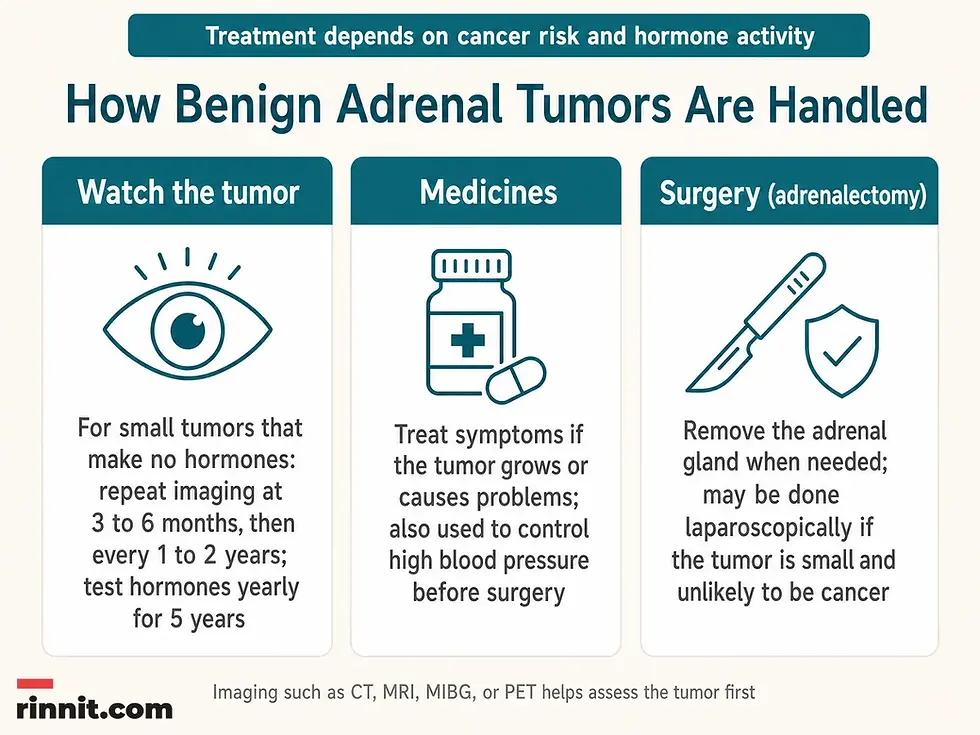
Watching the tumor
Treatment for small benign adrenal tumors that aren't making hormones might involve watching the tumor. Current European guidelines say a small mass that clearly looks benign on CT usually needs no repeat imaging or yearly hormone tests, while a mass with uncertain features may be rescanned in 6 to 12 months. Your care team will decide based on your scan and hormone results.
Medicines
If the tumor is getting bigger or causing symptoms, the symptoms might be treated with medicines. Medicines also might be used to treat symptoms such as high blood pressure before surgery.
Surgery
Surgery to remove the adrenal gland, called adrenalectomy, might be used to treat a benign adrenal tumor. The surgery may be done laparoscopically if the tumor is small and not likely to be cancer.
Approach | When it is used | What happens |
Watch the tumor | Small tumors not making hormones | Often no repeat imaging if the mass clearly looks benign on CT; a rescan in 6 to 12 months if features are uncertain |
Medicines | Tumor growing or causing symptoms | Treat the symptoms directly; also control high blood pressure before surgery |
Adrenalectomy (surgery) | When removal is needed | Remove the adrenal gland; may be done laparoscopically if the tumor is small and not likely to be cancer |
How do you prepare for your appointment?
You might start by seeing your primary health care professional. Or you might be sent to a specialist in the endocrine system, called an endocrinologist.
Here is some information to help you get ready for your appointment. When you make the appointment, ask if there is anything you need to do in advance, such as not eating or drinking before a certain test.
Make a list of your symptoms, including any that don't seem linked to the reason for your appointment, and when they began. Gather key personal information, including major stresses, recent life changes, and family medical history. List all medicines, vitamins, or other supplements you take, including doses. Write down questions to ask your health care professional. Take a family member or friend along, if possible, to help you remember the information you're given.
For a benign adrenal tumor, some questions to ask include: What is likely causing my symptoms or condition? Other than the most likely cause, what are other possible causes? What tests do I need? How likely is it that the tumor will become cancer? What is the best course of action? I have other health conditions; how can I best manage them together? Are there restrictions I need to follow? Should I see a specialist? Are there brochures or other printed material I can have, and what websites might be helpful?
What is the bottom line on benign adrenal tumors?
Finding out you have a tumor anywhere in your body is unsettling, and the word "tumor" deserves a pause. But an adrenal tumor that is benign is, by definition, not cancer. Most benign adrenal tumors cause no symptoms at all because they don't make hormones, and most don't need treatment. They are frequently discovered by accident on scans done for something entirely different.
What matters next is two questions: is the tumor making hormones, and could it behave like cancer? Blood and urine tests answer the first, and imaging such as CT, MRI, MIBG, or PET answers the second. Cancer in the adrenal gland is rare, so for most people these answers point toward simple watchful waiting: often no further scans if the mass clearly looks benign, or a single follow-up scan in 6 to 12 months if its features are uncertain.
When a tumor does cause trouble, medicines can control the symptoms, including high blood pressure before surgery, and removing the affected gland (adrenalectomy) is an established option that can sometimes be done laparoscopically. The key is not to panic, but to complete the hormone and imaging workup so the right plan follows the right findings.
Next steps: If a scan found an adrenal mass, the next step is a hormone workup with your health care professional, who may refer you to an endocrinologist. Ask about the blood and urine tests and the imaging plan, and whether watchful waiting fits your situation.
FAQ
Is a benign adrenal tumor cancer?
No. Benign means the mass is not cancer. Imaging helps confirm that the tumor is at low risk of behaving like cancer, which is rare in the adrenal glands.
Do benign adrenal tumors cause symptoms?
Many don't, because they don't make hormones. When they do cause symptoms, it depends on the hormone: adenomas can cause weight gain, easy bruising, high blood pressure, diabetes, depressed mood, tiredness, and muscle weakness, while pheochromocytomas can cause high blood pressure, fast heartbeat, sweating, tremors, and headache.
How are benign adrenal tumors usually found?
Benign adrenal tumors are often found by chance on imaging that was done for another reason. Hormone blood and urine tests plus imaging then determine how to handle the tumor.
Do benign adrenal tumors need to be removed?
Often no. Small tumors that aren't making hormones and clearly look benign on CT often need no further scans or yearly hormone tests, while those with uncertain features may be rescanned. Medicines or adrenalectomy (removal of the adrenal gland) are used when the tumor grows, causes symptoms, or has higher cancer risk.
Who is at higher risk for benign adrenal tumors?
People with a family history of these tumors, those with certain genetic syndromes passed through families, and people who have previously had an adrenal tumor surgically removed.
What is an adrenal incidentaloma?
An adrenal incidentaloma is an adrenal tumor found by chance on a scan done for another reason. Most are benign and do not make extra hormones, but your provider will usually order tests to check.
What tests show whether an adrenal tumor makes hormones?
Blood and urine tests check whether the tumor is making too much hormone and which one. CT or MRI scans help show whether the tumor looks benign.
What is a pheochromocytoma?
A pheochromocytoma is a tumor in the inner part of the adrenal gland that can release stress hormones. It can cause high blood pressure, a fast heartbeat, sweating, tremors, and headaches.
How is an adrenal tumor removed?
Surgery to remove the adrenal gland is called adrenalectomy. When the tumor is small and unlikely to be cancer, it can often be done laparoscopically through small cuts.
Can a benign adrenal tumor become cancer?
This is rare. Your care team decides on follow-up scans based on how the tumor looks, and growth or new symptoms may lead to treatment.
Disclaimer: This article is for general informational purposes only and does not constitute medical advice. Always consult a qualified health care provider for individual questions.
Related Reading
Dexamethasone Suppression Test (DST): Types, Preparation and Results explains the cortisol test used to diagnose Cushing syndrome.
References
Mayo Clinic Staff. Benign adrenal tumors - Symptoms and causes. Mayo Clinic. May 10, 2024. https://www.mayoclinic.org/diseases-conditions/benign-adrenal-tumors/symptoms-causes/syc-20356190
Mayo Clinic Staff. Benign adrenal tumors - Diagnosis and treatment. Mayo Clinic. May 10, 2024. https://www.mayoclinic.org/diseases-conditions/benign-adrenal-tumors/diagnosis-treatment/drc-20567035
Jing Y, et al. Prevalence and Characteristics of Adrenal Tumors in an Unselected Screening Population: A Cross-Sectional Study. Ann Intern Med. 2022;175(10):1383-1391. PMID 36095315. https://doi.org/10.7326/M22-1619
Elhassan YS, et al. Natural History of Adrenal Incidentalomas With and Without Mild Autonomous Cortisol Excess: A Systematic Review and Meta-analysis. Ann Intern Med. 2019;171(2):107-116. PMID 31234202. https://doi.org/10.7326/M18-3630
Fassnacht M, et al. European Society of Endocrinology clinical practice guidelines on the management of adrenal incidentalomas, in collaboration with the European Network for the Study of Adrenal Tumors. Eur J Endocrinol. 2023;189(1):G1-G42. PMID 37318239. https://doi.org/10.1093/ejendo/lvad066
Medical disclaimer
The information provided in this article is for educational purposes only and should not be used as a substitute for professional medical advice, diagnosis, or treatment. Always seek the advice of your physician or other qualified health provider with any questions you may have regarding a medical condition.



Comments