Blood Glucose Test: Normal Blood Sugar Levels, Prediabetes and Diabetes Ranges

Updated: 2 days ago
Written and medically reviewed by Dr. Baraa Alnahhal, MD · Last reviewed: November 2026 · How we review
Quick Answer: What is a blood glucose test?
A blood glucose test measures the amount of sugar (glucose) in the blood, mainly to screen for diabetes. A normal result is 70 to 99 mg/dL, 100 to 125 mg/dL suggests prediabetes, and a fasting level of 126 mg/dL or higher on more than one test usually means diabetes. [1]
What the research says
A fasting glucose of 126 mg/dL or more rarely gives a false diabetes diagnosis. A network meta-analysis of 73 studies found fasting plasma glucose had a specificity of 98% against the oral glucose tolerance test, the highest of the tests compared, though it detected only about half of cases (sensitivity 49%). (Duong et al., Frontiers in Medicine, 2023) [2]
A finger-prick meter is not reliable enough for diagnosis. In 529 pregnant women, a point-of-care glucometer identified gestational diabetes in 14.9% compared with 26.7% using lab tests, with a sensitivity of only 27.0%. (Adam and Rheeder, International Journal of Gynecology & Obstetrics, 2018) [3]
Key takeaways
A blood glucose test checks your blood sugar level and is mainly used to screen for Type 2 diabetes. [1]
A venous (lab) test is generally more accurate than a finger-prick (capillary) test. [1]
For a fasting test, have nothing but water for 8 to 12 hours beforehand. [1]
Normal is 70 to 99 mg/dL; prediabetes is 100 to 125 mg/dL; 126 mg/dL or higher on more than one fasting test usually means diabetes. [1]
The American Diabetes Association recommends regular screening for everyone 35 or older. [1]
What is a blood glucose test?
A blood glucose test measures the sugar in your blood. Glucose comes from the food you eat and from your liver, and it is your body's main source of energy. Insulin, a hormone made by your pancreas, helps keep your blood sugar in a healthy range. [1]
High blood sugar (hyperglycemia) usually points to diabetes, which happens when your pancreas makes little or no insulin or your body does not use insulin properly. [1]
What are the types of blood glucose tests?

Type | How it's done | Notes |
Capillary test | Finger prick and a glucose meter | Result in seconds |
Venous (plasma) test | Blood drawn from a vein and sent to a lab, often as part of a metabolic panel | Generally more accurate |
Fasting blood sugar test | Blood drawn after fasting | Gives a more accurate baseline, because food changes blood sugar |
At-home monitoring | Finger-prick meter or continuous glucose monitor (CGM) | Used by people with diabetes to manage it |
Sources: [1]
Why is a blood glucose test done?
There are four main reasons: [1]
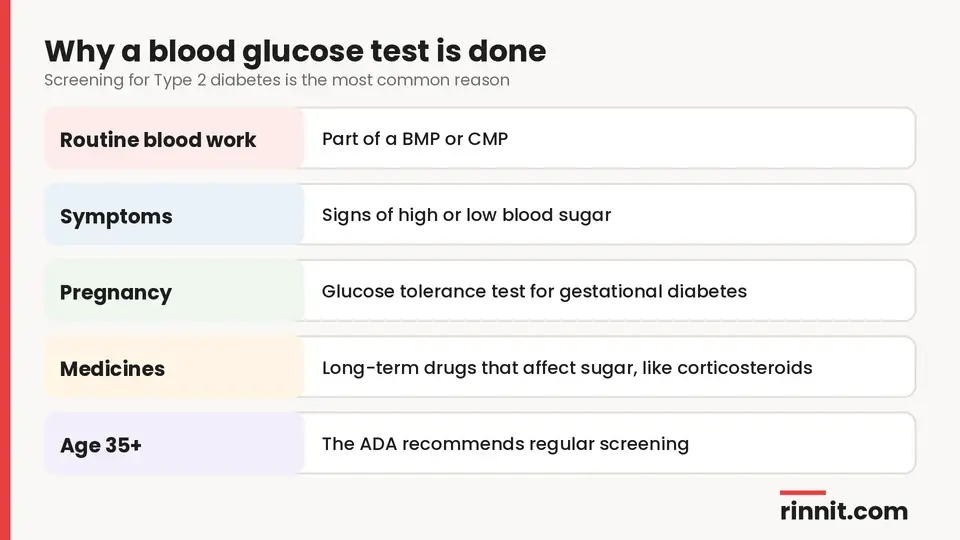
As part of routine blood work, such as a basic metabolic panel (BMP) or comprehensive metabolic panel (CMP)
If you have symptoms of high or low blood sugar
To check for gestational diabetes during pregnancy, using a glucose tolerance test
If you take long-term medicine that affects blood sugar, such as corticosteroids
Screening for Type 2 diabetes is the most common use. Regular screening is recommended if you have risk factors, and the American Diabetes Association recommends regular screening for anyone 35 or older. [1]
How do you prepare for a blood glucose test?
For a fasting blood glucose test, do not eat or drink anything except water for 8 to 12 hours beforehand. If the glucose test is part of a BMP or CMP, you may also need to fast for several hours. Your provider will tell you if there are special instructions. [1]
What happens during a blood glucose test?
Blood draw from a vein
You sit in a chair while a phlebotomist finds a vein, usually in your arm, cleans the area and inserts a small needle to collect blood in a tube. They then remove the needle, apply pressure and put on a bandage. [1]
Finger-prick test
A provider cleans your fingertip, pricks it with a small lancet and places a drop of blood on a test strip in a glucose meter. You get gauze to stop the bleeding, and the result shows within seconds. [1]
Venous results usually come back in one or two days; finger-prick results are immediate. [1]
What are normal blood glucose levels?
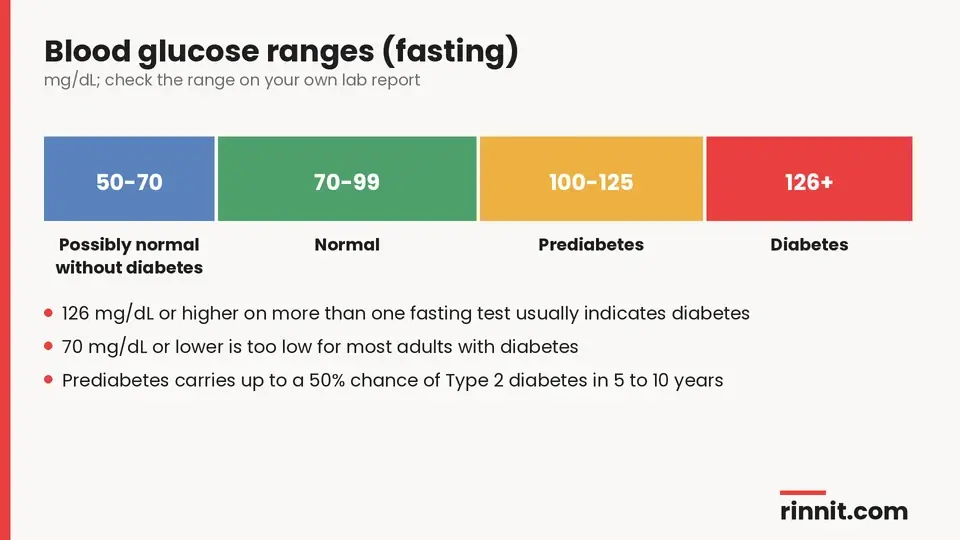
Result | mg/dL | mmol/L | What it means |
Normal | 70 to 99 | 3.9 to 5.5 | Healthy blood sugar |
Possibly normal without diabetes | 50 to 70 | 2.8 to 3.9 | Can be normal in people who do not have diabetes |
Prediabetes | 100 to 125 | 5.6 to 6.9 | Higher than normal; steps can be taken to reverse it |
Diabetes (fasting) | 126 or higher on more than one occasion | 7.0 or higher | Usually indicates diabetes |
Sources: [1]
People with prediabetes have up to a 50% chance of developing Type 2 diabetes over the next 5 to 10 years. Type 1 diabetes typically shows very high levels, 200 mg/dL (11.1 mmol/L) or higher. Before diagnosing diabetes, your provider will likely order an A1c test, which reflects your average blood sugar over a few months. [1]
What else can cause high blood glucose?
Adrenal gland problems, such as Cushing syndrome
Pancreas problems, such as pancreatitis
Hyperthyroidism
Major stress on the body, such as from surgery or trauma
Certain medicines, especially corticosteroids
Sources: [1]
What does low blood glucose mean?
A result of 70 mg/dL or lower is too low for most adults with diabetes. Low blood sugar (hypoglycemia) is common in Type 1 diabetes and can happen in Type 2 diabetes with certain medicines. It is much less common in people without diabetes. [1]
In people without diabetes, frequent low readings may point to liver disease, kidney disease, hypothyroidism, Addison disease (adrenal insufficiency), alcohol use disorder or a rare tumor called an insulinoma. A single low result is usually not a concern if you do not have diabetes. [1]
What happens after an abnormal result?
An abnormal result does not always mean you have a condition that needs treatment. Providers rely on more than one test to diagnose diabetes and other conditions, so ask your provider what your result means for you. [1]
Conclusion
A blood glucose test is a quick, simple way to check your blood sugar and screen for diabetes. A lab test from a vein is the more accurate option, and a fasting test gives the clearest baseline.
If your result is in the prediabetes or diabetes range, ask your provider about repeat testing, an A1c test and the steps that can bring your blood sugar back down.
Keep learning: Read our guides to the fasting blood sugar test, the A1C test and blood sugar monitoring at home. For more background, see the MedlinePlus page on the blood glucose test.
FAQ
What is a blood glucose test?
A test that measures the sugar in your blood, mainly to screen for diabetes. [1]
What is a normal blood glucose level?
70 to 99 mg/dL (3.9 to 5.5 mmol/L). [1]
What blood sugar level means prediabetes?
100 to 125 mg/dL (5.6 to 6.9 mmol/L). [1]
What blood sugar level means diabetes?
A fasting level of 126 mg/dL (7.0 mmol/L) or higher on more than one test usually indicates diabetes. [1]
How long should I fast before a blood glucose test?
Have nothing but water for 8 to 12 hours before a fasting test. [1]
Is a finger-prick test as accurate as a lab test?
Venous lab tests are generally more accurate than finger-prick tests. [1]
What is a low blood sugar level?
70 mg/dL or lower is too low for most adults with diabetes. [1]
What else can cause high blood sugar?
Cushing syndrome, pancreatitis, hyperthyroidism, major stress such as surgery, and medicines like corticosteroids. [1]
Who should get a blood glucose test?
People with risk factors for diabetes and, per the American Diabetes Association, everyone 35 or older. [1]
How long do blood glucose results take?
Finger-prick results are immediate; lab results usually take one or two days. [1]
Related Reading
Diabetes: Symptoms, Types, Causes, Diagnosis & Treatment — Complete Guide explains the condition a high glucose result can point to.
Prediabetes: Symptoms, Causes, and Treatment covers what a 100 to 125 mg/dL result means and how to reverse it.
Gestational Diabetes: Symptoms, Causes, Risks & Treatment — Complete Guide explains why glucose is tested during pregnancy.
Hypoglycemia: Managing Low Blood Sugar Emergencies and Prevention covers what a low glucose result means.
Hyperglycemia in Diabetes: Warning Signs, Target Numbers, and When It Becomes an Emergency explains high blood sugar in people with diabetes.
Understanding Insulinoma: Symptoms, Causes, and Recovery covers a rare cause of repeated low readings.
Cushing Syndrome: What High Cortisol Does to Your Body and How It Is Treated explains one non-diabetes cause of high blood sugar.
References
Cleveland Clinic. Blood Glucose (Sugar) Test: Levels & What They Mean. Cleveland Clinic. Last updated February 5, 2025. https://my.clevelandclinic.org/health/diagnostics/12363-blood-glucose-test
Duong KNC, Tan CJ, Rattanasiri S, et al. Comparison of diagnostic accuracy for diabetes diagnosis: A systematic review and network meta-analysis. Front Med (Lausanne). 2023;10:1016381. PMID 36760402. https://doi.org/10.3389/fmed.2023.1016381
Adam S, Rheeder P. Evaluating the utility of a point-of-care glucometer for the diagnosis of gestational diabetes. Int J Gynaecol Obstet. 2018;141(1):91-96. PMID 29164614. https://doi.org/10.1002/ijgo.12399
Medical disclaimer
This article is for general education only and does not replace advice from a qualified healthcare professional. Talk to your doctor about your own diagnosis and treatment, and seek emergency care right away for severe or sudden symptoms.



Comments