A1C Test: Normal Levels, Prediabetes and Diabetes Ranges and What Affects Results

Updated: 2 days ago
Written and medically reviewed by Dr. Baraa Alnahhal, MD · Last reviewed: November 2026 · How we review
Quick Answer: What is an A1C test?
An A1C test is a blood test that shows the average blood sugar (glucose) level over the past three months. Providers use it to detect prediabetes, help diagnose Type 2 diabetes and monitor treatment. An A1C below 5.7% is normal, 5.7% to 6.4% signals prediabetes, and 6.5% or higher usually indicates diabetes. You don't need to fast. [1]
What the research says
Higher A1C in people without diabetes predicts future diabetes and heart disease. In 11,092 adults without diabetes followed in the ARIC study, an A1C of 6.0% to 6.4% carried 4.48 times the risk of later diabetes compared with 5.0% to 5.4%, and an A1C of 6.5% or higher carried 16.47 times the risk. Coronary heart disease risk was 1.95 times higher at 6.5% or more. (Selvin et al., The New England Journal of Medicine, 2010) [2]
Each 1% drop in A1C is linked with fewer diabetes complications. In 3,642 people with Type 2 diabetes, every 1% reduction in average A1C was associated with a 21% lower risk of any diabetes-related outcome, 14% fewer heart attacks and 37% fewer microvascular complications, with no threshold below which risk stopped falling. (Stratton et al., BMJ, 2000) [3]
Key takeaways
A1C measures the share of hemoglobin carrying glucose, which reflects your average blood sugar over about three months. [1]
Below 5.7% is normal, 5.7% to 6.4% is prediabetes and 6.5% or higher usually means diabetes. [1]
Most adults with diabetes aim for an A1C of 7% or lower, but your personal target may differ. [1]
No fasting is needed, and a first high result is usually confirmed with another test. [1]
Anemia, pregnancy, kidney failure and hemoglobin variants can make A1C falsely high or low. [1]
What is an A1C test?
An A1C test measures the average amount of glucose in your blood over the past three months. The result is a percentage: the higher it is, the higher your blood sugar has been on average. Other names for the test include hemoglobin A1C, HbA1c, glycated hemoglobin and glycohemoglobin test. [1]
Providers use A1C to: [1]
Detect prediabetes
Help diagnose Type 2 diabetes
See how well a treatment plan is working if you have Type 1 or Type 2 diabetes
How does the A1C test work?
A1C relies on hemoglobin, the part of red blood cells that carries oxygen. Glucose in your blood sticks to hemoglobin, a process called glycation, and the more glucose there is, the more sticks. It stays attached for around three months, about how long a red blood cell lives. That's why A1C gives a longer view of blood sugar than a single glucose reading. [1]
When do you need an A1C test?
If you have diabetes, you should have an A1C test two or more times a year, as your care team recommends. If you don't have diabetes, your provider may order the test if you have symptoms such as intense thirst, frequent urination, blurry vision or constant tiredness. [1]
It's also used to screen people at risk of Type 2 diabetes, including those who: [1]
Have a family history of Type 2 diabetes
Had gestational diabetes
Have obesity
Are physically inactive
Are older than 35
How is the A1C test done?
There are two ways to take the sample. The vein blood draw is the most common and generally more accurate; the finger-prick version gives results within minutes but is used only to check diabetes management, not to diagnose it. [1]
Feature | Vein blood draw | Finger prick |
How it's done | A needle draws blood from a vein in your arm | A lancet pricks your fingertip for a drop of blood |
Where it's analyzed | Sent to a lab | Often tested on the spot |
Results | Usually later, from the lab | Within minutes |
Used for | Diagnosis and monitoring | Monitoring only |
Sources: [1]
Do you need to fast for an A1C test?
No. You don't need to fast before an A1C test. [1]
Are there risks?
Risk is very low. You may have slight tenderness or a bruise where the needle or lancet went in, which usually fades quickly. [1]
What do A1C results mean?
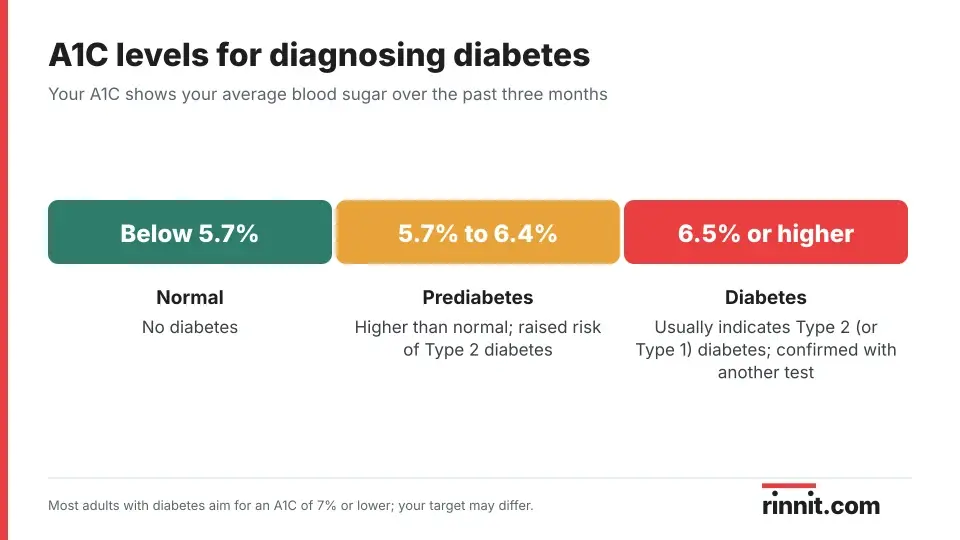
A1C level | What it means |
Below 5.7% | Normal; no diabetes |
5.7% to 6.4% | Prediabetes |
6.5% or higher | Usually indicates Type 2 (or Type 1) diabetes |
Sources: [1]
If you already have diabetes, your A1C shows how well your plan has worked over the last three months. It's an average, not a grade, and it can change with adjustments to medicine, insulin, diet or exercise. [1]
A1C and estimated average glucose (eAG)
Some labs also report an estimated average glucose (eAG), which converts your A1C into the same units your glucose meter uses (mg/dL or mmol/L). [1]
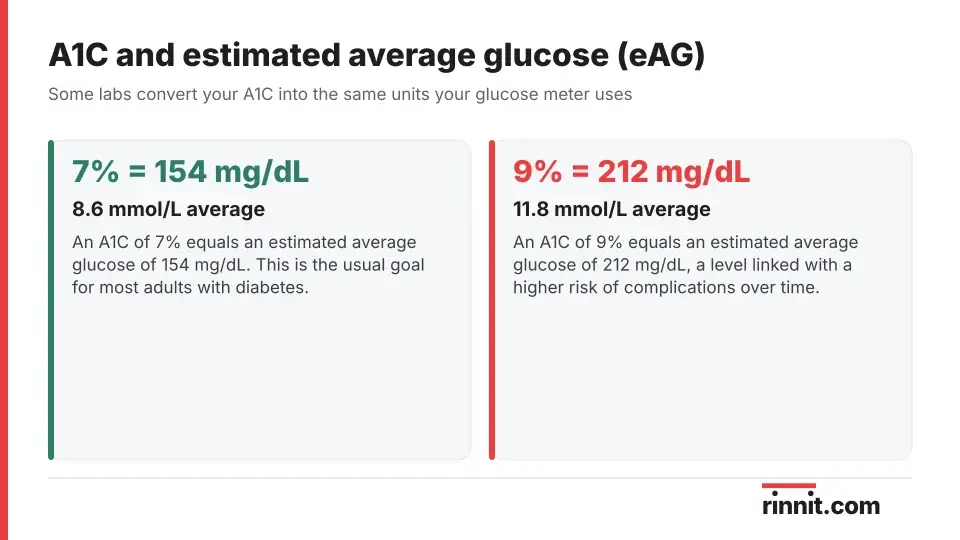
A1C | Estimated average glucose |
7% | 154 mg/dL (8.6 mmol/L) |
9% | 212 mg/dL (11.8 mmol/L) |
Sources: [1]
What is a normal A1C level?
For people without diabetes, a normal A1C is below 5.7%. For people with diabetes, the right target depends on your goals and treatment, and you and your provider set it together. The American Diabetes Association recommends a goal of 7% or lower for most adults with diabetes. [1]
Your target may be above 7% if you have limited life expectancy, severe low blood sugar episodes or trouble sensing them, or advanced complications such as chronic kidney disease, nerve problems or cardiovascular disease. People with Type 1 diabetes who are pregnant are often advised to keep A1C at 6.5% or lower. [1]
What is a dangerous A1C level?
The higher your A1C, especially when it stays high for years, the more likely you are to develop complications, including eye disease (retinopathy), kidney disease (nephropathy), nerve damage (neuropathy), gastroparesis, heart disease and stroke. Keeping A1C below 7% may lower this risk. [1] [3]
Can A1C results be wrong?
Yes. Genetics (such as hemoglobin variants), medical conditions, medicines and supplements, and errors in handling the sample can all affect the result. Most of these change how long red blood cells live or how healthy they are. [1]
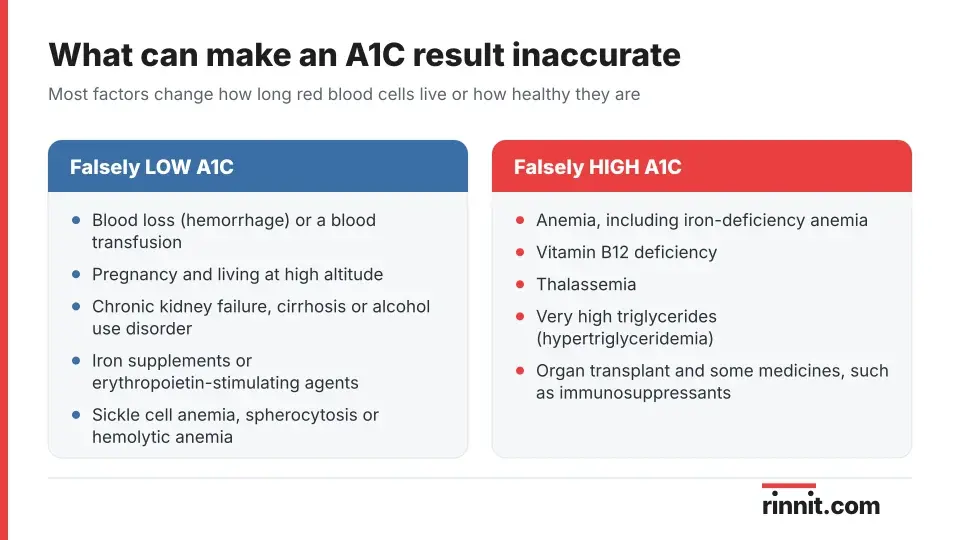
Falsely low A1C | Falsely high A1C |
Blood loss or a blood transfusion | Anemia, including iron-deficiency anemia |
Pregnancy or living at high altitude | Vitamin B12 deficiency |
Chronic kidney failure or cirrhosis | Thalassemia |
Iron supplements or erythropoietin-stimulating agents | High triglycerides (hypertriglyceridemia) |
Sickle cell anemia, spherocytosis or hemolytic anemia | Organ transplant, immunosuppressants and protease inhibitors |
Sources: [1]
Hemoglobin variants
Hemoglobin variants are inherited forms of hemoglobin other than the usual hemoglobin A. They don't raise your risk of diabetes, but they can affect some A1C tests. The most common are the hemoglobin C, D, E and S traits. Tell your provider if you think you may have one, since labs can use other methods. [1]
Can you have a high A1C without diabetes?
Yes. A first result of 6.5% or higher doesn't always mean diabetes. Medicines such as steroids, illness, anemia or a lab error can raise it. Providers rely on more than one test, such as a repeat A1C or a fasting blood glucose test, before diagnosing diabetes. [1]
Is A1C the best way to track diabetes?
A1C is an average, so two people can share an A1C of 7% even if one has steady readings around 154 mg/dL and the other swings between very high and very low. With continuous glucose monitors, many providers also use time in range, the share of the day your glucose stays in a target range, often 70 to 180 mg/dL. Most adults with diabetes aim for more than 70% time in range, about 17 hours a day. [1]
When should you call your doctor?
Contact your provider if you have symptoms of high blood sugar, such as intense thirst, frequent urination, blurry vision or ongoing tiredness, or if you have questions about your A1C result or target. [1]
Questions to ask your provider
What is my A1C target, and why?
How often should I have my A1C checked?
Could anemia or another condition affect my result?
Do I need a second test to confirm a diagnosis?
Would a continuous glucose monitor help me?
Conclusion
The A1C test gives a three-month picture of your blood sugar from a single blood sample with no fasting. It helps diagnose prediabetes and diabetes and shows how well treatment is working, with most adults with diabetes aiming for 7% or lower. [1]
Higher A1C is linked with more complications, while lowering it is linked with fewer, so your result is a useful guide for treatment decisions with your provider. [2] [3]
Keep learning: Read our guides to diabetes, prediabetes and hyperglycemia. For more on the test, see the NIDDK guide to the A1C test.
FAQ
What is an A1C test?
An A1C test is a blood test that shows your average blood sugar over the past three months, reported as a percentage. [1]
What is a normal A1C level?
For people without diabetes, a normal A1C is below 5.7%. [1]
What A1C level means prediabetes?
An A1C of 5.7% to 6.4% signals prediabetes. [1]
What A1C level means diabetes?
An A1C of 6.5% or higher usually indicates diabetes, typically confirmed with a second test. [1]
Do I need to fast for an A1C test?
No. You don't need to fast before an A1C test. [1]
What A1C should I aim for if I have diabetes?
Most adults with diabetes aim for 7% or lower, but your provider may set a different target based on your health. [1]
How often should I get an A1C test?
If you have diabetes, get an A1C test two or more times a year, as your care team recommends. [1]
What does an A1C of 7% mean in blood sugar?
An A1C of 7% equals an estimated average glucose of 154 mg/dL (8.6 mmol/L). [1]
What can make an A1C result inaccurate?
Anemia, blood loss, pregnancy, kidney failure, some medicines and hemoglobin variants can make A1C falsely high or low. [1]
Can you have a high A1C without diabetes?
Yes. Steroids, illness, anemia or a lab error can raise A1C, so providers confirm with another test. [1]
Related Reading
Learn more in our guide to Diabetes: Symptoms, Types, Causes, Diagnosis & Treatment — Complete Guide.
Learn more in our guide to Prediabetes: Symptoms, Causes, and Treatment.
Learn more in our guide to Gestational Diabetes: Symptoms, Causes, Risks & Treatment — Complete Guide.
Learn more in our guide to Hyperglycemia in Diabetes: Warning Signs, Target Numbers, and When It Becomes an Emergency.
C-Peptide Test: Purpose, Normal Range and What High or Low Results Mean explains the blood test that shows how much insulin your pancreas still makes.
Glucose Tolerance Test: Types, How to Prepare, What Happens and What Results Mean explains the 2-hour sugar-load test used to diagnose prediabetes, diabetes and gestational diabetes.
References
Cleveland Clinic. A1C: What It Is, Test, Levels & Chart. Cleveland Clinic. Last updated November 22, 2022. https://my.clevelandclinic.org/health/diagnostics/9731-a1c
Selvin E, Steffes MW, Zhu H, et al. Glycated hemoglobin, diabetes, and cardiovascular risk in nondiabetic adults. N Engl J Med. 2010;362(9):800-11. PMID 20200384. https://doi.org/10.1056/NEJMoa0908359
Stratton IM, Adler AI, Neil HA, et al. Association of glycaemia with macrovascular and microvascular complications of type 2 diabetes (UKPDS 35): prospective observational study. BMJ. 2000;321(7258):405-12. PMID 10938048. https://doi.org/10.1136/bmj.321.7258.405
Medical disclaimer
This article is for general education only and does not replace advice from a qualified healthcare professional. Talk to your doctor about your own diagnosis and treatment, and seek emergency care right away for severe or sudden symptoms.



Comments