C-Peptide Test: Purpose, Normal Range and What High or Low Results Mean

Updated: 2 days ago
Written and medically reviewed by Dr. Baraa Alnahhal, MD · Last reviewed: November 2026 · How we review
Quick Answer
A C-peptide test is a blood test that measures a protein the pancreas releases in equal amounts with insulin, showing how much insulin your own body is still making. Providers use it to tell type 1 from type 2 diabetes, investigate low blood sugar and check for an insulinoma. It's usually done after an 8–12-hour fast.
What the research says
Residual C-peptide matters in type 1 diabetes: a meta-analysis of 38 studies found that people who still produce detectable C-peptide have lower HbA1c, use less insulin each day, and have roughly half the odds of retinopathy (OR 0.53) and nephropathy (OR 0.62) (Alan MS et al., Journal of Diabetes and its Complications, 2025) [2]
Random, non-fasting C-peptide works well for classification: a 2026 review reports that a random, non-fasting C-peptide is convenient to do in clinic and performs well against gold-standard testing for classifying severe insulin deficiency and insulin dependence (Briggs L et al., Current Opinion in Endocrinology, Diabetes and Obesity, 2026) [3]
Key takeaways
C-peptide is made in a 1:1 ratio with insulin, so it reflects your own insulin production even if you inject insulin.
Normal fasting values are roughly 0.5–2.0 ng/mL (0.17–0.83 nmol/L), but always use your lab's range.
Low C-peptide with high glucose points to type 1 diabetes or long-standing type 2 diabetes.
High C-peptide suggests insulin resistance, an insulinoma, Cushing syndrome or reduced kidney clearance.
The test cannot diagnose diabetes on its own; it is interpreted alongside blood glucose and other tests.
What is a C-peptide test?
When the pancreas makes insulin, it first produces a larger molecule called proinsulin. Proinsulin splits into two pieces: insulin and connecting peptide (C-peptide). The two are released into the blood in equal amounts, so measuring C-peptide is a reliable way to estimate how much insulin your beta cells are producing. Sources: [1]
The advantage over measuring insulin directly is that insulin from injections or pens does not contain C-peptide, and C-peptide is cleared more slowly by the liver, so levels are steadier. Sources: [1]

The C-peptide test is a routine blood draw, usually done after an overnight fast.
Why is a C-peptide test done?
Your provider may order a C-peptide test to: Sources: [1]
Tell type 1 diabetes (little or no insulin produced) apart from type 2 diabetes (insulin produced but not used well).
Decide whether someone with type 2 diabetes still makes enough insulin for oral medicines to work, or whether insulin therapy is needed.
Investigate hypoglycemia (low blood sugar), including whether it is caused by an insulinoma or by too much injected insulin.
Monitor remaining beta-cell function after a pancreas transplant or pancreas surgery.
Help classify diabetes that does not fit a typical pattern, such as adult-onset type 1 or monogenic diabetes.
In type 1 diabetes, even a small amount of remaining C-peptide is linked to better outcomes. A meta-analysis of 38 studies found that people with detectable C-peptide had lower HbA1c, used less insulin, and had lower odds of eye and kidney complications. Sources: [2]
How do I prepare?
For a fasting test, do not eat or drink anything except water for 8–12 hours before the blood draw. Tell your provider about every medicine you take, especially insulin, sulfonylureas and other diabetes drugs, because some can raise or lower C-peptide. Your provider will tell you whether to take your usual doses. Sources: [1]
Some clinics use a random (non-fasting) C-peptide paired with a glucose level drawn at the same time. Research shows this approach classifies severe insulin deficiency reliably and is more convenient for routine care. Sources: [3]
What happens during the test?
A phlebotomist cleans the inside of your elbow and places a small needle in a vein.
A tube of blood is collected; this takes less than a minute.
Pressure and a bandage are applied.
Occasionally a 24-hour urine collection is used instead, which reflects average C-peptide production over a day.
Some providers add a stimulated C-peptide test, in which a glucose drink or a glucagon injection is given first and blood is drawn after a set time to see how much the pancreas can respond. Sources: [1]
Understanding your results
A typical fasting reference range is about 0.5–2.0 ng/mL (0.17–0.83 nmol/L). Ranges differ between laboratories, so compare your value with the range printed on your report. Results are always read together with your blood glucose at the time of the draw. Sources: [1]
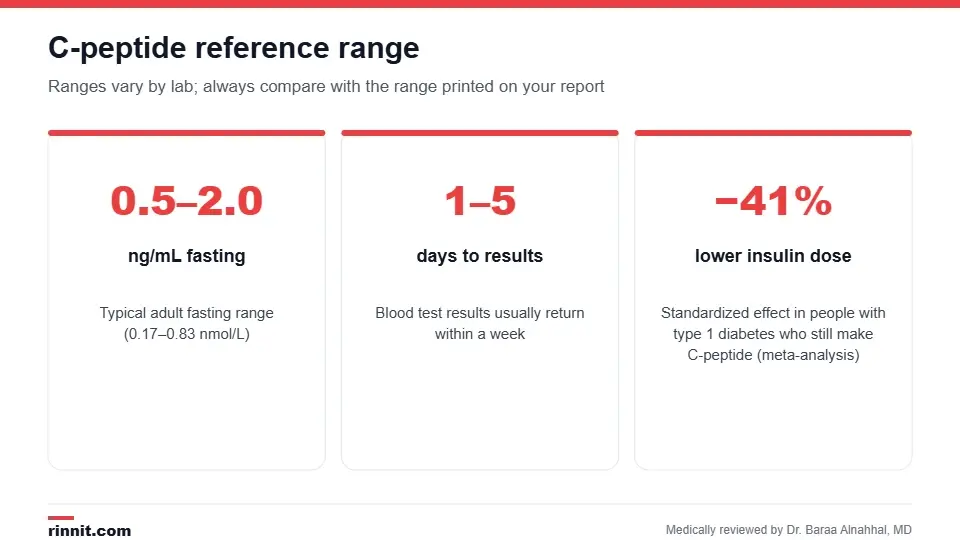
Reference range, turnaround time, and a key research finding for C-peptide.
Result pattern | What it may mean |
Low C-peptide, high glucose | Type 1 diabetes; long-standing type 2 diabetes with beta-cell loss |
Low C-peptide, low glucose | Hypoglycemia from injected insulin; some liver diseases |
High C-peptide, high glucose | Insulin resistance, early type 2 diabetes, Cushing syndrome |
High C-peptide, low glucose | Insulinoma; sulfonylurea medicines |
Normal C-peptide | Pancreas producing insulin normally |
Kidney failure can also raise C-peptide because the kidneys clear it from the blood, so values are interpreted with caution in people with reduced kidney function. Sources: [1]
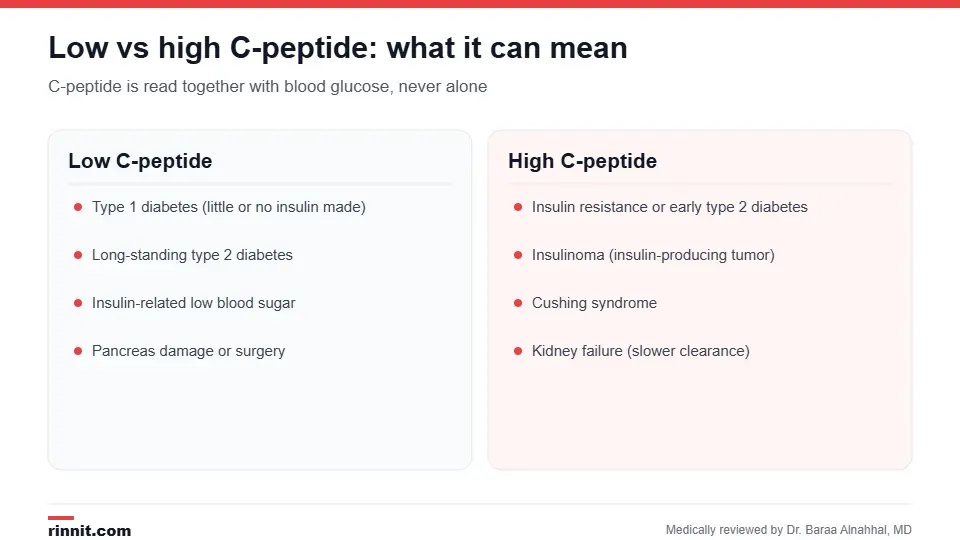
C-peptide is interpreted with your glucose level, never on its own.
What are the risks?
The test is very safe. You may notice slight bruising, soreness or light-headedness at the needle site. Infection is rare. Sources: [1]
What happens next?
A C-peptide test does not diagnose diabetes by itself. Depending on the result, your provider may order an A1C test, a fasting blood sugar test, diabetes autoantibodies, or imaging if an insulinoma is suspected. Sources: [1]
Conclusion
The C-peptide test is a small blood draw that answers a big question: how much insulin is your pancreas still making? That answer helps your care team choose the right type of treatment, from tablets to insulin, and can explain unexplained low blood sugar. If your result is outside the reference range, ask your provider what it means for your specific diagnosis and treatment plan.
Keep learning: read about insulin resistance and insulinoma to see how both ends of the C-peptide range are managed.
Frequently asked questions
What does a C-peptide test show?
It shows how much insulin your pancreas produces, because C-peptide and insulin are released in equal amounts. It helps distinguish diabetes types and find causes of low blood sugar.
Do I need to fast for a C-peptide test?
Usually yes, for 8–12 hours. Some providers use a random, non-fasting sample paired with a glucose level, which research shows is reliable for classifying insulin deficiency.
What is a normal C-peptide level?
A common fasting range is 0.5–2.0 ng/mL (0.17–0.83 nmol/L). Laboratories differ, so always use the range on your own report.
What does a low C-peptide mean?
With high glucose, it suggests the pancreas is making little insulin, as in type 1 diabetes or advanced type 2 diabetes. With low glucose, it can point to excess injected insulin.
What does a high C-peptide mean?
It suggests the body is making extra insulin, as in insulin resistance, early type 2 diabetes, Cushing syndrome, or an insulinoma. Kidney failure can also raise levels.
Can a C-peptide test diagnose diabetes?
No. It cannot diagnose diabetes on its own, but it helps classify the type once diabetes is confirmed by glucose or A1C testing.
Does injected insulin affect the result?
Injected insulin does not contain C-peptide, so the test still reflects your own production. Insulin can lower glucose and suppress your pancreas, which is why glucose is measured at the same time.
How long do results take?
Blood test results usually come back within 1–5 days. A 24-hour urine test may take a little longer.
Why does C-peptide matter in type 1 diabetes?
People who keep making even small amounts of C-peptide tend to have lower HbA1c, need less insulin and have fewer eye and kidney complications.
Is the test painful or risky?
It is a standard blood draw. Minor bruising or soreness is the most common effect; serious complications are rare.
Related Reading
Insulin Resistance: A Comprehensive Guide to Symptoms, Causes, and Management explains the condition behind many high C-peptide results.
Understanding Insulinoma: Symptoms, Causes, and Recovery covers the insulin-producing tumor that C-peptide testing helps detect.
Hypoglycemia: Managing Low Blood Sugar Emergencies and Prevention describes the low blood sugar episodes this test helps investigate.
A1C Test: Normal Levels, Prediabetes and Diabetes Ranges and What Affects Results the long-term glucose test usually ordered alongside C-peptide.
Fasting Blood Sugar Test: How to Prepare, Normal Levels and What Your Results Mean the glucose measurement that C-peptide results are interpreted against.
References
Cleveland Clinic. C-Peptide Test: What It Is, Purpose, Procedure & Results. Cleveland Clinic. Last updated October 3, 2022. https://my.clevelandclinic.org/health/diagnostics/24242-c-peptide-test
Alan MS, Tayebi A, Afshar EJ, et al. Association of detectable C-peptide levels with glycemic control and chronic complications in individuals with type 1 diabetes mellitus: a systematic review and meta-analysis. J Diabetes Complications. 2025;39(3):108867. PMID 39879848. https://doi.org/10.1016/j.jdiacomp.2024.108867
Briggs L, Read A, Darch S, et al. The evolution of C-peptide's role in diabetes care. Curr Opin Endocrinol Diabetes Obes. 2026;33(1):16-24. PMID 41355468. https://doi.org/10.1097/MED.0000000000000947
Medical disclaimer
This article is for general education only and does not replace advice from a qualified healthcare professional. Talk to your doctor about your own diagnosis and treatment, and seek emergency care right away for severe or sudden symptoms.



Comments