Fasting Blood Sugar Test: How to Prepare, Normal Levels and What Your Results Mean

Updated: 2 days ago
Written and medically reviewed by Dr. Baraa Alnahhal, MD · Last reviewed: November 2026 · How we review
Quick Answer: What is a fasting blood sugar test?
A fasting blood sugar test is a blood test that measures the sugar (glucose) in the blood after 8 to 12 hours without food or drink other than water. It screens for diabetes, prediabetes and gestational diabetes. A result below 100 mg/dL is normal, 100 to 125 mg/dL points to prediabetes, and 126 mg/dL or higher points to diabetes. [1]
What the research says
A fasting sugar in the prediabetes range raises your future diabetes risk sharply. A meta-analysis of prospective cohort studies found that 5% to 10% of people with impaired fasting glucose or impaired glucose tolerance developed diabetes each year. People with isolated impaired fasting glucose were 7.54 times as likely to develop diabetes as people with normal blood sugar, and people with both problems were 12.13 times as likely. (Gerstein et al., Diabetes Research and Clinical Practice, 2007) [2]
Prediabetes is a warning sign, not a fixed outcome. A review of 103 prospective cohort studies found that a fasting sugar of 100 to 125 mg/dL carried about four times the risk of type 2 diabetes compared with normal levels (hazard ratio 4.32). Yet in the 47 studies that tracked it, 33% to 59% of people with prediabetes returned to normal blood sugar within one to five years. (Richter et al., The Cochrane Database of Systematic Reviews, 2018) [3]
Key takeaways
A fasting blood sugar test measures your blood glucose when it should be at its lowest, after several hours without eating. [1]
You should not eat or drink anything except water for 8 to 12 hours before the test. [1]
Less than 100 mg/dL is normal, 100 to 125 mg/dL typically means prediabetes, and 126 mg/dL or higher points to diabetes. [1]
Providers do not diagnose diabetes from one abnormal result; a high reading is usually repeated. [1]
Prediabetes, type 2 diabetes and gestational diabetes often cause no symptoms at first, so testing can find them early. [1]
What is a fasting blood sugar test?
A fasting blood sugar test is a simple, common blood test that screens for diabetes, prediabetes or gestational diabetes, which is diabetes that develops during pregnancy. It is also called a fasting blood glucose test. [1]
The test measures the amount of sugar in your blood when it should be at its lowest. That is usually in the morning, after you have gone several hours without food or drink. [1]
Why would you need a fasting blood sugar test?
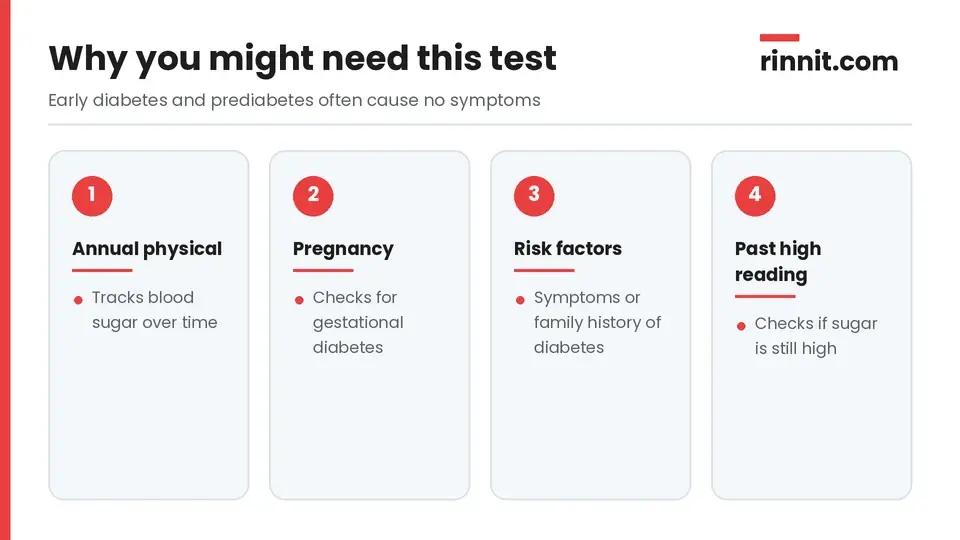
Providers order this test for routine checks and when diabetes risk is higher.
Prediabetes, type 2 diabetes and gestational diabetes often have no symptoms at first, so you can have one of these conditions without knowing it. [1]
Situation | Why the test helps |
Annual physical and bloodwork | Tracks changes in your blood sugar over time |
Pregnancy | Checks whether pregnancy hormones are causing gestational diabetes |
Symptoms, a family history of diabetes or other risk factors | Looks for diabetes or prediabetes |
A previous blood sugar reading that was higher than normal | Checks whether your level is still high |
Sources: [1]
How do you prepare for a fasting blood sugar test?
You should not eat or drink anything except water for 8 to 12 hours before the test. Your provider will tell you exactly how long to fast. [1]
Because the fast usually runs overnight, the test is typically done in the morning, when your blood sugar should be at its lowest. [1]
What happens during a fasting blood sugar test?

The test itself takes only a quick blood sample.
Most of the time, a healthcare provider draws blood from a vein in your arm and sends the sample to a lab. [1]
Sometimes your provider may use a finger prick instead, checking the drop of blood with a glucose meter and test strip in the office. [1]
When will you get your results?
What do fasting blood sugar test results mean?

Your result falls into one of three ranges.
In the United States, results are reported in milligrams per deciliter (mg/dL). Many other countries use millimoles per liter (mmol/L). [1]
Result | mg/dL | mmol/L |
Normal | Less than 100 | Less than 5.6 |
Prediabetes | 100 to 125 | 5.6 to 6.9 |
Diabetes | 126 or higher | 7 or higher |
Sources: [1]
A result of 126 mg/dL or above shows high blood sugar, the main sign of diabetes. [1]
What about a low result?
A fasting blood sugar below 70 mg/dL is considered low blood sugar for someone with diabetes, but it may be normal for someone without diabetes. Your provider may ask whether you have symptoms such as shakiness and may order more tests to look for a pattern. [1]
What happens if your result is abnormal?
A high result is usually repeated. Providers do not rely on one abnormal result to diagnose diabetes, so they often repeat the test to confirm it. [1]
Prediabetes is managed with lifestyle changes. Your provider will likely recommend changes to your diet and physical activity. [1]
Repeat testing tracks your level. Fasting blood sugar tests repeated over time show whether type 2 diabetes is developing. [1]
Early treatment matters. If you do have diabetes, it is important to start treatment as soon as possible. [1]
Conclusion
A fasting blood sugar test is a quick morning blood test that shows whether your glucose is normal, in the prediabetes range or high enough to suggest diabetes. Fasting for 8 to 12 hours beforehand helps make the result accurate.
One high number is not a diagnosis on its own. Ask your provider whether you need a repeat test and what steps can help protect your health.
Keep learning: Read our guide to prediabetes or our complete guide to diabetes, and learn about another key blood sugar test in our A1C test guide. For more trusted, doctor-reviewed health guides, visit Rinnit.com.
FAQ
What is a fasting blood sugar test?
A blood test that measures your blood sugar after several hours without food to screen for diabetes and prediabetes.
How long do I need to fast before the test?
Usually 8 to 12 hours with nothing to eat or drink except water; your provider will confirm the time.
Can I drink water before a fasting blood sugar test?
Yes, water is allowed while you fast.
What is a normal fasting blood sugar level?
Less than 100 mg/dL, or less than 5.6 mmol/L.
What fasting blood sugar level means prediabetes?
A result of 100 to 125 mg/dL (5.6 to 6.9 mmol/L) typically means prediabetes.
What fasting blood sugar level means diabetes?
126 mg/dL (7 mmol/L) or higher points to diabetes.
Can one high result diagnose diabetes?
No. Providers usually repeat the test to confirm a high result.
Is a fasting blood sugar below 70 mg/dL dangerous?
It counts as low for people with diabetes but may be normal for people without it; your provider may order more tests.
How is the test done?
Usually with a blood draw from a vein in your arm, or sometimes with a finger prick.
How soon will I get my results?
Lab results take hours to days; finger-prick results take seconds.
Related Reading
Diabetes: Symptoms, Types, Causes, Diagnosis & Treatment — Complete Guide explains the main types of diabetes and how they are diagnosed and treated.
Prediabetes: Symptoms, Causes, and Treatment covers the in-between range that a fasting result of 100 to 125 mg/dL can reveal.
Gestational Diabetes: Symptoms, Causes, Risks & Treatment — Complete Guide explains the diabetes that can develop during pregnancy, one reason this test is ordered.
Hyperglycemia in Diabetes: Warning Signs, Target Numbers, and When It Becomes an Emergency describes high blood sugar, the main sign of diabetes on this test.
Hypoglycemia: Managing Low Blood Sugar Emergencies and Prevention explains low blood sugar and how to prevent and treat it.
Type 2 Diabetes in Children: The Complete Parent's Guide to Signs, Causes, and Treatment helps parents understand type 2 diabetes in young people.
C-Peptide Test: Purpose, Normal Range and What High or Low Results Mean explains the blood test that shows how much insulin your pancreas still makes.
Glucose Tolerance Test: Types, How to Prepare, What Happens and What Results Mean explains the 2-hour sugar-load test used to diagnose prediabetes, diabetes and gestational diabetes.
References
Cleveland Clinic. Fasting Blood Sugar: Testing, Levels & What They Mean. Cleveland Clinic. Last updated January 31, 2025. https://my.clevelandclinic.org/health/diagnostics/21952-fasting-blood-sugar
Gerstein HC, Santaguida P, Raina P, et al. Annual incidence and relative risk of diabetes in people with various categories of dysglycemia: a systematic overview and meta-analysis of prospective studies. Diabetes Res Clin Pract. 2007;78(3):305-312. PMID 17601626. https://doi.org/10.1016/j.diabres.2007.05.004
Richter B, Hemmingsen B, Metzendorf MI, et al. Development of type 2 diabetes mellitus in people with intermediate hyperglycaemia. Cochrane Database Syst Rev. 2018;10(10):CD012661. PMID 30371961. https://doi.org/10.1002/14651858.CD012661.pub2
Medical disclaimer
This article is for general education only and does not replace advice from a qualified healthcare professional. Talk to your doctor about your own diagnosis and treatment, and seek emergency care right away for severe or sudden symptoms.



Comments