Urine Protein Creatinine Ratio (UPCR): Test, Normal Range and Results

Updated: 2 days ago
Written and medically reviewed by Dr. Baraa Alnahhal, MD · Last reviewed: November 2026 · How we review
Quick Answer: What is a urine protein creatinine ratio test?
A urine protein creatinine ratio (UPCR) test measures protein and creatinine in a single urine sample. Protein in urine can be a sign of kidney damage, and creatinine is a marker providers use to adjust the protein reading. It is quick, painless and has no risks. [1]
In adults, losing less than 150 mg of protein a day is normal, 150 to 500 mg is a moderate increase and more than 500 mg is a severe increase. [1]
What the research says
A spot ratio is good at ruling out significant proteinuria. Across 16 studies comparing a random urine protein:creatinine ratio with 24-hour collections, negative likelihood ratios ranged from 0.06 to 0.35, and the pooled value in preeclampsia studies was 0.14. (Price et al., Clinical Chemistry, 2005) [2]
It works in hypertensive pregnancy too. Pooling 9 studies of 1,003 hypertensive pregnant women, a cutoff of 30 mg/mmol detected proteinuria of 0.3 g/day or more with 83.6% sensitivity and 76.3% specificity, making it a reasonable rule-out test. (Côté et al., The BMJ, 2008) [3]
Key takeaways
UPCR measures protein and creatinine in one urine sample. [1]
It screens for and monitors kidney damage and helps check for preeclampsia. [1]
Normal adult kidney function means less than 150 mg of protein a day in urine. [1]
Infection, intense exercise, stress, pregnancy and daily aspirin can raise results for a short time. [1]
A result that stays high for months can point to kidney disease. [1]
What is a UPCR test?
A urine protein creatinine ratio (UPCR) test measures the amount of protein and creatinine in one urine sample. It is a type of kidney function test. [1]
Creatinine is a waste product your muscles make when they use energy. Protein in your urine can mean your kidneys are damaged. Creatinine is only a marker that providers use to adjust the protein measurement. [1]
Why is a UPCR test done?
Your provider may order a UPCR test to: [1]
Check for high protein in your urine (proteinuria), a symptom of kidney disease
Help diagnose conditions that damage the kidneys
Monitor kidney damage and see how well treatment is working
Screen as part of a routine physical exam
It is used when someone has signs of kidney disease or chronic kidney disease (CKD), when a pregnant person has signs of high blood pressure that may point to preeclampsia, and in people with diabetes or high blood pressure, the most common causes of severe kidney damage and kidney failure. [1]
How do you prepare for a UPCR test?
Drink a glass of water about 30 minutes before the test so you can give about 2 ounces of urine. You do not need to do anything else. [1]
How is the test done?

One clean urine sample is all it takes.
You collect a clean urine sample in a private bathroom at your provider's office: [1]
Wash your hands with soap and water and take the lid off the container.
Clean your genital area, especially around the urethra, with the antimicrobial wipes.
Urinate briefly into the toilet, then into the cup up to the fill line.
Finish urinating in the toilet, put the lid back on and return the cup.
You may be able to collect the sample at home. If so, keep it in the refrigerator until you take it to your provider. The sample is tested in the office or sent to a lab. [1]
UPCR vs. 24-hour urine test
Sometimes providers measure protein over a full 24 hours instead. A 24-hour collection can give a more accurate picture of protein levels across the day, while the UPCR needs only one sample, which is more convenient. [1]
What are normal UPCR results?
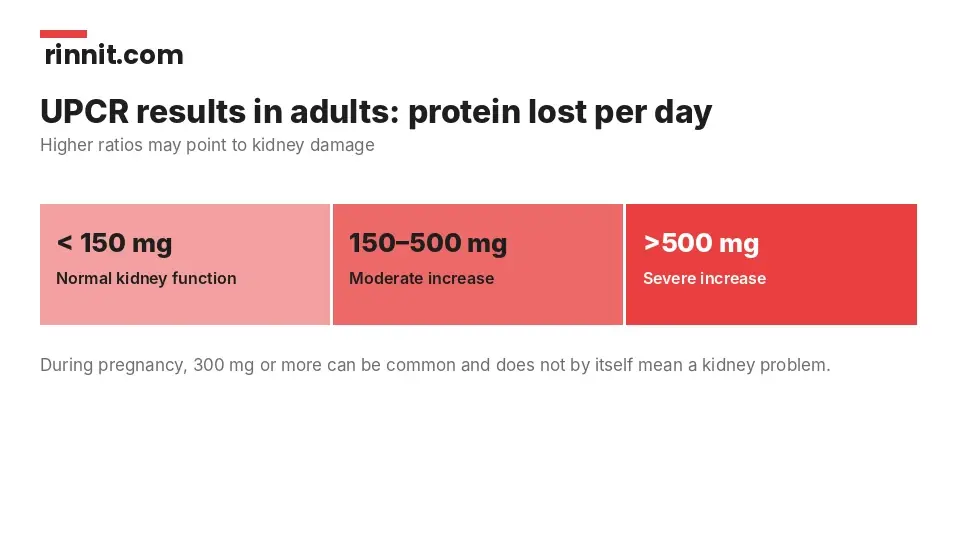
Protein lost in urine per day, in adults.
Results may be ready in minutes or take up to a few days. In adults, the amount of protein in urine is read like this: [1]
Protein in urine per day | What it means |
Less than 150 mg | Normal kidney function |
150 mg to 500 mg | Moderate increase |
More than 500 mg | Severe increase |
Sources: [1]
In general, a lower ratio means normal kidney function and a higher ratio may mean kidney damage. [1]
UPCR during pregnancy
UPCR normally rises during pregnancy. Urine protein rises a little in pregnancy, but 300 mg a day or more (a UPCR of 0.3 or higher) is considered significant and, with high blood pressure, can be a sign of preeclampsia, so your provider will check further. [1]
What can cause a high UPCR result?

Short-term causes can raise your result.
Some causes raise urine protein only for a short time: [1]
Infection
Inflammation
Intense physical activity
Pregnancy
Stress
Taking aspirin every day
Over the long term, unmanaged diabetes and unmanaged high blood pressure are the most common causes of severe kidney damage and kidney failure. [1]
What happens if your UPCR is high?
Your provider may repeat the test over several weeks for a more accurate picture. Rarely, results are unclear and you need to give another sample. A UPCR that stays higher than expected for several months can mean kidney disease, and your provider may refer you to a nephrologist, a kidney specialist. [1]
Follow-up tests may include: [1]
Albumin blood test
Creatinine clearance test
CT scan
Estimated glomerular filtration rate (eGFR)
Globulin blood tests
Kidney biopsy
Kidney ultrasound
Conclusion
The UPCR test is a simple, one-sample way to check how much protein your kidneys let into your urine. It helps find kidney damage early, track it over time and check for preeclampsia in pregnancy. [1]
One high result is not a diagnosis. Short-term causes are common, so your provider may repeat the test before deciding on next steps. [1]
Keep learning: Compare it with the urine albumin-creatinine ratio (UACR), see how a creatinine clearance test works, or read our chronic kidney disease guide. For more background, see MedlinePlus on protein in urine.
FAQ
What is a urine protein creatinine ratio test?
A urine test that measures protein and creatinine in one sample to check for kidney damage. [1]
Why would a doctor order a UPCR test?
To check for proteinuria, help diagnose kidney disease or preeclampsia, monitor kidney damage or as part of a routine exam. [1]
How do I prepare for a UPCR test?
Drink a glass of water about 30 minutes before so you can give about 2 ounces of urine. [1]
What is a normal UPCR result?
In adults, less than 150 mg of protein a day in urine. [1]
What UPCR level is considered high?
150 to 500 mg a day is a moderate increase and more than 500 mg is a severe increase. [1]
Is UPCR higher in pregnancy?
It rises a little, but 300 mg a day or more is significant and, with high blood pressure, can signal preeclampsia. [1]
What can cause a temporarily high UPCR?
Infection, inflammation, intense exercise, pregnancy, stress and daily aspirin. [1]
Is a UPCR better than a 24-hour urine test?
UPCR needs one sample; a 24-hour test can give a more accurate picture across the day. [1]
Does a high UPCR mean kidney disease?
Not always; a result that stays high for several months can point to kidney disease. [1]
Is the UPCR test painful?
No. It is noninvasive, quick and has no risks. [1]
Related Reading
Chronic Kidney Disease: What It Is, Its 5 Stages, Causes, and How It's Treated explains the long-term kidney damage this test helps find and monitor.
Nephrotic Syndrome: Symptoms, Causes, and Treatment Guide covers a kidney condition that causes heavy protein loss in urine.
Preeclampsia: Symptoms, Causes & What Helps — A Complete Guide explains the pregnancy condition this test helps check for.
Diabetic Nephropathy (Diabetic Kidney Disease): Symptoms, Causes, Diagnosis & Treatment — Complete Guide covers kidney damage from diabetes, a leading cause of proteinuria.
Orthostatic Proteinuria (Postural Proteinuria): Symptoms, Causes, Diagnosis, and Management — What You Need to Know explains a type of protein in urine linked to standing.
24-Hour Urine Test: How to Collect It, Why It's Done and What Results Mean explains how to collect a full-day urine sample and what it measures.
References
Cleveland Clinic. Urine Protein Creatinine Ratio (UPCR): Test & Results. Cleveland Clinic. Last updated December 12, 2025. https://my.clevelandclinic.org/health/diagnostics/23933-urine-protein-creatinine-ratio
Price CP, Newall RG, Boyd JC. Use of protein:creatinine ratio measurements on random urine samples for prediction of significant proteinuria: a systematic review. Clin Chem. 2005;51(9):1577-1586. PMID 16020501. https://doi.org/10.1373/clinchem.2005.049742
Côté AM, Brown MA, Lam E, et al. Diagnostic accuracy of urinary spot protein:creatinine ratio for proteinuria in hypertensive pregnant women: systematic review. BMJ. 2008;336(7651):1003-1006. PMID 18403498. https://doi.org/10.1136/bmj.39532.543947.BE
Medical disclaimer
This article is for general education only and does not replace advice from a qualified healthcare professional. Talk to your doctor about your own diagnosis and treatment, and seek emergency care right away for severe or sudden symptoms.



Comments