Biosimilars: What They Are, Safety and How They Compare to Biologics

Updated: 2 days ago
Written and medically reviewed by Dr. Baraa Alnahhal, MD · Last reviewed: November 2026 · How we review
Quick Answer
Biosimilars are medicines that are highly similar to biologics, drugs made from living organisms. They must pass rigorous FDA testing to show the same benefits without added risk. They treat conditions like rheumatoid arthritis, psoriasis, inflammatory bowel disease and cancer. They usually cost less, and the FDA states they're as safe and effective as the original biologic.
What the research says
Switching to a biosimilar worked as well: in the NOR-SWITCH trial of 482 people, switching from original infliximab to a biosimilar was as effective as staying on the original, with disease worsening in 30% versus 26% and similar serious side effects (Jørgensen KK et al., Lancet, 2017) [2]
Biosimilars matched the original for psoriasis: in 9 trials with 4,532 adults with psoriasis, ustekinumab biosimilars matched the original drug for skin clearing at 12 weeks, with comparable side effects (Montes-de-Oca-Saucedo CR et al., BioDrugs, 2026) [3]
Key takeaways
Biosimilars are highly similar to biologic medicines.
They must meet strict FDA standards.
They're as safe and effective as the original biologic.
They usually cost less.
Not every biosimilar can be swapped automatically at the pharmacy.
What are biosimilars?
Biologics are medicines made from living organisms. A biosimilar is made to match a biologic closely, but because living sources vary, it can't be an exact copy. Sources: [1]
What they treat

Biosimilars usually cost less than biologics.
Autoimmune diseases and rheumatoid arthritis.
Cancer and blood disorders.
Diabetes.
Macular degeneration.
Multiple sclerosis, osteoporosis and psoriasis. Sources: [1]
FDA requirements
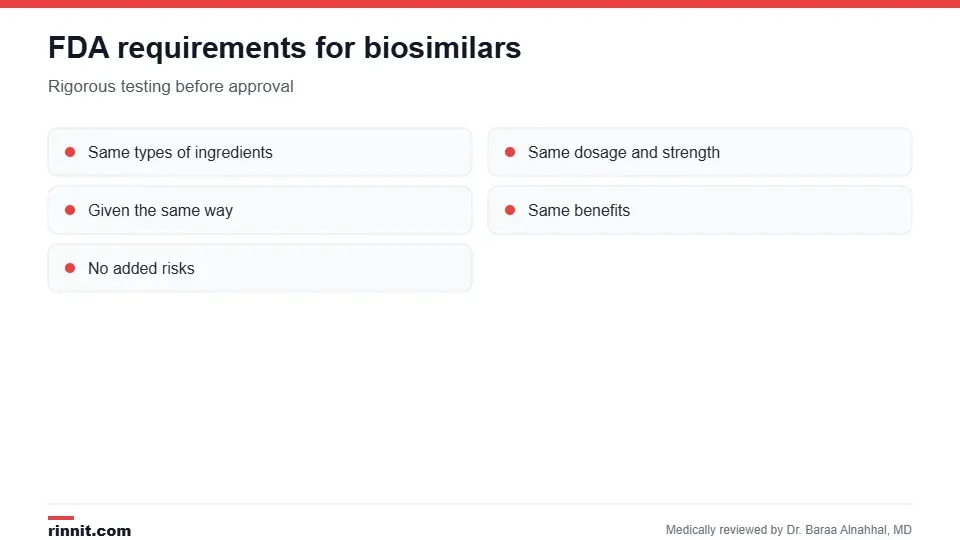
Each biosimilar goes through rigorous testing.
Made from the same types of ingredients as the biologic.
The same dosage and strength.
Taken the same way, such as a shot, injection or infusion.
The same benefits without added risks. Sources: [1]
Common biologics with biosimilars

New biosimilars are added regularly.
Biologic | Brand name | Number of biosimilars |
Adalimumab | Humira | 10 |
Ustekinumab | Stelara | 8 |
Bevacizumab | Avastin | 6 |
Pegfilgrastim | Neulasta | 6 |
Trastuzumab | Herceptin | 6 |
Infliximab | Remicade | 4 |
Insulin glargine | Lantus | 2 |
Not every biologic has a biosimilar, and new ones are added regularly. Sources: [1]
Can a biosimilar replace my biologic?
Pharmacists can usually swap a generic for a brand-name drug, but they can substitute a biosimilar only if the FDA labels it "interchangeable." Your provider may switch you to a biosimilar even if you started on the biologic. Sources: [1, 2]
Risks
Ask your provider about possible side effects. A biosimilar may not suit everyone, for example because of an ingredient or how it's made, so your provider may prefer the original biologic. Sources: [1]
Outlook
Biosimilars are as safe and effective as biologics and usually cost less, which can make treatment available to more people. Sources: [1, 3]
When to talk to your provider
If you take a biologic, ask whether a biosimilar is available and what its benefits and side effects are. Sources: [1]
Conclusion
Biosimilars offer the same benefits as biologic medicines, often at a lower cost. Talking with your provider can help you decide whether one fits your treatment.
Keep learning: read about biologics and monoclonal antibodies.
Frequently asked questions
What are biosimilars?
Medicines that are highly similar to biologic drugs.
Are biosimilars the same as generics?
Similar idea, but they aren't exact copies.
Are biosimilars safe?
Yes. They're as safe and effective as biologics.
Why do biosimilars cost less?
They usually cost less than the original biologic.
What do biosimilars treat?
Arthritis, psoriasis, IBD, cancer, diabetes and more.
Can my pharmacist switch me?
Only if the FDA has labeled the biosimilar interchangeable.
How are biosimilars given?
The same way as the biologic, such as a shot or infusion.
Does every biologic have a biosimilar?
No, but new ones are added regularly.
Can I switch from a biologic?
Yes, if your provider recommends it.
Who approves biosimilars?
The FDA, after rigorous testing.
Related Reading
Biologics: What They Are, Types, Uses and Side Effects the medicines biosimilars copy.
Monoclonal Antibodies: What They Are, How They Work, Uses and Side Effects a common type of biologic.
Inflammatory Bowel Disease: Symptoms, Causes, and Treatment a condition treated with biosimilars.
Psoriasis: Complete Guide to Symptoms, Types, Causes, and Treatment another condition they treat.
DMARDs (Disease-Modifying Antirheumatic Drugs): Types, Side Effects, and How Long They Take to Work arthritis medicines.
References
Cleveland Clinic. What Are Biosimilars? Cleveland Clinic. Last updated December 19, 2025. https://my.clevelandclinic.org/health/treatments/biosimilars
Jørgensen KK, Olsen IC, Goll GL, et al. Switching from originator infliximab to biosimilar CT-P13 compared with maintained treatment with originator infliximab (NOR-SWITCH): a 52-week, randomised, double-blind, non-inferiority trial. Lancet. 2017;389(10086):2304-2316. PMID 28502609. https://doi.org/10.1016/S0140-6736(17)30068-5
Montes-de-Oca-Saucedo CR, Ghanem L, Kirmani N, et al. Ustekinumab biosimilars versus reference ustekinumab for moderate-to-severe plaque psoriasis: a pre-switch systematic review and meta-analysis. BioDrugs. 2026;40(5):869-882. PMID 42393486. https://doi.org/10.1007/s40259-026-00795-9
Medical disclaimer
This article is for general education only and does not replace advice from a qualified healthcare professional. Talk to your doctor about your own diagnosis and treatment, and seek emergency care right away for severe or sudden symptoms.



Comments