C-Reactive Protein (CRP) Test: Normal Levels, High CRP and What Results Mean

Updated: 2 days ago
Written and medically reviewed by Dr. Baraa Alnahhal, MD · Last reviewed: November 2026 · How we review
Quick Answer: What is a C-reactive protein (CRP) test?
A C-reactive protein (CRP) test is a blood test that measures CRP, a protein the liver releases when there's inflammation. Providers use it to diagnose and monitor infections and inflammatory conditions such as rheumatoid arthritis. A normal CRP level is less than 0.9 mg/dL. CRP shows that inflammation is present but not where it is or what's causing it. [1]
What the research says
Higher CRP tracks with higher cardiovascular and overall risk. In a meta-analysis of 160,309 people without vascular disease from 54 studies, each threefold higher CRP level was linked to a 37% higher risk of coronary heart disease after adjusting for conventional risk factors, plus higher risks of stroke and death. (Emerging Risk Factors Collaboration, The Lancet, 2010) [2]
CRP is useful but imperfect for spotting bacterial infection. Pooling studies of hospitalized patients, CRP identified bacterial versus non-infectious inflammation with 75% sensitivity and 67% specificity, lower than procalcitonin (88% and 81%). (Simon et al., Clinical Infectious Diseases, 2004) [3]
Key takeaways
CRP is a protein your liver makes in response to inflammation. [1]
A CRP test helps diagnose or rule out serious infections and inflammatory diseases and helps track treatment. [1]
Normal CRP is generally less than 0.9 mg/dL, though each lab has its own range. [1]
A falling CRP after treatment usually means inflammation is improving. [1]
No fasting or special preparation is usually needed. [1]
What is a CRP test?
A CRP test measures the level of C-reactive protein, a protein made by your liver, in your blood. Your liver releases CRP in response to inflammation. [1]
When your body meets an offending agent, such as a virus, bacteria or toxic chemical, or when you're injured, your immune system sends out inflammatory cells and cytokines. They trap the offending agent or begin healing injured tissue. That can cause pain, swelling, bruising or redness, but it can also affect parts of your body you can't see, such as your joints. You normally have low CRP levels; moderately to severely high levels may signal a serious infection or another inflammatory condition. [1]
Why is a CRP test done?
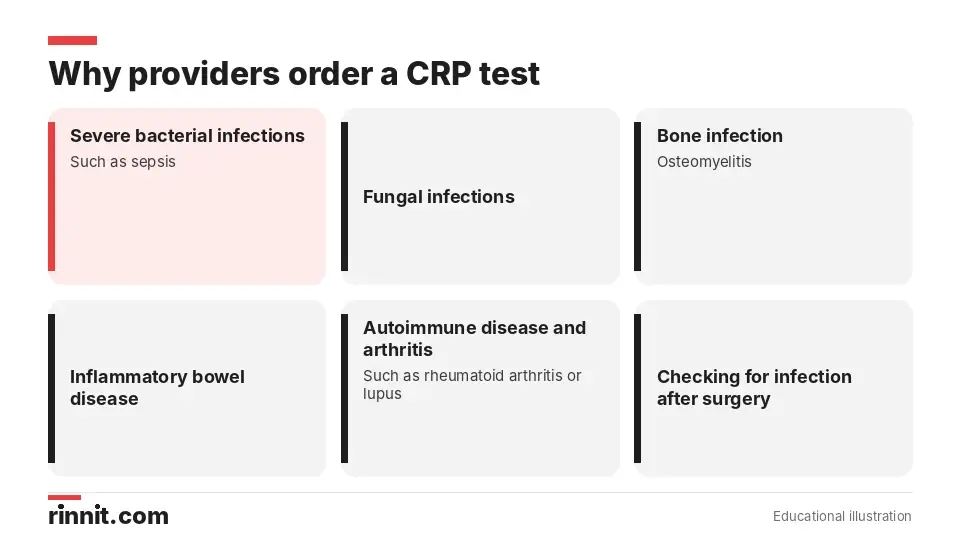
CRP helps flag serious infection and inflammation, and shows whether treatment is working.
Providers order a CRP test to help diagnose or rule out conditions such as: [1]
Severe bacterial infections, such as sepsis
Fungal infections
Bone infection (osteomyelitis)
Inflammatory bowel disease (IBD)
Some forms of arthritis
Autoimmune diseases, such as rheumatoid arthritis or lupus
Pelvic inflammatory disease (PID)
They also use CRP to watch for infection after surgery or other invasive procedures. Because CRP rises and falls with the amount of inflammation, a falling level is a sign that treatment is working. [1]
When would you need one?
Your provider may order a CRP test if you have symptoms of a serious bacterial infection, such as: [1]
Fever or chills
Rapid breathing (tachypnea)
Rapid heart rate (tachycardia)
Nausea and vomiting
A CRP test alone can't diagnose a condition or show where the inflammation is, so providers usually order more tests if your CRP is high. A related marker, the ESR (sed rate), is often checked alongside it. [1]
How do you prepare for a CRP test?
In most cases you don't need to do anything special, such as fasting. Your provider will tell you if your situation is different. [1]
What happens during a CRP test?
A phlebotomist or another trained provider draws your blood: [1]
You sit while they find a vein, usually on the inside of your arm opposite your elbow.
They clean and disinfect the area.
They insert a small needle, which may feel like a small pinch.
A small amount of blood collects in a test tube.
They remove the needle, hold gauze on the site and place a bandage.
The draw usually takes less than five minutes. A lab scientist then runs the sample on a machine called an analyzer. Risks are very low: you may have slight tenderness or a bruise that soon fades. Results usually come back within one or two days. [1]
What is a normal CRP level?

How high CRP rises gives clues to the type of problem, though it never shows the cause by itself.
Labs have different reference ranges, and your report will show your lab's range. In general: [1]
CRP level | What it may mean |
Less than 0.9 mg/dL | Normal |
1.0 to 10.0 mg/dL (moderate rise) | Systemic inflammation from conditions such as rheumatoid arthritis, lupus or other autoimmune diseases; heart attack; pancreatitis; bronchitis |
More than 10 mg/dL (marked rise) | Acute bacterial infections, viral infections, systemic vasculitis or major injury (trauma) |
Sources: [1]
Very high CRP levels are most often linked to acute bacterial infection. [1]
What does a low CRP level mean?
Because normal CRP is generally below 0.9 mg/dL, there's no such thing as a lower-than-normal level. If your CRP was high before and is now lower, your inflammation is likely settling or your treatment is working. [1]
What can raise CRP slightly?
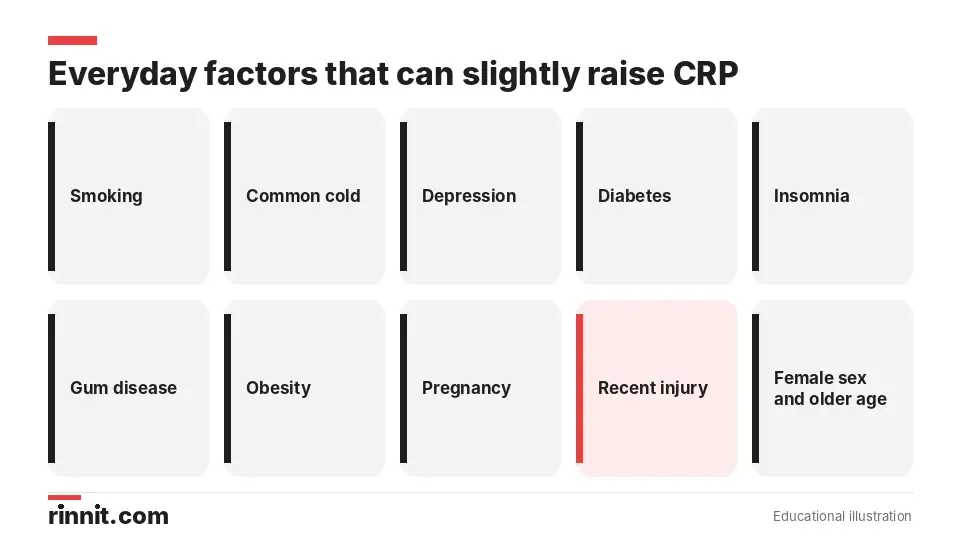
Many everyday factors nudge CRP up a little without serious disease.
A minor rise in CRP may come from: [1]
Cigarette smoking
The common cold
Depression
Diabetes
Insomnia
Gum disease (gingivitis or periodontitis)
Obesity
Pregnancy
A recent injury
Females and older people also have naturally higher CRP levels. [1]
Should you worry about an abnormal result?
Not necessarily, especially if it's only slightly high. Smoking, recent injury and certain health conditions can raise CRP, and errors can happen when samples are collected, transported or processed. About 1 in 20 healthy people have results outside the normal range. Your provider will discuss your result and may order more tests to find the cause. [1]
Conclusion
A CRP test is a quick, simple blood test that tells your provider whether inflammation is present and roughly how intense it is. It can't name the cause, so it works best alongside your symptoms, an exam and other tests. [1] [3]
If your CRP is high, ask your provider what they think is driving it and what follow-up tests make sense. If you're being treated for an infection or inflammatory disease, repeat CRP tests can show whether treatment is working. [1]
Keep learning: Read our sepsis guide or our rheumatoid arthritis guide. For more background, see the MedlinePlus page on the CRP test.
FAQ
What does a CRP test measure?
The level of C-reactive protein, which your liver releases into your blood when there's inflammation. [1]
What is a normal CRP level?
Generally less than 0.9 mg/dL, though each lab has its own reference range. [1]
What does a high CRP level mean?
It usually means inflammation somewhere in your body, but the test can't show where or why. [1]
What CRP level is considered very high?
Above 10 mg/dL is generally a marked rise, often seen with acute bacterial or viral infections, vasculitis or major injury. [1]
Can a CRP test diagnose a specific disease?
No. It shows inflammation, so providers use other tests to find the cause. [1]
Do I need to fast before a CRP test?
Usually not. Your provider will tell you if you need to prepare. [1]
What can cause a slightly high CRP?
Smoking, a cold, depression, diabetes, insomnia, gum disease, obesity, pregnancy or a recent injury. [1]
Can CRP be too low?
No. Normal CRP is already very low, so there's no lower-than-normal level. [1]
What does it mean if my CRP goes down?
Your inflammation is likely decreasing and your treatment may be working. [1]
How long do CRP test results take?
Usually one or two days. [1]
Related Reading
Sepsis: Complete Guide to Symptoms, Causes, Risks, and Treatment explains the life-threatening infection CRP testing helps flag.
Osteomyelitis: Symptoms, Causes, and Treatment covers bone infection that raises CRP.
Inflammatory Bowel Disease: Symptoms, Causes, and Treatment explains gut inflammation that CRP helps monitor.
Rheumatoid Arthritis — Symptoms, Causes, Diagnosis, Treatment & Complete Guide covers an autoimmune joint disease tracked with CRP.
Lupus: Symptoms, Causes & Treatment Guide explains another autoimmune disease that can raise CRP.
Pelvic Inflammatory Disease: Symptoms, Causes & Treatment — A Clear Guide covers a pelvic infection CRP testing can support.
Vasculitis: Symptoms, Causes, Treatment & Complete Guide explains blood vessel inflammation linked to marked CRP rises.
Blood Tests for Heart Disease Risk: Lipids, Lp(a), apoB and hs-CRP explains the blood tests used to estimate coronary artery disease risk.
References
Cleveland Clinic. C-Reactive Protein (CRP) Test: What It Is, Purpose & Results. Cleveland Clinic. Last updated May 17, 2022. https://my.clevelandclinic.org/health/diagnostics/23056-c-reactive-protein-crp-test
Emerging Risk Factors Collaboration; Kaptoge S, Di Angelantonio E, Lowe G, et al. C-reactive protein concentration and risk of coronary heart disease, stroke, and mortality: an individual participant meta-analysis. Lancet. 2010;375(9709):132-140. PMID 20031199. https://doi.org/10.1016/S0140-6736(09)61717-7
Simon L, Gauvin F, Amre DK, et al. Serum procalcitonin and C-reactive protein levels as markers of bacterial infection: a systematic review and meta-analysis. Clin Infect Dis. 2004;39(2):206-217. PMID 15307030. https://doi.org/10.1086/421997
Medical disclaimer
This article is for general education only and does not replace advice from a qualified healthcare professional. Talk to your doctor about your own diagnosis and treatment, and seek emergency care right away for severe or sudden symptoms.



Comments