Fecal Calprotectin Test: IBD vs IBS, How to Collect a Sample and Results

Updated: 2 days ago
Written and medically reviewed by Dr. Baraa Alnahhal, MD · Last reviewed: November 2026 · How we review
Quick Answer
A fecal calprotectin test is a stool test that measures calprotectin, a protein released by white blood cells. High levels mean there's inflammation in the intestines, which points toward inflammatory bowel disease (IBD). Normal levels make inflammation unlikely and support irritable bowel syndrome (IBS), which can help some people avoid a colonoscopy. You collect the sample at home.
What the research says
Calprotectin reliably flags bowel inflammation: a meta-analysis of 13 studies found fecal calprotectin detected IBD with 93% sensitivity and 96% specificity in adults, and 92% and 76% in children and teenagers, and using it before endoscopy would cut the number of adults needing endoscopy by about two-thirds (van Rheenen PF et al., BMJ, 2010) [2]
A low result helps rule out IBD: a meta-analysis in adults with IBS-type symptoms found that a calprotectin level of 40 µg/g or below meant a 1% or lower chance of having IBD (Menees SB et al., American Journal of Gastroenterology, 2015) [3]
Key takeaways
A stool test for intestinal inflammation.
High levels suggest IBD or another inflammatory cause; normal levels support IBS.
Helps decide who needs a colonoscopy and tracks IBD treatment.
Tell your provider about NSAIDs and PPIs, which can raise results.
Collect the sample before it touches toilet water and return it promptly.
What is calprotectin?
Calprotectin is a protein found mainly in neutrophils, white blood cells that rush to inflamed tissue. When the lining of the intestines is inflamed, neutrophils move into the bowel and calprotectin passes into the stool. Because it stays stable in stool for several days, it's a practical marker of gut inflammation. Sources: [1]
Why is it done?
To find the cause of ongoing belly pain, diarrhea or other bowel symptoms.
To tell inflammatory bowel disease apart from irritable bowel syndrome.
To decide whether a colonoscopy is needed.
To monitor Crohn's disease and ulcerative colitis treatment and spot flares early. Sources: [1, 2]
How do I prepare?
Tell your provider about all medicines and supplements. NSAIDs (such as ibuprofen and aspirin) and proton pump inhibitors (PPIs) can raise calprotectin, so your provider may ask you to stop them for a while before the test. Sources: [1]
How to collect the sample
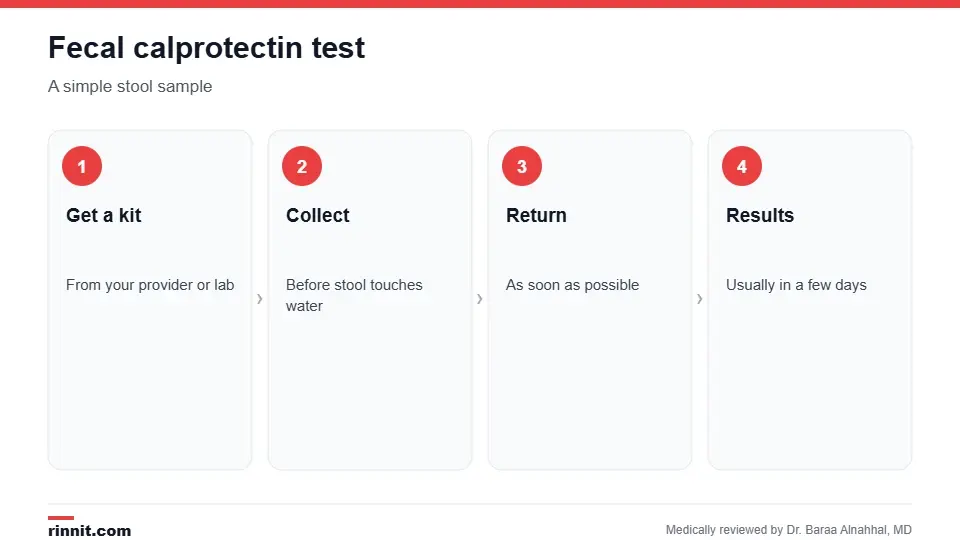
You collect the sample at home.
Get a collection kit from your provider or lab.
Place the collection paper or container so the stool doesn't touch the toilet water or urine.
Use the scoop or tube to collect a small amount as instructed.
Seal, label and return the sample as soon as possible. Sources: [1]
Like other stool tests, it's painless and has no side effects. Results usually take a few days. Sources: [1]
What do the results mean?
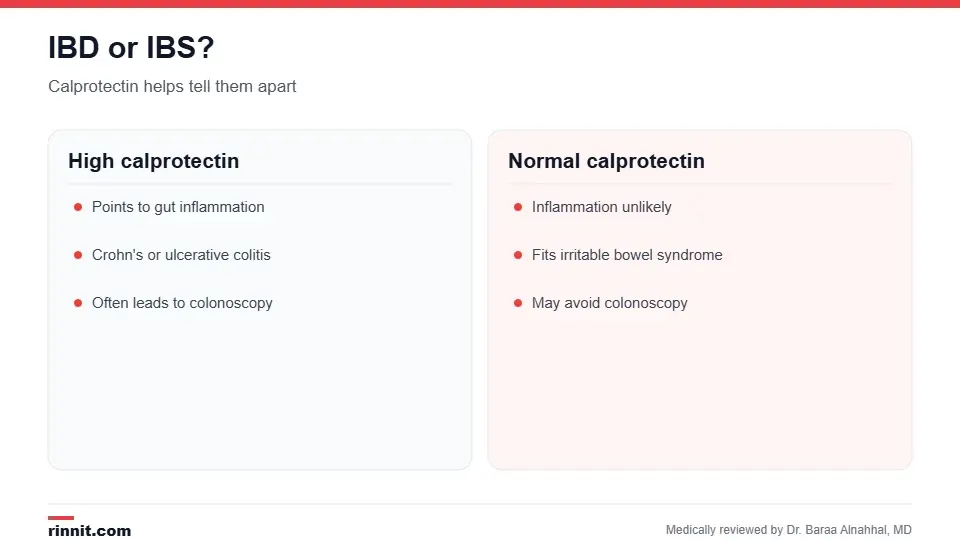
Calprotectin helps tell IBD from IBS.
Reports are given in micrograms per gram of stool (µg/g) and labeled normal, moderately high or very high. Cutoffs vary by lab and age; many labs consider levels below about 50 µg/g normal in adults, and research suggests 40 µg/g or below makes IBD very unlikely. Children, especially infants, normally have higher levels. Sources: [1, 3]
Result | What it may mean | Common next step |
Normal | Intestinal inflammation unlikely; symptoms may be IBS | Diagnosis based on symptoms; sometimes no scope needed |
Moderately high | Mild inflammation from infection, NSAIDs, celiac disease, diverticulitis or other causes | Repeat test or further evaluation |
Very high | Significant inflammation, most often IBD; also food poisoning | Colonoscopy and biopsy |
Sources: [1]
Other causes of high calprotectin

Calprotectin isn't specific to IBD.
Gut infections, such as C. difficile and food poisoning.
Celiac disease and autoimmune enteropathy.
Diverticulitis.
Peptic ulcer disease.
Gastrointestinal cancers.
Transplant rejection or graft-versus-host disease.
NSAIDs and PPIs. Sources: [1]
Conclusion
The fecal calprotectin test is a simple, noninvasive way to check for gut inflammation. A normal result is reassuring and can spare some people a colonoscopy, while a high result helps your provider decide on next steps. It doesn't give a final diagnosis, so it's always interpreted with your symptoms and other tests, such as a CRP blood test.
Keep learning: read about inflammatory bowel disease and irritable bowel syndrome.
Frequently asked questions
What does a fecal calprotectin test show?
Whether there's inflammation in your intestines.
Can it tell IBD from IBS?
Yes. High levels suggest IBD; normal levels support IBS.
What is a normal calprotectin level?
Many labs use below about 50 µg/g for adults; cutoffs vary.
Can calprotectin be high without IBD?
Yes, from infections, NSAIDs, celiac disease, diverticulitis and other causes.
Do I need to stop any medicines?
Possibly NSAIDs and PPIs; ask your provider.
How do I collect the sample?
With a home kit, keeping the stool out of the toilet water.
Can this test replace a colonoscopy?
It can help some people avoid one, but it doesn't give a final diagnosis.
Is it used to monitor IBD?
Yes. Rising levels can signal a flare.
How long do results take?
Usually a few days.
Is the test safe?
Yes. It's painless and has no side effects.
Related Reading
Inflammatory Bowel Disease: Symptoms, Causes, and Treatment the conditions high calprotectin points to.
Crohn's Disease: Symptoms, Causes, Flares vs. Remission and Treatment — What You Need to Know a type of IBD monitored with calprotectin.
Ulcerative Colitis: Symptoms, Causes, Diagnosis, and Treatment Explained another type of IBD.
Irritable Bowel Syndrome: Symptoms, Causes, and Treatment the condition a normal result supports.
Stool Test: Types, How to Collect a Sample and What Results Mean other tests done on stool samples.
References
Cleveland Clinic. Fecal Calprotectin Test: What It Is & Understanding Results. Cleveland Clinic. Last updated February 19, 2026. https://my.clevelandclinic.org/health/diagnostics/fecal-calprotectin-test
van Rheenen PF, Van de Vijver E, Fidler V. Faecal calprotectin for screening of patients with suspected inflammatory bowel disease: diagnostic meta-analysis. BMJ. 2010;341:c3369. PMID 20634346. https://doi.org/10.1136/bmj.c3369
Menees SB, Powell C, Kurlander J, et al. A meta-analysis of the utility of C-reactive protein, erythrocyte sedimentation rate, fecal calprotectin, and fecal lactoferrin to exclude inflammatory bowel disease in adults with IBS. Am J Gastroenterol. 2015;110(3):444-454. PMID 25732419. https://doi.org/10.1038/ajg.2015.6
Medical disclaimer
This article is for general education only and does not replace advice from a qualified healthcare professional. Talk to your doctor about your own diagnosis and treatment, and seek emergency care right away for severe or sudden symptoms.



Comments