What Is Microscopic Colitis? A Plain-Language Guide to This Hidden Cause of Watery Diarrhea

Updated: 20 hours ago
Medically reviewed by Dr. Baraa Alnahhal, MD · Last reviewed: October 17, 2026
Quick Answer: What is microscopic colitis?
Microscopic colitis is inflammation of the colon that causes watery diarrhea and is visible only under a microscope. It mostly affects women over age 50. Because the colon looks normal, diagnosis requires a tissue biopsy during colonoscopy. Treatment includes diet changes, stopping triggering medicines, anti-diarrheal drugs and steroids. It does not increase colon cancer risk.
What the research says
Risk factors: According to PubMed, a 2025 meta-analysis of 45 studies found higher odds of microscopic colitis with NSAID use (OR 2.57) and statin use (OR 2.15) compared with controls who had a biopsy. Proton pump inhibitors were not clearly linked when biopsy-checked controls were used (OR 1.81, 95% CI 0.75–4.35). [6]
Treatment: A 2025 meta-analysis of 19 randomized trials found budesonide produced higher clinical remission rates than mesalamine at 8 weeks, with fewer adverse events. [8]
Incomplete forms: A 2026 meta-analysis of 17 studies (1,370 patients) found a pooled clinical remission rate of 85% with budesonide in people whose biopsies showed incomplete microscopic colitis. [7]
Maintenance: A 2024 meta-analysis of 35 studies (11 randomized trials) found a pooled remission rate of 84% with budesonide maintenance therapy and a pooled relapse rate of 53% after budesonide was stopped. [10]
1. What is microscopic colitis?
Microscopic colitis is swelling and irritation, called inflammation, of the large intestine, which is also called the colon. This condition causes symptoms of watery diarrhea. The National Institute of Diabetes and Digestive and Kidney Diseases (NIDDK) notes that research suggests about 700,000 people in the United States have microscopic colitis.[1] [3]
The condition gets its name from needing to look at colon tissue under a microscope to diagnose it. The tissue appears typical on exam with a colonoscopy or flexible sigmoidoscopy. In other words, the problem hides from plain sight — a standard look inside the colon cannot find it.
There are two subtypes of microscopic colitis.
Subtype | What happens in the colon tissue |
Collagenous colitis | A thick layer of protein called collagen grows in the colon tissue |
Lymphocytic colitis | White blood cells called lymphocytes increase in the colon tissue |
Researchers believe collagenous (kuh-LAYJ-uh-nus) colitis and lymphocytic colitis may be forms of the same condition. Symptoms, testing, and treatment are the same for both subtypes.[4]

The colon looks normal during an exam — the inflammation shows up only when a tissue sample is studied under a microscope.
2. What does microscopic colitis feel like?
Symptoms of microscopic colitis include watery diarrhea, belly pain, cramps or bloating, weight loss, nausea, not being able to control bowel movements (called fecal incontinence), and the body not having enough water (called dehydration).[1]
The watery diarrhea can occur about five to 10 times a day. Other symptoms include an urgent need to have a bowel movement and a noisy digestive system, and persistent diarrhea can lead to malnutrition.[9]
The symptoms of microscopic colitis can come and go. At times, symptoms improve on their own.
Microscopic colitis is a lifelong condition that may flare up in reaction to certain triggers. Remission can last for months or years, and flare-ups typically last for days to weeks.[9]
3. When should you see a doctor?
If you have watery diarrhea that lasts more than a few days, contact your healthcare professional to diagnose and treat your condition.[1]
4. What causes microscopic colitis?
Microscopic colitis causes swelling and irritation of the colon for reasons that are not clear. Researchers believe that the causes may include the following.[1]
Possible cause | What happens |
Medicines | Some medicines can inflame the lining of the colon |
Bile acid | Bile acid not absorbed as it should be inflames the lining of the colon |
Bacteria or viruses | Bacteria that make toxins, or viruses, interact with the lining of the colon |
Autoimmune disease | Conditions in which the immune system attacks healthy tissues, such as rheumatoid arthritis, celiac disease, or psoriasis, are linked to microscopic colitis |
5. Who is at higher risk?
Risk factors for microscopic colitis include the following.[1]
Risk factor | Details |
Age | Most common in people older than age 50 |
Sex | Women are more likely to have it than men; some studies suggest a link between post-menopausal hormone therapy and microscopic colitis |
Autoimmune disease | People with microscopic colitis sometimes also have celiac disease, thyroid disease, rheumatoid arthritis, type 1 diabetes, or psoriasis |
Genetic link | Research suggests there may be a link between microscopic colitis and a family history of irritable bowel syndrome |
Smoking | Recent studies have shown a link between tobacco smoking and microscopic colitis, mostly in people ages 16 to 44 |
There is also some evidence that anxiety and depression can trigger symptoms.[9]
Some research studies show a link between using certain medicines that may increase the risk of microscopic colitis, but not all studies agree.
Medicine group | Examples |
Pain relievers | Aspirin, ibuprofen (Advil, Motrin IB, others), naproxen sodium (Aleve) |
Proton pump inhibitors | Lansoprazole (Prevacid), esomeprazole (Nexium), pantoprazole (Protonix), rabeprazole (Aciphex), omeprazole (Prilosec), dexlansoprazole (Dexilant) |
SSRIs (antidepressants) | Sertraline (Zoloft), paroxetine (Paxil) |
Other medicines | Acarbose, flutamide, ranitidine, carbamazepine (Carbatrol, Tegretol, others), clozapine (Clozaril, Versacloz), entacapone (Comtan), simvastatin (Flolipid, Zocor), topiramate (Topamax, Qsymia, others) |
Some research suggests that hormone replacement therapy, beta-blockers and statins may also contribute.[9]
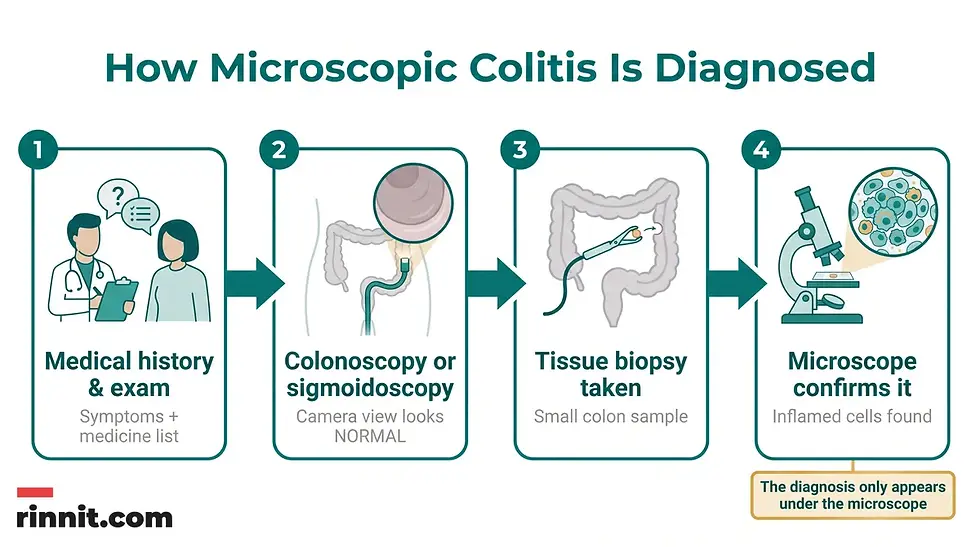
Because the colon looks normal on exam, a tissue biopsy studied under a microscope is what confirms the diagnosis.
6. How is microscopic colitis diagnosed?
A complete medical history, physical exam, and testing can help tell whether other conditions, such as celiac disease, may be causing diarrhea. Your healthcare professional also will ask about medicines you take.[2]
To help confirm a diagnosis, you may have one or more of the following tests and procedures.
Test or procedure | What it does |
Colonoscopy and biopsies | A thin, flexible, lighted tube with a camera (colonoscope) views the entire colon; instruments take a tissue sample (biopsy) to study under a microscope |
Flexible sigmoidoscopy | A slender, lighted tube (sigmoidoscope) views the rectum and most of the sigmoid colon — the last 1 to 2 feet (30 to 60 centimeters) of the large intestine — and a tissue sample is taken during the exam |
Stool sample study | Helps rule out infection as the cause of the diarrhea |
Blood test | Looks for signs of anemia or celiac disease |
Upper endoscopy with biopsy | A long, thin tube with a camera looks at the upper digestive tract; a biopsy may be taken to rule out celiac disease |
Intestinal tissues often appear typical in microscopic colitis. So a colon tissue sample, called a biopsy, taken during a colonoscopy or flexible sigmoidoscopy is needed to confirm a diagnosis. In both subtypes, cells in colon tissue can be seen under the microscope to make a diagnosis.
7. How is microscopic colitis treated?
Microscopic colitis may get better on its own. But when symptoms are severe or do not go away, you may need treatment to relieve them. Healthcare professionals most often start with the simplest treatments that are least likely to cause side effects.[2]
Diet changes and stopping certain medicines
Treatment usually begins with changes to your diet and medicines that may help relieve diarrhea. Your healthcare professional might suggest that you eat a low-fat, low-fiber diet — foods that have less fat and are low in fiber may help relieve diarrhea in the short term, though this diet may not help in the long term.
You may also be asked to limit dairy products, gluten, caffeine, and sugar, since these foods may make symptoms worse. And you may stop taking any medicines that might be causing your symptoms, switching to another medicine to treat your condition if needed.
A short-term elimination diet, such as the low-FODMAP diet, can help identify trigger foods, and an anti-inflammatory eating pattern such as the Mediterranean diet may also be suggested. Quitting smoking is also recommended.[9]
Medications
If you keep having symptoms, your healthcare professional may suggest medication.
Medicine type | Examples | What it does |
Anti-diarrheal medicines | Loperamide (Imodium), bismuth subsalicylate (Pepto-Bismol) | Helps slow diarrhea |
Steroids | Budesonide (Entocort EC, Ortikos, others) | Reduces colon inflammation |
Bile acid blockers | Cholestyramine/aspartame, cholestyramine (Locholest, Prevalite), colestipol (Colestid) | Blocks bile acids that may irritate the colon |
Immune-suppressing medicines | Mercaptopurine (Purinethol), azathioprine (Azasan, Imuran) | Reduces swelling and irritation in the colon |
Biologic medicines | Infliximab (Remicade), adalimumab (Humira), vedolizumab (Entyvio) | Reduces swelling and irritation in the colon |
Bulking agents such as psyllium can make stool more solid, and diphenoxylate is another anti-diarrheal medicine that may be used.[9]
Surgery
Very rarely, when the symptoms of microscopic colitis are severe and medicines do not work, your healthcare professional may suggest surgery to remove all or part of your colon.

Providers start with the simplest treatments — diet changes and stopping problem medicines — before moving to stronger medication.
8. What home habits can help?
Changes to your diet may help relieve the diarrhea of microscopic colitis.[2]
Drink plenty of fluids. Water is best, but fluids with added sodium and potassium, called electrolytes, may help as well. Try drinking broth or watered-down fruit juice. Do not drink beverages that are high in sugar or sorbitol or contain alcohol or caffeine, such as coffee, tea, and colas — these can make symptoms worse.
Choose soft, easy-to-digest foods. These include applesauce, bananas, melons, and rice. Do not eat high-fiber foods such as beans and nuts. Eat only well-cooked vegetables. If your symptoms are getting better, slowly add high-fiber foods back to your diet, and talk to your healthcare professional about how long to continue this type of diet.
Eat several small meals rather than a few large meals. Spacing meals throughout the day may ease diarrhea.
Avoid irritating foods. Stay away from spicy, fatty, or fried foods and any other foods that make your symptoms worse.
9. Does microscopic colitis cause long-term harm?
Microscopic colitis usually causes little long-term harm, with minimal complications for most people once it is successfully treated. Importantly, the condition does not increase the risk of colon cancer.[3]
10. How should you prepare for your appointment?
If you are going to be evaluated for chronic watery diarrhea, here is some information to help you get ready.[2]
Before your appointment, be aware of anything you should not do beforehand — this might include eating solid food on the day before your appointment. Write down your symptoms, including when they started and how they have changed or worsened over time. Make a list of all your medicines, vitamins, or supplements, including doses. Write down your key medical information, including other conditions you have, and note if you have been in a hospital in the last few months. Write down key personal information, including any recent changes or stressors in your life, and details of your daily diet, including whether you usually use caffeine and alcohol.
What questions should you ask?
Some basic questions to ask your healthcare professional include the following.
Question | Why it helps |
What is the most likely cause of my condition? | Points to the right diagnosis |
Will my condition go away or last? | Sets expectations for the future |
What kinds of tests do I need? | Helps you prepare for what comes next |
What treatments can help? | Clarifies your options |
Are there other medical problems linked to microscopic colitis? | Flags related conditions to check |
If I need surgery, what will my recovery be like? | Prepares you for the worst-case path |
Are there foods and drinks I need to avoid? | Turns diet changes into a clear plan |
What will your doctor ask?
Your healthcare professional is likely to ask when your symptoms began, whether they are ongoing or come and go, how many loose bowel movements you have each day, how severe your cramping and nausea are, whether there has been blood in your stools, and whether you have lost weight.
They will also ask about recent travel, whether anyone else at home is sick with diarrhea, recent hospital stays or antibiotics, what makes your diarrhea worse, and what medicines you are taking — especially any started in the weeks before the diarrhea began. Questions about your typical daily diet, caffeine and alcohol use, celiac disease and gluten-free eating, and diabetes or thyroid disease help paint the full picture. Finally, your doctor will ask what seems to improve or worsen your symptoms.
Don't hesitate to ask questions anytime you do not understand something.
What can you do in the meantime?
You may find relief from diarrhea by making changes to your diet: eat bland, low-fat foods, and avoid dairy products, spicy foods, caffeine, and alcohol.
Conclusion
Microscopic colitis is a hidden form of colon inflammation that causes watery diarrhea but looks completely normal on standard exams — it only reveals itself under a microscope. It most often affects women over 50, may be tied to certain medicines, bile acids, infections, or autoimmune conditions, and it does not raise your risk of colon cancer. Most people do well with simple steps: adjusting the diet, pausing medicines that may cause symptoms, or taking targeted medication, and many cases improve on their own.
If watery diarrhea has lasted more than a few days, contact your healthcare professional. Bring a list of your medicines and symptoms, because small details — like a pain reliever or heartburn drug you started weeks ago — can be the key to finding the cause.
Learn more. If watery diarrhea lasts more than a few days, contact your healthcare professional for diagnosis and treatment. For more plain-language guides on digestive health and chronic conditions, visit Rinnit.com.
Frequently Asked Questions
What is microscopic colitis?
Microscopic colitis is swelling and irritation (inflammation) of the large intestine (colon) that causes watery diarrhea. It is called "microscopic" because the colon looks normal on exam — diagnosis requires a tissue biopsy viewed under a microscope.
What is the difference between collagenous and lymphocytic colitis?
Collagenous and lymphocytic colitis are the two subtypes. In collagenous colitis, a thick layer of protein called collagen grows in colon tissue. In lymphocytic colitis, white blood cells called lymphocytes increase in colon tissue. Researchers believe they may be forms of the same condition, and symptoms, testing, and treatment are the same for both.
Why doesn't a colonoscopy show microscopic colitis?
Intestinal tissues often appear typical in microscopic colitis. A biopsy taken during the colonoscopy or flexible sigmoidoscopy is needed to confirm the diagnosis, because the inflamed cells can only be seen under a microscope.
Who is most likely to get microscopic colitis?
Microscopic colitis is most common in people older than 50, and women are more likely to have it than men. Other risk factors include autoimmune diseases (celiac disease, thyroid disease, rheumatoid arthritis, type 1 diabetes, psoriasis), a family history of irritable bowel syndrome, smoking (mostly ages 16 to 44), and certain medicines.
Can medicines cause microscopic colitis?
Some research studies show a link between certain medicines — including pain relievers (aspirin, ibuprofen, naproxen), proton pump inhibitors, and some antidepressants — and microscopic colitis, though not all studies agree. Providers may suggest stopping a suspected medicine.
How is microscopic colitis treated?
Microscopic colitis may improve on its own. When it does not, treatment usually starts with a low-fat, low-fiber diet, limiting dairy, gluten, caffeine, and sugar, and stopping medicines that may cause symptoms. Medications include anti-diarrheal drugs, steroids, bile acid blockers, immune-suppressing medicines, and biologic medicines. Surgery to remove all or part of the colon is very rarely needed.
Does microscopic colitis increase the risk of colon cancer?
No. The condition does not increase the risk of colon cancer, and there are minimal complications for most people once it is successfully treated.
What home habits help with microscopic colitis?
Drink plenty of fluids (water or electrolyte drinks like broth), choose soft easy-to-digest foods such as applesauce, bananas, melons, and rice, eat several small meals instead of a few large ones, and avoid spicy, fatty, fried foods, dairy, caffeine, and alcohol.
Related Reading
Irritable Bowel Syndrome: Symptoms, Causes, and Treatment — another common condition that causes ongoing belly symptoms.
What Is Ischemic Colitis? The Colon Blood Flow Problem That Usually Heals on Its Own — and the Signs That Mean Trouble — another type of colitis with a different cause.
References
Mayo Clinic Staff. Microscopic colitis - Symptoms and causes. Mayo Clinic. September 9, 2026. https://www.mayoclinic.org/diseases-conditions/microscopic-colitis/symptoms-causes/syc-20351478
Mayo Clinic Staff. Microscopic colitis - Diagnosis and treatment. Mayo Clinic. September 9, 2026. https://www.mayoclinic.org/diseases-conditions/microscopic-colitis/diagnosis-treatment/drc-20351483
National Institute of Diabetes and Digestive and Kidney Diseases (NIDDK). Definition & Facts of Microscopic Colitis. NIDDK. Last reviewed April 2021. https://www.niddk.nih.gov/health-information/digestive-diseases/microscopic-colitis/definition-facts
Cleveland Clinic. Lymphocytic Colitis: Symptoms & Treatment Options. Cleveland Clinic. Last updated January 19, 2023. https://my.clevelandclinic.org/health/diseases/24634-lymphocytic-colitis
Boland K, et al. Microscopic Colitis: A Review of Collagenous and Lymphocytic Colitis. Gastroenterol Hepatol (N Y). 2017;13(11):671-677. PMID 29230146. https://pubmed.ncbi.nlm.nih.gov/29230146/
Rancz A, et al. Risk Factors for Microscopic Colitis: A Systematic Review and Meta-Analysis. J Gastroenterol Hepatol. 2025;40(9):2148-2162. PMID 40673380. https://doi.org/10.1111/jgh.70007
Tome J, et al. Risk Factors and Management of Incomplete Microscopic Colitis: A Systematic Review and Meta-Analysis. Inflamm Bowel Dis. 2026;32(4):765-774. PMID 41317038. https://doi.org/10.1093/ibd/izaf257
Malik A, et al. Budesonide Versus Mesalamine in Microscopic Colitis: A Comparative Meta-analysis of Randomized Controlled Trials. J Clin Gastroenterol. 2025;59(7):629-639. PMID 39042479. https://doi.org/10.1097/MCG.0000000000002025
Cleveland Clinic. Microscopic Colitis. Cleveland Clinic. Last updated July 7, 2025. https://my.clevelandclinic.org/health/diseases/17227-microscopic-colitis
Tome J, Tariq R, Hassett LC, et al. Effectiveness and Safety Profile of Budesonide Maintenance in Microscopic Colitis: A Systematic Review and Meta-Analysis. Inflamm Bowel Dis. 2024;30(7):1178-1188. PMID 37589651. https://doi.org/10.1093/ibd/izad178
Medical disclaimer
This article is for informational purposes only and is not medical advice. Always consult a qualified healthcare professional for diagnosis and treatment decisions.



Comments