Stool Test: Types, How to Collect a Sample and What Results Mean

Updated: 2 days ago
Written and medically reviewed by Dr. Baraa Alnahhal, MD · Last reviewed: November 2026 · How we review
Quick Answer: What is a stool test?
A stool test checks a sample of your poop for germs (bacteria, viruses and parasites), hidden blood and signs of digestive disease. Providers use it to find what's causing symptoms such as diarrhea, belly pain or blood in your stool, and to help detect colon cancer. You collect the sample at home, and results take one to three days. [1]
What the research says
The FIT stool test is good at finding colorectal cancer. In a meta-analysis of 19 studies of average-risk adults, fecal immunochemical tests (FIT) detected colorectal cancer with a pooled sensitivity of 79% and specificity of 94%. (Lee et al., Annals of Internal Medicine, 2014) [2]
Adding DNA markers finds more cancers, with more false alarms. In 9,989 average-risk adults, a stool DNA test found 92.3% of colorectal cancers versus 73.8% for FIT, but its specificity was lower (86.6% vs 94.9%). (Imperiale et al., The New England Journal of Medicine, 2014) [3]
Key takeaways
A stool test looks for germs, hidden blood and other signs of digestive problems. [1]
The main types are FOBT, FIT-DNA and tests for infection. [1]
You can usually collect the sample at home with a kit from your provider. [1]
Return the sample quickly; one not returned within 24 hours usually can't be tested. [1]
If symptoms continue despite a negative test, your provider may suggest a colonoscopy. [1]
What is a stool test?
A stool test looks for pathogens (bacteria, viruses and parasites) in your poop that can make you sick. It can also look for other signs that something's wrong, such as hidden blood. Providers use stool tests to check for many gastrointestinal (GI) problems, including infections and cancers. [1]
Why would you need a stool test?
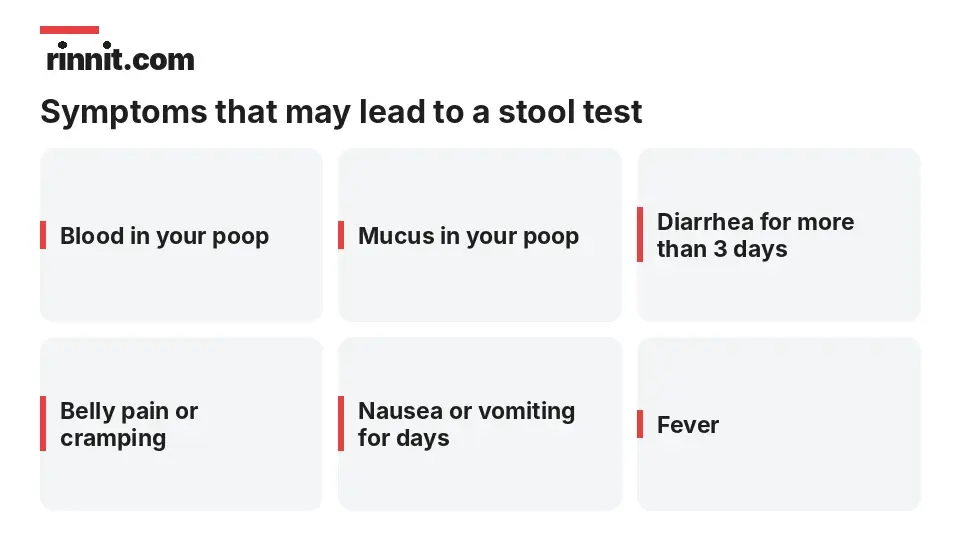
Stool tests help find infections, bleeding and other digestive problems.
Your provider may recommend a stool test if you have: [1]
Blood in your poop
Mucus in your poop
Diarrhea that's lasted more than three days
Stomach pain or cramping
Nausea or vomiting that lasts days
Fever
What can a stool test check for?
Stool tests can help find many GI conditions, including: [1]
Anal fissures (small tears in the anus)
Anemia (a lack of red blood cells)
Colitis (swelling or irritation in the colon)
Colon polyps
Diverticulosis (bulging pockets in the intestine)
Exocrine pancreatic insufficiency (trouble breaking down food)
Gastrointestinal bleeding
Hemorrhoids
Bacterial, viral or parasitic infections
Inflammatory bowel disease (IBD)
Steatorrhea (excess fat in your poop)
Stomach ulcers
What are the types of stool tests?
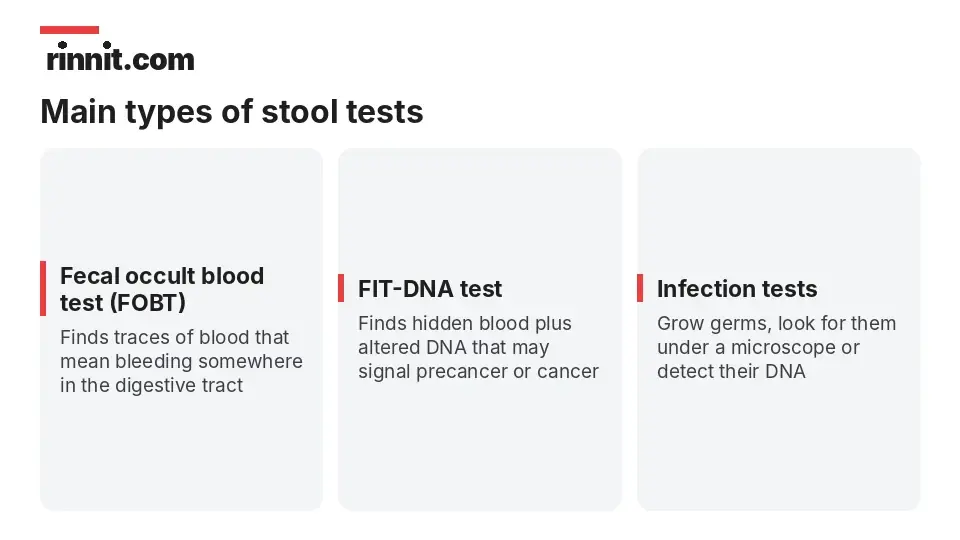
Your provider picks the test based on your symptoms.
Your provider chooses the test based on your symptoms. [1]
Test | What it looks for |
Traces of blood in your poop; a positive result means bleeding somewhere in your digestive tract | |
FIT-DNA test (FIT = fecal immunochemical test) | Tiny amounts of blood plus altered DNA that could point to precancerous or cancerous changes |
Tests for infection | Germs, found by growing them, viewing them under a microscope or detecting their DNA |
Sources: [1]
How do you prepare for a stool test?
You may not need any special preparation. For some tests, your provider may ask you to stop certain medicines or avoid certain foods. Instructions vary by test and person, so ask your provider what applies to you. [1]
How do you collect a stool sample?

Samples not returned within 24 hours usually can't be tested.
In most cases you collect the sample at home. Your provider gives you everything you need, including a container labeled with your name and birthdate. Follow their instructions; these general steps help: [1]
Pee first, so urine doesn't mix with the stool sample and affect the results.
Place something in the toilet to catch your poop, such as a tray, a container, or plastic wrap stretched between the seat and the bowl rim. (Don't use plastic wrap if your stool is loose or watery.)
Don't let your poop touch the inside of the toilet bowl, which can contaminate the sample.
Use the plastic scoop (or a disposable spoon) to place the sample in the container, up to the fill line or the amount your provider asked for.
Close the container right away and tighten the lid.
Tip any leftover poop into the toilet.
Put everything you used in a plastic bag, tie it tightly and throw it away.
Wash your hands well with antibacterial soap and running water.
Take the sample to the lab or your provider's office as soon as possible. You can keep it in the refrigerator for a short time if needed.
If you don't return the sample within 24 hours, it probably won't be tested. [1]
How is the sample tested?
It depends on the test. The lab may smear the stool on a test card, look at it on a glass slide under a microscope, place it on a plate with food that helps germs grow, or use a machine that copies germ DNA over and over to find hard-to-see germs. [1]
What do stool test results mean?
You'll likely get results in one to three days, though some tests take longer. [1]
Result | What it means |
Negative | Your poop looks typical, and the lab didn't find signs of disease such as blood or germs |
Positive | The lab found a germ (often named in the result) or other signs such as an abnormal amount of blood or fat |
Sources: [1]
A positive result helps your provider find the cause of your symptoms and choose treatment. If a stool test finds hidden blood or abnormal DNA, you'll need a follow-up colonoscopy to look for the cause, such as polyps or cancer. [1]
Is a stool test as good as a colonoscopy?
Stool tests give useful information, but sometimes changes in your intestine are too early to show up in stool. If your stool tests are negative and your symptoms continue, your provider may suggest a colonoscopy, which uses a thin tube with a light and camera to look inside your colon and can find growths while they're small and easier to remove. [1]
Conclusion
A stool test is a simple, noninvasive way to find out what's behind digestive symptoms, from infections to bleeding and early signs of colon cancer. Collecting the sample correctly and returning it quickly helps you get accurate results. [1]
It's normal to feel uneasy about giving a sample, but don't let that stop you. Tell your provider if something doesn't feel right. [1]
Keep learning: Read our guide to colorectal cancer screening or our fecal occult blood test guide. For more background, see the Merck Manual page on stool occult blood tests.
FAQ
What is a stool test?
A test of a poop sample that looks for germs, hidden blood and other signs of digestive disease.
Why would a doctor order a stool test?
For symptoms such as bloody or mucus-filled stool, diarrhea over three days, belly pain, vomiting or fever.
What are the main types of stool tests?
The fecal occult blood test, the FIT-DNA test and tests for infection.
How do I collect a stool sample at home?
Pee first, catch the stool without it touching toilet water, scoop it into the container, seal it and wash your hands.
How long can a stool sample sit before testing?
Return it as soon as possible; samples not returned within 24 hours usually aren't tested.
Do I need to prepare for a stool test?
Usually not, but your provider may ask you to stop certain medicines or foods.
How long do stool test results take?
Usually one to three days.
What does a positive stool test mean?
The lab found a germ or signs such as blood or excess fat that need follow-up.
Can a stool test detect colon cancer?
FOBT and FIT-DNA tests can find signs of colon cancer, such as hidden blood or altered DNA.
Is a stool test as good as a colonoscopy?
Not always. If symptoms continue after a negative test, your provider may suggest a colonoscopy.
Related Reading
Colon Cancer: Symptoms, Screening, Diagnosis, Treatment and Support explains a cancer stool tests help detect.
Irritable Bowel Syndrome: Symptoms, Causes, and Treatment covers a common cause of ongoing gut symptoms.
Ulcerative Colitis: Symptoms, Causes, Diagnosis, and Treatment Explained describes a form of inflammatory bowel disease.
Giardia Infection: How This Waterborne Parasite Spreads covers a parasite often found with stool testing.
Chronic Diarrhea: Symptoms, Causes, Treatment and Outlook explains long-lasting diarrhea and its causes.
Intestinal Parasites: Symptoms, Causes, and Effective Treatments covers infections stool tests can identify.
Fecal Calprotectin Test: IBD vs IBS, How to Collect a Sample and Results explains the stool test that checks for gut inflammation.
References
Cleveland Clinic. Stool Test: What It Is, Purpose, Procedure, Results & Types. Cleveland Clinic. Last updated August 24, 2023. https://my.clevelandclinic.org/health/diagnostics/25210-stool-test
Lee JK, Liles EG, Bent S, et al. Accuracy of fecal immunochemical tests for colorectal cancer: systematic review and meta-analysis. Ann Intern Med. 2014;160(3):171-181. PMID 24658694. https://doi.org/10.7326/M13-1484
Imperiale TF, Ransohoff DF, Itzkowitz SH, et al. Multitarget stool DNA testing for colorectal-cancer screening. N Engl J Med. 2014;370(14):1287-1297. PMID 24645800. https://doi.org/10.1056/NEJMoa1311194
Medical disclaimer
This article is for general education only and does not replace advice from a qualified healthcare professional. Talk to your doctor about your own diagnosis and treatment, and seek emergency care right away for severe or sudden symptoms.



Comments