Contrast Enema for Children: What to Expect for Your Child

Updated: 3 days ago
Written and medically reviewed by Dr. Baraa Alnahhal, MD · Last reviewed: November 2026 · How we review
Quick Answer
A contrast enema for children, also called a pediatric barium enema, is an X-ray test that uses contrast and fluoroscopy (X-ray video) to look at a child's colon. It's most often done to find out why a child has trouble pooping. Your child stays awake and needs no sedation. The test takes 30 to 45 minutes.
What the research says
Enemas also treat intussusception: a review of 32,451 children found air enemas successfully fixed intussusception, a telescoping bowel, in 82.7% vs. 69.6% with liquid enemas, with very low perforation rates (Sadigh G et al., AJR Am J Roentgenol, 2015) [2]
A biopsy is more accurate for Hirschsprung: a systematic review found contrast enema had 70% sensitivity and 83% specificity for Hirschsprung disease, compared with 93% and 98% for rectal suction biopsy (de Lorijn F et al., J Pediatr Gastroenterol Nutr, 2006) [3]
Key takeaways
A pediatric contrast enema uses barium and X-rays to view the colon.
It helps find causes of constipation, diarrhea and Hirschsprung disease.
Your child stays awake; no sedation is needed.
It takes about 30 to 45 minutes.
Stool may look white for a couple of days afterward.
What is a contrast enema?
The colon doesn't show up well on a plain X-ray. Contrast coats its lining so the radiologist can see its shape, size and position and spot narrowing, blockages or unusual widening. In Hirschsprung disease, a section of the colon lacks nerve cells, which often shows as a narrow segment with a wider section above it. Adults have a similar test called a barium enema. Sources: [1]
Why it's done
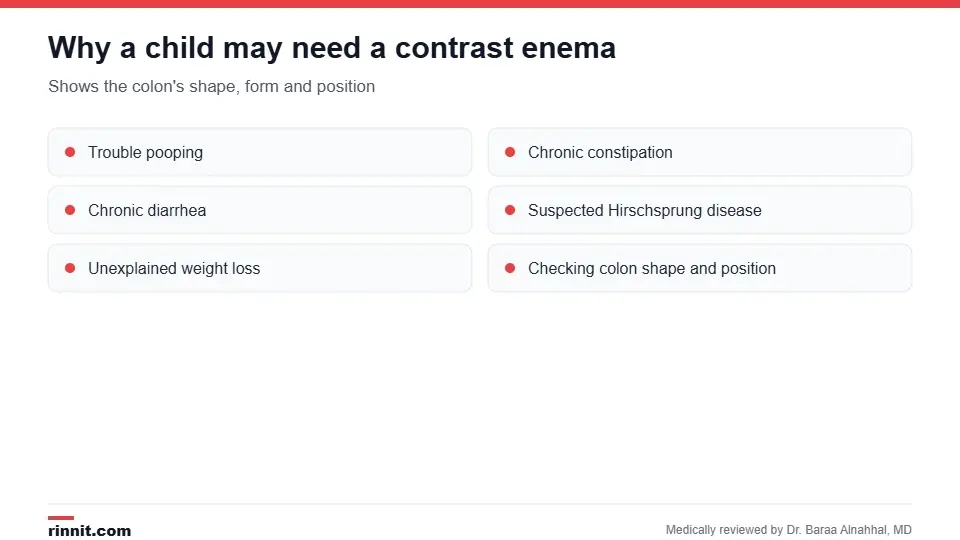
The test shows the colon's shape, form and position.
Chronic constipation.
Chronic diarrhea.
Suspected Hirschsprung disease.
Unexplained weight loss.
Checking the colon's shape and position. Sources: [1]
For Hirschsprung disease, a contrast enema is a useful first step, but a rectal biopsy is more accurate and is needed to confirm the diagnosis. Sources: [3]
How to prepare
Usually no preparation is needed unless your provider says otherwise.
Your child can usually eat and drink normally.
Bring a favorite blanket or stuffed animal for comfort.
Explain the test in simple words so your child knows what to expect. Sources: [1]
What happens during the test

The test takes about 30 to 45 minutes.
Your child changes into a gown and lies on the exam table.
A first X-ray of the belly is taken.
Your child lies on one side with knees raised, and a small tube is gently placed in the rectum and taped in place.
Contrast flows from a bag into the colon while X-ray video is recorded; your child may be asked to roll from side to side.
The tube is removed, your child uses the restroom and a final X-ray is taken. Sources: [1]
Risks
The test is generally safe and uses minimal radiation. Some children have bloating, constipation, diarrhea, headache or nausea. An allergic reaction is rare, and a tear in the bowel is very rare. Sources: [1]
After the test
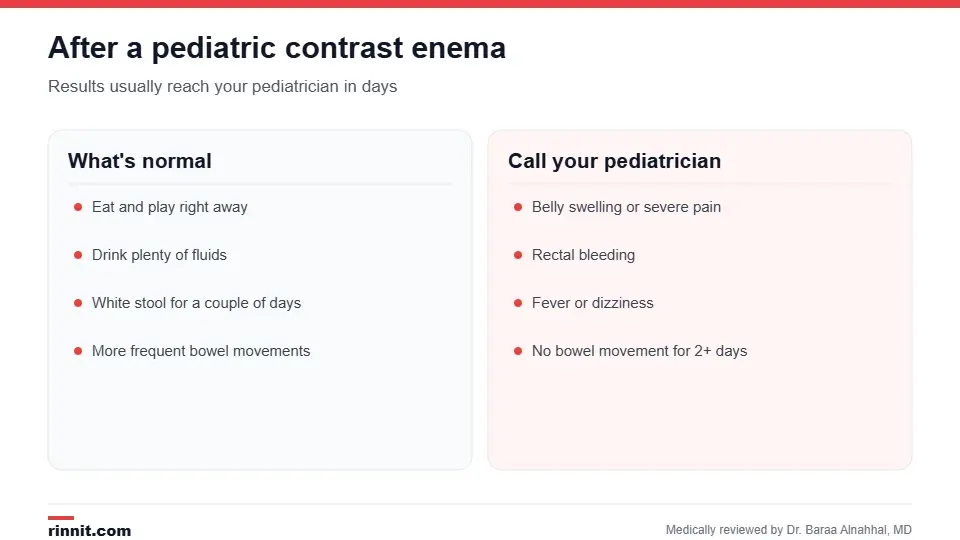
Results usually reach your pediatrician within days.
Your child can eat and return to normal activities right away.
Offer plenty of fluids.
Stool may look white for a couple of days, and bowel movements may be more frequent. Sources: [1]
Call your pediatrician for belly swelling, rectal bleeding, dizziness, fever, severe belly pain or no bowel movement for more than 2 days. Sources: [1]
What the results mean
Result | What it means |
Negative | No problems found |
Positive | A problem such as a narrowing or blockage; more tests may be needed |
The radiologist sends a report and images to your pediatrician, usually within 1 to several days. Sources: [1, 2, 3]
Conclusion
A pediatric contrast enema is a safe, quick way to look at a child's colon without sedation. It helps find the cause of ongoing bowel problems so your child can get the right care.
Keep learning: read about constipation in children and the barium enema.
Frequently asked questions
What is a contrast enema for children?
An X-ray test that uses contrast to view a child's colon.
Will my child be sedated?
No. Your child stays awake.
How long does it take?
About 30 to 45 minutes.
Does my child need to fast?
Usually not.
Does it hurt?
It may feel uncomfortable, but it's usually not painful.
Can I stay with my child?
Often yes; ask the imaging team.
Why is my child's stool white?
From the contrast; it clears in a couple of days.
Can it diagnose Hirschsprung disease?
It can suggest it, but a rectal biopsy confirms it.
What are the risks?
Mild bloating or nausea; serious problems are very rare.
When will we get results?
Usually within 1 to several days.
Related Reading
Barium Enema (Lower GI Series): Purpose, Preparation, Procedure and Results the adult version of this test.
Constipation in Children: Symptoms, Causes and When to Get Help a common reason for the test.
Pediatric Hearing Tests: Hearing Checks for Babies and Children by Age another guide to tests for children.
Upper GI Series: What It Is, Why It's Done, How to Prepare and What to Expect X-ray imaging of the upper GI tract.
Colonoscopy: Purpose, Prep, Procedure, Results and Risks a camera exam of the colon.
References
Cleveland Clinic. Pediatric Contrast/Barium Enema: What To Expect for My Child's BE. Cleveland Clinic. Last updated December 13, 2024. https://my.clevelandclinic.org/health/diagnostics/16579-contrast-enema-for-children
Sadigh G, Zou KH, Razavi SA, et al. Meta-analysis of air versus liquid enema for intussusception reduction in children. AJR Am J Roentgenol. 2015;205(5):W542-W549. PMID 26496576. https://doi.org/10.2214/AJR.14.14060
de Lorijn F, Kremer LC, Reitsma JB, et al. Diagnostic tests in Hirschsprung disease: a systematic review. J Pediatr Gastroenterol Nutr. 2006;42(5):496-505. PMID 16707970. https://doi.org/10.1097/01.mpg.0000214164.90939.92
Medical disclaimer
This article is for general education only and does not replace advice from a qualified healthcare professional. Talk to your doctor about your own diagnosis and treatment, and seek emergency care right away for severe or sudden symptoms.



Comments