Barium Enema (Lower GI Series): Purpose, Preparation, Procedure and Results

Updated: 2 days ago
Written and medically reviewed by Dr. Baraa Alnahhal, MD · Last reviewed: November 2026 · How we review
Quick Answer: What is a barium enema?
A barium enema (called a contrast enema or lower GI series) is an X-ray of the large intestine. A provider fills the colon with barium, a liquid inserted through the rectum, so the bowel shows up clearly. The test takes 30 to 60 minutes, needs no sedation and helps explain rectal bleeding, changing bowel habits or lower belly pain. [1]
What the research says
CT colonography finds more cancers and large polyps. In a UK trial of 3,838 people aged 55 or older with bowel symptoms, CT colonography detected colorectal cancer or large polyps in 7.3% of patients versus 5.6% with barium enema. Barium enema missed 12 of 85 cancers, compared with 3 of 45 for CT colonography. (Halligan et al., The Lancet, 2013) [2]
Colonoscopy beats barium enema for follow-up after polyp removal. In 862 paired exams after polypectomy, double-contrast barium enema found polyps in only 35% of the exams in which colonoscopy found them, rising to about half for adenomas larger than 0.5 cm. (Winawer et al., The New England Journal of Medicine, 2000) [3]
Key takeaways
A barium enema is an X-ray of the colon that uses barium contrast inserted through the rectum. [1]
You need a clear bowel, so you'll follow a bowel prep with a laxative and a clear liquid diet. [1]
The test takes about 30 to 60 minutes, with no sedation or anesthesia. [1]
Constipation is the most common side effect; drinking plenty of water afterward helps. [1]
Colonoscopy and CT colonography are usually more accurate, but a barium enema still has a place. [1] [2]
Single-contrast vs double-contrast barium enema
There are two types of barium enema: [1]
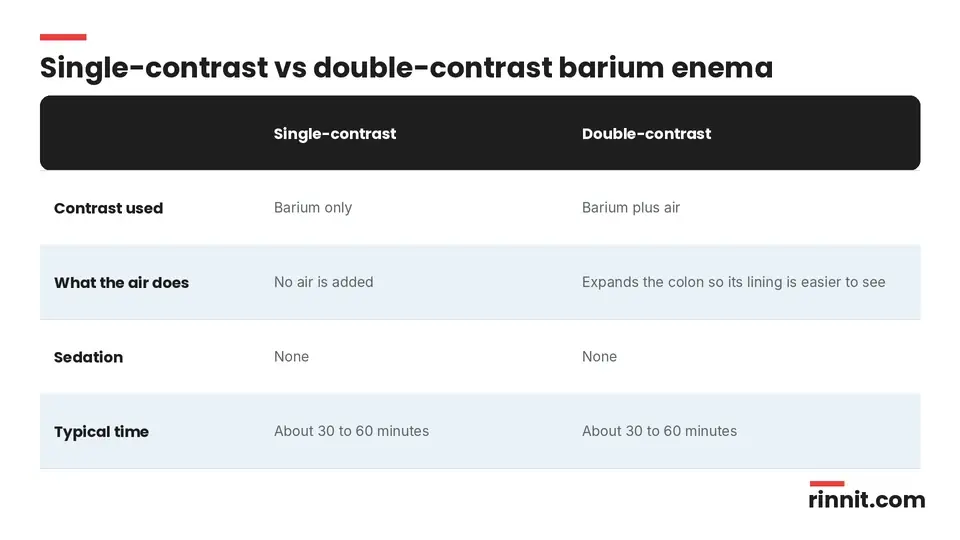
Single-contrast enema | Double-contrast enema | |
What's used | Barium only | Barium plus air blown into the colon |
What the air does | — | Expands the colon so its lining is easier to see |
Sources: [1]
Why would you need a barium enema?
Your provider may suggest a barium enema if you have unexplained symptoms affecting the large bowel, such as: [1]
Rectal bleeding or blood in your poop
Changes in bowel habits, like how often you poop
Unexplained chronic diarrhea
Unexplained lower abdominal pain
Unexplained weight loss
The test can show findings that help explain those symptoms, including an anal fistula, a bowel obstruction, colon polyps, diverticulosis or ulcerative colitis. [1]
Barium enema vs colonoscopy and CT colonography
Barium enemas are less common than they used to be, because colonoscopy and CT colonography (virtual colonoscopy) work better in many cases. Still, a barium enema can have advantages: [1]
It's more widely available than colonoscopy or colonography.
It's less invasive than a colonoscopy and doesn't need anesthesia.
You may be allergic to the contrast dye used in CT colonography, but not to barium.
Your provider may be looking for something that's easy to see on an X-ray.
How does a barium enema work?
A barium enema uses fluoroscopy, a type of X-ray that works like a video. It shows organs moving in real time, which helps your care team see how they're working. Barium coats the inside of your intestine so its outline stands out, and your team can watch the liquid move through your colon. [1]
How do you prepare for a barium enema?
Your bowel needs to be empty for the pictures to be clear, so your provider will prescribe a bowel preparation, similar to the prep before a colonoscopy. [1]
Most prep kits include an oral laxative with detailed instructions.
In most cases, you'll follow a clear liquid diet for a few days before taking the laxative.
Some people get different instructions, so follow the ones your provider gives you.
Tell your provider about all medications, supplements and health conditions, including pregnancy. They may adjust your instructions or reschedule the test. [1]
What happens during a barium enema?
A radiologist or radiology technician does the exam in a hospital or outpatient radiology center. It usually takes about 30 to 60 minutes. You'll change into a gown and lie on your side on the exam table. You won't get sedation or anesthesia, so you'll be awake and able to talk with the team. [1]
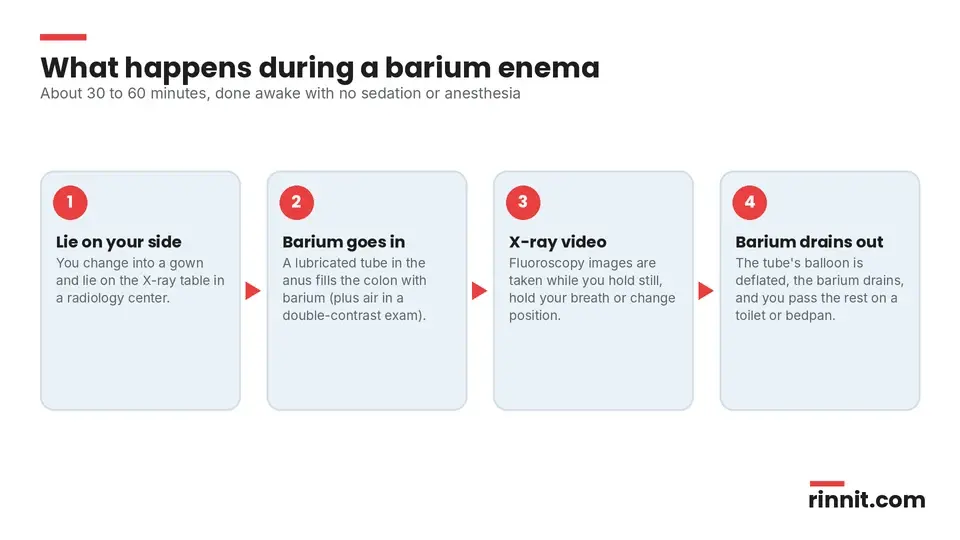
A lubricated tube is gently placed in your anus, and liquid barium flows through it into your intestine. In a double-contrast exam, air is also blown in.
X-rays are taken while you hold very still. You may be asked to hold your breath or move into different positions.
The balloon at the end of the tube is deflated, and the barium drains out. A toilet or bedpan is nearby so you can pass what's left.
Sources: [1]
As the bowel fills, you may feel uncomfortably full or like you need to poop. The balloon on the tube catches any leakage. [1]
What are the risks of a barium enema?
Constipation is the most common side effect. It's usually mild, but severe constipation could block the bowel, so drink plenty of water after the test. [1]
Some bowel preps can rarely cause electrolyte imbalances or kidney injury in some people, because of the sodium phosphate they contain. Your provider will choose a suitable formula for you. [1]
Other complications are very rare: [1]
An allergic reaction to the barium
Barium leaking through a hole or tear in the intestine
Radiation harm to you, or to a fetus if you're pregnant
What to expect after a barium enema
You can go back to your usual eating and activities right away. [1]
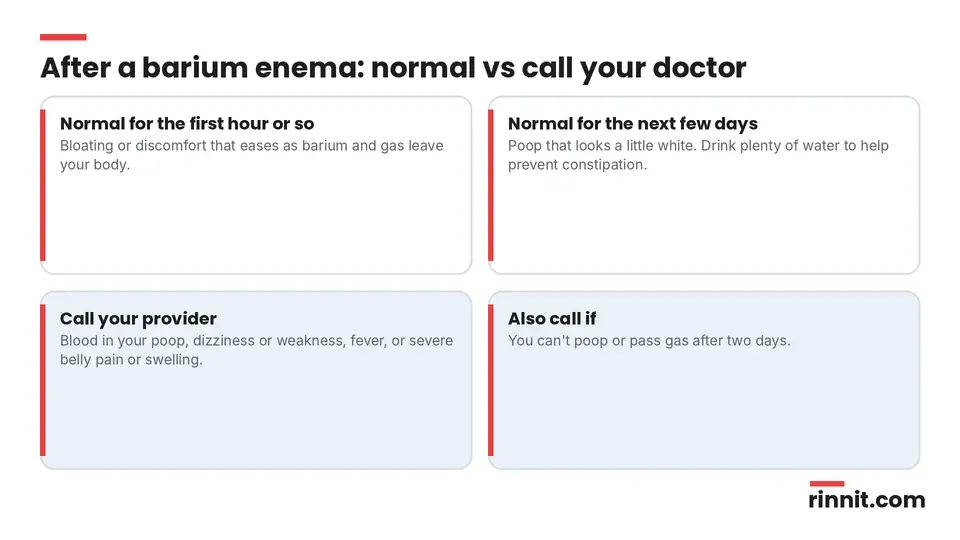
When | What's normal |
First hour or so | Bloating or discomfort that eases as the barium and gas leave |
Next few days | Poop that looks a little white from the barium |
Several days | Your provider contacts you with the radiologist's report and next steps |
Sources: [1]
If you can't poop or pass gas, call your provider; they can suggest ways to get things moving. [1]
When should you call your doctor?
Call your provider if you develop any of these after the procedure: [1]
Blood in your poop
Dizziness or weakness
Fever
Severe belly pain or swelling
You can't poop or pass gas after two days
Conclusion
A barium enema is a short, sedation-free X-ray exam that outlines the large intestine and can help explain bowel symptoms. Good bowel prep makes the pictures clear, and drinking plenty of water afterward lowers the chance of constipation.
If your provider suggests a barium enema, ask why it was chosen over a colonoscopy or CT colonography, and what the next step would be if something shows up.
Keep learning: Read our guides to colon polyps and colon cancer, or see how an enema works. For more background, see the NIDDK overview of the lower GI series.
FAQ
What is a barium enema?
It's an X-ray of the large intestine that uses barium contrast, inserted through the rectum, to make the colon show up clearly.
Is a barium enema the same as a lower GI series?
Yes. A barium enema is also called a lower GI series or a contrast enema.
How long does a barium enema take?
It usually takes about 30 to 60 minutes.
Are you sedated for a barium enema?
No. You stay awake without sedation or anesthesia and can talk with the team during the test.
How do I prepare for a barium enema?
You'll take a prescribed bowel prep, usually a laxative after a few days of clear liquids, so your colon is empty.
Does a barium enema hurt?
It's usually not painful, but you may feel very full or like you need to poop while the colon fills.
What is the difference between a single- and double-contrast barium enema?
A single-contrast enema uses only barium; a double-contrast enema also adds air to expand the colon.
What are the side effects of a barium enema?
Constipation is most common; bloating and white-looking poop for a few days are also normal.
Is a barium enema better than a colonoscopy?
Usually not. Colonoscopy and CT colonography work better in many cases, but a barium enema is less invasive and more widely available.
When will I get my barium enema results?
It may take several days; your provider contacts you after the radiologist's report.
When should I call a doctor after a barium enema?
Call if you have blood in your poop, fever, dizziness, severe belly pain, or can't poop or pass gas after two days.
Related Reading
Contrast Enema for Children: What to Expect for Your Child explains the X-ray test that views a child's colon.
Colon Polyps: Complete Guide to Symptoms, Causes, and Treatment explains the growths a barium enema can show in the colon.
Diverticulitis: Symptoms, Causes, Treatment & Diet — Complete Guide covers diverticular disease, one of the conditions this X-ray can reveal.
Ulcerative Colitis: Symptoms, Causes, Diagnosis, and Treatment Explained explains an inflammatory bowel disease the test can help find.
Anal Fistula: Symptoms, Causes, Treatment & Complete Guide explains a tunnel near the anus that a barium enema may show.
Constipation: Symptoms, Causes, Diagnosis and Treatment — What You Need to Know explains the most common side effect after a barium enema and how to prevent it.
References
Cleveland Clinic. Barium Enema: What It Is, Preparation & Procedure. Cleveland Clinic. Last updated June 9, 2025. https://my.clevelandclinic.org/health/diagnostics/17961-barium-enema
Halligan S, Wooldrage K, Dadswell E, et al. Computed tomographic colonography versus barium enema for diagnosis of colorectal cancer or large polyps in symptomatic patients (SIGGAR): a multicentre randomised trial. Lancet. 2013;381(9873):1185-1193. PMID 23414648. https://doi.org/10.1016/S0140-6736(12)62124-2
Winawer SJ, Stewart ET, Zauber AG, et al. A comparison of colonoscopy and double-contrast barium enema for surveillance after polypectomy. National Polyp Study Work Group. N Engl J Med. 2000;342(24):1766-1772. PMID 10852998. https://doi.org/10.1056/NEJM200006153422401
Medical disclaimer
This article is for general education only and does not replace advice from a qualified healthcare professional. Talk to your doctor about your own diagnosis and treatment, and seek emergency care right away for severe or sudden symptoms.



Comments