Anal Fistula: Symptoms, Causes, Treatment & Complete Guide

Updated: 2 days ago
Medically reviewed by Dr. Baraa Alnahhal, MD. Last updated: October 17, 2026.
An anal fistula (fistula-in-ano) is a tunnel between the inside of the anus and the skin around it, usually left behind after an infected anal gland drains as an abscess. Surgery is usually needed, and the surgeon's goal is to close the tunnel completely while protecting the sphincter muscles that control stool.
Quick Answer: What is an anal fistula?
An anal fistula, also called fistula-in-ano, is a tunnel between the inside of the anus and the outside skin, usually left after an infected anal gland forms an abscess that drains. Symptoms include a skin opening, oozing pus, blood or stool, pain and fever. Surgery is usually needed, and a fistula can return even after successful treatment.
What the research says
Plugs and fibrin glue fail more often than surgical repair in complex fistulas. A network meta-analysis of 16 randomized trials found that cutting seton, fistulotomy with sphincter reconstruction, LIFT and VAAFT had failure rates similar to the advancement flap. Anal fistula plugs (odds ratio 3.6, 95% CI 1.1–11.5) and fibrin glue (odds ratio 7.5, 95% CI 2.2–25) failed significantly more often. Only the cutting seton, a seton tightened to cut through the muscle, carried a higher risk of incontinence (odds ratio 8.6, 95% CI 1–72.5) (Sierra Fernández et al., Updates Surg, 2025) [3].
The advancement flap heals more fistulas than the plug. Across 12 studies and 847 patients with complex fistulas, the healing rate was 64.4% with the endoanal advancement flap versus 48.3% with the anal fistula plug, with no significant difference in recurrence, wound infection or complications (An et al., Updates Surg, 2023) [4].
Anal Fistula at a Glance
Aspect | Summary |
What it is | A tunnel between the inside of the anus and the outside skin (fistula-in-ano) |
How it forms | Infected anal gland, then abscess, then drainage, leaving an open tunnel that never closes |
Key symptoms | Skin opening, redness, oozing (pus, blood, stool), pain when sitting or passing stool, fever |
Typical patient | Adults around age 40; more common in males; younger patients with Crohn's disease |
Main risk factors | Drained anal abscess, Crohn's disease or other IBD, anal-area trauma, anal infections, anal-cancer surgery or radiation |
Diagnosis | Physical exam plus mapping the tunnel (MRI, endoscopic ultrasound, fistulography, exam under anesthesia) |
Main treatment | Surgery: fistulotomy, advancement flap, or LIFT. Nonsurgical options are sometimes available |
Main risks | Recurrence even with effective treatment; possible fecal incontinence after surgery |
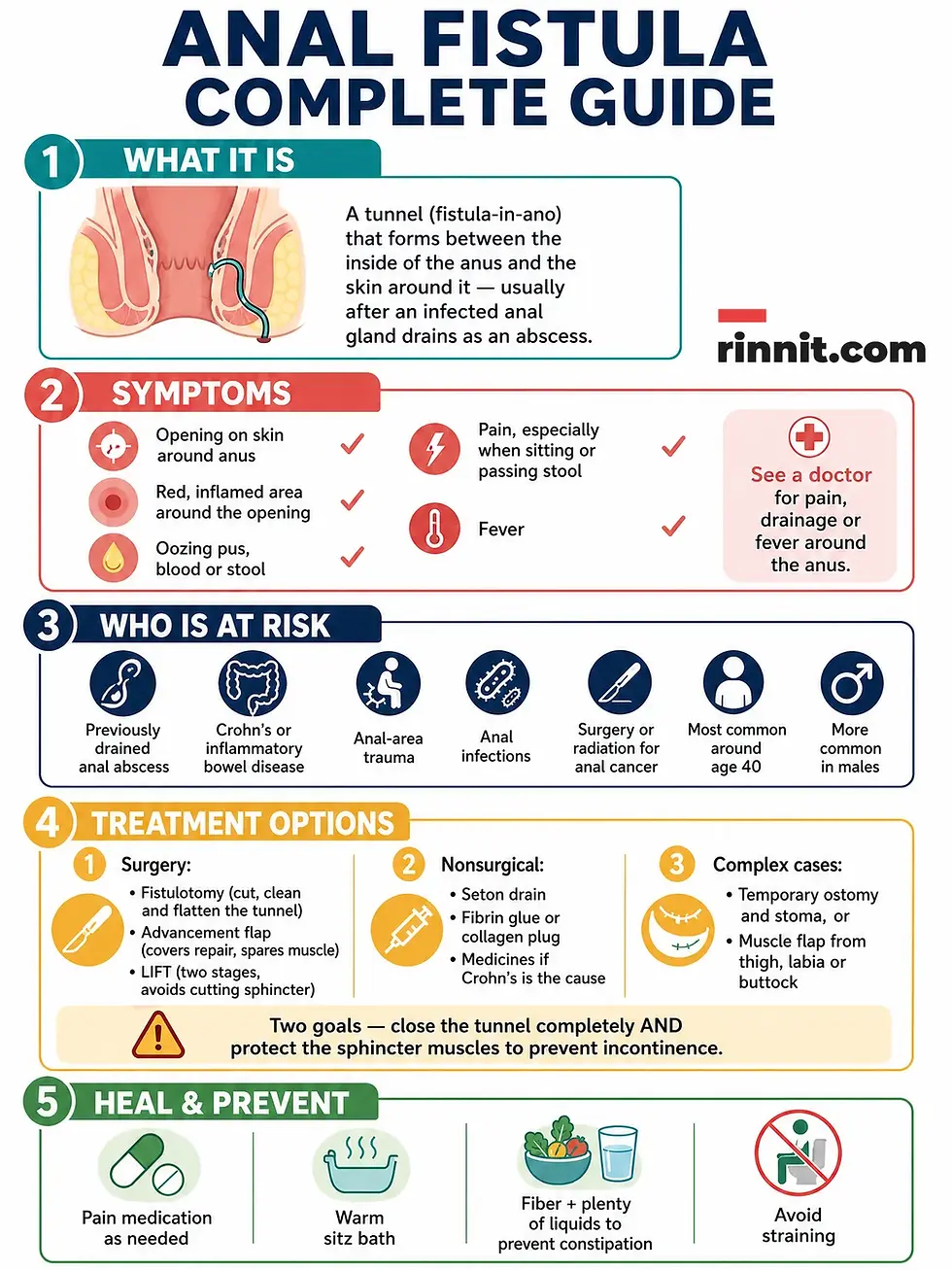
A complete guide to anal fistula: what it is, symptoms, who is at risk, treatment options, and how to heal. Source: rinnit.com
What Is an Anal Fistula?
An anal fistula, also called fistula-in-ano, is a tunnel that develops between the inside of the anus and the outside skin around the anus [1]. The anus is the muscular opening at the end of the digestive tract where stool exits the body.
Most anal fistulas are the result of an infection that starts in an anal gland. The infection causes an abscess that drains on its own or is drained surgically through the skin next to the anus. This drainage tunnel remains open and connects the infected anal gland or the anal canal to a hole in the outside skin around the anus [1].
Surgery is usually needed to treat an anal fistula. Sometimes nonsurgical treatments may be an option [1].
What are the symptoms of an anal fistula?
Anal fistula symptoms can include an opening on the skin around the anus, redness and inflammation, oozing of pus, blood or stool, pain and fever [1].
An opening on the skin around the anus.
A red, inflamed area around the tunnel opening.
Oozing of pus, blood, or stool from the tunnel opening.
Pain in the rectum and anus, especially when sitting or passing stool.
Fever.
If you notice pain, drainage, or fever around the anus, see a healthcare professional. These signs deserve a proper evaluation.
What causes an anal fistula?
Most anal fistulas are caused by an infection that starts in an anal gland. The infection results in an abscess that drains on its own or is drained surgically through the skin next to the anus. A fistula is the tunnel that forms under the skin along this drainage tract. The tunnel connects the anal gland or anal canal to a hole in the outside skin around the anus [1].
Rings of sphincter muscle at the opening of the anus allow you to control the release of stool. Fistulas are classified by their involvement of these sphincter muscles. This classification helps the surgeon determine treatment options [1], which is one of the reasons mapping the tunnel matters so much.

How an anal fistula forms: the three-step path from an infected anal gland to an open tunnel. Source: rinnit.com
What are the risk factors for an anal fistula?
A previously drained anal abscess, Crohn's disease, trauma or infection of the anal area, and surgery or radiation for anal cancer raise the risk of an anal fistula [1].
Previously drained anal abscess, the most direct path to a fistula.
Crohn's disease or other inflammatory bowel disease.
Trauma to the anal area.
Infections of the anal area.
Surgery or radiation for treatment of anal cancer.
Anal fistulas occur most often in adults around the age of 40 but may occur in younger people, especially if there is a history of Crohn's disease [1]. Anal fistulas occur more often in males than in females [1].
What complications can an anal fistula cause?
The two main anal fistula complications are recurrence of the abscess and fistula, and loss of bowel control after surgery.
Recurrence is possible. Even with effective treatment of an anal fistula, recurrence of an abscess and an anal fistula is possible [1].
Surgery may affect bowel control. Surgical treatment may result in the inability to hold in stool (fecal incontinence) [1], which is why protecting the sphincter muscles is a central goal of every treatment choice.
How is an anal fistula diagnosed?
To diagnose an anal fistula, your healthcare provider will discuss your symptoms and do a physical exam, including looking at the area around and inside your anus [2].
The external opening of an anal fistula is usually easily seen on the skin around the anus. Finding the internal opening inside the anal canal is more complicated [2], and knowing the complete path of an anal fistula is important for effective treatment.
Imaging test | What it does |
MRI | Can map the fistula tunnel and provide detailed images of the sphincter muscle and other structures of the pelvic floor |
Endoscopic ultrasound | Uses high-frequency sound waves to identify the fistula, the sphincter muscles, and surrounding tissues |
Fistulography | An X-ray of the fistula that uses an injected contrast to identify the anal fistula tunnel |
Examination under anesthesia | A colon and rectal surgeon may recommend anesthesia during an examination of the fistula. It allows a thorough look at the fistula tunnel and can identify any possible complications |
Other options to identify the fistula's internal opening include:
Fistula probe: an instrument specially designed to be inserted through a fistula is used to identify the fistula tunnel.
Anoscope: a small endoscope used to view the anal canal.
Flexible sigmoidoscopy or colonoscopy: these procedures use an endoscope to examine the large intestine (colon). Sigmoidoscopy evaluates the lower part of the colon (sigmoid colon). Colonoscopy, which examines the full length of the colon, is important to look for other disorders, especially if ulcerative colitis or Crohn's disease is suspected [2].
An injected dye solution: this may help locate the fistula opening [2].
How is an anal fistula treated?
Treatment of an anal fistula depends on the fistula's location and complexity and its cause. The goals are to repair the anal fistula completely to prevent recurrence and to protect the sphincter muscles. Damage to these muscles can lead to fecal incontinence [2]. Although surgery is usually required, sometimes nonsurgical treatments may be an option [2].
Surgical Options
Procedure | How it works | Best for |
Fistulotomy | The surgeon cuts the fistula's internal opening, scrapes and flushes out the infected tissue, then flattens the tunnel and stitches it in place. For a more complicated fistula, some of the tunnel may need to be removed. May be done in two stages if a significant amount of sphincter muscle must be cut or if the entire tunnel can't be found | The standard operation for many fistulas |
Endorectal advancement flap | The surgeon creates a flap from the rectal wall before removing the fistula's internal opening; the flap is then used to cover the repair | Reduces the amount of sphincter muscle that is cut |
LIFT (ligation of the intersphincteric fistula tract) | A two-stage treatment for more-complex or deep fistulas. LIFT allows the surgeon to access the fistula between the sphincter muscles and avoid cutting them. A silk or latex string (seton) is first placed into the fistula tunnel, forcing it to widen over time. Several weeks later, the surgeon removes infected tissue and closes the internal fistula opening | Complex or deep fistulas where sparing the sphincter matters most |
Nonsurgical Options
Option | How it works |
Seton placement | The surgeon places a seton into the fistula to help drain the infection; this allows the tunnel to heal. This procedure may be combined with surgery |
Fibrin glue and collagen plug | The surgeon clears the tunnel and stitches shut the internal opening. Special glue made from a fibrous protein (fibrin) is then injected through the fistula's external opening. The anal fistula tunnel can also be sealed with a plug of collagen protein and then closed |
Medication | Medication may be part of treatment if Crohn's disease is the cause of an anal fistula |
Complex Cases
In cases of complex anal fistula, more-invasive surgical procedures may be recommended:
Ostomy and stoma: the surgeon creates a temporary opening in the abdomen to divert the intestines away from the anal canal. Waste is collected into a bag on the abdomen. This procedure allows the anal area time to heal [2].
Muscle flap: in very complex anal fistulas, the tunnel may be filled with healthy muscle tissue from the thigh, labia, or buttock [2].
What home remedies help an anal fistula heal?
Home remedies for an anal fistula include pain medication as needed, warm sitz baths, more fiber and liquid in your diet, and avoiding straining during bowel movements.
How should you prepare for an anal fistula appointment?
If you have an anal fistula, you may be referred to a specialist in digestive diseases (gastroenterologist) or a colon and rectal surgeon [2]. When you make the appointment, ask if there's anything you need to do in advance, such as not eating for a time (fasting) before having a specific test [2].
Make a list of:
Your symptoms, even if they may seem unrelated to the reason for your appointment.
Key personal information, including major stresses, recent life changes, and personal and family medical history.
All medications, vitamins, herbs, or other supplements you take, including the dosages.
Questions to ask your healthcare provider.
Basic questions to ask include:
What is likely causing my symptoms?
Are there any other possible causes for my symptoms?
Do I need any tests?
Is my condition likely temporary or ongoing?
Are there any dietary suggestions I should follow?
Are there restrictions I need to follow?
What treatment do you recommend?
What are the alternatives to the primary approach you're suggesting?
I have these other health conditions. How can I best manage them together?
Are there brochures or other printed material I can have? What websites do you recommend?
Don't hesitate to ask other questions during your appointment.
What to Expect From Your Doctor
You may be asked:
When did your symptoms begin?
Have your symptoms been continuous or occasional?
How severe are your symptoms?
Where do you feel your symptoms the most?
Does anything seem to improve your symptoms?
What, if anything, seems to worsen your symptoms?
Do you have any other medical conditions, such as Crohn's disease?
Do you have problems with constipation?
Frequently Asked Questions
What is an anal fistula?
An anal fistula (fistula-in-ano) is a tunnel that develops between the inside of the anus and the outside skin around the anus. It usually forms when an infected anal gland causes an abscess that drains, and the drainage tunnel fails to close.
What are the symptoms of an anal fistula?
Symptoms include an opening on the skin around the anus, a red inflamed area around the tunnel opening, oozing of pus, blood, or stool from the opening, pain in the rectum and anus (especially when sitting or passing stool), and fever.
What causes an anal fistula?
Most anal fistulas start with an infection in an anal gland. The infection forms an abscess that drains on its own or is drained surgically, and the drainage tunnel remains open, connecting the anal gland or anal canal to a hole in the outside skin.
Is surgery always needed for an anal fistula?
Surgery is usually required to treat an anal fistula, but sometimes nonsurgical treatments may be an option, such as a seton drain, fibrin glue, a collagen plug, or medication when Crohn's disease is the cause.
What is the difference between fistulotomy, an advancement flap, and LIFT?
Fistulotomy cuts and cleans the tunnel, then flattens and stitches it closed. An endorectal advancement flap uses a flap from the rectal wall to cover the repair, reducing the sphincter muscle that is cut. LIFT is a two-stage procedure for complex fistulas that works between the sphincter muscles so they are not cut.
Can an anal fistula come back after treatment?
Yes. Even with effective treatment, recurrence of an abscess and an anal fistula is possible. That is why the surgeon's two goals are to repair the fistula completely and to protect the sphincter muscles.
Will anal fistula surgery affect bowel control?
Surgical treatment may result in the inability to hold in stool (fecal incontinence). Protecting the sphincter muscles, the rings that control the release of stool, is a central goal of treatment planning, which is why procedures like the advancement flap and LIFT were developed.
Conclusion
The main lessons of this guide: First, an anal fistula is a tunnel, not just a wound. It forms when an infected anal gland drains as an abscess and the channel never closes, so it rarely heals on its own. Second, the symptoms are hard to ignore. An opening on the skin, oozing pus or blood, pain when sitting or passing stool, and fever all point to the need for a professional evaluation. Third, treatment is a balancing act. The surgeon must close the tunnel completely to prevent recurrence while protecting the sphincter muscles that control stool, and options exist for every level of complexity.
This guide has covered what an anal fistula is, its symptoms, how the infection, abscess and tunnel chain forms, risk factors (including the Crohn's connection), complications, the diagnostic workup for mapping the tunnel, surgical and nonsurgical treatment options, complex-case procedures, home remedies during healing, and appointment preparation.
Related Reading
Seton Placement: Procedure, Types, Recovery and Care explains how a thin seton drains an anal fistula, the difference between draining and cutting setons, and home care.
Barium Enema (Lower GI Series): Purpose, Preparation, Procedure and Results explains the colon X-ray test that can help find this condition.
References
Mayo Clinic Staff. Anal fistula — Symptoms & causes. Mayo Clinic. Accessed Oct. 11, 2026. https://www.mayoclinic.org/diseases-conditions/anal-fistula/symptoms-causes/syc-20352871
Mayo Clinic Staff. Anal fistula — Diagnosis & treatment. Mayo Clinic. Accessed Oct. 11, 2026. https://www.mayoclinic.org/diseases-conditions/anal-fistula/diagnosis-treatment/drc-20537243
Sierra Fernández I, Balciscueta Coltell Z, Uribe Quintana N. Systematic review and network meta-analysis of cryptoglandular complex anal fistula treatment: evaluation of surgical strategies. Updates in Surgery. 2025;77(4):1067-1078. PMID 40442569. https://doi.org/10.1007/s13304-025-02270-6
An Y, Chen X, Tian M, et al. Comparison of clinical outcomes of anal fistula plug and endoanal advancement flap repair treating the complex anal fistula: a systematic review and meta-analysis. Updates in Surgery. 2023;75(8):2103-2115. PMID 37882975. https://doi.org/10.1007/s13304-023-01674-6
Medical disclaimer
This article is for general information only and does not replace professional medical advice, diagnosis, or treatment. Always consult a qualified healthcare provider for decisions about your health.



Comments