Constipation: Symptoms, Causes, Diagnosis and Treatment — What You Need to Know

Updated: 2 days ago
Medically reviewed by Dr. Baraa Alnahhal, MD · Last reviewed: September 2026
Quick Answer: Constipation is defined as having fewer than three bowel movements a week, though everyone has their own normal pattern. It happens when the colon absorbs too much water from stool as it moves too slowly through the digestive tract, leaving the stool dry, hard, and difficult to pass. Common causes include not enough fiber or water, low activity, routine changes, stress, and certain medications — from pain medicines and iron pills to antidepressants and blood pressure drugs. Most mild cases improve with more water, fiber, and exercise. See a healthcare provider if constipation is new, lasts more than three weeks, is accompanied by blood in your stool, or comes with severe pain or unintentional weight loss.
What Is Constipation, in Plain Language?
Having fewer than three bowel movements a week is, technically, the definition of constipation. But how often you go varies widely from person to person. Some people go several times a day while others only go one to two times a week.
Whatever your bowel movement pattern is, it is unique and normal for you — as long as you do not stray too far from your usual pattern.
Regardless of your pattern, one fact is certain: the longer you go before you have a bowel movement, the more difficult it becomes for stool to pass.
The key features that usually define constipation include the following:
Your stools are dry and hard.
Your bowel movements are painful, and your stools are difficult to pass.
You have a feeling that you have not fully emptied your bowels.
Constipation is one of the most frequent gastrointestinal complaints in the United States. At least 2.5 million people see their healthcare provider each year because of it, so you are far from alone if this describes you.
TL;DR — The Short Version
Constipation means fewer than three bowel movements a week, dry hard stools, or a feeling of incomplete emptying. It happens when stool moves too slowly through the colon, which absorbs too much water and leaves stool hard and difficult to pass. Most cases are linked to lifestyle factors — low fiber, low water intake, inactivity, routine changes — or to medications and medical conditions. Most mild cases respond to home care: more water, more fiber, regular movement, and not ignoring the urge to go. Some causes are medical and need a provider's evaluation.
"It happens most often due to changes in diet or routine, or due to inadequate intake of fiber." — the reviewed medical source on constipation
When Should You See a Healthcare Provider?
For most people, constipation is a temporary, manageable problem. But certain signs mean it is time to talk to a healthcare provider rather than continue self-care.
Situation | What to do |
Constipation is a new problem for you | Contact a healthcare provider |
Constipation lasts longer than three weeks | Contact a healthcare provider |
You see blood in your poop | Contact a healthcare provider |
You have severe pain with bowel movements | Contact a healthcare provider |
You are losing weight unintentionally | Contact a healthcare provider |
You have symptoms of outlet dysfunction constipation | Contact a healthcare provider |
Constipation may be a temporary situation, a long-term issue, or a sign of a more serious condition. See your provider, especially if you have noticed a change in your bowel pattern or feel that your life is being ruled by your bowels.
How Does Constipation Happen?
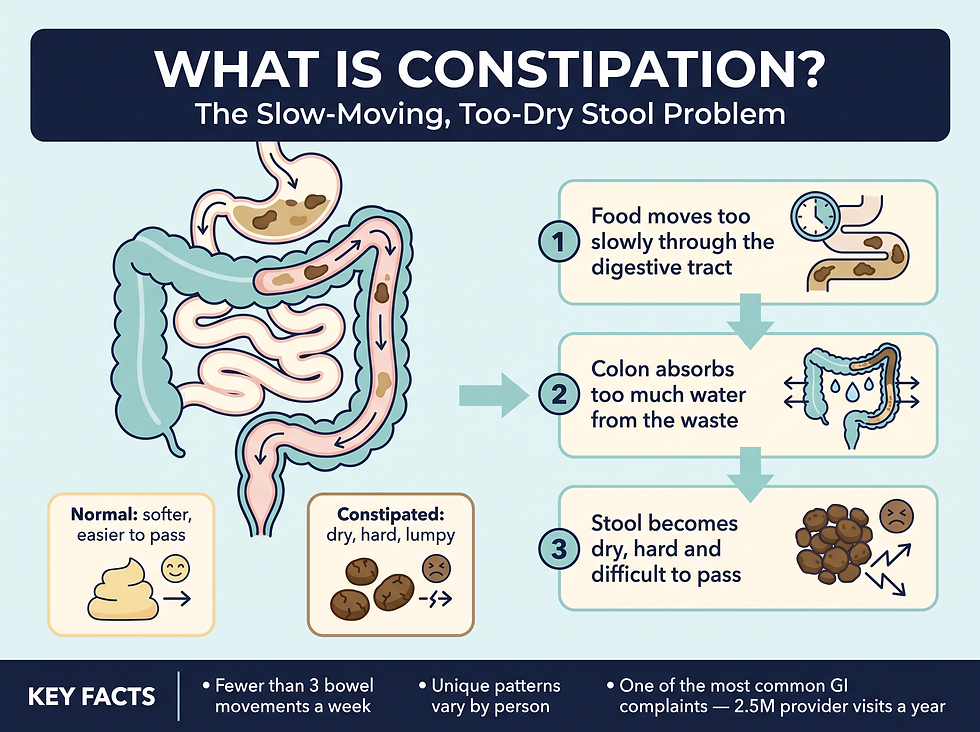
Constipation happens because your colon (large intestine) absorbs too much water from your stool. This dries out your stool, making it hard in consistency and difficult to push out of your body.
To back up a bit: as food normally moves through your digestive tract, your intestines gradually absorb the nutrients. The partially digested food (waste) that passes from your small intestine to your large intestine becomes your stool. Your colon absorbs water from this waste, which makes it more solid.
If you have constipation, food may move too slowly through your digestive tract. This gives your colon more time — too much time — to absorb water from the waste. The stool becomes dry, hard, and difficult to push out.
What Are the Signs and Symptoms of Constipation?
Constipation symptoms include the following:
You have fewer than three bowel movements a week.
Your stools are dry, hard, and/or lumpy.
Your stools are difficult or painful to pass.
You have a stomachache or cramps.
You feel bloated and nauseated.
You feel that you have not completely emptied your bowels after a movement.
Symptom | What it means in practice |
Fewer than three bowel movements a week | The technical definition of constipation |
Dry, hard, lumpy stools | The colon has absorbed too much water from the stool |
Difficult or painful bowel movements | Hard stool is hard to push out |
Stomachache or cramps | Pain related to backed-up stool and straining |
Bloating and nausea | Backed-up stool pressing on the digestive tract |
Feeling of incomplete emptying | A sense that the bowels have not fully emptied after a movement |

What Causes Constipation?
There are many causes of constipation, including lifestyle factors, medications, and medical conditions.
Lifestyle factors
Common lifestyle causes of constipation include the following:
Not eating enough fiber.
Not drinking enough water (dehydration).
Not getting enough exercise.
Changes in your regular routine, such as traveling or eating, or going to bed at different times.
Consuming large amounts of milk or cheese.
Stress.
Resisting the urge to have a bowel movement.
Medications that can cause constipation
Many drugs can cause constipation. Ask your healthcare provider or pharmacist if you have any questions or concerns about medications you take.
Medication type | Examples |
Strong pain medicines (narcotics) | Codeine, oxycodone, hydromorphone |
NSAIDs | Ibuprofen, naproxen |
Antidepressants | SSRIs such as fluoxetine; tricyclics such as amitriptyline |
Antacids | Those containing calcium or aluminum, such as Tums |
Iron pills | Iron supplements |
Allergy medications | Antihistamines such as diphenhydramine |
Blood pressure medicines | Calcium channel blockers (verapamil, diltiazem, nifedipine) and beta-blockers (atenolol) |
Psychiatric medications | Clozapine, olanzapine |
Antiseizure medications | Phenytoin, gabapentin |
Antinausea medications | Ondansetron |
Never stop taking your medications or supplements before talking with your provider first.
Medical conditions that can cause constipation
Medical and health conditions that can cause constipation include the following:
Endocrine conditions, like underactive thyroid gland (hypothyroidism), diabetes, uremia, and hypercalcemia.
Colorectal cancer.
Irritable bowel syndrome (IBS).
Diverticulitis.
Outlet dysfunction constipation. This is a defect in the coordination of your pelvic floor muscles. These muscles support the organs within your pelvis and lower abdomen, and they are needed to help release stool. Read more in our guide to anismus (dyssynergic defecation).
Obstructed defecation syndrome, where complex or unexplained causes may be preventing you from having normal bowel movements.
Intestinal pseudo-obstruction, where the motor system in your colon can become temporarily paralyzed (as in paralytic ileus or Ogilvie syndrome).
Neurologic disorders, including spinal cord injury, multiple sclerosis, Parkinson's disease, and stroke.
Lazy bowel syndrome, when your colon contracts poorly and retains stool.
Intestinal obstruction.
Structural defects in your digestive tract, like fistula, colonic atresia, volvulus, intussusception, imperforate anus, or malrotation.
Multiple organ diseases, such as amyloidosis, lupus, and scleroderma.
Pregnancy.

What Are the Risk Factors for Constipation?
People of all ages can have an occasional bout of constipation. But certain risk factors make people more likely to become consistently constipated ("chronic constipation").
Risk factor | Why it matters |
Age (older than 65) | People over 65 are often less active, have a slower metabolism, and have less muscle contraction strength along the digestive tract |
Hormone changes | Constipation is common during pregnancy and after childbirth; the fetus inside the uterus may slow the passage of stool |
Not eating enough high-fiber foods | Fiber keeps food moving through your digestive system |
Taking certain medications | Many drug classes slow bowel movements |
Neurological and digestive diseases | Diseases of the brain, spinal cord, and gut interfere with normal bowel function |
Can Constipation Cause Internal Damage?
There are a few complications that could happen if you do not have soft, regular bowel movements. Some complications include the following:
Swollen, inflamed veins in your rectum (hemorrhoids).
Tears in the lining of your anus from hardened stool trying to pass through (anal fissures).
An infection in the pouches (diverticula) that sometimes form off your colon wall from stool that has become trapped and infected (diverticulitis).
A pile-up of too much stool in your rectum and anus (fecal impaction).
Damage to your pelvic floor muscles from straining to move your bowels. These muscles help control your bladder, among other things. Too much straining for too long may cause urine to leak from your bladder (stress urinary incontinence).
Can constipation cause toxins to build up in your body?
This usually is not the case. Although your colon holds on to stool longer when you are constipated and you may feel uncomfortable, it is an expandable container for your waste. It takes a severe illness in your colon for the walls to leak toxins into your body (toxic megacolon).
Complication | How it develops |
Hemorrhoids | Swollen, inflamed veins in the rectum |
Anal fissures | Tears in the anal lining from hardened stool |
Diverticulitis | Infection in pouches (diverticula) that form off the colon wall |
Fecal impaction | Pile-up of too much stool in the rectum and anus |
Pelvic floor damage | Straining damages muscles that control the bladder, possibly causing stress urinary incontinence |
How Is Constipation Diagnosed?
What should you expect when you talk to a healthcare provider?
Talking to a healthcare provider — or anyone — about your bowel movements (or lack of them) may not be the most pleasant of topics. But know that your provider is there for you. They are a trained healthcare professional who has discussed just about every health topic you can think of with their patients.
Your provider will begin by asking you questions about your medical history, bowel movements, lifestyle, and routines.
Medical history questions may include: What are your current and past diseases or health conditions? Have you lost or gained any weight recently? Have you had any previous digestive tract surgeries? What medications and supplements do you take? Does anyone in your family have constipation, diseases of the digestive tract, or a history of colon cancer? Have you had a colonoscopy?
Bowel movement history questions may include: How often do you have a bowel movement? What do your stools look like? Have you noticed any blood or red streaks in your stool? Have you ever seen blood in the toilet bowl or on the toilet paper after you wipe?
Lifestyle and routine questions may include: What do you eat on a typical day for each meal? How often do you eat fruits and vegetables? How much water do you drink? What is your exercise routine?
Your provider will also perform a physical exam, which includes a check of your vital signs (temperature, pulse, blood pressure). They will use a stethoscope to listen to the sounds in your abdomen. They will also touch your abdomen to check for pain, tenderness, swelling, and lumps.
Be aware that your provider may also perform a rectal exam. This is a finger exam of the inside of your rectum. It is a quick check for any masses or problems that can be felt by a finger.
What lab tests and other medical tests may be done?
Your healthcare provider may not order any tests, or may order many types of tests and procedures. Tests will depend on your symptoms, medical history, and overall health, and what they think the cause might be. Most of the time, additional lab testing is not required for a diagnosis. However, your healthcare provider may choose to do more based on your symptoms.
Test type | What it checks for |
Blood tests and urine tests | Signs of hypothyroidism, anemia, and diabetes |
Stool sample | Signs of infection, inflammation, and cancer |
Imaging (CT, MRI, lower GI series) | Other problems that could be causing constipation — but these usually are not ordered |
Colonoscopy or sigmoidoscopy | Internal view of the colon with a scope; possible biopsy to test for cancer or other issues; removal of any polyps (see our guide to colon polyps) |
Colorectal transit studies | Consuming a small dose of a radioactive substance (pill or meal) and tracking how it moves through the intestines |
Bowel function tests | How well the anus and rectum hold and release stool; includes defecography (a type of X-ray), the balloon expulsion test, and anorectal manometry — used to rule out outlet dysfunction constipation |
How Do You Relieve Constipation?
You can manage most cases of mild to moderate constipation at home. Self-care starts by taking an inventory of what you eat and drink and then making changes.
Some recommendations for immediate constipation relief at home include the following:
Drink two to four extra glasses of water a day. Avoid caffeine-containing drinks and alcohol, which can cause dehydration. Also, avoid juice and high-sweetened beverages.
Avoid processed meats, fried foods, and refined carbs like white bread, pasta, and potatoes. It is OK to eat lean meats like poultry and low-fat dairy products.
Add fruits, vegetables, whole grains, and other high-fiber foods to your daily diet. Eat fewer high-fat foods, like meat, eggs, and cheese.
Eat prunes, bran cereal, and other high-fiber fruits like oranges, pineapples, berries, mangos, avocados, and papaya.
Keep a food diary and single out foods that constipate you.
Get moving — exercise.
Check how you sit on the toilet; raising your feet, leaning back, or squatting may make having a bowel movement easier.
Add an over-the-counter supplemental fiber to your diet (like Metamucil, MiraLAX, Citrucel, or Benefiber). It is best to start slowly with these.
If needed, take a very mild over-the-counter stool softener or laxative (such as docusate). Mineral oil enemas and stimulant laxatives are other options. There are many laxative choices. Ask your pharmacist or healthcare provider for help in making a choice. Do not use laxatives for more than two weeks without calling your provider. Overuse of laxatives can worsen your symptoms.
Do not read or use your phone or other devices while trying to move your bowels. And avoid holding the urge to use the bathroom. Eventually, it will block the signal from your colon to your brain to relax and let the stool out.
Medication and supplement review
In addition to self-care methods, your healthcare provider will review your medications and supplements (if you take any). Some of these products can cause constipation. If they do, your provider may change the dose, switch to another drug, and/or ask that you stop taking the supplement.
Prescription constipation medicines
A few prescription drugs are available to treat constipation. These include the following:
Prescription drug | Brand names |
Lubiprostone | Amitiza |
Prucalopride | Prudac, Motegrity |
Plecanatide | Trulance |
Lactulose | Cephulac, Kristalose |
Linaclotide | Linzess |
Your healthcare provider will pick the drug that might work best for you based on the results of your tests.
Is surgery ever needed?
Surgery is rarely needed to treat constipation. But your healthcare provider may recommend surgery if a structural problem in your colon is causing constipation. Examples of these problems include a blockage in your colon (intestinal obstruction), a narrowing in a portion of your intestine (intestinal stricture), a tear in your anus (anal fissure), and the collapse of part of your rectum into your vagina (rectal prolapse).
Some causes of outlet dysfunction constipation may be treated with surgery. This is best discussed after testing. You may also need surgery if a colonoscopy reveals cancer in your colon, rectum, or anus.
How Can You Prevent Constipation?
Use the same home-based methods you used to treat constipation to prevent it from becoming a chronic problem.
Eat a well-balanced diet with plenty of fiber. Good sources of fiber are fruits, vegetables, legumes, and whole-grain breads and cereals. Fiber and water help your colon pass stool. Most of the fiber in fruits is found in the skin, such as in apples. Fruits with seeds you can eat, like strawberries, have the most fiber. Bran is a great source of fiber, too. Eat bran cereal or add bran cereal to other foods, like soup and yogurt. People with constipation should eat between 18 and 30 grams of fiber every day. If you have diverticulitis, you might be advised to avoid fruits with seeds.
Drink eight 8-ounce glasses of water a day. (Note: milk can cause constipation in some people.) Liquids that contain caffeine, such as coffee and soft drinks, can dehydrate you. You may need to stop drinking these products until your bowel habits return to normal.
Exercise regularly. It does not need to be much — even walking helps a lot.
Use a dietary supplement like magnesium for constipation. (Not everyone should take magnesium. Check with your healthcare provider before taking.)
Move your bowels when you feel the urge. Do not wait.
How to Prepare for Your Appointment
Write down your symptoms and how long they have been happening. Bring a list of all medications and supplements you take. Note your typical daily diet, your water intake, and your exercise routine. Write down the questions you want to ask, including: Why am I constipated? What can I take for immediate constipation relief? What home remedies for constipation do you recommend? What should I eat or drink to prevent constipation? How else can I prevent constipation?
Do not be embarrassed to talk openly and honestly about your bowel movements. Your provider has discussed just about every health topic with their patients.
The Bottom Line
Constipation is one of the most common digestive complaints, and it is usually temporary and manageable. It is defined by fewer than three bowel movements a week, dry hard stools, or a feeling of incomplete emptying, and it happens when stool moves too slowly through a colon that absorbs too much water. Most cases respond to straightforward home care: more water, more fiber, regular exercise, and responding to the urge to go. When constipation is new, lasts more than three weeks, or comes with blood, severe pain, or unintentional weight loss, see a healthcare provider for an evaluation — because constipation can sometimes be a sign of a more serious condition.
Talk openly with your healthcare provider about your bowel movements and any questions or concerns. If you have noticed a change in your bowel pattern, or feel that your life is being ruled by your bowels, be safe and see your provider.
Take action today: start with a glass of water, add fiber-rich fruits and vegetables to your next meal, and schedule a check-in with your healthcare provider if your symptoms match any of the warning signs above.
Frequently Asked Questions
What is the medical definition of constipation?
Fewer than three bowel movements a week is the technical definition of constipation. However, everyone has their own normal frequency — from several times a day to one or two times a week — and staying close to your personal pattern is what matters.
What are the main signs of constipation?
The key signs are fewer than three bowel movements a week, dry hard lumpy stools, difficult or painful bowel movements, stomachache or cramps, bloating and nausea, and a feeling that you have not completely emptied your bowels.
Why does stool become hard and dry?
Stool becomes hard because the colon absorbs too much water from it. When food moves too slowly through the digestive tract, the colon has too much time to absorb water, leaving stool dry and difficult to push out.
Is constipation common?
Yes. Constipation is one of the most frequent gastrointestinal complaints in the United States, and at least 2.5 million people see their healthcare provider each year because of it.
What are the most common lifestyle causes of constipation?
The common lifestyle causes are not eating enough fiber, not drinking enough water, not getting enough exercise, changes in routine, consuming large amounts of milk or cheese, stress, and resisting the urge to have a bowel movement.
Which medications can cause constipation?
Many drugs can, including strong pain medicines (codeine, oxycodone, hydromorphone), NSAIDs (ibuprofen, naproxen), antidepressants, calcium- or aluminum-containing antacids, iron pills, antihistamines, certain blood pressure medicines, psychiatric medications, antiseizure medications, and antinausea medicines. Ask your provider or pharmacist about any drug you take.
Can medical conditions cause constipation?
Yes. Conditions include hypothyroidism, diabetes, uremia, hypercalcemia, colorectal cancer, IBS, diverticulitis, outlet dysfunction constipation, obstructed defecation syndrome, intestinal pseudo-obstruction, neurologic disorders (spinal cord injury, multiple sclerosis, Parkinson's disease, stroke), lazy bowel syndrome, intestinal obstruction, structural digestive tract defects, amyloidosis, lupus, scleroderma, and pregnancy.
Who is at higher risk of chronic constipation?
Risk factors include being older than 65, hormone changes (constipation is common during pregnancy and after childbirth), not eating enough high-fiber foods, taking certain medications, and having certain neurological or digestive diseases.
Can constipation cause internal damage?
Yes. Possible complications include hemorrhoids, anal fissures, diverticulitis, fecal impaction, and pelvic floor muscle damage from straining that can lead to stress urinary incontinence.
Can constipation cause toxins to build up in my body?
Usually not. The colon is an expandable container for waste, and it takes a severe colon illness (toxic megacolon) for the walls to leak toxins into your body.
When should I see a healthcare provider for constipation?
See a provider if constipation is a new problem, if it lasts more than three weeks, if you see blood in your stool, if you have severe pain with bowel movements, if you are losing weight unintentionally, or if you have symptoms of outlet dysfunction constipation.
Can I treat constipation at home?
Yes, most mild to moderate cases can be managed at home with extra water (two to four extra glasses a day), high-fiber foods like prunes and bran cereal, exercise, avoiding processed meats and refined carbs, and responding to the urge to go.
Should I take a laxative?
A very mild over-the-counter stool softener or laxative (such as docusate) may help if needed, and there are many laxative choices. Ask your pharmacist or provider for help choosing. Do not use laxatives for more than two weeks without calling your provider, because overuse can worsen your symptoms.
Are there prescription medicines for constipation?
Yes. Prescription options include lubiprostone (Amitiza), prucalopride (Prudac, Motegrity), plecanatide (Trulance), lactulose (Cephulac, Kristalose), and linaclotide (Linzess). Your provider picks the drug that might work best for you based on test results.
Is surgery ever needed for constipation?
Rarely. Surgery may be recommended for structural problems such as an intestinal obstruction, an intestinal stricture, an anal fissure, or a rectal prolapse, and for some causes of outlet dysfunction constipation. You may also need surgery if a colonoscopy finds cancer.
How much fiber should I eat to prevent constipation?
People with constipation should eat between 18 and 30 grams of fiber every day. Good sources are fruits, vegetables, legumes, whole-grain breads and cereals, and bran.
Does drinking water help prevent constipation?
Yes. Fiber and water help your colon pass stool. The recommendation is to drink eight 8-ounce glasses of water a day. Caffeinated drinks like coffee and soft drinks can dehydrate you, and milk can cause constipation in some people.
Can sitting differently on the toilet help?
It may. Raising your feet, leaning back, or squatting may make having a bowel movement easier.
Should I go to the toilet when I feel the urge?
Yes. Do not wait, and do not read or use your phone or other devices while trying to move your bowels. Holding the urge can eventually block the signal from your colon to your brain to relax and let stool out.
Will my provider do a rectal exam?
They may. A rectal exam is a finger exam of the inside of your rectum. It is a quick check for any masses or problems that can be felt by a finger.
What tests might be ordered?
Most of the time, additional lab testing is not required. If ordered, tests can include blood and urine tests (checking for hypothyroidism, anemia, and diabetes), a stool sample, colonoscopy or sigmoidoscopy, colorectal transit studies, and bowel function tests such as defecography, the balloon expulsion test, and anorectal manometry. CT, MRI, or lower GI series imaging is possible but usually not ordered.
Is constipation common during pregnancy?
Yes. Hormone changes can make you more prone to constipation, and it is common during pregnancy and after childbirth. The fetus inside the uterus may slow down the passage of stool.
Can I exercise to prevent constipation?
Yes. Regular exercise helps a lot — even walking is helpful.
Can I use magnesium for constipation?
Some people use a magnesium dietary supplement for constipation, but not everyone should take magnesium. Check with your healthcare provider before taking it.
How should I talk to my provider about constipation?
Openly and honestly. Your provider is a trained healthcare professional who has discussed just about every health topic with their patients. Bringing a food and symptom diary, a medication list, and written questions makes the visit more useful.
Related Reading
External References
For deeper reading, consult authoritative references including NIDDK — Constipation, American College of Gastroenterology — Constipation, American Gastroenterological Association — Constipation, and IFFGD — Chronic Constipation.
Sources
Medical review source on constipation — symptoms, causes, diagnosis, and treatment page (medically reviewed; last updated July 18, 2023). Cleveland Clinic — Constipation
Medical disclaimer: This article is for general informational purposes only and does not constitute medical advice. It is not a substitute for professional medical diagnosis or treatment. Always seek the advice of your physician or other qualified healthcare provider with any questions regarding a medical condition. Never disregard professional medical advice or delay seeking care because of information read here. If you think you may have a medical emergency, call your doctor or emergency services immediately.
Comments