Pediatric Hearing Tests: Hearing Checks for Babies and Children by Age

Updated: 3 days ago
Written and medically reviewed by Dr. Baraa Alnahhal, MD · Last reviewed: November 2026 · How we review
Quick Answer
Pediatric hearing tests check how well babies and children hear, so hearing loss can be found early. About 1 to 2 in every 1,000 babies are born with hearing loss, and early diagnosis supports speech and language development. All U.S. babies get a newborn hearing screening. The tests are painless and take 30 minutes to 2 hours.
What the research says
Early diagnosis improves language: in 120 children with permanent hearing loss, those confirmed by 9 months of age had better receptive and expressive language scores at about age 8 than those diagnosed later (Kennedy CR et al., New England Journal of Medicine, 2006) [2]
Identification by 6 months makes a difference: the 72 children whose hearing loss was identified by 6 months of age had significantly better language scores than the 78 identified later, across all degrees of hearing loss (Yoshinaga-Itano C et al., Pediatrics, 1998) [3]
Key takeaways
About 1 to 2 in 1,000 babies are born with hearing loss.
All U.S. newborns get a hearing screening.
The test used depends on your child's age.
The tests are painless and take 30 minutes to 2 hours.
Early diagnosis and treatment help speech and language develop.
Why children need hearing tests
Children learn to talk by hearing the people around them, so even mild hearing loss can affect speech, language, learning and social skills. Hearing tests are done after a newborn screening that needs follow-up, or when parents, teachers or providers notice possible signs of hearing problems. Sources: [1]
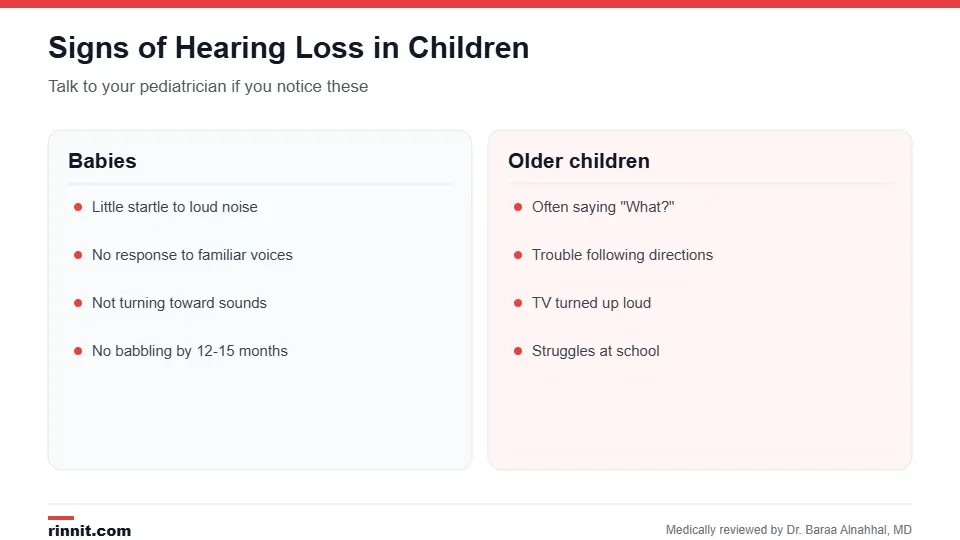
Talk to your pediatrician if you notice these signs.
Age | Possible signs of hearing loss |
Babies | Little startle to loud noises, no response to familiar voices, not turning toward sounds, no babbling by 12 to 15 months |
Older children | Often saying "What?", trouble following directions, turning the TV up loud, difficulty with background noise, struggles at school |
Sources: [1]
Hearing tests by age
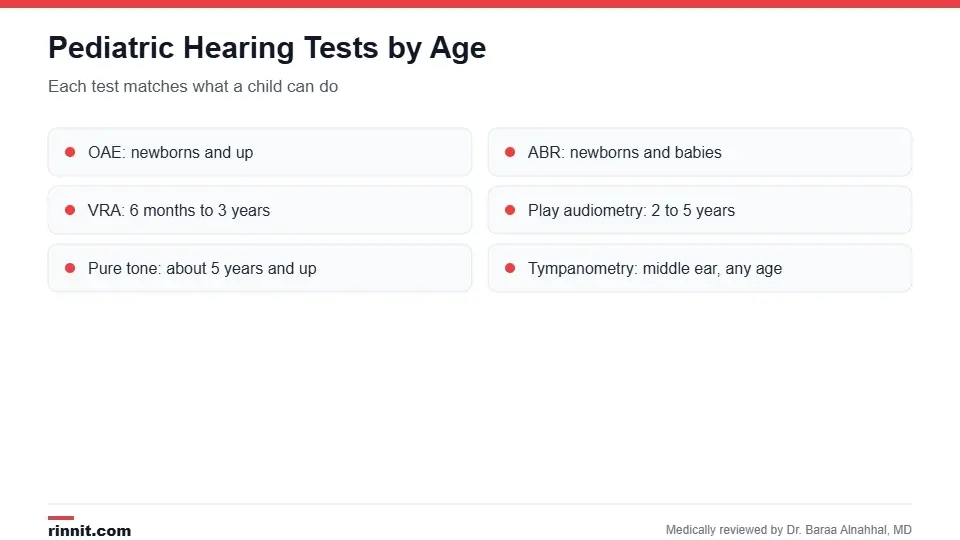
Each test is matched to what a child can do at that age.
Test | Age | How it works |
Otoacoustic emissions (OAE) | Newborns and up | A soft earbud measures echoes from the inner ear; no response needed; "pass" or "refer" |
Auditory brainstem response (ABR) | Newborns and babies | Earbuds and scalp electrodes record brain responses to sound; may take up to 2 hours |
Visual reinforcement audiometry (VRA) | 6 months to 3 years | Child looks toward a light or toy when hearing a sound |
Conditioned play audiometry (CPA) | 2 to 5 years | Child drops a block in a bucket when hearing a sound |
Pure tone test | About 5 years and up | Child raises a hand or presses a button for each sound |
Tympanometry | Any age | Checks the eardrum and middle ear; doesn't measure hearing itself |
Sources: [1]
How to prepare your child
Practice "listen and look" or "listen and drop" games at home.
Help your child get used to wearing headphones.
Make sure your child is rested and fed; babies often sleep through OAE and ABR tests.
Bring a favorite quiet toy or comfort item.
Ask the audiologist about ways to keep your child calm. Sources: [1]
What happens during the test
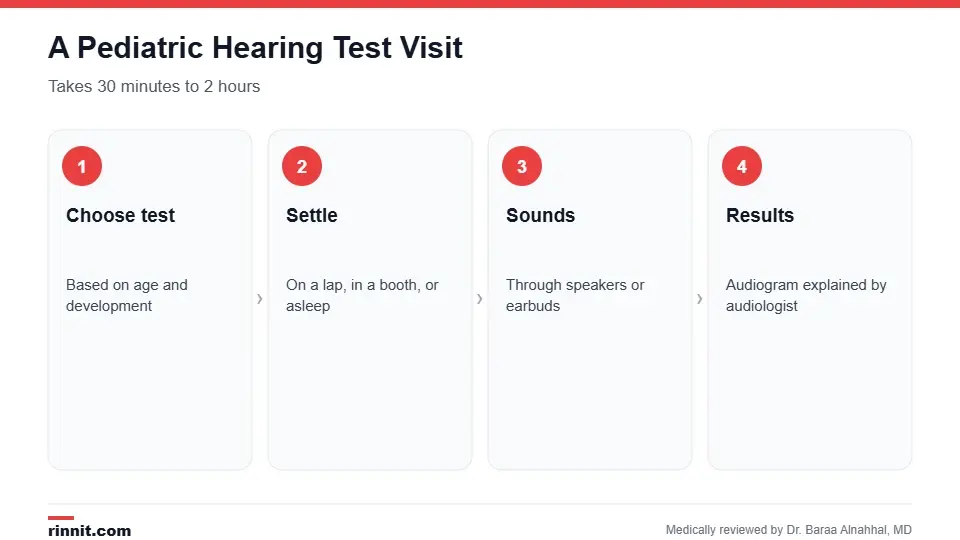
Testing takes 30 minutes to 2 hours.
An audiologist chooses tests based on your child's age and development.
Your child sits on your lap or in a chair in a quiet sound booth, or a baby sleeps.
Sounds are played through speakers, headphones or earbuds.
Your child's responses, or their ear and brain signals, are recorded.
The audiologist explains the results. Sources: [1]
Results
Results are shown on an audiogram, which shows the softest sounds your child can hear at different pitches, and a tympanogram for middle ear function. A "refer" result on a newborn screening doesn't always mean hearing loss; it means more testing is needed. If hearing loss is found, treatment may include hearing aids, cochlear implants, speech therapy or treatment of ear infections. Sources: [1]
Conclusion
Hearing tests for children are safe, painless and tailored to each age. Finding hearing loss early gives children the best chance to develop speech and language on time, so follow up on any screening result or concern.
Keep learning: read about the hearing test and tympanometry.
Frequently asked questions
How common is hearing loss in babies?
About 1 to 2 in every 1,000 babies are born with it.
Do all newborns get a hearing test?
Yes. All U.S. babies receive a newborn hearing screening.
What is an OAE test?
A quick test that measures echoes from the inner ear with a soft earbud.
What is an ABR test?
A test that records brain responses to sound with scalp electrodes.
Do hearing tests hurt?
No. They're painless.
How long does a pediatric hearing test take?
About 30 minutes to 2 hours.
What does a "refer" result mean?
More testing is needed; it doesn't always mean hearing loss.
Can a baby sleep during the test?
Yes. OAE and ABR often work best while a baby sleeps.
What age can a child do a pure tone test?
Usually around age 5.
What happens if hearing loss is found?
Options include hearing aids, cochlear implants and speech therapy.
Related Reading
Auditory-Verbal Therapy: How It Helps Children Listen and Speak explains auditory-verbal therapy.
Contrast Enema for Children: What to Expect for Your Child explains the X-ray test that views a child's colon.
Hearing Test: What It Is, Why It's Done, Types, What to Expect and Results hearing tests for older children and adults.
Tympanometry: What It Is, How It's Done and What Tympanogram Results Mean a test of the eardrum and middle ear.
Hearing Loss: Symptoms, Causes, and Treatment Options causes and treatment of hearing loss.
Ear Infections: Symptoms, Causes, and Treatment a common cause of temporary hearing loss in children.
Evoked Potential Test: VEP, BAER and SSEP for MS and Nerve Problems includes the brainstem auditory test used for infants.
References
Cleveland Clinic. Pediatric Hearing Tests. Cleveland Clinic. Last updated September 24, 2026. https://my.clevelandclinic.org/health/diagnostics/pediatric-hearing-tests
Kennedy CR, McCann DC, Campbell MJ, et al. Language ability after early detection of permanent childhood hearing impairment. New England Journal of Medicine. 2006;354(20):2131-2141. PMID 16707750. https://doi.org/10.1056/NEJMoa054915
Yoshinaga-Itano C, Sedey AL, Coulter DK, et al. Language of early- and later-identified children with hearing loss. Pediatrics. 1998;102(5):1161-1171. PMID 9794949. https://doi.org/10.1542/peds.102.5.1161
Medical disclaimer
This article is for general education only and does not replace advice from a qualified healthcare professional. Talk to your doctor about your own diagnosis and treatment, and seek emergency care right away for severe or sudden symptoms.



Comments