Ear Infections: Symptoms, Causes, and Treatment

Updated: 2 days ago
Medically reviewed by Dr. Baraa Alnahhal, MD · Last reviewed: October 2026

Quick Answer: What is an ear infection?
An ear infection is an infection of the middle ear, the air-filled space behind the eardrum, where trapped fluid becomes infected. Ear pain is the most common sign in children. See a doctor if symptoms last more than 2 to 3 days or a child is under 6 months. Many clear within 1 to 2 weeks without antibiotics. [1] [2]
What the research says
According to PubMed:
Antibiotics help only modestly in most children. A Cochrane review of 13 placebo-controlled trials (3,401 children) found that 60% of children had recovered by 24 hours whether or not they received antibiotics. Antibiotics reduced pain at 2 to 3 days (RR 0.70; 95% CI 0.57-0.86; NNTB 20) but caused more vomiting, diarrhea or rash (RR 1.38; 95% CI 1.19-1.59; NNTH 14). They were most useful in children under 2 with infection in both ears, or with ear discharge (Venekamp et al., Cochrane Database Syst Rev, 2015; DOI).
Tubes for recurrent infections add only a small quality-of-life gain at high cost. A cost-effectiveness analysis using data from a randomized trial of children aged 6-35 months with recurrent acute otitis media found tubes cost $989 more per child and gained 0.69 quality-adjusted life-days, about $520,855 per quality-adjusted life-year. Medical management was favored in 66% of model iterations (Noorbakhsh et al., J Pediatr, 2022; DOI).
Decongestants and antihistamines are not proven to help. A 2025 Cochrane review found the evidence very uncertain about their benefits and harms in children with acute otitis media, and no relevant trials had been published since 2003 (Darlison et al., Cochrane Database Syst Rev, 2025; DOI).
Study details are from PubMed abstracts.
Key facts about ear infections
Fact | Detail |
What it is | Infection of the middle ear (acute otitis media) [1] |
Who gets it most | Children ages 6 months to 2 years [1] |
Main cause | A cold, flu, or allergy that swells and blocks the eustachian tubes [1] |
How it often ends | Clears on its own in about 1 to 2 weeks [2] |
First treatment | Pain relief and watchful waiting in mild cases [2] |
When antibiotics are used | In children under 6 months, or with moderate to severe symptoms [2] |
What does an ear infection feel like?
Ear infections most often follow a cold, the flu, or allergy symptoms. Swelling in the nose, throat, and ear tubes traps fluid behind the eardrum, and that fluid can become infected. [1]
Signs and symptoms in children include:
Ear pain, especially when lying down
Tugging or pulling at an ear
Trouble sleeping
Crying more than usual
Fussiness
Trouble hearing or replying to sounds
Loss of balance
Fever
Fluid draining from the ear
Headache
Loss of appetite
Adults may notice ear pain or a feeling of pressure, fluid draining from the ear, and trouble hearing. [1]
Fluid draining from the ear can mean the eardrum has torn. Most tears heal on their own within about 72 hours, but some need surgery. [1]
When to see a doctor
Seek medical care if any of the following apply: [1]
Sign | Why it matters |
Symptoms lasting more than 2 to 3 days | An infection that lingers may need treatment |
A child under 6 months old | Babies this young need evaluation |
Symptoms getting worse | Worsening pain or fever needs attention |
Sleepless or cranky infant after a cold | Babies cannot describe ear pain; irritability after an upper respiratory infection is a clue |
Fluid, pus, or blood from the ear | This can mean a torn eardrum |
Hearing loss | Fluid can interfere with hearing and learning |
What causes an ear infection?
A bacterium or virus in the middle ear causes most ear infections. The trouble usually starts with a cold, the flu, or an allergy. These conditions cause swelling and stuffiness in the nose, throat, and the narrow tubes that connect the middle ear to the back of the throat, called eustachian tubes. [1]
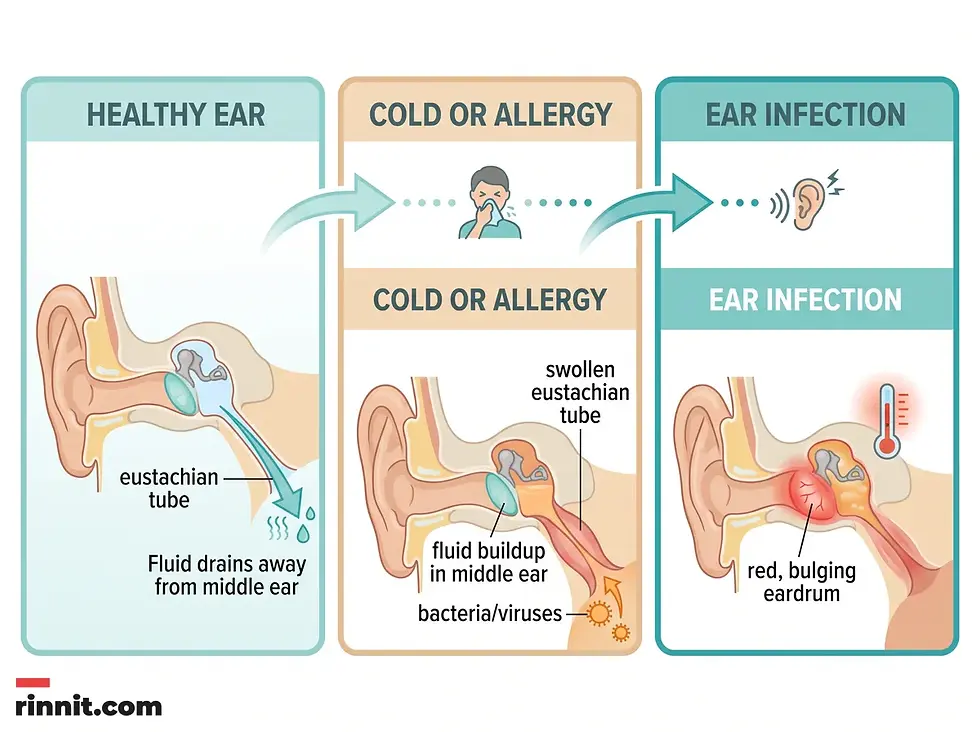
The eustachian tubes do three jobs. They keep air pressure even in the middle ear, bring in fresh air, and drain fluids. When they swell shut, fluid backs up into the middle ear, and the trapped fluid can become infected. [1]
Young children are far more likely than adults to get ear infections. Their eustachian tubes are narrower and more level, so they drain poorly and clog more easily. [1]
The anatomy of the middle ear explains how sound travels. Three tiny bones sit in the air-filled space: the hammer (malleus), the anvil (incus), and the stirrup (stapes). The eardrum separates the middle ear from the outer ear. The snail-shaped cochlea sits in the inner ear and helps with hearing and balance. [1]
Two small pads of tissue called adenoids sit high in the back of the nose, near the openings of the eustachian tubes. Adenoids help fight infection, and they usually shrink by puberty. When adenoids swell during illness, they can block the eustachian tubes and cause a middle ear infection. [1]
Related ear conditions
Three related conditions involve fluid in the middle ear without the typical active infection picture. [1]
Condition | What happens |
Otitis media with effusion | Fluid builds up in the middle ear after an infection improves or when tubes stay blocked. There is no active infection. |
Chronic otitis media with effusion | Fluid stays in the middle ear or keeps coming back. New infections are more likely, and hearing can suffer. |
Chronic suppurative otitis media | The infection does not go away with usual treatment. It can create a hole in the eardrum that will not heal. |
Who is at higher risk?
Children between 6 months and 2 years of age are the most likely to get ear infections because of the size and shape of their eustachian tubes. [1]
Risk factor | Why it raises risk |
Age 6 months to 2 years | Eustachian tubes are small and drain poorly |
Group child care | More exposure to colds means more ear infections |
Bottle feeding | Bottle-fed babies get more infections than breastfed babies, especially when a bottle is given in a crib |
Fall and winter seasons | Colds and flu peak in these seasons, and seasonal allergies add risk |
Tobacco smoke and air pollution | Poor air quality irritates the airways and ear tubes |
Cleft palate | The eustachian tube cannot drain well |
What happens if an ear infection is left untreated?
Most mild ear infections improve without treatment. But repeated infections or fluid that will not drain can cause lasting problems. [1]
Hearing loss is the most common complication. Mild hearing loss is common during an infection and usually recovers. Repeated infections or constant fluid can cause more serious loss. Lasting damage to the eardrum or middle ear bones may be permanent. Hearing loss in infants and toddlers can slow speech, social, and development skills. [1]
The infection can also spread. Mastoiditis is an infection of the bony section behind the ear that can form pus-filled cysts and damage the bone. Rarely, the infection can reach the brain membranes and cause meningitis. A torn eardrum usually heals within about 72 hours, but some tears need surgery to close. [1]
How is an ear infection diagnosed?
A doctor can usually diagnose an ear infection from the symptoms and a physical exam. The exam uses an otoscope, a lighted instrument that lets the doctor see the eardrum and ear canal. A red, bulging eardrum usually means an infection is present. If the doctor is uncertain, if symptoms do not respond to treatment, or if other problems exist, other tests may follow. [2]
Finding | Meaning |
Fluid in the middle ear or infection symptoms | Acute otitis media |
Fluid but no infection symptoms | Otitis media with effusion |
Long-term infection with an eardrum tear | Chronic suppurative otitis media |
How are ear infections treated?
Many ear infections clear without antibiotics. The treatment plan depends on the person's age and how severe the symptoms are. [2]
Pain relief first
Over-the-counter acetaminophen or ibuprofen can ease ear pain when used per the label instructions. Ask a doctor or pharmacist about the right option and dose. Children and teens should never take aspirin while recovering from chickenpox or flu-like symptoms, because combining aspirin with these illnesses is linked to Reye's syndrome, a rare but serious condition. Numbing ear drops can give short-term pain relief when the eardrum has not torn. [2]
Watchful waiting
Medical guidelines support watchful waiting for mild cases. A doctor may wait before prescribing antibiotics when: [2] [4]
Age | Criteria for waiting |
6 to 23 months | Mild pain in one ear for less than 48 hours, and temperature below 102.2 F (39 C) |
24 months or older | Mild pain in one or both ears for less than 48 hours, and temperature below 102.2 F (39 C) |
Antibiotics
Situation | Guidance |
6 months or older with moderate to severe pain | Antibiotics if pain lasts at least 48 hours or temperature is at least 102.2 F (39 C) |
6 to 23 months with mild symptoms | Antibiotics may be prescribed for mild pain lasting less than 48 hours |
24 months or older with mild symptoms | Antibiotics may be prescribed for mild pain lasting less than 48 hours |
Under 6 months | Antibiotics are given without a wait-and-see period |
Take all the antibiotic as directed, even when feeling better. Stopping early raises the chance the infection returns. If a dose is missed, ask a doctor or pharmacist what to do. Using antibiotics only when truly needed matters: overuse lets bacteria become resistant, and resistant bacteria no longer respond to the medicine as well. [2]
Ear tubes
Children with frequent ear infections, chronic infections, or fluid that stays in the middle ear after an infection may benefit from ear tubes. These tiny plastic or metal tubes are also called tympanostomy tubes, ventilation tubes, or pressure equalization tubes. They help drain fluid and prevent fluid buildup. [2] [3]
A surgeon places the tubes during an outpatient surgery called a myringotomy. Under general anesthesia, a tiny hole is made in the eardrum, the fluid is suctioned out, and the tube is inserted. Some tubes stay in place for 6 months to 2 years and fall out on their own, and the hole usually closes after that. Longer-lasting tubes may need surgical removal. [2]
Treating chronic ear infections
Chronic suppurative otitis media is harder to treat. Antibiotic ear drops are usually the main approach. The doctor may suction fluid out of the ear before applying the drops. [2]
Follow-up monitoring
Children with frequent ear infections or constant fluid in the middle ear need careful follow-up. Hearing and language testing help catch delays early. [2]
Home care while waiting
While an ear infection clears, a few comfort measures help. Acetaminophen or ibuprofen eases pain and fever when used per the label. A warm, moist washcloth over the ear may feel soothing. Rest and fluids support recovery. Ear pain often worsens at night, so pain medicine before bedtime can help a child sleep. [2]
Preventing ear infections
Colds and flu are the usual starting point for ear infections. Steps that prevent colds also prevent many ear infections. [1]
Wash hands often and well, avoid sharing cups and utensils, and cover coughs and sneezes with an elbow.
Keep sick children home from group child care when possible. Limiting group child care size can reduce the number of colds.
Keep the home smoke-free, and spend time in smoke-free places. Secondhand smoke raises the risk of ear infections.
Breastfeeding for at least 6 months may protect against ear infections. If bottle feeding, hold the baby upright and never prop the bottle or put a baby to bed with a bottle.
Keep vaccines up to date. A seasonal flu shot and other vaccines for both children and adults can lower the number of infections that lead to ear infections.

Preparing for your appointment
A family healthcare professional usually diagnoses and treats ear infections, and may refer the patient to an ear, nose, and throat (ENT) specialist if infections keep coming back. [2]
The doctor will likely ask about the symptoms, when they started, and how severe the ear pain is. Questions may cover ear pulling, sleep problems, irritability, fever, and whether the draining fluid is clear, cloudy, or bloody. The doctor will also ask about trouble hearing, any recent cold or flu, allergies, prior ear infections, and medicine allergies such as a reaction to amoxicillin. Writing answers down before the visit helps. [2]
Conclusion
An ear infection is uncomfortable but usually brief. Most cases clear within 1 to 2 weeks, and pain relief covers the worst of the symptoms while the body heals. Watchful waiting spares many children unnecessary antibiotics, and careful use of antibiotics keeps these medicines working when they are truly needed. [2]
Children who get repeated infections need ongoing attention. Unchecked fluid and recurring infections can harm hearing, which can slow speech and learning. Ear tubes offer an option for children whose ears will not clear on their own. [1] [2]
Next steps: If an earache lasts more than 2 to 3 days, or your child is under 6 months old, contact a healthcare professional.
Frequently asked questions
What is the best thing to do for an ear infection?
Start with pain relief using acetaminophen or ibuprofen per the label, then watch the symptoms closely. Many ear infections clear within 1 to 2 weeks without antibiotics. Mild cases in children 6 months and older may be watched for 48 hours before antibiotics are needed. Children under 6 months always need medical evaluation and antibiotics. [2]
How do you know if an earache is an infection?
Ear pain with a fever, fluid draining from the ear, or a red bulging eardrum seen during an exam usually points to an infection. A doctor confirms it by looking at the eardrum with a lighted instrument called an otoscope. [2]
Can an ear infection go away on its own?
Yes. Many ear infections clear without antibiotics, often within 1 to 2 weeks. This is why doctors often recommend pain management and watchful waiting for mild cases before prescribing antibiotics. [2] [4]
How should you sleep with an ear infection?
Prop up the head with extra pillows. Lying flat can increase pressure and pain in the middle ear. Pain medicine taken before bedtime can also help a child stay asleep through the night.
What is the fastest way to get rid of an ear infection?
There is no instant fix. Pain medicine eases symptoms quickly, and antibiotics work when the case is moderate to severe or the child is under 6 months. The infection itself typically takes 1 to 2 weeks to clear, whether or not antibiotics are used. [2]
This article is for general education and is not a substitute for professional medical advice, diagnosis, or treatment. Always consult a qualified healthcare professional about your individual situation.
Related Reading
Adenoidectomy (Adenoid Removal): Surgery and Recovery explains adenoid removal surgery in children.
Rinne Test: Tuning Fork Hearing Check and What Results Mean explains the tuning fork test that checks for conductive hearing loss.
Pediatric Hearing Tests: Hearing Checks for Babies and Children by Age explains the hearing tests used for babies and children of each age.
Tympanometry: What It Is, How It's Done and What Tympanogram Results Mean explains the quick middle ear test that can point to this condition.
Weber Test for Hearing Loss: How It's Done and What Results Mean explains the tuning fork test that helps tell conductive from sensorineural hearing loss.
References
Mayo Clinic Staff. Ear infection (middle ear) - Symptoms and causes. Mayo Clinic. April 23, 2025. https://www.mayoclinic.org/diseases-conditions/ear-infections/symptoms-causes/syc-20351616
Mayo Clinic Staff. Ear infection (middle ear) - Diagnosis and treatment. Mayo Clinic. April 23, 2025. https://www.mayoclinic.org/diseases-conditions/ear-infections/diagnosis-treatment/drc-20351622
National Institute on Deafness and Other Communication Disorders. Ear infections in children. NIDCD. March 16, 2022. https://www.nidcd.nih.gov/health/ear-infections-children
Centers for Disease Control and Prevention. Ear infection basics. CDC. April 17, 2024. https://www.cdc.gov/ear-infection/about/index.html
Venekamp RP, Sanders SL, Glasziou PP, et al. Antibiotics for acute otitis media in children. Cochrane Database Syst Rev. 2015;(6):CD000219. PMID 26099233. https://doi.org/10.1002/14651858.CD000219.pub4
Noorbakhsh KA, Liu H, Kurs-Lasky M, et al. Cost-effectiveness of management strategies in recurrent acute otitis media. J Pediatr. 2022;256:11-17.e2. PMID 36470464. https://doi.org/10.1016/j.jpeds.2022.11.032
Darlison P, Moresco L, Nussbaumer-Streit B, et al. Decongestants and antihistamines for acute otitis media in children. Cochrane Database Syst Rev. 2025;11(11):CD015839. PMID 41307300. https://doi.org/10.1002/14651858.CD015839.pub2



Comments