Adenoidectomy (Adenoid Removal): Surgery and Recovery

Updated: 2 days ago
Written and medically reviewed by Dr. Baraa Alnahhal, MD · Last reviewed: November 2026 · How we review
Quick Answer
An adenoidectomy is surgery to remove the adenoids, small lumps of immune tissue behind the nose. It's done in children ages 1 to 7 when enlarged adenoids cause trouble breathing, sleep apnea, chronic sinus problems or ear problems. It takes 30 minutes, and most children go home the same day. Removing the adenoids doesn't weaken the immune system.
What the research says
Adenoidectomy helps some children with ear problems: pooling 10 trials, adenoidectomy lowered treatment failure at 12 months from 70% to 51% in children 4 and older with persistent glue ear, and from 27% to 16% in children under 2 with repeat ear infections (Boonacker CW et al., Health Technology Assessment, 2014) [2]
Benefits for glue ear are modest: a Cochrane review of 10 studies with 1,785 children found adenoidectomy may slightly reduce persistent glue ear at 2 years (65% vs. 73%), and bleeding was rare (1 of 251 children) (MacKeith S et al., Cochrane Database of Systematic Reviews, 2023) [3]
Key takeaways
An adenoidectomy removes enlarged adenoids behind the nose.
It's most often done in children ages 1 to 7.
It treats breathing problems, sleep apnea, sinus and ear problems.
Surgery takes about 30 minutes, and most children go home the same day.
Recovery usually takes one to two weeks.
What is an adenoidectomy?
Adenoids help fight germs you breathe in, but they can swell from infections or allergies, and some children are born with large adenoids. Because adenoids often shrink after age 7, adults rarely need this surgery. Sources: [1]
Why it's done
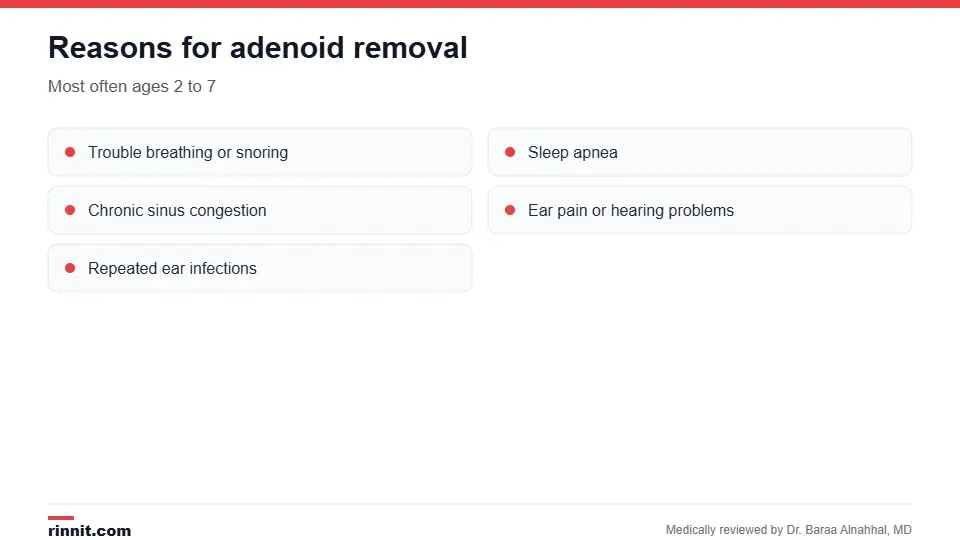
Most surgeries happen between ages 2 and 7.
Enlarged adenoids that make it hard to breathe or sleep.
Chronic sinus drainage and congestion.
Eustachian tube problems that cause ear pain or hearing trouble. Sources: [1]
Untreated sleep apnea can affect speech, learning and, with long-term mouth breathing, facial bone growth. Sources: [1]
How to prepare
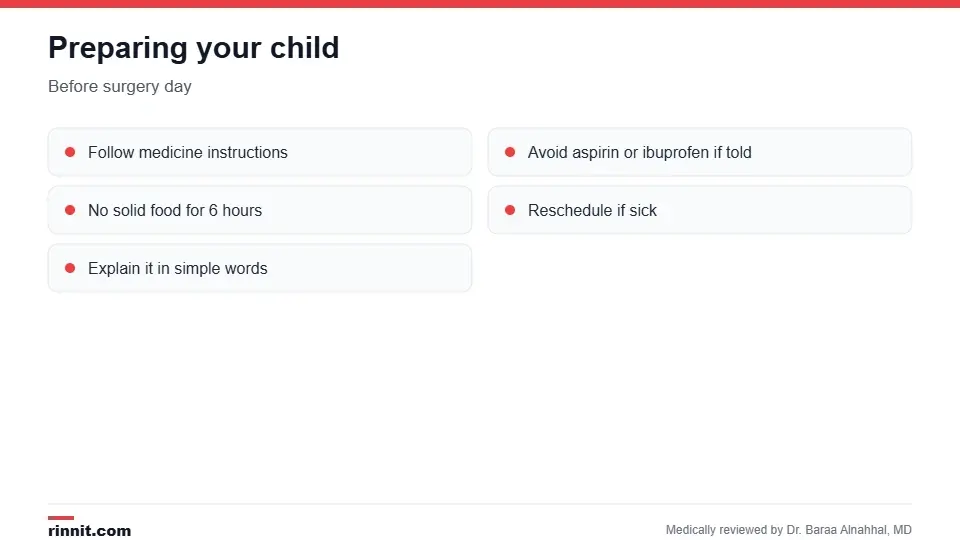
Emotional preparation helps both you and your child.
Follow your provider's medicine instructions; you may need to avoid aspirin or ibuprofen.
Your child usually stops solid food at least 6 hours before surgery.
Surgery may be postponed if your child gets a cold or flu.
Explain the surgery simply; some providers use a teddy bear to show what will happen. Sources: [1]
What happens during surgery

Surgery takes about 30 minutes.
Your child gets general anesthesia.
The surgeon removes the adenoids through the mouth, with no outside cuts.
Heat (electrocautery) may be used to stop bleeding.
A tonsillectomy or ear tubes may be done at the same time.
Your child wakes up in recovery within 1 to 2 hours. Sources: [1]
Risks
Infection.
Reaction to anesthesia.
Excessive bleeding.
Permanent voice changes.
Adenoids can regrow, though a second surgery is rarely needed. Sources: [1, 3]
Recovery
When | What to expect |
First 24 hours | Upset stomach or vomiting |
First 1 to 2 days | Fever; pain usually starts to ease |
About 1 week | Most children need time off school |
1 to 2 weeks | Full recovery |
Bad breath, noisy breathing, sore throat, neck pain and earache are common. Offer cold, soft foods and plenty of fluids, and avoid spicy, crunchy or acidic foods. A clean cool-mist humidifier may help. Sources: [1]
When to call your provider
Trouble swallowing.
Your child can't keep food or drinks down.
A fever lasting 3 or more days.
Coughing up blood clots or vomiting blood that looks like coffee grounds. Sources: [1]
Conclusion
An adenoidectomy is a quick, safe surgery that can help children breathe, sleep and hear better. Almost all children make a full recovery within a couple of weeks.
Keep learning: read about tonsillectomy and ear tubes.
Frequently asked questions
What is an adenoidectomy?
Surgery to remove the adenoids behind the nose.
Why are adenoids removed?
When they're enlarged and cause breathing, sleep, sinus or ear problems.
What age is adenoidectomy done?
Usually between ages 1 and 7.
How long does surgery take?
About 30 minutes.
Will my child go home the same day?
Most do.
Are there stitches or scars?
No. The surgery is done through the mouth.
How long is recovery?
One to two weeks.
Does removing adenoids weaken the immune system?
No.
Can adenoids grow back?
Sometimes, but a second surgery is rarely needed.
Do adults have adenoidectomies?
Rarely, since adenoids usually shrink with age.
Related Reading
Adenoids: Function, Location, and Health Impact what adenoids are and what they do.
Tonsillectomy: Procedure, Recovery Timeline and Risks Explained a surgery often done with adenoidectomy.
Ear Tubes (Tympanostomy): Why They're Placed, What Happens, and How Recovery Goes tubes for fluid in the ears.
Pediatric Sleep Apnea: Symptoms, Causes & Treatment — A Parent's Guide a common reason for adenoid removal.
Ear Infections: Symptoms, Causes, and Treatment ear infections in children.
References
Cleveland Clinic. Adenoidectomy (Adenoid Removal): Surgery & Recovery. Cleveland Clinic. Last updated January 2, 2026. https://my.clevelandclinic.org/health/treatments/15447-adenoidectomy-adenoid-removal
Boonacker CW, Rovers MM, Browning GG, et al. Adenoidectomy with or without grommets for children with otitis media: an individual patient data meta-analysis. Health Technology Assessment. 2014;18(5):1-118. PMID 24438691. https://doi.org/10.3310/hta18050
MacKeith S, Mulvaney CA, Galbraith K, et al. Adenoidectomy for otitis media with effusion (OME) in children. Cochrane Database of Systematic Reviews. 2023;10(10):CD015252. PMID 37870083. https://doi.org/10.1002/14651858.CD015252.pub2
Medical disclaimer
This article is for general education only and does not replace advice from a qualified healthcare professional. Talk to your doctor about your own diagnosis and treatment, and seek emergency care right away for severe or sudden symptoms.



Comments