Ear Tubes (Tympanostomy): Why They're Placed, What Happens, and How Recovery Goes

Updated: 6 days ago
Written and medically reviewed by Dr. Baraa Alnahhal, MD · Last reviewed: October 2026 · How we review
Quick Answer: What is tympanostomy (ear tube surgery)?
Tympanostomy is a short outpatient surgery in which an ear, nose and throat surgeon places a tiny hollow tube in the eardrum to drain trapped fluid and let air into the middle ear. Children usually get ear tubes for repeated ear infections or fluid lasting over three months; adults mainly for barotrauma. Most people recover within one to two days. [1]
What the research says
Ear tubes cut repeat ear infections in the first six months. A review of 5 randomized trials (805 children) included one trial of 95 children in which 46% of children with ear tubes had no new ear infection at six months, compared with 5% of children who were only monitored — about one fewer infection per child in that period. Persistent eardrum holes after tubes were uncommon. (Venekamp et al., Cochrane Database Syst Rev, 2018) [2]
For very young children, tubes are not always better than medicine. In a trial of children aged 6 to 35 months with repeated ear infections, the yearly infection rate over two years was 1.48 with ear tubes and 1.56 with antibiotic treatment of each episode — not a significant difference. Tubes delayed the first new infection, while children treated with medicine had fewer days of ear drainage. (Hoberman et al., N Engl J Med, 2021) [3]
Tubes clear long-lasting fluid faster, but the hearing gain fades over time. A review of 19 randomized trials (2,888 children) reported one trial of 54 children in which, at six months, fluid persisted in 20.4% of children with tubes versus 68.0% without treatment. Hearing improvements were small, and it is unclear whether they last after longer follow-up. (MacKeith et al., Cochrane Database Syst Rev, 2023) [4]
Key takeaways
Ear tubes are small hollow cylinders of plastic or metal placed in the eardrum. [1]
The surgery usually takes less than 15 minutes, and you go home the same day. [1]
Most tubes fall out on their own within 9 to 18 months. [1]
Most people feel better in one to two days and return to normal routines after 24 hours. [1]
Call your doctor for ear pain that medicine doesn't ease, fever, ear bleeding, or rising drainage. [1]
What are ear tubes and how does tympanostomy work?
Ear tubes are small hollow cylinders, made of plastic or metal, that a surgeon inserts into the eardrum (tympanic membrane) during a surgery called tympanostomy. [1]
The tube opens a small pathway between the outer ear and the middle ear. That pathway does two jobs:
Tympanostomy is one of the most common surgeries in children. Adults can get ear tubes too, but it is less common. [1]

Who needs ear tubes?
Ear tubes are recommended for children with repeated middle ear infections or long-lasting fluid, and for adults mainly with barotrauma. [1]
Group | Main reasons for ear tubes |
Children | Several middle ear infections (acute otitis media) |
Children | Fluid behind the eardrum (effusion) that lasts longer than three months |
Adults | Barotrauma — a painful condition caused by air pressure changes, such as airplane ear |
Leaving these problems untreated matters. Repeated infections and trapped fluid can lead to speech difficulties or permanent hearing loss. [1]
What is the difference between myringotomy and tympanostomy?
Myringotomy is a small cut in the eardrum to drain extra fluid, while tympanostomy is the placement of the tube in that cut. [1]
Procedure | What it does | Done alone? |
Myringotomy | Opens the eardrum to drain middle ear fluid | Sometimes |
Tympanostomy | Places a tube in the opening so the ear keeps draining | Often combined with myringotomy |
How do you prepare for ear tube surgery?
Preparing for ear tube surgery mainly involves a medication review and fasting. [1]
Medications: Your surgeon reviews your medical history and tells you which medicines to stop before surgery.
Fasting: You or your child usually can't eat or drink for several hours beforehand.
What happens during ear tube surgery?
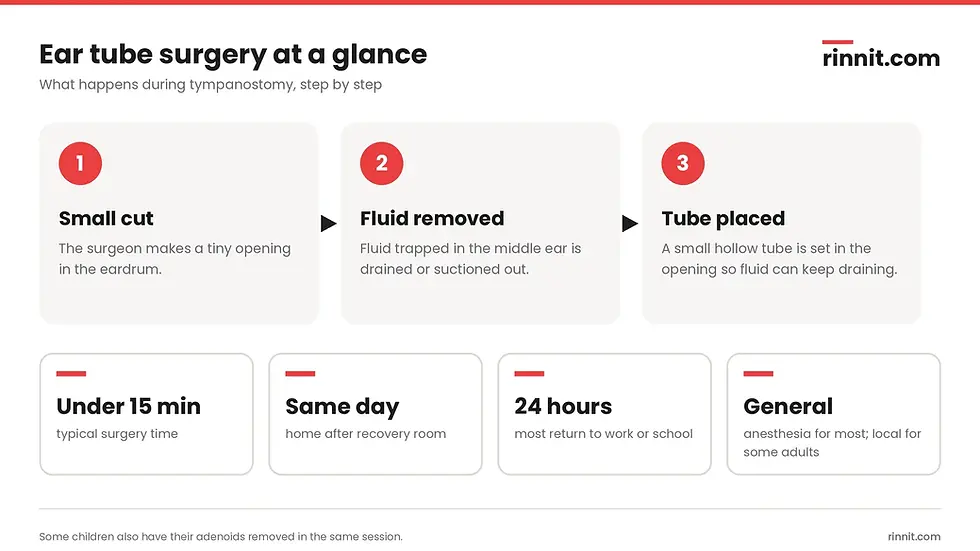
Ear tube surgery is a quick, three-step procedure that usually takes less than 15 minutes. [1]
Most people receive general anesthesia, so they sleep through it. Some adults may have local anesthesia instead, which numbs only the ear. [1]
Small cut: The surgeon makes a tiny opening in the eardrum.
Fluid removed: Fluid trapped in the middle ear is drained or suctioned out.
Tube placed: The surgeon sets the ear tube in the opening so fluid can keep draining. [1]
It can take place in an operating room or in the provider's office. Because it is outpatient surgery, you go home the same day. [1]
In some cases — especially when a child has had ear tubes before — the surgeon may also remove the adenoids. Adenoids are immune tissue above the roof of the mouth, behind the nose. Removing them may prevent future ear tube surgeries. [1]
What happens after ear tube surgery?
After ear tube surgery, you rest in a recovery room until the anesthesia wears off. Feeling groggy or sick to your stomach for a short time is normal. [1]
Your surgeon may also recommend:
Antibiotic ear drops to treat infection — see our guide to using ear drops safely. [1]
Earplugs for activities such as swimming and showering. [1]
Follow-up visits every few months to make sure the tubes are working, and possibly a hearing test. [1]
How long do ear tubes stay in?
Ear tubes usually stay in for 9 to 18 months and then fall out on their own. [1]
The eardrum normally closes around the tube and holds it in place. If a tube hasn't come out after two years, the surgeon can remove it. [1]
What are the benefits and risks of ear tubes?
Ear tubes can mean fewer and milder ear infections and better hearing, but they also carry a small risk of eardrum problems. [1]
Benefits | Possible complications |
Fewer oral antibiotics needed for ear infections | The eardrum hole doesn't close after the tube comes out (may need repair surgery called tympanoplasty) |
Less pain and lower fevers during ear infections | Eardrum scarring (tympanosclerosis) |
Improved or restored hearing | Ear infections that keep coming back |
Better speech development | Tubes fall out too early or don't come out |
Fewer sleep problems linked to chronic ear infections | Ongoing ear drainage (otorrhea) |
— | Eardrum thinning or hardening after several tube surgeries |
— | Tubes clogged by earwax buildup |
Scarring is more common than most parents expect. One review found tympanosclerosis in about a third of ears that received tubes, while ear drainage in children aged three to seven happened in fewer than 2% of tube ears over two years. [5]
How long is recovery from ear tube surgery?
Recovery from ear tube surgery is fast: most people feel better within one to two days. [1]
Mild ear pain is common at first, and over-the-counter pain relievers can help. Most children and adults return to school, work and normal routines 24 hours after surgery. [1]

When should you call a doctor after ear tube surgery?
Call your healthcare provider after ear tube surgery if you or your child develop any of these signs: [1]
Ear pain that doesn't go away with medication
Fever or chills
Bleeding from the ear
Ear drainage that increases after the first few days
Ear tube surgery at a glance
Question | Answer |
Who performs it? | An ear, nose and throat (ENT) surgeon |
How long does it take? | Usually less than 15 minutes |
Anesthesia | General for most; local for some adults |
Hospital stay | None — same-day discharge |
Back to normal routines | About 24 hours |
How long tubes stay | Usually 9–18 months |
If tubes don't fall out | Surgeon can remove them after two years |
Source: [1]
Conclusion
Ear tubes are a small, quick fix for a frustrating problem. By letting air in and fluid out, they can mean fewer painful infections, better hearing and easier sleep — especially for young children. Recovery usually takes a day or two, and the tubes fall out on their own.
They aren't right for everyone, though. Research shows the benefits are strongest in the first months, and some young children do just as well with medicine alone. That is why the decision is best made with your ENT surgeon, based on how often infections happen and how long fluid lasts.
Next step: If you or your child keep getting ear infections or have muffled hearing, read our full guide to ear infections, then book an ENT visit and ask whether ear tubes could help. Bookmark this page so you can check the warning signs after surgery.
FAQ
What is tympanostomy?
Tympanostomy is a surgery to place ear tubes in the eardrum. An ear, nose and throat surgeon performs it to drain trapped fluid and let air into the middle ear.
Why do children need ear tubes?
Children need ear tubes mainly for several middle ear infections or for fluid behind the eardrum that lasts longer than three months. Untreated, these problems can affect speech and hearing.
Can adults get ear tubes?
Adults can get ear tubes, mainly to treat barotrauma, a painful ear condition caused by air pressure changes. The tubes let air into the middle ear and stop fluid from building up.
Is ear tube surgery painful?
Ear tube surgery is usually done under general anesthesia, so it isn't felt during the procedure. Mild ear pain afterward is common and usually eases with over-the-counter pain relievers within one to two days.
How long do ear tubes stay in?
Ear tubes usually stay in for 9 to 18 months and then fall out on their own. If a tube is still in place after two years, the surgeon can remove it.
Can you swim or shower with ear tubes?
Your surgeon may recommend earplugs for swimming and showering while ear tubes are in place. Follow your own surgeon's advice for your situation.
What are the risks of ear tubes?
The main risks of ear tubes are an eardrum hole that doesn't close, eardrum scarring, ongoing drainage, repeat infections, and tubes that fall out early, stay too long or clog.
When should I call a doctor after ear tube surgery?
Call a doctor after ear tube surgery for ear pain that medicine doesn't relieve, fever or chills, bleeding from the ear, or drainage that increases after the first few days.
Do ear tubes fall out on their own?
Yes. Most ear tubes fall out on their own as the eardrum heals and gently pushes them out. If a tube stays in too long, the ear, nose and throat surgeon may remove it.
Is ear drainage normal after ear tube surgery?
Some drainage can happen in the first few days after surgery. Drainage later on often means an ear infection, which is usually treated with antibiotic ear drops. Call your provider if drainage lasts more than a few days, is bloody or comes with a fever.
Related Reading
Adenoidectomy (Adenoid Removal): Surgery and Recovery explains adenoid removal surgery in children.
References
Cleveland Clinic. Ear Tubes (Tympanostomy): Definition & Procedure. Cleveland Clinic. Last updated April 8, 2022. https://my.clevelandclinic.org/health/treatments/15609-ear-tubes-tympanostomy
Venekamp RP, Mick P, Schilder AG, et al. Grommets (ventilation tubes) for recurrent acute otitis media in children. Cochrane Database Syst Rev. 2018;5(5):CD012017. PMID 29741289. https://doi.org/10.1002/14651858.CD012017.pub2
Hoberman A, Preciado D, Paradise JL, et al. Tympanostomy Tubes or Medical Management for Recurrent Acute Otitis Media. N Engl J Med. 2021;384(19):1789-1799. PMID 33979487. https://doi.org/10.1056/NEJMoa2027278
MacKeith S, Mulvaney CA, Galbraith K, et al. Ventilation tubes (grommets) for otitis media with effusion (OME) in children. Cochrane Database Syst Rev. 2023;11(11):CD015215. PMID 37965944. https://doi.org/10.1002/14651858.CD015215.pub2
Browning GG, Rovers MM, Williamson I, et al. Grommets (ventilation tubes) for hearing loss associated with otitis media with effusion in children. Cochrane Database Syst Rev. 2010;2010(10):CD001801. PMID 20927726. https://doi.org/10.1002/14651858.CD001801.pub3
National Institute on Deafness and Other Communication Disorders. Ear Infections in Children, Babies & Toddlers. NIDCD. Last updated March 16, 2022. https://www.nidcd.nih.gov/health/ear-infections-children
Medical disclaimer
This article is for general education and does not replace advice from your own doctor. Always follow the instructions of your surgeon or healthcare provider, and seek urgent care if symptoms are severe or getting worse.



Comments