Airplane Ear (Ear Barotrauma): Why Your Ears Clog on Flights and What Actually Helps

Updated: 2 days ago
Medically reviewed by {i}Dr. Baraa Alnahhal, MD{/i} · Last reviewed: October 17, 2026
Quick Answer
Airplane ear, or ear barotrauma, is a condition in which a sudden change in air or water pressure affects your middle ear, often during flights or diving [1]. Symptoms are usually mild, such as a clogged feeling, trouble hearing or ear pain [1]. Most cases resolve with self-care, but go to the ER if fluid comes from your ear [1].
What the research says
A decongestant pill roughly halved ear symptoms in adults who often get flight ear pain. In a randomized, double-blind trial of 150 adult volunteers with a history of ear pain during air travel (124 completed it), barotrauma symptoms were reported by 34% of those who took 120 mg of pseudoephedrine 30 minutes before departure versus 71% of the placebo group, a 52% relative risk reduction (95% CI 33% to 71%). Oxymetazoline nasal spray did little better than placebo (64% reported symptoms) (PubMed: Jones et al., Am J Emerg Med, 1998) [5].
The same pill did not help young children. In a placebo-controlled trial covering 91 flights with 50 children aged 6 months to 6 years, ear pain was reported on 14% of flights. Pseudoephedrine did not reduce it on ascent (4% vs 5% with placebo) or descent (12% vs 13%), but it increased drowsiness at takeoff (60% vs 27%) (PubMed: Buchanan et al., Arch Pediatr Adolesc Med, 1999) [6].
A review of the evidence found mixed results for decongestants. Of three randomized trials identified, one showed oral pseudoephedrine reduced ear pain in adults with recurrent ear pain during air travel, one found it did not reduce in-flight ear pain in children, and one found that oxymetazoline nasal spray taken 30 minutes before descent did not significantly reduce barotrauma symptoms in adults (PubMed: Mirza and Richardson, J Laryngol Otol, 2005) [7].
What Is Airplane Ear (Ear Barotrauma)?
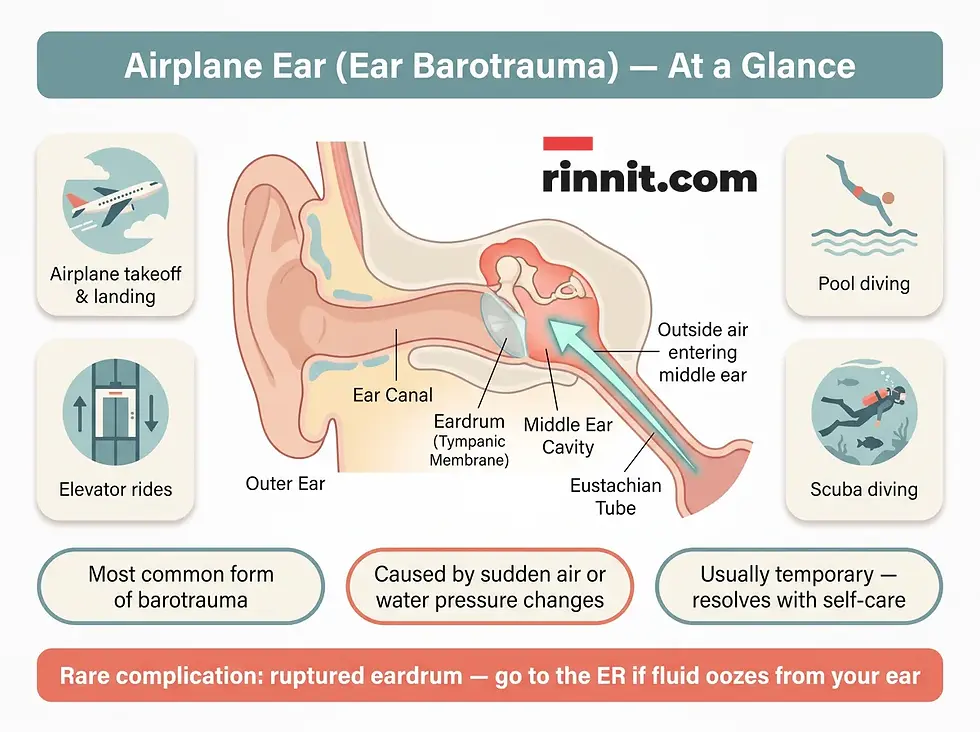
Ear barotrauma refers to damage to your ears that can happen if there's a sudden change in air pressure or water pressure that affects your middle ear [1]. Some people call ear barotrauma "airplane ear" because it often affects people when they fly in an airplane. But people can also develop ear barotrauma riding in an elevator, diving to the bottom of a swimming pool, or scuba diving [1].
Ear barotrauma is the most common form of barotrauma [1]. In general, ear barotrauma is a temporary issue that goes away with self-care or when air and/or water pressure changes stop [1].
Quick fact | Detail |
What it is | Ear damage from a sudden change in air or water pressure affecting the middle ear [1] |
Common name | "Airplane ear" because it often happens when flying [1] |
Rank | The most common form of barotrauma [1] |
Triggers | Airplane takeoff/landing, elevator rides, pool diving, scuba diving [1] |
Usual course | Temporary: resolves with self-care or when pressure changes stop [1] |
Rare complication | Ruptured eardrum (very rare; seek emergency care if fluid oozes from the ear) [1] |
What are the signs and symptoms of airplane ear?
In general, airplane ear symptoms are mild, but they can get worse [1].
Symptom | What you may experience |
Clogged or blocked feeling [1] | Your ear feels stopped up or full, like you're underwater |
Sounds become muffled or harder to hear | |
A lightheaded, off-balance feeling | |
Severe ear pain [1] | Sharp or intense pain inside the ear |
Fluid oozing from the ear (very rare) [1] | May be a sign of a ruptured eardrum, a medical emergency [1] |
The key escalation to watch for is fluid coming from your ear. Very rarely, you may feel fluid oozing from your ear. That may be a sign you have a ruptured eardrum [1].

What Causes Ear Barotrauma?
Ear barotrauma happens when air or water pressure suddenly changes, putting pressure on your eustachian tubes [1]. Your eustachian tubes run from the back of your middle ear to the back of your throat. The tubes help maintain equal air pressure on both sides of your eardrum by letting outside air into your middle ear [1].
Air pressure changes when airplanes take off and land. That change happens faster than your eustachian tubes can react [1]. The same thing happens if you do deep-water diving, as water pressure quickly changes [1].
Pressure trigger | What happens |
Airplane takeoff and landing | Air pressure changes faster than your eustachian tubes can react [1] |
Elevator rides | Sudden altitude/pressure shifts in the middle ear [1] |
Pool diving (to the bottom) | Water pressure quickly changes [1] |
Scuba diving | Water pressure changes quickly with depth [1] |
What makes it more likely?
Ear barotrauma can happen more frequently if you have congestion from a cold or allergies [1]. Congestion may block or inflame your eustachian tubes, making it even harder for them to manage air pressure changes [1].
Complications
Rarely, you may develop a ruptured eardrum. This typically heals on its own after a few weeks [1]. But you should call a healthcare provider right away if you have any of the following symptoms: hearing loss, ringing in your ears (tinnitus), discharge from your ears, or nausea from a spinning sensation (vertigo) [1].
Complication | What to know |
Ruptured eardrum | Rare; typically heals on its own after a few weeks [1] |
Hearing loss | Call a healthcare provider right away [1] |
Tinnitus (ringing in ears) | Call a healthcare provider right away [1] |
Discharge from ears | Call a healthcare provider right away [1] |
Vertigo (nausea from a spinning sensation) | Call a healthcare provider right away [1] |
How Is Ear Barotrauma Diagnosed?
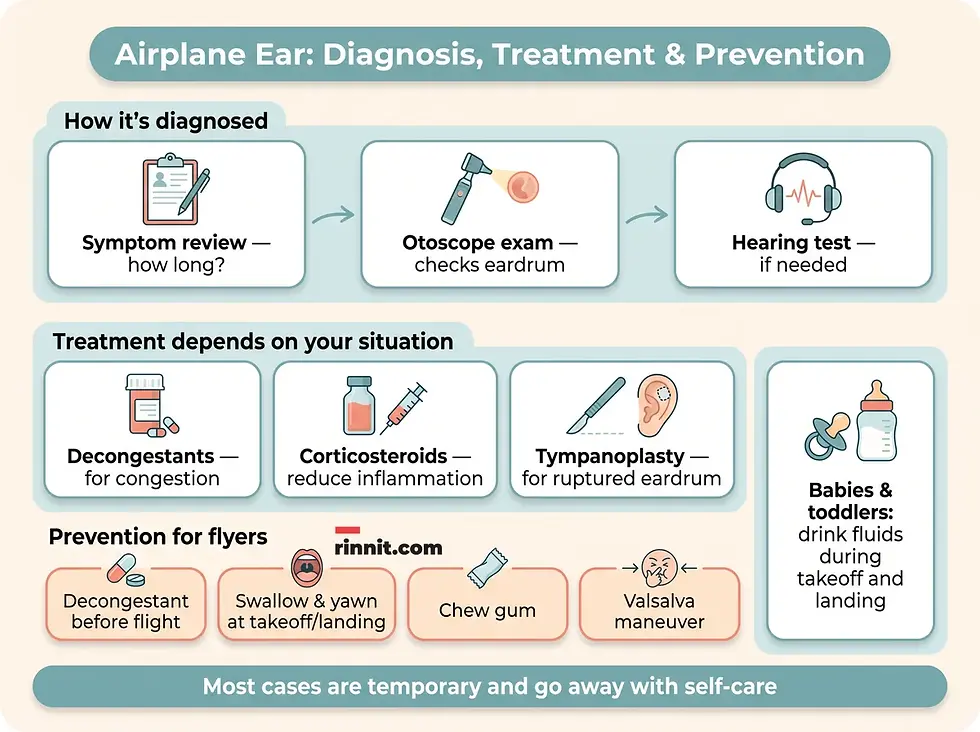
A healthcare provider will ask about your symptoms and how long you've had them. They will then check your ear with an otoscope, a special lighted instrument that lets providers look inside your ear to see if you have eardrum damage or an ear infection [1]. If needed, your provider may refer you to an audiologist for a hearing test [1].
What airplane ear treatments work?
Treatment varies depending on your situation. Your treatment may include decongestants to help with congestion, corticosteroids to reduce inflammation [1] [4], and, if you have a ruptured eardrum, tympanoplasty to close the hole in your eardrum [1].
What is the outlook for airplane ear?
Many symptoms ease as soon as your eustachian tubes can manage air or water pressure changes [1]. In some cases, you may need medication to manage congestion or inflammation. In that case, it may be a few days before your ears feel normal [1]. Rarely, airplane ear causes ruptured eardrums. In that case, you may need surgery [1].
How can you prevent airplane ear before your next flight or dive?
Preventing airplane ear (ear barotrauma) means planning ahead for air travel and, if you scuba dive, following diving safety practices for managing water pressure changes [1]. Here are some suggestions that may help prevent ear barotrauma during air travel:
Prevention tip | How it helps |
Reducing congestion helps prevent airplane ear [1] | |
This helps your eustachian tubes open; the more they open, the more your tubes can even out the air pressure [1] | |
Have babies and toddlers drink fluids during takeoff and landing [1] | Ensures they'll swallow and avoid airplane ear [1] |
Helps equalize the pressure [1] | |
Blow your nose gently into a tissue [1] | Alleviates pressure [1] |
Valsalva maneuver: blow air through your nose while closing your mouth and pinching your nose [1] | This simple exercise allows more air to get into your eustachian tubes [1] |
Wear earplugs [1] | Helps regulate pressure within your ears [1] |
If you scuba dive, make sure you know and follow diving safety best practices, including how to manage water pressure changes [1]. A little foresight goes a long way toward preventing ear barotrauma. If there's an airplane trip in your future, plan ahead to reduce your risk.
When should you seek care for airplane ear?
In general, ear barotrauma is a temporary issue. Contact your provider if your ears still feel full or stuffed even after your flight is through or you've finished scuba diving [1]. Rarely, ear barotrauma may cause a ruptured eardrum. Go to the emergency room if you notice fluid coming from your ear [1].
If you have ear barotrauma, you may wonder what happened to your ears and what you can do to prevent it. Questions worth asking your provider include: What is ear barotrauma? Is it serious? Can I lose my hearing from ear barotrauma? What's the treatment? What should I do to prevent airplane ear?
Conclusion
Airplane ear is one of the most common pressure-related injuries, and one of the most avoidable. A sudden change in air or water pressure overwhelms your eustachian tubes, leaving your ear clogged, your hearing muffled, and, in painful cases, your eardrum under strain. Most cases pass on their own or with simple decongestants; only rarely does it damage an eardrum enough to need surgery [1]. If you fly often, pack decongestants, chew gum, swallow and yawn on takeoff and landing, and teach the kids to drink through altitude changes. If fluid ever oozes from your ear, treat it as an emergency: that's the one warning sign that should never wait.
Ready to fly without ear pain? Try the prevention checklist above before your next trip. If your ears still feel full after landing, or you notice fluid, hearing loss, ringing, or vertigo, contact a healthcare provider to check for eardrum damage before it worsens.
Frequently Asked Questions
1. What is airplane ear (ear barotrauma)?
Ear barotrauma refers to damage to your ears caused by a sudden change in air pressure or water pressure affecting your middle ear. People call it "airplane ear" because it often happens during flights, but it can also occur when riding in an elevator, diving to the bottom of a swimming pool, or scuba diving. It is the most common form of barotrauma.
2. Why do my ears feel clogged during a flight?
Air pressure changes when airplanes take off and land, and that change happens faster than your eustachian tubes can react. These tubes connect the back of your middle ear to the back of your throat and keep equal air pressure on both sides of your eardrum. When they can't keep up, your ear feels clogged or blocked.
3. What are the symptoms of airplane ear?
Symptoms are usually mild and include a feeling that your ear is clogged or blocked, trouble hearing, dizziness, and severe ear pain. Very rarely, fluid may ooze from your ear, which can signal a ruptured eardrum.
4. How long does airplane ear last?
Ear barotrauma is generally a temporary issue. Many symptoms ease as soon as your eustachian tubes can manage the pressure change. If medication is needed for congestion or inflammation, it may be a few days before your ears feel normal. A ruptured eardrum, when it occurs, typically heals on its own after a few weeks.
5. Can airplane ear cause a ruptured eardrum?
Rarely, yes. A ruptured eardrum typically heals on its own after a few weeks, but some cases may need surgery (tympanoplasty). Go to the emergency room if you notice fluid coming from your ear. Call a provider right away for hearing loss, ringing in your ears, discharge from your ears, or vertigo.
6. What is the Valsalva maneuver for ears?
The Valsalva maneuver is a simple exercise where you blow air through your nose while closing your mouth and pinching your nose. This allows more air to get into your eustachian tubes and helps equalize ear pressure.
7. Can a cold or allergies make airplane ear worse?
Yes. Ear barotrauma can happen more frequently if you have congestion from a cold or allergies. Congestion may block or inflame your eustachian tubes, making it even harder for them to manage air pressure changes. Taking a decongestant before your flight can help. Check with a doctor or pharmacist first if you have high blood pressure, heart disease, thyroid disease, glaucoma or prostate problems, are pregnant, or are giving it to a young child, since decongestant pills did not prevent flight ear pain in young children and made many drowsy.
8. How do I prevent airplane ear in babies and toddlers?
If you're traveling with babies or toddlers, encourage them to drink fluids during takeoff and landing. That ensures they'll swallow, which helps their eustachian tubes open and equalize pressure, avoiding airplane ear.
9. What treats airplane ear?
Treatment depends on your situation and may include decongestants to relieve congestion, corticosteroids to reduce inflammation, or tympanoplasty (surgery to close a hole in the eardrum) if the eardrum has ruptured.
10. Is airplane ear serious?
In general, no. It is a temporary issue that goes away with self-care or when pressure changes stop. However, contact your provider if your ears still feel full or stuffed after your flight or dive, and go to the emergency room if fluid comes from your ear.
11. Can scuba diving cause ear barotrauma?
Yes. Deep-water diving causes water pressure to change quickly, just as airplane takeoff and landing change air pressure quickly. The same mechanism affects the middle ear. Scuba divers should know and follow diving safety best practices, including how to manage water pressure changes.
Related Reading
Eustachian Tube Dysfunction: Symptoms, Types, Causes, Diagnosis, Treatment and Outlook — What You Need to Know explains blocked ear tubes that cause pressure and muffled hearing.
Barotrauma: The Pressure Injury From Flying and Diving That's Usually Minor — but Can Turn Life-Threatening When It Hits Your Lungs or Gut covers pressure injuries to the ears, sinuses and lungs.
Ruptured Eardrum (Eardrum Membrane Rupture): Symptoms, Causes, and Treatment explains the signs of a torn eardrum and how it heals.
Ear Infections: Symptoms, Causes, and Treatment reviews common ear infections and when to see a doctor.
References
Cleveland Clinic. Ear Barotrauma (Airplane Ear). Cleveland Clinic. Mar. 13, 2023. https://my.clevelandclinic.org/health/diseases/17929-airplane-ear
American Academy of Otolaryngology-Head and Neck Surgery Foundation. Ears and Altitude (Barotrauma). ENT Health. Last reviewed Aug. 2018. https://www.enthealth.org/conditions/ears-and-altitude-barotrauma/
Battisti AS, Haftel A, Murphy-Lavoie HM. Barotrauma. In: StatPearls [Internet]. Treasure Island (FL): StatPearls Publishing; updated 2023 Jun 26. PMID 29493973. https://www.ncbi.nlm.nih.gov/books/NBK482348/
National Library of Medicine (U.S.). Ear barotrauma. MedlinePlus Medical Encyclopedia. Review date Apr. 29, 2026. https://medlineplus.gov/ency/article/001064.htm
Jones JS, Sheffield W, White LJ, et al. A double-blind comparison between oral pseudoephedrine and topical oxymetazoline in the prevention of barotrauma during air travel. Am J Emerg Med. 1998;16(3):262-264. PMID 9596428. https://doi.org/10.1016/s0735-6757(98)90097-3
Buchanan BJ, Hoagland J, Fischer PR. Pseudoephedrine and air travel-associated ear pain in children. Arch Pediatr Adolesc Med. 1999;153(5):466-468. PMID 10323625. https://doi.org/10.1001/archpedi.153.5.466
Mirza S, Richardson H. Otic barotrauma from air travel. J Laryngol Otol. 2005;119(5):366-370. PMID 15949100. https://doi.org/10.1258/0022215053945723
Medical Disclaimer
This article is for informational purposes only and does not constitute medical advice. Always seek the advice of your physician or other qualified health provider with any questions you may have regarding a medical condition. Never disregard professional medical advice or delay in seeking it because of something you have read here.



Comments