Hearing Loss: Symptoms, Causes, and Treatment Options

Updated: 2 days ago
Medically reviewed by Dr. Baraa Alnahhal, MD · Last reviewed: September 2026
TL;DR
Hearing loss is most commonly the gradual kind that comes on little by little with age — called presbycusis (pres-bih-KU-sis). Nearly half the people in the United States older than age 75 have some age-related hearing loss. There are three types: conductive (outer or middle ear), sensorineural (inner ear), and mixed. The usual culprits are aging and loud noise, which wear out the tiny hair cells in the snail-shaped cochlea — the part of the inner ear where damage and hearing loss occur; once gone, these cells generally don’t come back, so you usually can’t get hearing back, though there are ways to improve what you hear. Watch for 8 signs: muffled speech, trouble understanding words in crowds, missing non-vowel letter sounds, asking others to repeat themselves, raising TV volume, avoiding social settings, irritation at background noise, and tinnitus (ringing in the ears). One warning is urgent: if you have a sudden loss of hearing, particularly in one ear, seek medical attention right away. Diagnosis runs from a simple physical exam through whisper tests, tuning fork tests, app-based screenings, and audiometer tests done by an audiologist (a hearing-loss specialist). Treatment depends on cause and severity: removing earwax (a fixable cause), ear tubes or other surgery, hearing aids, or cochlear implants that bypass the damaged parts of the inner ear. Prevention centers on earplugs and earmuffs, regular hearing tests, and turning down the volume — noise above 70 decibels over time can start to damage hearing.
Quick Answer: What You Need to Know About Hearing Loss
Who is this for? Anyone noticing they’re turning up the TV, asking people to repeat themselves, or hearing ringing in the ears — and anyone with sudden hearing loss in one ear, who needs care right away.
What it is: Reduced ability to hear sound, most often from aging or loud noise damaging the inner ear’s hair cells.
Three types: Conductive (outer/middle ear), sensorineural (inner ear), and mixed (a mix of the two).
How common: Nearly half of U.S. adults over 75 have some age-related hearing loss (presbycusis).
Eight early signs: Muffled speech, trouble in noisy crowds, missing non-vowel sounds, asking others to speak up, louder TV volume, avoiding social settings, bother from background noise, and ringing in the ears.
Main causes: Age and loud noise; also earwax buildup, ear infections, bone growths or tumors, and a ruptured eardrum.
Red flag: Sudden hearing loss — especially in one ear — needs medical attention right away.
Diagnosis: Physical exam, whisper test, tuning fork tests, app-based screening, and audiometer tests by an audiologist.
Treatment: Earwax removal, ear tubes/surgery, hearing aids, or cochlear implants — matched to the cause and severity.
Source currency note: this article is based on clinical information from the source pages, dated July 31, 2026.
What Is Hearing Loss?
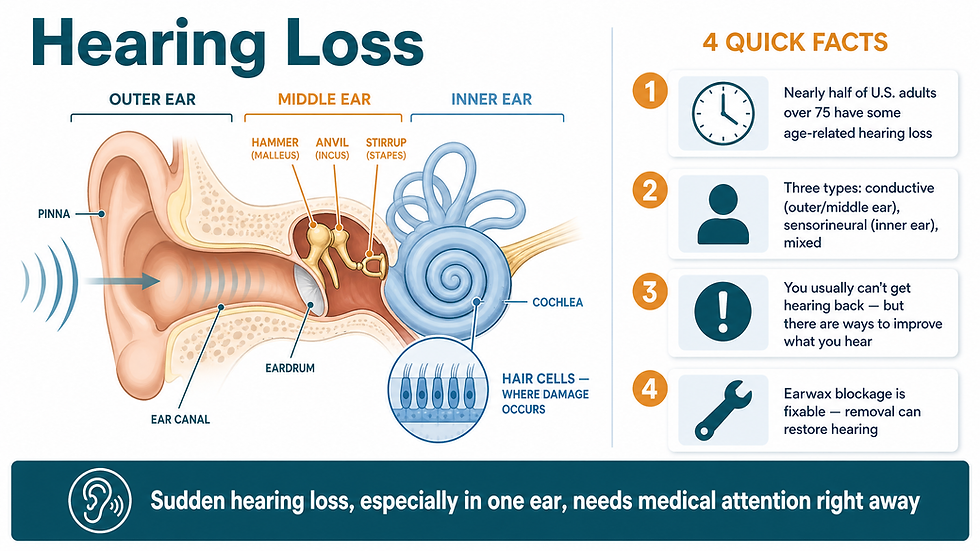
Hearing loss that comes on little by little as you age is common. Nearly half the people in the United States older than age 75 have some age-related hearing loss.
There are three types of hearing loss. Conductive hearing loss involves the outer or middle ear. Sensorineural hearing loss involves the inner ear. Mixed hearing loss is a mix of the two.
Aging and being around loud noises both can cause hearing loss. Other factors, such as too much earwax, can make it harder to hear for a time.
One point deserves to be stated plainly: you usually can’t get hearing back. But there are ways to improve what you hear.
How Hearing Works — and Where It Breaks
To understand hearing loss, it helps to know how hearing works. The ear has three main parts: the outer ear, middle ear, and inner ear. Each converts sound waves into signals that travel to the brain.
Part of the ear | What it does |
Outer ear | The visible part (the pinna) gathers sound waves and directs them into the ear canal |
Middle ear | The eardrum (tympanic membrane) vibrates when struck by sound; a chain of three tiny bones — the hammer (malleus), anvil (incus), and stirrup (stapes) — amplifies the vibration; the eustachian tube equalizes pressure and drains fluid |
Inner ear | The snail-shaped cochlea receives the vibration through its fluids; thousands of tiny hair cells convert vibrations into electrical impulses, which travel along the auditory nerve to the brain’s auditory cortex |
This is where hearing loss begins for most people. It is in the cochlea that the initial damage occurs due to age, noise exposure, or medication — the hair cells or nerve cells that send sound signals to the brain become fewer or don’t function well, and they don’t send electrical signals properly anymore.
What Are the Signs of Hearing Loss?

Symptoms of hearing loss may include:
Sign | What it looks like in daily life |
Muffled speech and other sounds | People sound like they’re talking through cotton |
Trouble understanding words in crowds | Noisy restaurants become exhausting or impossible |
Missing non-vowel letter sounds | Consonants like “s” and “f” disappear from speech |
Asking others to speak more slowly, clearly and loudly | Frequent “what?” and “say that again” |
Turning up the television or radio | Family notices the volume keeps climbing |
Staying clear of some social settings | Avoiding gatherings where conversation is hard |
Being bothered by background noise | Background chatter overwhelms the speaker |
Ringing in the ears (tinnitus) | A ringing, roaring, or hissing that isn’t really there |
When Should You See a Doctor?
Two situations call for attention. The first is urgent: if you have a sudden loss of hearing, particularly in one ear, seek medical attention right away.
The second is the slow and subtle kind. Talk to your healthcare professional if loss of hearing is causing you trouble. Age-related hearing loss happens little by little, so you may not notice it at first — friends and family often notice the changes before you do.
What Causes Hearing Loss?
Causes of hearing loss fall into two broad groups: those that damage the inner ear and those that block or disrupt the sound path before it gets there.
Cause | What it means | Reversible? |
Damage to the inner ear | Aging and loud noise cause wear and tear on the hairs or nerve cells in the cochlea; higher-pitched tones may seem muffled and words hard to pick out against background noise | Usually not — this is why most sensorineural hearing loss is permanent |
Buildup of earwax | Over time, earwax can block the ear canal and keep sound waves from passing through; earwax removal can help restore hearing | Yes — earwax blockage is fixable |
Ear infection or unusual bone growths or tumors | In the outer or middle ear, any of these can cause hearing loss | Often, with treatment of the underlying condition |
Ruptured eardrum (tympanic membrane perforation) | Loud blasts of noise, sudden pressure changes, poking the eardrum with an object, or infection can cause the eardrum to burst | Often, with treatment or healing |
The key distinction to remember: temporary hearing loss can happen when your ears are plugged with wax or fluid behind the eardrum, but nerve-related hearing loss is usually permanent — just about all types of sensorineural hearing loss have to do with the loss of function of hair cells in the inner ear.
Who Is at Risk?
Factors that damage or lead to loss of the hairs and nerve cells in the inner ear include:
Risk factor | How it damages hearing |
Aging | The inner ear breaks down over time |
Loud noise | Gradual exposure to loud sounds damages inner ear cells — or a single short blast, such as from a gunshot |
Family traits | Your genes may make you more likely to have ear damage from sound or aging |
Noises on the job | Jobs with constant loud noise — farming, construction, factory work — can lead to damage inside the ear |
Noises at play | Snowmobiling, motorcycling, carpentry, loud music; explosive noises from firearms and jet engines can cause immediate, permanent hearing loss |
Some medicines | The antibiotic gentamicin, sildenafil (Revatio, Viagra), and certain cancer medicines can damage the inner ear; very high doses of aspirin, other pain relievers, antimalarial medicines, or loop diuretics can cause short-term ringing or hearing loss |
Some illnesses | Illnesses such as meningitis that cause high fever can harm the cochlea |
How Loud Is Too Loud?
A decibel is the unit used to measure how loud sound is. Noise above 70 decibels over time can start to damage hearing, and the louder the noise, the less time it takes to cause lasting damage.
Decibels | Noise source | Zone |
30 | Whisper | Safe |
40 | Refrigerator | Safe |
60 | Normal conversation | Safe |
75 | Dishwasher | Safe |
85 | Heavy city traffic, school cafeteria | Risk |
95 | Motorcycle | Risk |
100 | Snowmobile | Risk |
110 | Chainsaw, jackhammer, rock concert, symphony | Risk |
115 | Sandblasting | Risk |
120 | Ambulance siren, thunder | Risk |
140–165 | Firecracker, firearms | Risk |
For perspective on workplace exposure, occupational safety guidelines allow the following maximum time around loud noise without hearing protection: 90 decibels for 8 hours, 95 for 4 hours, 100 for 2 hours, 105 for 1 hour, 110 for 30 minutes, and 115 for 15 minutes or less.
What Can Happen If Hearing Loss Is Ignored?
Hearing loss can make life less pleasant. Older adults with hearing loss often report being depressed. Because hearing loss can make it harder to talk with others, some people with hearing loss feel cut off from others.
Hearing loss is also linked to loss of thinking skills, known as cognitive impairment, and to an increased risk of falling.
Can You Prevent Hearing Loss?
Three steps can help prevent hearing loss from loud noises and keep age-related hearing loss from getting worse:
Prevention step | What to do |
Protect your ears | Staying away from loud noise is the best protection; in the workplace, plastic earplugs or glycerin-filled earmuffs can help protect hearing |
Have your hearing tested | If you work around a lot of noise, think about regular hearing tests; if you’ve lost some hearing, take steps to prevent further loss |
Avoid risks from hobbies and play | Snowmobiling, jet skiing, hunting, power tools, and rock concerts can damage hearing over time; wear hearing protectors, take breaks from noise, and turn down the volume when listening to music |
How Is Hearing Loss Diagnosed?

Tests to diagnose hearing loss may include:
Test | What happens |
Physical exam | A healthcare professional looks in your ear for possible causes such as earwax or an infection; the way your ear is formed might cause hearing problems, too |
Screening tests | A whisper test — covering one ear at a time while listening to words spoken at many volumes — shows how you react to sounds |
App-based hearing tests | You can use an app on your mobile device to screen yourself for hearing loss |
Tuning fork tests | Two-pronged metal instruments that make sounds when tapped; simple tests can help find hearing loss and show where the ear damage is |
Audiometer tests | A specialist in hearing loss — an audiologist — runs thorough tests; sounds and words are directed through earphones to each ear at low levels to find the quietest sound you can hear |
How Is Hearing Loss Treated?
You can get help for hearing loss. Treatment depends on the cause of the hearing loss and how bad it is.
Treatment option | When it’s used | How it works |
Removing earwax | When earwax blockage is the cause | A fixable cause — a healthcare professional might remove earwax using suction or a small tool with a loop on the end |
Surgery | For some types of hearing loss | For repeated infections that cause fluid in the ear, a healthcare professional might put in small tubes that help the ears drain |
Hearing aids | If hearing loss is from damage to the inner ear | A hearing specialist (audiologist) explains how they can help and what kinds there are, and fits you; digital devices can be adjusted over a wide range of hearing loss and can connect to your cellphone |
Cochlear implants | When a regular hearing aid isn’t likely to help much | Unlike a hearing aid that makes sound stronger, an implant goes around the parts of the inner ear that don’t work to stimulate the hearing nerve — with a sound processor behind the ear, a transmitter sending signals to a receiver implanted under the skin, and electrodes threaded into the cochlea |
Hearing aids are not one-size-fits-all. Important decisions include whether the device will have rechargeable batteries or ones that need replacing, and whether the hearing aid sits behind or in the ear. Styles include behind the ear, in the canal, and completely in the canal. An audiologist can help sort through the options and create a personal solution.
For profound hearing loss, cochlear implants work by bypassing the damaged hair cells and sending signals directly to the hearing nerve and brain. An audiologist and an ears-nose-and-throat specialist can tell you the risks and benefits.
Coping and Support: 7 Tips for Staying Connected
These tips can help you stay connected if you have hearing loss:
Tip | Why it helps |
Tell your friends and family | Let them know you’ve lost some hearing |
Put yourself in a good position to hear | Face the person you’re talking to |
Turn off background noise | Television noise makes talking and listening harder |
Ask others to speak up, but not too loud, and speak clearly | Most people will be helpful if they know |
Get the other person’s attention before speaking | Don’t try to talk to someone in a different room |
Choose quiet settings | Pick a place away from noisy areas |
Consider using a listening aid | TV-listening systems, phone-audio devices, smartphone apps, and closed-circuit systems in public places can help |
Preparing for Your Appointment
If you think you have hearing loss, call your healthcare professional, who might refer you to an audiologist — a hearing specialist.
What you can do: Make a list of your symptoms and how long you’ve had them — including whether the hearing loss is in one ear or both. Ask friends and family to help you make the list; they may know of changes you don’t. Make a list of key medical information, especially related to ear conditions: any repeated infections, injury to your ear, or ear surgery you’ve had — plus medicines, vitamins, or supplements you take, including doses. Describe your work history, including jobs with high noise levels, even from long ago. Take a family member or friend along to help you remember the information you get. And make a list of questions for your healthcare professional.
Questions to ask your healthcare professional | Questions your healthcare professional will ask you |
What’s the most likely cause of my symptoms? | How would you describe your symptoms? Does either ear hurt or leak fluid? |
What else might be causing my symptoms? | Did your symptoms begin all at once? |
What tests do I need? | Do you have ringing, roaring, or hissing in your ears? |
Should I stop taking any of my medicines? | Do you have dizziness or balance problems? |
Should I see a specialist? | Do you have a history of ear infections, ear trauma, or ear surgery? |
— | Have you ever worked in a job with loud noise, flown airplanes, or been in military combat? |
— | Does your family tell you that you keep the television or radio too loud? |
— | Do you have trouble hearing people who talk in a low voice, or on the telephone? |
— | Do you often ask others to speak up or repeat themselves — more in noisy settings like a crowded restaurant? |
— | Can you hear when someone comes up behind you? |
— | Does your hearing affect your quality of life? |
— | Would you be willing to try a hearing aid? |
Conclusion
Hearing loss is one of the most common — and most ignored — health changes in later life, and it is no longer only a condition of later life. Its damage happens invisibly inside the cochlea, where hair cells worn down by age, noise, or medication stop converting sound into signals, and the person losing hearing is usually the last to know. That is why the warning signs matter: muffled speech, a TV volume that keeps climbing, words that vanish in noisy restaurants, and ringing in the ears. Most of this hearing loss can’t be reversed, but the picture is far from bleak. Earwax blockage is fixable. Hearing aids are digital, adjustable, and increasingly connected to modern life. Cochlear implants bypass damaged inner-ear structures entirely. And everyday habits — earplugs at work and play, regular hearing tests, and a quieter playlist — genuinely slow the loss. If you’ve noticed any of the signs, the first step is simple: talk to your healthcare professional.
Notice any of the eight signs of hearing loss? Don’t wait it out — talk to your healthcare professional or an audiologist, and explore our related guides on ear health, tinnitus, and protecting your hearing at work and play.
FAQ
Is hearing loss permanent?
Not always. Hearing loss from earwax blockage is fixable — removal can restore hearing, and ruptured eardrums or middle-ear problems can often be treated. But nerve-related (sensorineural) hearing loss is usually permanent, because the hair cells in the inner ear don’t come back.
What is presbycusis?
Presbycusis (pres-bih-KU-sis) is hearing loss that comes on little by little as you age. Nearly half of people in the United States older than age 75 have some age-related hearing loss.
What are the first signs of hearing loss?
Muffling of speech and other sounds, trouble understanding words in a crowd, trouble hearing non-vowel letter sounds, asking others to speak more slowly and clearly, needing to turn up the TV or radio, staying clear of some social settings, being bothered by background noise, and ringing in the ears (tinnitus).
Is sudden hearing loss an emergency?
Yes — if you have a sudden loss of hearing, particularly in one ear, seek medical attention right away.
What noise levels damage hearing?
Noise above 70 decibels over time can start to damage hearing. The louder the noise, the less time it takes: at 100 decibels (snowmobile), about 2 hours of unprotected exposure is the occupational maximum; at 115 decibels, 15 minutes or less. Explosive noises from firearms and jet engines can cause immediate, permanent hearing loss.
How is hearing loss tested?
With a physical exam, a whisper test, tuning fork tests, app-based screening tests, and thorough audiometer tests performed by an audiologist — a hearing-loss specialist who finds the quietest sound you can hear in each ear.
Can hearing aids really help?
If hearing loss is from damage to the inner ear, a hearing aid can be helpful. Because they’re digital, hearing aids can be adjusted over a wide range of hearing loss — and options now include rechargeable batteries and cellphone connectivity. When hearing aids aren’t enough, cochlear implants can bypass the damaged parts of the inner ear to stimulate the hearing nerve directly.
Can hearing loss affect anything besides hearing?
Yes. Older adults with hearing loss often report being depressed, and some feel cut off from others. Hearing loss is also linked to cognitive impairment (loss of thinking skills) and to an increased risk of falling.
Related Reading
References
Hearing loss — Symptoms & causes — clinical overview, how hearing works, symptoms, causes, risk factors, decibel tables, complications, and prevention
Hearing loss — Diagnosis & treatment — clinical overview, diagnostic tests, earwax removal, ear tubes, hearing aids, cochlear implants, coping strategies, and appointment preparation
This article is for general information only and does not replace professional medical advice. Always consult a qualified healthcare provider about diagnosis and treatment decisions.
Health information, not medical advice. This article is for general education and is not a substitute for professional diagnosis or treatment. Always consult a qualified healthcare provider about your own health, and seek emergency care for urgent symptoms.
Comments