Hearing Test: What It Is, Why It's Done, Types, What to Expect and Results

Updated: 2 days ago
Written and medically reviewed by Dr. Baraa Alnahhal, MD · Last reviewed: November 2026 · How we review
Quick Answer: What is a hearing test?
A hearing test, also called audiometry, is the main way to find out whether you have hearing loss, what type it is and how mild or severe it is. An audiologist uses painless tests such as pure-tone, speech and bone conduction testing, often with headphones. Results are ready right away and are shown on a chart called an audiogram.
What the research says
A simple whispered voice test can pick up hearing problems fairly well. A systematic review of 8 studies found that in adults, the whispered voice test caught 90% to 100% of people with hearing impairment confirmed by audiometry, with specificity of 70% to 87%. In children, sensitivity ranged from 80% to 96%, and the authors noted concerns about how consistently the test is done in primary care. (Pirozzo et al., BMJ, 2003) [2]
Quick screening questions miss some hearing loss, which is why full testing still matters. An evidence review for the US Preventive Services Task Force included 41 studies with 26,386 people aged 50 or older. Asking a single screening question detected mild hearing loss with a pooled sensitivity of 66% and specificity of 76%, and moderate hearing loss with a sensitivity of 80% and specificity of 74%. (Feltner et al., JAMA, 2021) [3]
Treating hearing loss is linked with less cognitive decline over time. A meta-analysis of 31 studies with 137,484 participants found that, in 8 long-term studies with 126,903 people, hearing aid users had a 19% lower risk of cognitive decline than people with uncorrected hearing loss (hazard ratio 0.81). Short-term cognitive test scores also improved by about 3% after people started using hearing aids. (Yeo et al., JAMA Neurology, 2023) [4]
Key takeaways
A hearing test shows whether you have hearing loss, which type you have and whether it is mild, moderate or severe [1].
Common tests include pure-tone testing, bone conduction testing, speech testing, auditory brainstem response, otoacoustic emissions and tympanometry [1].
You do not need to do anything special to prepare, and the tests do not hurt [1].
Results are usually available right away and are plotted on an audiogram [1].
People who work in very loud places should be tested every year, while many others may not need testing until their 50s or 60s [1].
At-home and online tests may hint at a problem, but a full evaluation by an audiologist is still recommended [1].
What is a hearing test?
A hearing test helps your audiologist understand how well you hear and what to do next.
A hearing test, or audiometry, is the primary way to check for hearing loss [1]. It is sometimes called a full audiologic evaluation [1].
An audiologist is the hearing specialist who performs these tests, explains what the results mean and recommends next steps [1]. Most people in the United States will have a hearing test at some point in their lives [1].
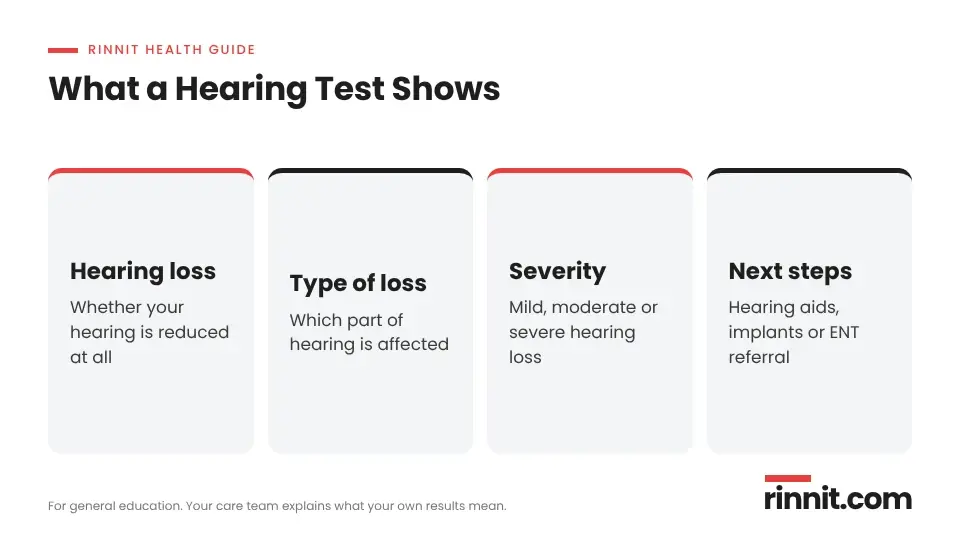
The tests show whether you have hearing loss, what type it is and how severe it is [1]. This information guides treatment choices, such as hearing aids or other devices [1].
Why you might need a hearing test
A hearing test can be helpful at any age when there is a concern about hearing [1]. Your healthcare provider may refer you to an audiologist if you think your hearing has changed [1].
Babies and children
Adults
How often to get tested
Who | Suggested timing |
People with very noisy jobs, such as factory or construction work | Every year |
Most other adults without symptoms | Often not needed until their 50s or 60s, when age-related hearing loss commonly starts |
Anyone who notices hearing changes | Talk to a healthcare provider, who may refer you to an audiologist |
Babies who do not pass newborn screening | A full hearing test after the screening |
Sources: [1]
Types of hearing tests
Your audiologist may use one test or a combination of tests, depending on your age and symptoms [1]. Each test looks at a different part of how you hear [1].
Test | What it checks | What you do |
Pure-tone testing | The softest sounds you can hear at different pitches | Respond each time you hear a tone |
Bone conduction testing | How well the inner ear responds to vibration through the skull | Respond to tones sent by a small device behind the ear or on the forehead |
Speech testing | How well you hear and repeat spoken words | Repeat words spoken at soft and loud levels |
Auditory brainstem response (ABR) | How the brain responds to sound | Stay still while electrodes record brain activity |
Otoacoustic emissions (OAE) | Whether the inner ear makes sounds in response to sound | Sit quietly with a small earphone in place |
Tympanometry | How the eardrum moves and how the middle ear is working | Sit still while a probe gently changes air pressure in the ear |
Sources: [1]
ABR testing is often used for babies, young children and people who cannot respond during pure-tone testing, because it does not require you to respond [1].
How to prepare for a hearing test
You do not need any special preparation before a hearing test [1].
It can help to write down any hearing changes you have noticed, such as trouble with conversations or needing more volume on the TV, so you can share them with your audiologist [1].
What happens during a hearing test

Most hearing tests are quick, painless and need only simple responses from you.
Most hearing tests take place in a sound-treated room while you wear headphones or earphones [1]. The tests are painless [1].
Pure-tone testing
An audiometer plays tones at different pitches and volumes [1]. Each time you hear a sound, you raise your hand, press a button or say "yes" [1]. Your audiologist records the results on an audiogram [1].
Bone conduction testing
A small device is placed behind your ear or on your forehead [1]. It sends gentle vibrations through the bones of your skull to your inner ear [1]. Your audiologist compares these results with your pure-tone results to learn more about the type of hearing loss [1].
Speech testing
You listen to words spoken at soft and then louder levels and repeat them back [1]. The audiologist notes the softest level of speech you can hear and repeat [1].
Auditory brainstem response (ABR)
Small electrodes are placed on your head to record brain wave activity in response to sounds [1]. You do not need to respond, but you do need to stay still [1].
Otoacoustic emissions (OAE)
A small earphone is placed in your ear [1]. It measures the faint sounds your inner ear makes in response to sound [1].
Tympanometry
A small probe is placed in your ear and gently moves air to see how your eardrum responds [1]. The results are shown on a chart called a tympanogram [1]. This test can find a ruptured eardrum, fluid behind the eardrum or earwax buildup [1].
Are there risks with a hearing test?
Hearing tests are painless, and there are no special risks described for these tests [1].
At-home and online hearing tests
Many at-home and online hearing tests are available [1]. They may suggest that you have a hearing problem, but they are not a substitute for testing by an audiologist [1]. If an at-home test raises a concern, talk to your healthcare provider [1].
Understanding your hearing test results

An audiogram is a picture of how well you hear different pitches and volumes.
Your results are usually available right after your test [1]. They are shown on an audiogram, a chart that maps how well you hear pitches from low to high and sounds from soft to loud [1].
Your audiologist will explain whether your hearing is in the expected range or whether you have hearing loss [1]. If you do have hearing loss, they will tell you what type it is and whether it is mild, moderate or severe [1].
Tympanometry results appear on a separate chart called a tympanogram, which shows how your eardrum moves [1].
Next steps after a hearing test
What happens next depends on your results [1]. Your audiologist will talk with you about the options that fit your situation [1].
If earwax is causing the problem, you may be referred to an ear, nose and throat (ENT) specialist, also called an otolaryngologist, for removal [1].
If you have hearing loss, your audiologist may suggest hearing aids or cochlear implants [1].
Your audiologist can fit hearing aids or arrange more testing to see if a cochlear implant may help you [1].
If you think your hearing is changing, do not wait for symptoms to get worse. Talk to your healthcare provider, who may refer you to an audiologist for testing [1].
Conclusion
A hearing test is a simple, painless way to learn how well you hear. It shows whether you have hearing loss, what type it is and how severe it is, and the results are usually ready the same day.
If you have trouble hearing conversations, work in a noisy place or have a child who did not pass a hearing screening, a full evaluation by an audiologist is a good next step. Finding hearing loss early opens the door to treatments such as hearing aids that can help you stay connected.
Keep learning: Read our guide to hearing loss symptoms, causes and treatment options or our guide to hearing aid types and how they work. For more background, see the MedlinePlus guide to hearing tests for adults.
FAQ
What is a hearing test?
A hearing test, or audiometry, checks whether you have hearing loss, what type it is and how mild or severe it is.
Why would I need a hearing test?
You may need one if you struggle to follow conversations, turn up the TV volume often, work around loud noise or have a child who failed newborn screening.
Does a hearing test hurt?
No. Hearing tests are painless. You mostly listen to sounds through headphones and respond when you hear them.
How do I prepare for a hearing test?
No special preparation is needed. It helps to note any hearing changes you have noticed so you can share them with your audiologist.
What happens during a pure-tone hearing test?
You sit in a quiet room with headphones and raise your hand, press a button or say "yes" each time you hear a tone.
Who performs a hearing test?
An audiologist, a specialist in hearing, performs the tests, explains the results and recommends next steps.
When will I get my hearing test results?
Results are usually available right away. Your audiologist will go over your audiogram with you at the same visit.
What does an audiogram show?
An audiogram is a chart showing how well you hear different pitches, from low to high, at different volumes, from soft to loud.
What happens if my hearing test shows hearing loss?
Your audiologist will explain the type and severity and may suggest hearing aids, cochlear implants or a referral to an ENT specialist.
Are at-home hearing tests accurate?
At-home and online tests can hint at a problem, but they do not replace a full hearing evaluation by an audiologist.
How often should I get my hearing tested?
People in very noisy jobs should be tested yearly. Many other adults may not need testing until their 50s or 60s unless they notice changes.
Related Reading
Rinne Test: Tuning Fork Hearing Check and What Results Mean explains the tuning fork test that checks for conductive hearing loss.
Pediatric Hearing Tests: Hearing Checks for Babies and Children by Age explains the hearing tests used for babies and children of each age.
Hearing Loss: Symptoms, Causes, and Treatment Options explains the signs and causes of hearing loss that a hearing test can confirm.
What Is Conductive Hearing Loss? Symptoms, Causes, Diagnosis & Treatment Explained covers a type of hearing loss that bone conduction testing and tympanometry help identify.
What Is Tinnitus? A Plain-Language Guide to Ringing in the Ears explains ringing in the ears, a symptom that often leads to a hearing evaluation.
Understanding Age-Related Hearing Loss (Presbycusis): Causes, Symptoms, and Management covers the gradual hearing loss that often prompts testing in your 50s or 60s.
Otosclerosis: Symptoms, Causes, and Management Strategies explains a middle ear condition that is often found through hearing tests.
Acoustic Neuroma (Vestibular Schwannoma): What It Is, Symptoms, Causes, and Treatment Options covers a noncancerous tumor that can cause hearing loss in one ear and may first show up on a hearing test.
References
Cleveland Clinic. What Is a Hearing Test? Cleveland Clinic. Last updated August 29, 2025. https://my.clevelandclinic.org/health/diagnostics/24104-hearing-test
Pirozzo S, Papinczak T, Glasziou P. Whispered voice test for screening for hearing impairment in adults and children: systematic review. BMJ. 2003;327(7421):967. PMID 14576249. https://doi.org/10.1136/bmj.327.7421.967
Feltner C, Wallace IF, Kistler CE, et al. Screening for Hearing Loss in Older Adults: Updated Evidence Report and Systematic Review for the US Preventive Services Task Force. JAMA. 2021;325(12):1202-1215. PMID 33755082. https://doi.org/10.1001/jama.2020.24855
Yeo BSY, Song HJJMD, Toh EMS, et al. Association of Hearing Aids and Cochlear Implants With Cognitive Decline and Dementia: A Systematic Review and Meta-analysis. JAMA Neurol. 2023;80(2):134-141. PMID 36469314. https://doi.org/10.1001/jamaneurol.2022.4427
Medical disclaimer
This article is for general education only and does not replace advice from a qualified healthcare professional. Talk to your doctor about your own diagnosis and treatment, and seek emergency care right away for severe or sudden symptoms.



Comments