Understanding Age-Related Hearing Loss (Presbycusis): Causes, Symptoms, and Management

Updated: 2 days ago
Medically reviewed by {i}Dr. Baraa Alnahhal, MD{/i} · Last reviewed: October 2026
Quick Answer
Presbycusis, or age-related hearing loss, is a progressive condition in which hearing gradually declines with age [1]. It is the most common cause of hearing loss worldwide, affecting approximately two out of three Americans over the age of 70 [1]. There is no cure [1], but hearing aids and lifestyle adjustments help protect remaining hearing and prevent social isolation.
What the research says
Treating hearing loss improved everyday communication, and the benefit lasted. In the ACHIEVE randomized trial of adults aged 70-84 with untreated mild-to-moderate hearing loss, those given hearing aids and audiological counseling improved by about 9.5 more points (95% CI -11.0 to -8.0) on a 0-40 hearing handicap scale after 3 years than those given health education. The gap was already present at 6 months (-8.9 points; 95% CI -10.4 to -7.5) (PubMed: Sanchez et al., J Am Geriatr Soc, 2024) [2].
Hearing aids slowed cognitive decline most in people at highest risk. In a secondary analysis of the ACHIEVE trial (977 participants), 3-year cognitive decline was 61.6% slower (95% CI 33.7% to 94.1%) with hearing intervention than with health education among participants in the top quartile of predicted risk of cognitive decline. The trial overall suggested that hearing intervention may not reduce 3-year cognitive decline in all older adults with hearing loss (PubMed: Pike et al., Alzheimers Dement, 2025) [3].
Hearing loss is linked to a higher risk of dementia. A meta-analysis of 8 cohort studies that measured hearing loss with pure-tone audiometry found a hazard ratio of 1.32 (95% CI 1.30 to 1.34) for dementia, pointing to a relationship between the two. Studies that analyzed cognitive decline with linear regression found no statistically significant results (PubMed: Peribáñez García et al., Am J Otolaryngol, 2026) [4].
What is Age-Related Hearing Loss (Presbycusis)?
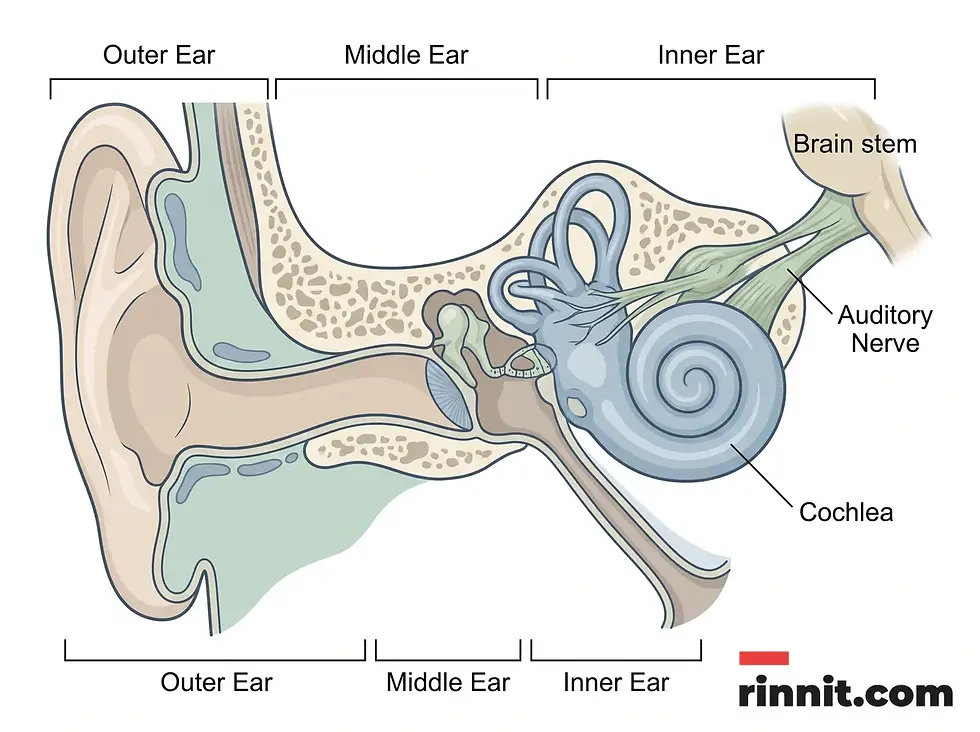
Presbycusis is a specific type of sensorineural hearing loss that develops gradually over time as part of the natural aging process [1]. This condition occurs due to changes in the inner ear, specifically damage to the delicate structures responsible for transmitting sound to the brain. As the most prevalent cause of hearing impairment globally [1], it significantly impacts daily communication and overall quality of life for millions of older adults.
The condition is categorized based on the specific type of damage within the inner ear. Understanding these distinctions helps healthcare providers predict the impact on a patient's life and tailor management strategies accordingly.
Feature | Sensory Presbycusis | Neural Presbycusis |
Primary Cause | Loss of outer hair cells in the organ of Corti [1]. | Loss of nerve cells in the cochlea or auditory pathway [1]. |
Impact on Hearing | General difficulty hearing sounds. | Significant impact on speech discrimination [1]. |
Location of Damage | Base of the cochlea within the inner ear [1]. | Cochlea and/or pathways leading to the brain [1]. |
What are the symptoms of age-related hearing loss (presbycusis)?
The onset of age-related hearing loss is typically slow and subtle, making it difficult to notice initially. However, as the condition progresses, individuals often find themselves struggling in common social situations. Recognizing these early signs is crucial for seeking timely intervention and maintaining social connections.
Common symptoms and behavioral changes include:
Auditory Changes: Difficulty hearing high-pitched sounds, such as birds singing or alarms, and the development of tinnitus (ringing in the ears) [1].
Communication Struggles: Increased difficulty understanding speech, particularly in noisy environments like restaurants or crowded rooms [1].
Device Reliance: A persistent need to turn up the volume on televisions, cell phones, computers, and tablets [1].
Social Impact: Straining to follow conversations, which can lead to frustration and social withdrawal.
What causes age-related hearing loss, and who is at risk?
The primary driver of presbycusis is the cumulative effect of aging on the inner ear. However, several other factors can accelerate the progression or increase the severity of the hearing loss. Genetics plays a significant role, as a family history of hearing loss often indicates a higher likelihood of developing the condition [1].
Risk Factor | Description and Impact |
Noise Exposure | Prolonged exposure to loud sounds can worsen age-related damage [1]. |
Genetics | Hearing loss often runs in families [1], suggesting a hereditary component. |
Ototoxicity | Certain medications can cause inner ear damage as a side effect [1]. |
Lifestyle Choices | Smoking affects circulation, potentially leading to earlier onset of hearing loss [1]. |
Research also suggests potential links between hearing loss and systemic health conditions, including coronary artery disease, diabetes, high blood pressure, and stroke [1]. Managing these underlying conditions is an essential part of a holistic approach to preserving hearing health.

How is age-related hearing loss diagnosed?
Diagnosing presbycusis involves a combination of physical examinations and specialized auditory testing. A primary care provider typically begins the process by checking the ears for signs of inflammation, infection, or eardrum damage using an otoscope [1]. If hearing loss is suspected, a referral to an audiologist is usually the next step.
The gold standard for diagnosing age-related hearing loss is the pure tone test. During this evaluation, the patient wears headphones and identifies the quietest volume they can hear at various pitches [1]. This allows the audiologist to map the specific frequencies where hearing is impaired and determine the severity of the loss.
How is age-related hearing loss managed and treated?
Age-related hearing loss has no cure [1], but hearing aids, communication adjustments and regular audiologist checkups can help manage it and improve hearing. The most common intervention is the use of hearing aids, which amplify sounds and deliver them directly to the ear [1]. Although they do not restore hearing to its original state [1], they significantly enhance the ability to communicate and engage with others.

Effective management also involves practical communication adjustments:
Informing Others: Sharing your hearing situation with friends, family, and colleagues allows them to adjust their speaking habits, such as facing you directly [1].
Environmental Control: Reducing background noise and moving away from loud sound sources can make communication much easier.
Regular Monitoring: Annual checkups with an audiologist are essential to track the progression of the hearing loss [1] and ensure that hearing aids are functioning optimally.
Conclusion and Next Steps
Age-related hearing loss is a common and manageable part of the aging process. By recognizing the symptoms early and seeking professional evaluation, individuals can maintain their quality of life and stay connected to their communities. If you notice changes in your hearing, consult a healthcare provider to discuss diagnostic testing and potential treatment options. Protecting your hearing now can help delay the progression of presbycusis and ensure a more vibrant future.
Frequently Asked Questions
1. Is presbycusis a normal part of aging?
Yes, aging is the most common reason for hearing loss worldwide, affecting a majority of older adults.
2. Can presbycusis be cured?
No, there is currently no cure for age-related hearing loss, but it can be effectively managed with hearing aids.
3. What is the difference between sensory and neural presbycusis?
Sensory involves loss of hair cells in the cochlea, while neural involves loss of nerve cells in the auditory pathway.
4. Does smoking affect hearing loss?
Yes, smoking can affect circulation and increase the chance of developing hearing loss at an earlier age.
5. Can hearing aids restore my hearing to normal?
No, hearing aids amplify sounds but cannot restore lost hearing or cure the underlying condition.
6. How often should I have my hearing tested?
Once diagnosed, most providers recommend annual checkups with an audiologist to monitor progression.
7. What are the common complications of untreated hearing loss?
Untreated hearing loss can lead to social isolation and an increased risk of anxiety or depression.
8. Can loud noise make presbycusis worse?
Yes, people with noise-induced hearing loss often develop more severe age-related hearing loss.
9. Is tinnitus a symptom of presbycusis?
Yes, ringing in the ears (tinnitus) is a common symptom associated with age-related hearing loss.
10. How can I protect my hearing as I age?
Wear ear protection in loud environments, turn down device volumes, and manage overall health conditions.
Related Reading
Hearing Test: What It Is, Why It's Done, Types, What to Expect and Results explains the hearing tests used to measure the type and degree of hearing loss.
References
Cleveland Clinic. Presbycusis (Age-Related Hearing Loss). Cleveland Clinic. Sep. 12, 2025. https://my.clevelandclinic.org/health/diseases/5840-age-related-hearing-loss
Sanchez VA, Arnold ML, Garcia Morales EE, et al. Effect of hearing intervention on communicative function: A secondary analysis of the ACHIEVE randomized controlled trial. J Am Geriatr Soc. 2024;72(12):3784-3799. PMID 39266468. https://doi.org/10.1111/jgs.19185
Pike JR, Huang AR, Reed NS, et al. Cognitive benefits of hearing intervention vary by risk of cognitive decline: A secondary analysis of the ACHIEVE trial. Alzheimers Dement. 2025;21(5):e70156. PMID 40369891. https://doi.org/10.1002/alz.70156
Peribáñez García R, Rodriguez Rodriguez FÁ, Ascaso Adiego B, et al. Relationship between hearing loss, cognitive impairment, and dementia; meta-analysis of cohort studies in which the exposure factor is hearing loss measured by audiometry. Am J Otolaryngol. 2026;47(2):104799. PMID 41806683. https://doi.org/10.1016/j.amjoto.2026.104799
Medical Disclaimer
This article is for informational purposes only and does not constitute medical advice. Always seek the advice of your physician or other qualified health provider with any questions you may have regarding a medical condition. Never disregard professional medical advice or delay in seeking it because of something you have read here.



Comments