Acoustic Neuroma (Vestibular Schwannoma): What It Is, Symptoms, Causes, and Treatment Options

Updated: 3 days ago
Medically reviewed by Dr. Baraa Alnahhal, MD · Last reviewed: October 2026
Quick Answer
An acoustic neuroma is a benign tumor on the vestibulocochlear nerve, which carries hearing and balance signals to the brain [1]. Common symptoms are one-sided gradual hearing loss, ear ringing and unsteadiness [1]. It usually grows about 1 millimeter per year and can be monitored, removed surgically or treated with radiation [1] [2]. Treatment cannot restore lost hearing but can preserve what remains [2].
What the research says
For small tumors, microsurgery and radiosurgery preserve hearing about equally, but they differ in tumor control and facial nerve effects. A meta-analysis of 32 studies of small-to-medium (under 3 cm) sporadic vestibular schwannomas found hearing preservation of 56% after microsurgery (10 studies, 809 patients) and 59% after radiosurgery (23 studies, 1,234 patients) at about 65 months (P = 0.1527). Tumor control was 98% with microsurgery versus 92% with radiosurgery (P < 0.0001), and facial nerve dysfunction was 10% versus 2% (P < 0.0001). The authors estimated that about 50% of patients lose serviceable hearing by 5 years with either approach (PubMed: Savardekar et al., World Neurosurg, 2022) [3].
Both treatments raise the odds of hearing loss but ease dizziness. In a meta-analysis of 21 studies (987 patients), the odds of hearing loss rose after surgery (OR 3.52, 95% CI 2.13 to 5.81) and after radiosurgery (OR 3.30, 95% CI 1.39 to 7.80), while the odds of dizziness fell (surgery OR 0.10, 95% CI 0.02 to 0.47; radiosurgery OR 0.22, 95% CI 0.05 to 0.99). Pooled facial symmetry loss was 14.3% after surgery versus 7% after radiosurgery (PubMed: Yakkala et al., Acta Neurochir (Wien), 2022) [4].
Head-to-head trial evidence is limited and low in quality. A systematic review of three non-randomized prospective controlled trials (339 patients with unilateral vestibular schwannoma) found an indication of greater benefit of single-fraction radiosurgery over microsurgery for facial palsy (OR 0.06, 95% CI 0.02 to 0.21, p < 0.001, 2 studies). There were no clinically relevant differences for mortality, vertigo, headaches, tinnitus, balance, or quality of life, and it is unclear whether the findings hold beyond 2 years (PubMed: Jakubeit et al., Syst Rev, 2022) [5].
What Is an Acoustic Neuroma?
An acoustic neuroma, now called a vestibular schwannoma, is a tumor that develops on the main nerve leading from the inner ear to the brain. This nerve is called the vestibulocochlear nerve, and there is one on each side of the head. It directly affects balance and hearing.
Despite its name, an acoustic neuroma is not technically a brain tumor. It grows inside the skull, close to the brainstem, but it does not arise from brain tissue and is not classified as a central nervous system tumor. It is a type of peripheral nerve tumor that forms from Schwann cells, the cells that help protect and support nerve cells in the body [1].
Key fact | Detail |
Medical name | Vestibular schwannoma |
Tumor type | Benign (non-cancerous) peripheral nerve tumor [1] |
Where it grows | Vestibulocochlear nerve, inside the inner ear canal near the brainstem |
Growth rate | About 1 millimeter per year on average [1] |
How common | Fewer than 1 in 20,000 people diagnosed each year [1] |
Age pattern | Risk increases with age; about 1 in 5,000 people over 70 diagnosed each year [1] |
The tumor grows between the vestibulocochlear nerve and the facial nerve inside the inner ear canal. Pressure on these nerves can cause hearing loss, ringing in the ear, and facial weakness [1]. These tumors are benign, meaning they are not cancerous and do not spread to other parts of the body.
Acoustic neuroma can affect both ears, but it usually affects just one [1]. It may also cause numbness or weakness in the muscles on the affected side of the face. Treatments include monitoring, radiation, and surgical removal [1].
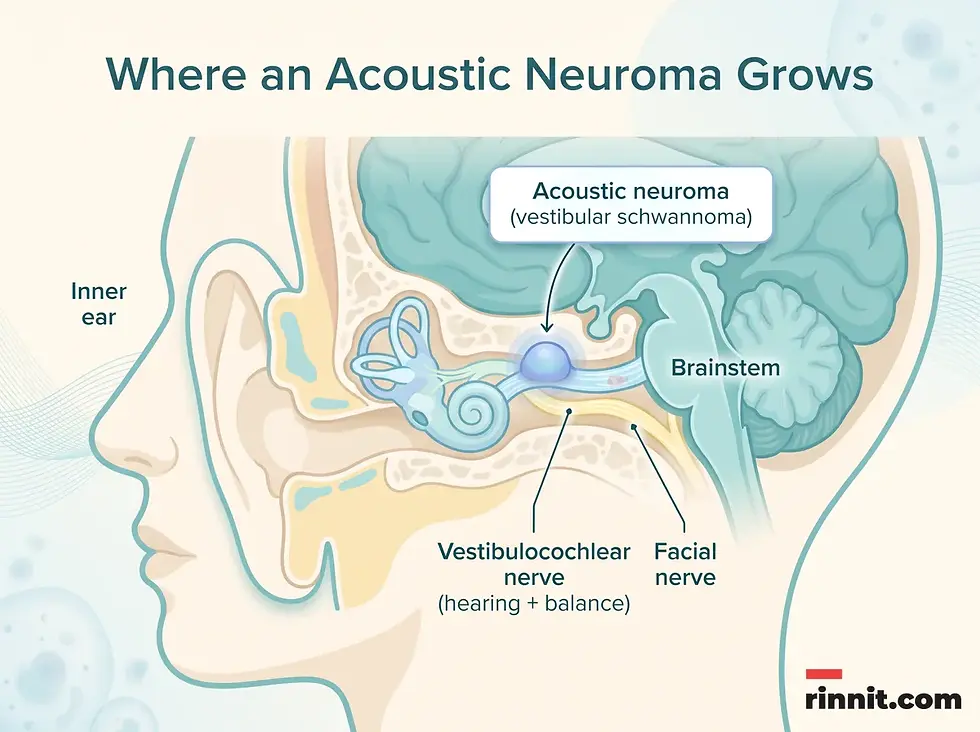
What are the symptoms of an acoustic neuroma?
Symptoms of an acoustic neuroma are often easy to miss and may take years to develop, because these tumors grow very slowly. Most grow at a rate of about 1 millimeter per year, which is about the thickness of a credit card [1]. Some grow a little faster, and it is possible for some to stay the same size for years [1].
Symptoms usually happen because of pressure on the vestibulocochlear nerve from the tumor. The tumor can also press on the facial nerve, which directs facial muscles, and the trigeminal nerve, which affects feeling in the face. This can lead to numbness in the face or difficulty moving the face [1]. An acoustic neuroma generally does not cause neck pain [1]. Blood vessels or other brain structures can also be affected [1]. As the tumor grows, symptoms may become more noticeable or worsen.
Symptom | How it typically presents |
Hearing loss | Usually gradual, over months to years; one side or worse on one side; rarely sudden [1] |
Ringing in the ear (tinnitus) | Heard in the affected ear |
Loss of balance or unsteadiness | Not feeling steady; sometimes brief vertigo |
Dizziness | Ongoing or intermittent |
Facial numbness | Pressure on the trigeminal nerve |
Facial weakness | Very rare; loss of muscle movement [1] |
Notably, acoustic neuroma tumors typically do not cause symptoms often seen with other brain tumors, such as headaches, memory loss, neck pain, or thinking difficulties. These symptoms are rare and generally occur only if the tumor becomes large enough to press on nearby brain structures. Rarely, an acoustic neuroma may grow large enough to compress the brainstem and become life-threatening [1].
Hearing Loss and Acoustic Neuroma
Hearing loss related to acoustic neuroma is considered sensorineural hearing loss. This means the hearing loss is caused by damage to the inner ear or the nerves responsible for hearing, rather than some sort of buildup or blockage [1].
Most people with an acoustic neuroma lose hearing in just one ear, and about 9 out of 10 people experience this pattern [1]. The hearing loss often starts with trouble hearing higher-pitched sounds, and difficulty usually gets worse over time. For some people hearing fades slowly; for others it may decline more suddenly. Sometimes hearing can partly come back, but typically it continues to decline even if the tumor itself is not growing [1].
People with this hearing loss may notice that they rely more on one ear to listen, ask people to speak into their "better" ear, find it hard to tell where voices are coming from, struggle to follow conversations in crowded rooms, feel that voices sound unclear or muffled even at loud volume, and have ringing in the ears [1].
When should you see a doctor about an acoustic neuroma?
See a healthcare professional if you notice hearing loss in one ear, ringing in your ear, or trouble with balance. Early diagnosis of an acoustic neuroma may help keep the tumor from growing large enough to cause complications such as total hearing loss [1].
Warning sign | Why it matters |
Hearing loss in one ear | Affects about 9 in 10 people with acoustic neuroma; early evaluation enables earlier options |
Ringing in one ear | Tinnitus in the affected ear is a common early sign |
Trouble with balance or dizziness | The tumor affects the balance nerve; persistent unsteadiness deserves evaluation |
Facial numbness | May signal pressure on the trigeminal or facial nerve |
What Causes an Acoustic Neuroma?
Experts do not fully understand what causes acoustic neuroma. In most people with the condition, there is no clear cause. In some people, the tumor is linked to a change in a gene on chromosome 22. This gene makes a protein that helps control the growth of Schwann cells, which cover and protect nerves. When the gene does not work properly, these cells can grow out of control and form a tumor [1].
The gene change may be related to a rare condition called NF2-related schwannomatosis, also known as NF2 (formerly neurofibromatosis type 2). People with this condition usually have tumors on the hearing and balance nerves on both sides of the head [1]. These are known as bilateral vestibular schwannomas.
Feature | What happens |
Most cases | No clear cause identified |
Genetic mechanism | Gene change on chromosome 22 disrupts control of Schwann cell growth [1] |
NF2 connection | Some tumors linked to NF2-related schwannomatosis |
Bilateral tumors | NF2 usually causes tumors on the hearing and balance nerves on both sides |
What are the risk factors for an acoustic neuroma?
Acoustic neuroma has one confirmed risk factor: having a parent with the rare genetic condition NF2-related schwannomatosis (NF2). However, only a small number of people with acoustic neuromas have NF2 [1]. A hallmark feature of NF2 is the growth of acoustic neuromas on the vestibulocochlear nerve on both sides of the head. People with NF2 also may develop tumors on other nerves [1].
NF2 is an autosomal dominant condition, meaning the gene related to the condition can pass to a child from just one parent. Each child of an affected parent has a 50-50 chance of inheriting the gene [1].
Risk factor | What the evidence shows |
Family history of NF2 | The only confirmed risk factor; an affected parent passes the gene to each child with a 50% chance [1] |
Long-term loud noise exposure | Research links years of loud noise to a slightly higher chance of developing an acoustic neuroma, though overall risk remains low |
Research shows that being around loud noise for many years may affect more than hearing. It also may be linked to a slightly higher chance of developing an acoustic neuroma [1]. The overall risk is still low, but these findings suggest that long-term noise exposure might influence health in more ways than just causing hearing loss.
What complications can an acoustic neuroma cause?
If an acoustic neuroma grows larger or is left untreated, it can lead to complications. The most common involve hearing loss and balance issues, but larger tumors also may affect nearby nerves and brain structures, causing more serious problems.
Complication type | Complications |
Common in many cases | One-ear hearing loss (usually permanent), tinnitus, balance trouble or unsteadiness (sometimes brief vertigo) [1] |
More likely with large or untreated tumors | Facial numbness or weakness, headaches or pressure from brainstem crowding, ataxia (worsening balance and walking difficulties), hydrocephalus (fluid buildup raising pressure in the head), swallowing or voice changes (rare) [1] |
Special situations | In NF2, tumors can occur on both sides, leading to hearing loss in both ears [1] |
Hydrocephalus is a buildup of fluid in the skull that can occur when a large acoustic neuroma blocks the flow of cerebrospinal fluid between the brain and spinal cord. It raises pressure inside the head and can lead to upset stomach, vomiting, sleepiness, or vision changes [1].
How Is an Acoustic Neuroma Diagnosed?
An acoustic neuroma may be difficult to diagnose in the early stages because symptoms develop gradually and can be overlooked. Common symptoms such as hearing loss are also associated with many other middle and inner ear issues [2]. After asking questions about your symptoms, a member of your healthcare team conducts a physical exam, including an ear exam [2]. Further testing may follow.
Test | What it involves | What it tells you |
Hearing test (audiogram/audiometry) | An audiologist directs sounds of various tones to one ear at a time at fainter levels, and may use words | Identifies hearing loss patterns; cannot confirm a tumor on its own, but certain patterns prompt MRI [2] |
MRI with contrast | Imaging scan using contrast dye | Usually used to diagnose acoustic neuroma; detects tumors as small as 1 to 2 millimeters [2] |
CT scan | X-ray-based imaging | Used if MRI is unavailable or not possible; may miss small tumors [2] |
Because other conditions, such as Meniere's disease, can cause similar symptoms, testing is especially important [2]. A hearing test helps identify patterns of hearing loss, while imaging like MRI or CT can detect whether a tumor is present. Together, these evaluations help doctors accurately distinguish between the two conditions.

How is an acoustic neuroma treated?
Treatment for an acoustic neuroma usually cannot bring back hearing that has already been lost [2]. But if the tumor is found early, surgery or radiation may sometimes help keep the hearing you have [2]. If much of your hearing is already gone, your care team may discuss ways to manage the loss. These options may include hearing aids and cochlear implants. In rare cases, a special device called an auditory brainstem implant, which sends sound signals directly to the brain, may help [2].
Your treatment may vary depending on the size and growth rate of the tumor, your overall health, and your signs and symptoms. There are three treatment approaches: monitoring, surgery, and radiation therapy [2].
Approach | Best suited for | Goal |
Monitoring (watchful waiting) | Small tumors that are not growing or growing slowly, few or no symptoms, older adults, people who are not good surgery candidates | Track growth and hearing with regular imaging and hearing tests every 6 to 12 months [2] |
Surgery | Tumors that continue to grow, are very large, or cause symptoms | Remove as much of the tumor as possible while preserving the facial nerve |
Radiation therapy | Small tumors (usually under 2.5 centimeters), older adults, or when surgery is too risky [2] | Stop tumor growth while preserving facial nerve function and sometimes hearing |

Monitoring
You and your healthcare team may decide to monitor an acoustic neuroma if it is small and not growing or if it is growing slowly. Also called watchful waiting, this may be an option if the tumor causes few or no symptoms. Monitoring also may be recommended if you are an older adult or if you are not a good candidate for more aggressive treatment such as surgery [2].
While being monitored, you will need regular imaging and hearing tests, usually every 6 to 12 months [2]. These tests determine whether the tumor is growing and how quickly. If scans show growth or if symptoms worsen, you may need surgery or radiation.
Surgery
Surgery to remove an acoustic neuroma may be needed if the tumor continues to grow, is very large, or causes symptoms. The surgery usually involves a craniotomy, which removes part of the skull [2]. Surgeons use three main approaches:
Approach | How it is done | When it is used |
Retrosigmoidal (suboccipital) | Opening behind the ear; the most common approach [2] | Tumors of many sizes; sometimes allows hearing preservation |
Translabyrinthine | Through the inner ear bone | Larger tumors when significant hearing is already lost; sacrifices hearing but gives a wide view and protects the facial nerve [2] |
Middle fossa | Small opening above the ear | Small tumors when hearing preservation is the main goal [2] |
The main goals of surgery are to remove as much of the tumor as possible and to preserve the facial nerve, which controls the muscles in the face. In some cases, complete removal is not possible. If the tumor is very close to the brainstem or facial nerve, the surgeon may leave a small portion behind [2] to avoid serious complications.
Before surgery, you may have a brain MRI, the preferred imaging test because it shows the exact size and location of the tumor [2] and its relationship to nearby nerves and brain structures. The surgery is done under general anesthesia [2], and the tumor is removed either through the inner ear or through an opening in the skull, depending on the approach.
Surgery carries risks. Hearing loss on the side of the tumor is possible. Balance issues are common right after the procedure but usually improve with time [2]. In some cases, the hearing, balance, or facial nerves may be irritated or damaged [2], leading to lasting changes.
Possible surgical complication | Notes |
Hearing loss | On the side of the tumor |
CSF (cerebrospinal fluid) leak | May happen through the surgery area |
Facial weakness or numbness | Facial nerve irritation or damage |
Tinnitus and balance trouble | Ringing in the ear; unsteadiness |
Persistent headache | Can continue after the procedure |
Meningitis | Rare infection of the cerebrospinal fluid |
Stroke or brain bleeding | Very rare |
Recovery varies depending on tumor size and surgical approach. Hospital stays are usually 3 to 7 days [2], and you may need several weeks at home to rest. Balance troubles often get better within weeks to months as the brain adapts. Fatigue can last for several months [2]. Full recovery may take weeks to months, though some nerve-related changes, such as hearing loss, are permanent [2].
Radiation Therapy
Several types of radiation therapy are used to treat acoustic neuroma.
Type | How it works | Typical use |
Stereotactic radiosurgery (e.g., Gamma Knife) | Many small gamma rays deliver a precise radiation dose with no incision | Small tumors, usually less than 2.5 centimeters (about the size of a peanut); older adults; when surgery is too risky [2] |
Fractionated stereotactic radiotherapy (SRT) | Small radiation doses over several sessions | Slowing tumor growth while protecting nearby healthy brain tissue [2] |
Proton beam therapy | Protons target the tumor | Lowering radiation reaching healthy brain areas [2] |
Other systems, such as CyberKnife and linear accelerator-based radiosurgery, work in a similar way by shaping multiple beams of radiation so they meet at the tumor [2]. This allows treatment without an incision and helps protect the surrounding brain and nerves.
The goal of radiosurgery is to stop the tumor from growing, preserve facial nerve function, and in some cases preserve hearing. The effects happen slowly, so it may take weeks, months, or even years before changes are seen. Your healthcare team monitors progress with follow-up MRI scans and hearing tests [2].
Risks and side effects of radiosurgery may include changes in hearing (including hearing loss), tinnitus, weakness or numbness in the face, poor balance, and the possibility that the tumor continues to grow and needs additional treatment [2].
Comparing Surgery and Radiosurgery Outcomes
Research across many studies shows that both surgery and radiosurgery are effective treatments [2] [3].
Outcome measure | Surgery | Radiosurgery |
Tumor control | Better long-term control for larger tumors; similar for smaller tumors [2] | Effective; similar results for smaller tumors |
Hearing | Hearing loss common; less likely to preserve hearing | More likely to preserve hearing, especially for small tumors |
Facial nerve | Some facial weakness right after surgery, most recover over time [2] | |
Other symptoms | More likely to improve tinnitus, vertigo, imbalance, facial numbness [2] | Less likely to improve these symptoms, but causes fewer new nerve problems [2] |
Can the Tumor Come Back?
Acoustic neuroma sometimes can return after treatment. The risk depends on how it was treated. After complete surgical removal, regrowth is rare, usually less than 5% [2]. But when part of the tumor is left behind to protect nearby nerves or the brainstem, the chance of regrowth is between 10% and 20% [2].
After radiosurgery, treatments such as Gamma Knife and CyberKnife are designed to stop the tumor from growing, not to remove it. Most tumors remain stable or shrink, but in about 5% to 10% of cases, the tumor may continue to grow or regrow later [2]. Regular MRI scans are recommended after either surgery or radiosurgery to check whether the tumor is stable or if additional treatment is needed [2].
Can It Shrink on Its Own?
Most acoustic neuromas grow slowly, and some stop growing for years. Rarely, studies have shown that an acoustic neuroma may shrink slightly without treatment. But this is not common, and it is not possible to predict which tumors might do this [2]. For this reason, regular MRI scans are important during monitoring.
Risks of Leaving It Untreated
If left untreated, an acoustic neuroma can continue to grow and cause permanent complications. These include hearing loss (usually in one ear), ringing in the ear, and problems with balance. Larger tumors may press on nearby nerves, leading to facial numbness or weakness. In rare cases, very large tumors can block the flow of cerebrospinal fluid and cause hydrocephalus, a dangerous buildup of fluid and pressure in the brain [2].
Supportive Therapy
In addition to treatment that removes or stops tumor growth, supportive therapies can help reduce symptoms. These help with dizziness, balance trouble, and other complications. Balance therapy, physical therapy, occupational therapy, and hearing assistance are part of comprehensive treatment. For hearing loss, cochlear implants or other treatments may be used [2].
How can people cope with an acoustic neuroma and find support?
Dealing with the possibility of hearing loss and facial paralysis can be quite stressful. Deciding which treatment approach is right for you also can be challenging. Educating yourself about acoustic neuromas helps you make better-informed choices. Besides talking to your healthcare team and audiologist, you may want to talk to a counselor or social worker, or connect with others who have had an acoustic neuroma to learn about their experiences during and after treatment.
Maintaining a strong support system matters. Family and friends can help you through this challenging time, and other people with an acoustic neuroma may offer especially comforting understanding. A member of your healthcare team or a social worker may connect you with a support group, or you can find an in-person or online support group through the Acoustic Neuroma Association.
Coping strategy | How it helps |
Educate yourself | The more you know, the better prepared you are to make treatment choices |
Talk to counselors or social workers | Emotional support during a stressful decision period |
Connect with other patients | Learning about others' experiences during and after treatment |
Build a support system | Family, friends, and support groups offer practical and emotional help |
How should you prepare for an appointment about an acoustic neuroma?
For an acoustic neuroma, you may first see a healthcare professional who refers you to an ear, nose and throat doctor or a neurosurgeon. Before the appointment, ask if anything needs to be done in advance, such as fasting before a specific test. Then prepare the following:
Preparation step | Details |
Write down all symptoms | Include any that may seem unrelated to the reason for the appointment |
List all medicines, vitamins, and supplements | Include everything you are taking |
Bring a family member or friend | A second person may remember details you missed |
Write down your questions | Helps you make the most of limited appointment time |
Some basic questions to ask your healthcare team include: What is likely causing my symptoms? Are there other possible causes? What kinds of tests do I need? What treatment options are available, and which do you recommend for me? What is the likelihood of side effects from each option? What happens if I do nothing? Are there brochures or recommended websites to review?
Your doctor will likely ask when your symptoms began, whether they are constant or come and go, how severe they are, whether any family members have an acoustic neuroma, how well you can hear with the affected ear (for example, using it on the phone), and whether you have or have had regular headaches.
Conclusion
An acoustic neuroma is a rare, benign tumor that grows slowly on the nerve connecting the inner ear to the brain. Its hallmark signs (one-sided gradual hearing loss, tinnitus, and unsteadiness) are easy to overlook, which makes early medical evaluation the most important step. Treatment cannot restore hearing that is already lost, but acting early can preserve remaining hearing and prevent permanent complications such as total hearing loss, facial nerve damage, or dangerous fluid buildup [1] [2].
If you notice hearing loss in one ear, ringing in your ear, or trouble with balance, talk to a healthcare professional about whether an evaluation or a referral to an ear, nose, and throat specialist or neurosurgeon is right for you.
Frequently Asked Questions
1. What is an acoustic neuroma?
An acoustic neuroma, now called vestibular schwannoma, is a benign (non-cancerous) tumor that develops on the vestibulocochlear nerve, the main nerve leading from the inner ear to the brain. It affects hearing and balance and grows slowly, at about 1 millimeter per year. It is a rare tumor, affecting fewer than 1 in 20,000 people per year.
2. Is an acoustic neuroma a brain tumor?
Technically, no. An acoustic neuroma grows inside the skull near the brainstem but does not arise from brain tissue and is not classified as a central nervous system tumor. It is a type of peripheral nerve tumor that forms from Schwann cells, though it is sometimes called a benign brain tumor because of its location.
3. What are the first signs of an acoustic neuroma?
The first signs are usually hearing loss in one ear (often starting with high-pitched sounds), ringing in the affected ear, and loss of balance or unsteadiness. Facial numbness can also occur. These symptoms develop gradually over months to years because the tumor grows slowly, which is why they are often missed.
4. Can an acoustic neuroma cause hearing loss in both ears?
Usually it affects just one ear, and about 9 out of 10 people lose hearing in only one ear. Tumors in both ears are possible, but they usually occur in people with a rare genetic condition called NF2-related schwannomatosis (NF2), which typically causes tumors on the hearing and balance nerves on both sides of the head.
5. What causes an acoustic neuroma?
In most people, there is no clear cause. In some cases, the tumor is linked to a change in a gene on chromosome 22 that normally helps control the growth of Schwann cells. When the gene does not work properly, these cells can grow out of control and form a tumor. This gene change may be related to NF2-related schwannomatosis.
6. Can an acoustic neuroma be prevented?
There is no proven way to prevent an acoustic neuroma, since the cause is unclear in most cases. The only confirmed risk factor is a family history of NF2-related schwannomatosis. Long-term exposure to loud noise may be linked to a slightly higher risk, though the overall risk remains low.
7. How is an acoustic neuroma diagnosed?
Diagnosis starts with a physical exam, including an ear exam, and a hearing test (audiogram) performed by an audiologist. A hearing test alone cannot confirm the tumor, but certain patterns prompt imaging. MRI with contrast is usually used and can detect tumors as small as 1 to 2 millimeters. A CT scan is an alternative when MRI is not possible, though it may miss small tumors.
8. What are the treatment options for an acoustic neuroma?
There are three approaches: monitoring (watchful waiting) for small, slow-growing, or symptom-free tumors; surgery to remove the tumor, especially if it is growing, large, or causing symptoms; and radiation therapy such as stereotactic radiosurgery, typically for smaller tumors under 2.5 centimeters. The choice depends on tumor size and growth rate, overall health, and symptoms.
9. What happens if an acoustic neuroma is left untreated?
Untreated, the tumor can continue to grow and cause permanent complications, including hearing loss in one ear, ringing in the ear, and balance problems. Larger tumors may press on nearby nerves, causing facial numbness or weakness. Rarely, very large tumors can block cerebrospinal fluid flow and cause hydrocephalus, a dangerous buildup of fluid and pressure in the brain.
10. Can acoustic neuroma come back after treatment?
Yes, it sometimes can. After complete surgical removal, regrowth is rare (usually less than 5%), but when part of the tumor is left behind, the chance of regrowth is 10% to 20%. After radiosurgery, most tumors remain stable or shrink, but in about 5% to 10% of cases the tumor may continue to grow. Regular MRI scans are recommended after either treatment.
11. Can natural remedies or lifestyle changes cure an acoustic neuroma?
No. No natural remedies, vitamins, or lifestyle changes can shrink or cure an acoustic neuroma. Because the tumor grows from Schwann cells on the hearing and balance nerve, it requires medical monitoring and sometimes treatment such as surgery or radiosurgery. Healthy habits support overall wellness but do not stop tumor growth.
Trusted External Resources
Acoustic Neuroma Association — patient support groups and condition education
National Institute on Deafness and Other Communication Disorders — Vestibular Schwannoma — acoustic neuroma and neurofibromatosis overview
Children's Tumor Foundation — NF2-SWN — information on NF2-related schwannomatosis
ASHA — Sensorineural Hearing Loss — understanding sensorineural hearing loss
Related Reading
Hearing Test: What It Is, Why It's Done, Types, What to Expect and Results explains the hearing tests used to measure the type and degree of hearing loss.
Videonystagmography (VNG) Test: What It Checks, Steps and Results explains how a VNG test checks the inner ear balance system.
References
Mayo Clinic Staff. Acoustic neuroma (vestibular schwannoma) - Symptoms and causes. Mayo Clinic. Nov. 11, 2025. https://www.mayoclinic.org/diseases-conditions/acoustic-neuroma/symptoms-causes/syc-20356127
Mayo Clinic Staff. Acoustic neuroma (vestibular schwannoma) - Diagnosis and treatment. Mayo Clinic. Nov. 11, 2025. https://www.mayoclinic.org/diseases-conditions/acoustic-neuroma/diagnosis-treatment/drc-20356132
Savardekar AR, Terrell D, Lele SJ, et al. Primary treatment of small to medium (<3 cm) sporadic vestibular schwannomas: a systematic review and meta-analysis on hearing preservation and tumor control rates for microsurgery versus radiosurgery. World Neurosurg. 2022;160:102-113.e12. PMID 34838768. https://doi.org/10.1016/j.wneu.2021.11.083
Yakkala VK, Mammi M, Lamba N, et al. Audiovestibular symptoms and facial nerve function comparing microsurgery versus SRS for vestibular schwannomas: a systematic review and meta-analysis. Acta Neurochir (Wien). 2022;164(12):3221-3233. PMID 35962847. https://doi.org/10.1007/s00701-022-05338-z
Jakubeit T, Sturtz S, Sow D, et al. Single-fraction stereotactic radiosurgery versus microsurgical resection for the treatment of vestibular schwannoma: a systematic review and meta-analysis. Syst Rev. 2022;11(1):265. PMID 36503553. https://doi.org/10.1186/s13643-022-02118-9
Medical Disclaimer
This article is for informational purposes only and does not constitute medical advice. Always seek the advice of your physician or other qualified health provider with any questions you may have regarding a medical condition. Never disregard professional medical advice or delay in seeking it because of something you have read here.



Comments