Videonystagmography (VNG) Test: What It Checks, Steps and Results

Updated: 2 days ago
Written and medically reviewed by Dr. Baraa Alnahhal, MD · Last reviewed: November 2026 · How we review
Quick Answer: What is a VNG test?
Videonystagmography (VNG) is a test that checks the vestibular system, the inner ear and brain network that keeps you balanced. You wear goggles with small cameras that record your eye movements while you follow targets and change positions. It looks for nystagmus, a type of involuntary eye movement. The test takes about an hour and is painless. [1]
What the research says
Caloric testing still adds information. A meta-analysis of 11 studies with 2,670 people with dizziness found abnormal results in 55% of caloric tests but only 21% of video head impulse tests, so the two tests work best together rather than one replacing the other. (Vallim et al., Brazilian Journal of Otorhinolaryngology, 2021) [2]
Eye movements are a sensitive clue. In 136 people with suspected inner ear nerve inflammation, spontaneous nystagmus had a sensitivity of 92%, but bedside tests alone could not confirm the diagnosis, which supports formal balance testing. (von Bernstorff et al., The Neurologist, 2024) [3]
Key takeaways
VNG tests the vestibular system, which controls balance and your sense of position. [1]
It records nystagmus, involuntary eye movements that inner ear problems can cause. [1]
The test has three parts: ocular, positional and caloric testing. [1]
It takes about an hour; plan a light meal and a ride home. [1]
A VNG alone does not diagnose the cause, so more tests may follow. [1]
What is videonystagmography (VNG)?
VNG is a test of your vestibular system. This system helps you keep your balance and know where you are in relation to your surroundings. [1]
The test looks for nystagmus, an involuntary eye movement that can go up and down, side to side or both. Problems with the balance organs in your inner ear can cause it. [1]
Why would you need a VNG test?
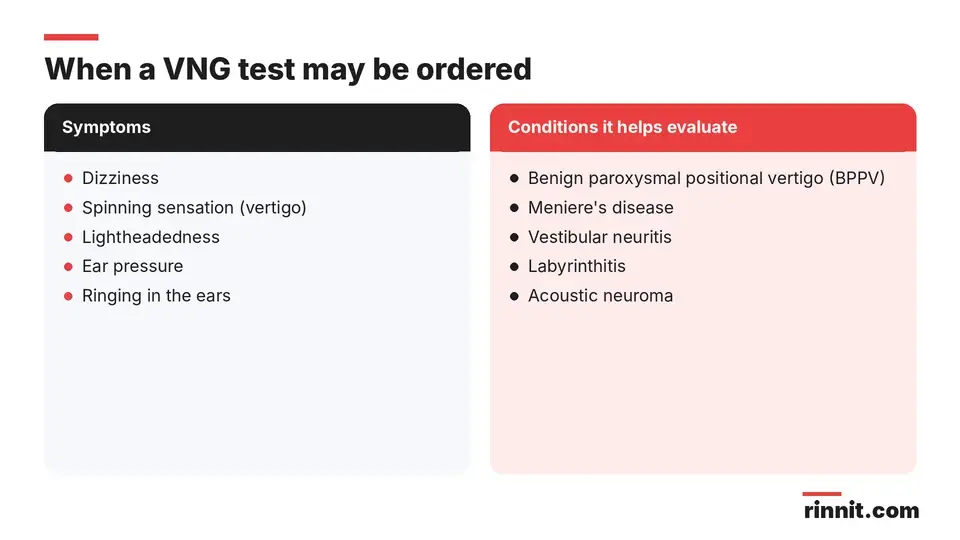
An audiologist or another balance or hearing specialist may order a VNG if you have: [1]
Dizziness
A spinning sensation (vertigo)
Lightheadedness
Ear pressure
Ringing in your ears
These symptoms can be linked to conditions such as: [1]
Acoustic neuroma
Benign paroxysmal positional vertigo (BPPV)
Labyrinthitis
Ménière's disease
Vestibular neuritis
How do you prepare for a VNG?
VNG is considered safe and simple, and side effects are rare. Because you may feel sick afterward, your provider may suggest a light meal beforehand. The test can make you dizzy, so arrange a ride home. [1]

What happens during a VNG test?
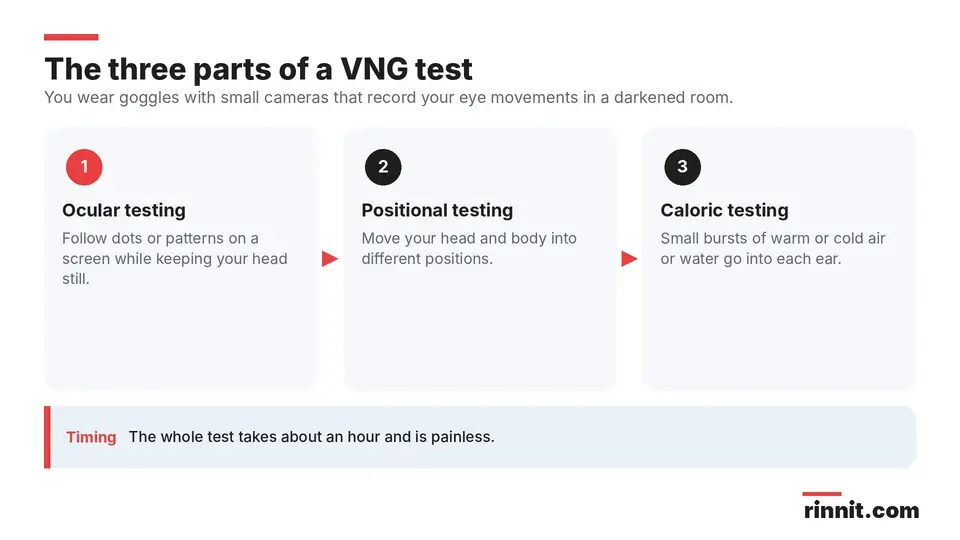
You sit in a darkened room wearing goggles with cameras that record your eye movements. The test has three parts. [1]
Part | What you do | What it checks |
Ocular testing | Follow dots or patterns on a screen while keeping your head still | How your eyes track movement |
Positional testing | Move your head and body in different directions | Whether certain positions trigger nystagmus |
Caloric testing | Small bursts of warm or cold air or water go into each ear | How each inner ear responds |
Sources: [1]
The whole test takes about an hour. [1]
What do VNG results mean?
Results depend on which part of the test showed a change. For example, nystagmus during positional testing may suggest BPPV. [1]
A VNG does not diagnose the underlying condition by itself. Your provider may order more tests to find the cause and plan treatment. [1]
Can a VNG diagnose multiple sclerosis?
No. Providers use other tests for multiple sclerosis, such as an MRI, optical coherence tomography (OCT) or evoked potential testing. [1]
Conclusion
If dizziness or vertigo keeps coming back, a VNG offers a painless, hour-long way to see how your inner ear balance system is working. It turns your eye movements into clues about where the problem may lie.
Eat lightly, bring someone to drive you home and expect that your provider may suggest further tests to pin down the exact cause.
Keep learning: Read our vertigo (BPPV) guide or our guide to the Dix-Hallpike maneuver. For more background, see the MedlinePlus page on electronystagmography.
FAQ
What is a VNG test?
It is a test that records your eye movements with camera goggles to check how well your inner ear balance system works. [1]
What does VNG stand for?
Videonystagmography. [1]
Why would I need a VNG?
For dizziness, vertigo, lightheadedness, ear pressure or ringing in the ears. [1]
What conditions can a VNG help evaluate?
BPPV, Ménière's disease, vestibular neuritis, labyrinthitis and acoustic neuroma. [1]
What are the three parts of a VNG?
Ocular testing, positional testing and caloric testing. [1]
How long does a VNG test take?
About an hour. [1]
Does a VNG test hurt?
No. It is painless, though it can make you briefly dizzy or nauseated. [1]
Should I eat before a VNG?
A light meal beforehand may help, since nausea afterward is possible. [1]
Can I drive after a VNG?
Arrange a ride home because the test can make you dizzy. [1]
Can a VNG diagnose multiple sclerosis?
No. Other tests, such as MRI, are used for multiple sclerosis. [1]
Related Reading
Electronystagmography (ENG): Balance Testing for Dizziness and Vertigo explains the electrode-based eye movement test for balance problems.
Vertigo (BPPV): Symptoms, Causes, and How It Is Treated explains the most common cause of positional nystagmus.
Understanding Meniere's Disease: Symptoms, Causes, and Management covers an inner ear disorder a VNG helps evaluate.
Vestibular Neuritis: Causes, Symptoms, and Recovery describes inner ear nerve inflammation that can show up on caloric testing.
Acoustic Neuroma (Vestibular Schwannoma): What It Is, Symptoms, Causes, and Treatment Options explains a growth on the balance nerve linked to dizziness.
Nystagmus: Understanding Uncontrollable Eye Movements explains the eye movement a VNG records.
References
Cleveland Clinic. Videonystagmography (VNG). Cleveland Clinic. Last updated June 2, 2025. https://my.clevelandclinic.org/health/diagnostics/22630-videonystagmography
Vallim MGB, Gabriel GP, Mezzalira R, et al. Does the video head impulse test replace caloric testing in the assessment of patients with chronic dizziness? A systematic review and meta-analysis. Braz J Otorhinolaryngol. 2021;87(6):733-741. PMID 33642214. https://doi.org/10.1016/j.bjorl.2021.01.002
von Bernstorff M, Obermueller T, Blum J, et al. Accuracy of the Bedside Examination in Patients With Suspected Acute Unilateral Peripheral Vestibulopathy. Neurologist. 2024;29(4):238-242. PMID 38797929. https://doi.org/10.1097/NRL.0000000000000571
Medical disclaimer
This article is for general education only and does not replace advice from a qualified healthcare professional. Talk to your doctor about your own diagnosis and treatment, and seek emergency care right away for severe or sudden symptoms.



Comments