Electronystagmography (ENG): Balance Testing for Dizziness and Vertigo

Updated: 3 days ago
Written and medically reviewed by Dr. Baraa Alnahhal, MD · Last reviewed: November 2026 · How we review
Quick Answer
Electronystagmography (ENG) is a test that records eye movements to check how well the inner ear balance system and the nerves controlling the eyes are working. It looks for nystagmus, fast involuntary eye movements that can signal a balance problem. It helps evaluate dizziness, vertigo and balance problems. It takes about 90 minutes and may cause brief dizziness.
What the research says
ENG and VNG can be recorded together: in healthy volunteers, recording ENG and videonystagmography (VNG) at the same time caused no interference between the tests, though ENG measured somewhat lower nystagmus speeds during caloric testing than VNG (Bielińska M et al., Otolaryngologia Polska, 2018) [2]
Balance tests can't replace MRI for acoustic neuroma: a review of screening methods for vestibular schwannoma (acoustic neuroma) in people with one-sided hearing or balance problems found that non-imaging tests, including ENG and caloric testing, had low diagnostic accuracy, so MRI remains needed (Hentschel M et al., Clinical Otolaryngology, 2017) [3]
Key takeaways
ENG records eye movements to check the inner ear and eye nerves.
Electrodes around the eyes track nystagmus.
The test includes gaze, positional and caloric parts.
It takes about 90 minutes and may cause brief dizziness.
Stop sedatives and anti-vertigo medicines 24 to 48 hours before if told.
What is ENG?
Your inner ear and brain work with your eyes to keep your vision steady when you move. When the vestibular system isn't working properly, your eyes may make jerking movements called nystagmus. ENG measures these movements to check four cranial nerves: the oculomotor, trochlear, abducens and vestibular nerves. It's usually done by an audiologist. Sources: [1]
ENG vs. VNG
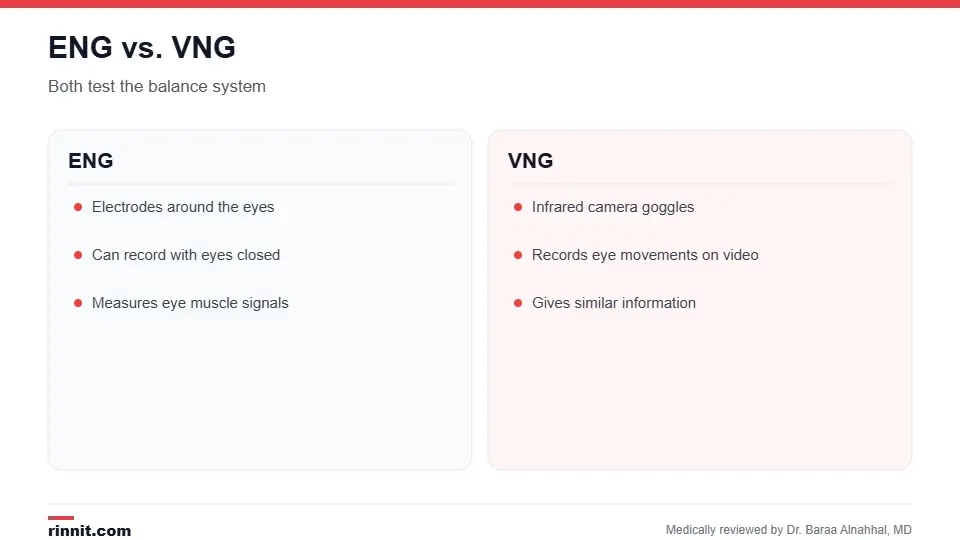
Both tests give similar information.
Test | How eye movements are recorded | Notes |
ENG | Electrodes on the skin around the eyes | Can be done with eyes closed |
Infrared camera goggles | Records eye movements directly on video |
Both give similar information about nerve and inner ear function. Sources: [1, 2]
Why it's done
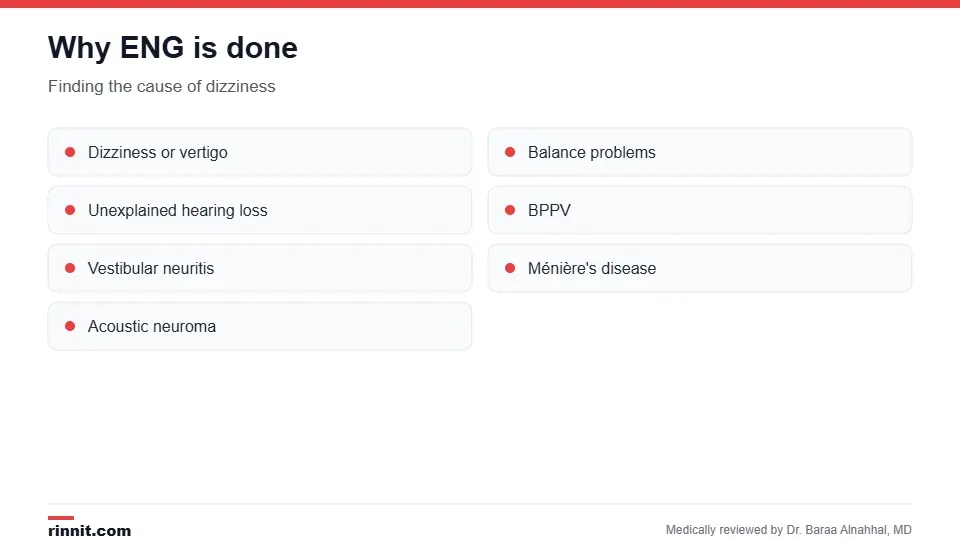
ENG helps find the cause of dizziness.
Dizziness, vertigo or balance problems.
Unexplained hearing loss.
Monitoring conditions such as acoustic neuroma, BPPV, vestibular neuritis, Ménière's disease and Usher syndrome. Sources: [1]
How to prepare
Usually no special preparation is needed.
Tell your provider about all medicines and supplements.
You may be asked to stop sedatives or anti-vertigo medicines for 24 to 48 hours beforehand.
Consider having someone drive you home in case you feel dizzy. Sources: [1]
What happens during the test
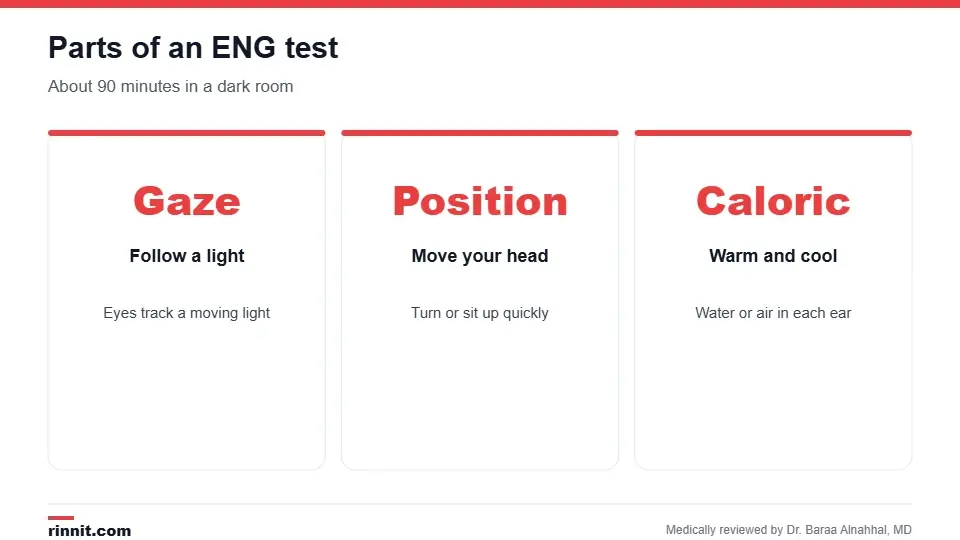
The whole test takes about 90 minutes.
Electrodes are placed above, below and beside each eye, plus one on the forehead, using sticky patches or a headband.
Gaze test: in a dark room, you keep your head still and follow a moving light with your eyes.
Positional test: you turn your head or sit up quickly while your eye movements are recorded.
Caloric test: warm and cool water or air is placed in each ear to stimulate the balance nerve. Sources: [1]
The caloric part can make you briefly dizzy or nauseated, which usually passes the same day. Sources: [1]
Risks
ENG is low risk. Quick movements can cause neck or back pain. Rarely, water pressure can injure the eardrum, so providers may use air instead of water if you have a hole in your eardrum. Sources: [1]
Results
Abnormal eye movements can point to inner ear or nerve damage. Possible causes include blood vessel problems, cholesteatoma, certain medicines, movement disorders, multiple sclerosis, infections and injury. Abnormal results often lead to more tests, such as an MRI, and treatment depends on the cause. Sources: [1, 3]
Conclusion
ENG uses your eye movements as a window into your balance system. It helps your care team find the cause of dizziness or vertigo and choose the right treatment.
Keep learning: read about videonystagmography (VNG) and vestibular testing.
Frequently asked questions
What does ENG test?
Eye movements that reflect how your inner ear balance system works.
What is nystagmus?
Fast, involuntary eye movements that can signal a balance problem.
How long does ENG take?
About 90 minutes.
Does ENG hurt?
No, but the caloric part may make you briefly dizzy.
What is the caloric test?
Warm and cool water or air placed in each ear to stimulate the balance nerve.
What is the difference between ENG and VNG?
ENG uses electrodes; VNG uses camera goggles.
Should I stop my medicines?
Possibly sedatives and anti-vertigo medicines for 24 to 48 hours, if told.
Who performs ENG?
Usually an audiologist.
Can I drive home?
It's safer to have someone drive you in case you feel dizzy.
Can ENG diagnose an acoustic neuroma?
It may suggest one, but an MRI is needed to diagnose it.
Related Reading
Videonystagmography (VNG) Test: What It Checks, Steps and Results the camera-based version of this test.
Vestibular Testing (Vestibular Test Battery): Types, How to Prepare, What to Expect and Results an overview of balance tests.
Nystagmus: Understanding Uncontrollable Eye Movements the eye movements ENG records.
Vertigo (BPPV): Symptoms, Causes, and How It Is Treated a common cause of dizziness.
Understanding Meniere's Disease: Symptoms, Causes, and Management an inner ear disorder ENG helps assess.
References
Cleveland Clinic. Electronystagmography (ENG): What It Is, Procedure & Results. Cleveland Clinic. Last updated April 12, 2022. https://my.clevelandclinic.org/health/diagnostics/22704-electronystagmography-eng
Bielińska M, Polaczkiewicz A, Pietkiewicz P, et al. Concurrent ENG and VNG recording in healthy people: preliminary report. Otolaryngologia Polska. 2018;72(2):45-49. PMID 29748450. https://doi.org/10.5604/01.3001.0011.7251
Hentschel M, Scholte M, Steens S, et al. The diagnostic accuracy of non-imaging screening protocols for vestibular schwannoma in patients with asymmetrical hearing loss and/or unilateral audiovestibular dysfunction: a diagnostic review and meta-analysis. Clinical Otolaryngology. 2017;42(4):815-823. PMID 27905190. https://doi.org/10.1111/coa.12788
Medical disclaimer
This article is for general education only and does not replace advice from a qualified healthcare professional. Talk to your doctor about your own diagnosis and treatment, and seek emergency care right away for severe or sudden symptoms.



Comments