Vestibular Testing (Vestibular Test Battery): Types, How to Prepare, What to Expect and Results

Updated: 2 days ago
Written and medically reviewed by Dr. Baraa Alnahhal, MD · Last reviewed: November 2026 · How we review
Quick Answer: What is vestibular testing?
Vestibular testing is a set of tests that check how well the balance system in the inner ear works. It's ordered for dizziness, vertigo or feeling off balance and can show whether the cause is in the inner ear or the brain. The appointment lasts two hours, the tests are considered safe, and dizziness may linger briefly afterward.
What the research says
VEMP testing is very specific for inner ear fluid buildup but misses many cases on its own. A meta-analysis of vestibular evoked myogenic potentials for endolymphatic hydrops found a pooled sensitivity of 49% and specificity of 95%, so the authors recommended VEMP as part of a test battery for Meniere's disease rather than as a stand-alone test. (Zhang et al., Scientific Reports, 2015) [2]
Caloric and head impulse results can help tell Meniere's disease from vestibular migraine. A meta-analysis of 21 studies with 3,096 patients found people with Meniere's disease were 7 times more likely to show reduced response on caloric testing and 3.4 times more likely to have an abnormal video head impulse test than people with vestibular migraine. (Vosbeek et al., Otology & Neurotology, 2025) [3]
Key takeaways
Vestibular testing checks how the balance system in your inner ear works [1].
It is ordered for dizziness, vertigo or feeling off balance [1].
It can show whether symptoms come from the inner ear or a neurological problem, or rule out an inner ear cause [1].
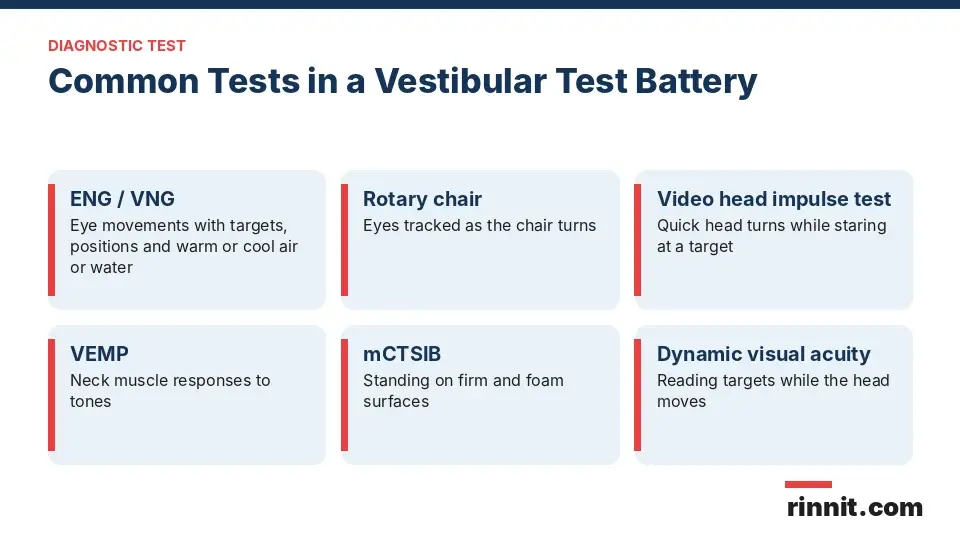
Tests may include ENG or VNG, rotary chair, mCTSIB, video head impulse test, VEMP and dynamic visual acuity [1].
Arrange a ride home, skip eye makeup and follow instructions on food, alcohol and medicines [1].
The visit usually lasts about two hours, and results are often reviewed with you at the end [1].
What is vestibular testing?
Vestibular testing is a set of tests, sometimes called a vestibular test battery, that checks how the balance system in your inner ear works [1]. Your provider may order it if you have dizziness, vertigo or feel off balance [1].
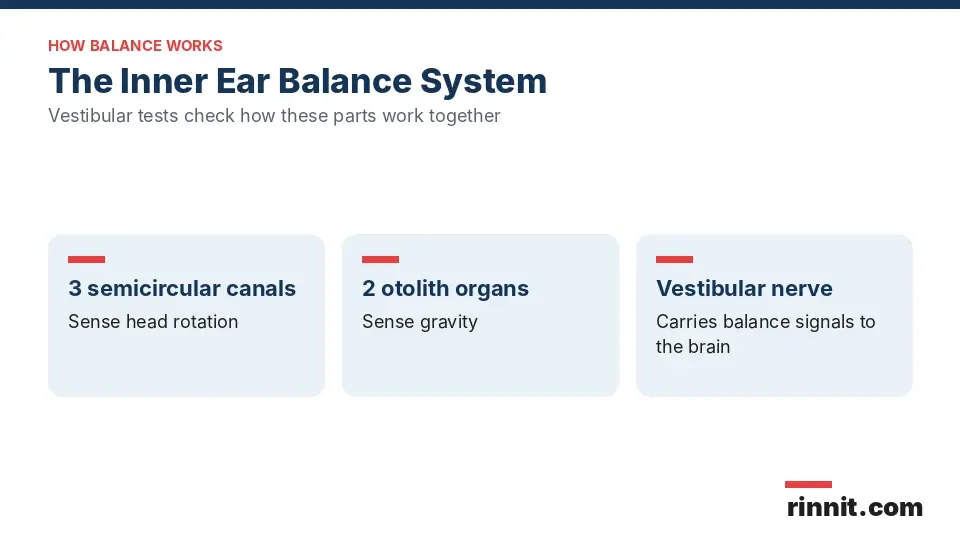
The vestibular system includes three semicircular canals that sense head rotation, two otolith organs that sense gravity and the vestibular nerve [1]. Testing shows how these parts help you coordinate movement and keep your balance [1].
Why vestibular testing is done
Vestibular testing can show whether your symptoms come from your inner ear or from a neurological, or brain, problem [1]. It can help diagnose conditions such as [1]:
It can also help rule out an inner ear cause. Vision problems, injuries, medicines and other health conditions can cause balance-type symptoms even when there is no balance disorder [1].
How vestibular tests work
An audiologist, a specialist in hearing and balance disorders, guides you through simple tasks and asks you questions [1]. Your balance depends on three inputs working together: vision, proprioception, which is your sense of touch and body position, and the vestibular system [1].
A reflex called the vestibulo-ocular reflex (VOR) keeps your vision steady when your head moves [1]. The audiologist watches your eye movements to check this reflex, including looking for nystagmus, which are involuntary eye movements [1].
Types of vestibular tests
Your audiologist chooses tests based on your symptoms, so you may need only some of these, or others [1].
Test | What you do | What it shows |
Electronystagmography (ENG) or videonystagmography (VNG) | Follow a moving target, change head and body positions, and have warm or cool air or water placed in the ear canal; ENG uses electrodes around the eyes and VNG uses goggles with a camera | How the nerves that control eye movement, hearing and balance are working [1] |
Rotary chair | Sit in a motorized chair that turns right and left while wearing goggles | How your eyes and inner ear keep vision focused during motion [1] |
mCTSIB balance test | Stand barefoot on a firm and then a foam surface for 30 seconds each, eyes open and closed | How vision, foot sensation and the inner ear each affect your steadiness [1] |
Video head impulse test (VHIT) | Stare at a target while the audiologist moves your head quickly side to side or up and down | How well each of the three semicircular canals detects head movement [1] |
Vestibular evoked myogenic potentials (VEMP) | Turn your head while listening to tones through headphones, with sensors on your neck | How the otolith organs, the saccule and utricle, are working [1] |
Dynamic visual acuity (DVA) | Identify targets on a screen with your head still, then while it moves | How well your vision holds steady during head movement [1] |
Fall risk assessment | Includes tests of inner ear function | Factors that raise your risk of falling, including inner ear function [1] |
Sources: [1]
How to prepare for vestibular testing
Follow your audiologist's specific instructions [1].
Arrange for someone to drive you home, since dizziness or unsteadiness can linger [1].
Ask which medicines to pause, because some can affect results [1].
Follow guidance on eating and drinking. You may be told to eat only a small meal or fast, and to avoid alcohol [1].
Do not wear eye makeup such as eyeliner, mascara or dark eyeshadow, because the audiologist needs to see all your eye movements [1].

How long does vestibular testing take?
The appointment is usually scheduled for about two hours, but it may be shorter depending on your symptoms and results [1].
Is vestibular testing safe?
Yes. Vestibular testing is considered safe [1]. Some tests can make you feel dizzy or unsteady, and this may linger for a short time afterward [1].
Vestibular test results
Results are either normal, meaning there are no signs that your inner ear balance system is causing your symptoms, or abnormal, meaning there are signs of vestibular or neurological problems contributing to them [1].
Your audiologist may review the results with you at the end of the appointment or later if more time is needed, and the results are sent to the provider who referred you [1]. You may receive an after-visit summary with follow-up instructions [1].
Will I need more tests?
Your results decide the next steps [1]. Your provider may refer you to a specialist or order imaging, such as an MRI to look for soft tissue damage or a CT scan to look for bone damage in the inner ear [1].
How to schedule
Depending on your health insurance, you may need a medical order. Ask your provider whether vestibular testing is right for you [1].
Conclusion
Vestibular testing uses a series of simple tasks to find out whether your dizziness, vertigo or unsteadiness comes from the inner ear or elsewhere. An audiologist guides you through each step.
Plan for about two hours, bring a driver and skip eye makeup. Completing the tests brings you closer to a diagnosis and the right treatment.
Keep learning: Read our guide to the hearing test, our guide to the MRI scan or our guide to the CT scan. For more background, see the MedlinePlus guide to balance problems.
FAQ
What is vestibular testing?
It is a set of tests that check how the balance system in your inner ear works.
Why would I need vestibular testing?
It is ordered for dizziness, vertigo or feeling off balance, to find whether the cause is in the inner ear or the brain.
What conditions can vestibular testing help diagnose?
BPPV, labyrinthitis, Meniere's disease and vestibular neuritis, among others.
What tests are part of a vestibular test battery?
ENG or VNG, rotary chair, mCTSIB, video head impulse test, VEMP, dynamic visual acuity and fall risk assessment.
Who performs vestibular testing?
An audiologist, a specialist in hearing and balance disorders.
How should I prepare for vestibular testing?
Arrange a ride home, skip eye makeup and follow instructions on food, alcohol and medicines.
Can I wear makeup to vestibular testing?
No eye makeup. The audiologist needs to see all your eye movements clearly.
How long does vestibular testing take?
The appointment is usually scheduled for about two hours.
Is vestibular testing safe?
Yes. You may feel dizzy or unsteady during some tests, and this can linger briefly.
What happens after abnormal vestibular test results?
You may be referred to a specialist or have imaging, such as an MRI or CT scan of the inner ear.
Related Reading
Electronystagmography (ENG): Balance Testing for Dizziness and Vertigo explains the electrode-based eye movement test for balance problems.
Vertigo (BPPV): Symptoms, Causes, and How It Is Treated explains BPPV, the most common inner ear cause of vertigo that testing can help identify.
Understanding Meniere's Disease: Symptoms, Causes, and Management covers Meniere's disease, which vestibular tests such as VEMP and caloric testing help diagnose.
Vestibular Neuritis: Causes, Symptoms, and Recovery explains inflammation of the balance nerve, often confirmed with head impulse and caloric tests.
Vestibular Migraine: Symptoms, Causes, and Management covers a migraine type that causes vertigo and that testing helps tell apart from inner ear disease.
Dizziness and Vertigo: Symptoms, Causes & Treatment Guide explains the symptoms that most often lead to vestibular testing.
Vestibular Disorders: Symptoms, Causes, and Management gives an overview of the balance disorders a vestibular test battery is designed to find.
References
Cleveland Clinic. What Is Vestibular Testing? Cleveland Clinic. Last updated May 9, 2023. https://my.clevelandclinic.org/health/diagnostics/21518-vestibular-test-battery
Zhang S, Leng Y, Liu B, et al. Diagnostic Value of Vestibular Evoked Myogenic Potentials in Endolymphatic Hydrops: A Meta-Analysis. Sci Rep. 2015;5:14951. PMID 26455332. https://doi.org/10.1038/srep14951
Vosbeek EGM, Seelen M, Schermer TR, et al. The Differences in Caloric Test and vHIT Results Between Menière's Disease and Vestibular Migraine: A Systematic Review and Meta-Analysis. Otol Neurotol. 2025;46(10):1191-1201. PMID 41126437. https://doi.org/10.1097/MAO.0000000000004644
Medical disclaimer
This article is for general education only and does not replace advice from a qualified healthcare professional. Talk to your doctor about your own diagnosis and treatment, and seek emergency care right away for severe or sudden symptoms.



Comments