Understanding Meniere's Disease: Symptoms, Causes, and Management

Updated: 3 days ago
Medically reviewed by Dr. Baraa Alnahhal, MD · Last reviewed: October 2026
Editorial note: This article is provided for educational purposes only. It is not medical advice. Always consult a qualified healthcare professional about your individual health situation.
Quick Answer: What Is Meniere's Disease?
Meniere's disease is a rare inner ear disorder that disrupts balance and hearing through abnormal buildup of endolymph fluid. [1] It causes unpredictable episodes of intense vertigo, ringing in the ears and fluctuating hearing loss that may become permanent. [1] Diagnosis involves hearing and balance testing, and treatment includes strict salt reduction, medications or surgery to manage fluid pressure. [1]
What the research says
Few high-quality trials support medicines for Meniere's disease. A Cochrane review of 10 studies with 848 participants, covering betahistine, diuretics, antivirals and corticosteroids, concluded that the evidence for systemic medicines is very uncertain, with results rated as low or very low certainty (Webster et al., Cochrane Database Syst Rev, 2023 [2]).
Injections and sac surgery may work better than pills or pressure therapy. An umbrella review of 25 randomized trials (n = 1,248) found the evidence generally low in certainty. Betahistine and positive pressure therapy probably do not reduce symptoms compared with placebo, while intratympanic gentamicin or steroid injections and endolymphatic sac surgery may reduce symptoms (van Esch et al., BMJ Evid Based Med, 2021 [3]).
Older age and sleep disorders are linked to higher risk. A meta-analysis of 25 studies (n = 1,471,944) identified age (HR 2.21, 95% CI 1.85-2.65) and sleep disorder (HR 1.68, 95% CI 1.47-1.93) as risk factors for Meniere's disease (Hu et al., Eur Arch Otorhinolaryngol, 2022 [4]).
What Is Meniere's Disease?
Meniere's disease, clinically referred to as idiopathic endolymphatic hydrops, is a chronic condition affecting the inner ear's ability to process balance and sound signals. [1] It occurs when a fluid called endolymph accumulates excessively within the endolymphatic sac and surrounding membranes. [1] This buildup creates pressure that interferes with the delicate sensory structures of the ear, leading to sudden and often debilitating symptoms.

The disorder is considered rare and most frequently develops in individuals between the ages of 40 and 60. [1] While the exact cause remains unknown, the resulting episodes can vary in duration from twenty minutes to a full day. [1] Without proper clinical intervention, the condition typically worsens over time, potentially leading to ongoing balance instability and permanent sensory loss. [1]
What are the symptoms of Meniere's disease?
The clinical presentation of Meniere's disease is defined by a specific triad of symptoms that occur in recurrent episodes. These episodes can appear back-to-back or be separated by long periods of remission. [1] The unpredictability of these attacks often contributes to significant emotional distress, including anxiety and depression. [1]
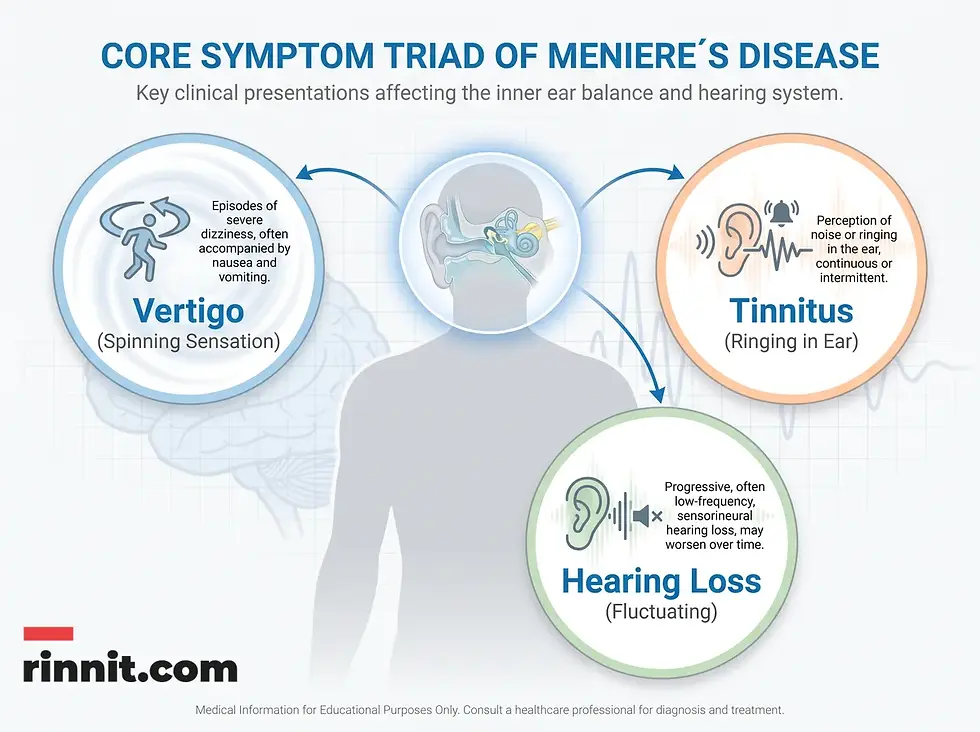
Symptom | Description and Impact |
Vertigo | Intense spinning sensations that may cause "drop attacks" or severe falls. |
Hearing Loss | Fluctuating difficulty hearing, often beginning with lower pitches in one ear. |
Tinnitus | Persistent ringing, whirring, or whooshing sounds in the affected ear. |
Aural Fullness | A distinct feeling of pressure or congestion within the inner ear. |
Beyond the core symptoms, individuals often experience secondary effects such as nausea and vomiting during acute attacks. [1] Over a period of eight to ten years, the fluctuating hearing loss associated with these episodes frequently transitions into a permanent condition. [1]
What causes Meniere's disease, and what are the risk factors?
Medical experts believe the primary driver of Meniere's disease is the disruption of fluid signals to the brain caused by endolymph buildup. [1] Several factors are suspected to trigger this accumulation, including inner ear blockages, head injuries, viral infections, and severe migraines. Research also suggests that allergies may play a role in the development of the disorder. [1]
Genetic factors are present in approximately 7% to 10% of cases, indicating a hereditary component for some families. [1] Additionally, individuals with certain autoimmune conditions—such as lupus, rheumatoid arthritis, or ankylosing spondylitis—may face a higher risk of developing the disease. [1] Females are also slightly more likely to be diagnosed than males. [1]
How is Meniere's disease diagnosed and treated?
Diagnosis is typically conducted by an otolaryngologist (ENT) through a combination of physical and neurological examinations. [1] Clinical testing is essential to rule out other conditions, such as brain tumors, that may mimic the symptoms of inner ear disorders. [1] Common diagnostic tools include audiometry to assess hearing levels and vestibular test batteries to evaluate the balance system's reflexes. [1]
Although no definitive cure exists, a variety of management strategies can reduce the impact of the disease. [1] Treatment usually begins with conservative measures before progressing to more invasive options if symptoms persist. [1]

Lifestyle Modifications: Patients are advised to follow a low-sodium diet, limiting sodium to no more than 1,500 milligrams per day. [1] Reducing caffeine, alcohol, and MSG consumption can also help manage fluid levels.
Pharmacological Support: Diuretics (water pills) are used to lower total body fluid, while betahistine is sometimes used, though trials suggest it probably works no better than placebo. [1] Acute vertigo is often managed with medications like diazepam or meclizine. [1]
Advanced Interventions: In persistent cases, healthcare providers may recommend steroid injections or gentamicin through the eardrum. [1] [3] Specialized therapies, including vestibular rehabilitation and cognitive behavioral therapy, support physical balance and mental health. [1]
Conclusion
Meniere's disease is a complex, lifelong condition that requires a proactive and multidisciplinary approach to care. By combining dietary discipline with modern medical treatments and physical therapy, most individuals can successfully manage their symptoms and mitigate the risk of long-term complications. Understanding the triggers and maintaining a consistent treatment plan are the most effective ways to preserve hearing and maintain a high quality of life.
What should you do if you have symptoms of Meniere's disease?
If you are experiencing recurrent dizziness, ringing in your ears, or sudden changes in your hearing, it is vital to seek an evaluation from an ear, nose, and throat specialist. Early diagnosis and the implementation of a personalized management plan can help you regain control over your balance and protect your long-term auditory health.
Sources: Cleveland Clinic — Ménière's Disease | Webster et al., 2023 | van Esch et al., 2021 | Hu et al., 2022
Frequently Asked Questions
1. What is Meniere's disease?
Meniere's disease is a chronic inner ear disorder caused by fluid buildup that leads to vertigo, hearing loss, and tinnitus.
2. What are the main symptoms of Meniere's disease?
The primary symptoms include episodes of vertigo, ringing in the ears (tinnitus), hearing loss, and a feeling of pressure in the ear.
3. What causes Meniere's disease?
The exact cause is unknown, but it is linked to a buildup of endolymph fluid in the inner ear, which may be triggered by infections, injuries, or allergies.
4. How long do Meniere's episodes last?
An episode can last anywhere from 20 minutes to a full 24 hours, and they may occur frequently or months apart.
5. Is there a cure for Meniere's disease?
There is currently no cure, but treatments like diet changes and medications can effectively manage symptoms and reduce attack frequency.
6. What is the recommended diet for Meniere's disease?
Healthcare providers recommend a low-sodium diet, typically limited to 1,500 milligrams of sodium per day, and avoiding caffeine and alcohol.
7. Can Meniere's disease cause permanent hearing loss?
Yes, if left untreated, the repeated episodes can lead to permanent hearing loss, usually over a period of eight to ten years.
8. Who is most at risk for Meniere's disease?
Meniere's disease most commonly affects adults between the ages of 40 and 60, with a slightly higher prevalence in females.
9. How is Meniere's disease diagnosed?
Diagnosis involves a physical exam, hearing tests, and vestibular balance testing conducted by an ENT specialist.
10. Can surgery treat Meniere's disease?
Surgery, such as an endolymphatic sac procedure, may be recommended for severe cases that do not respond to medication or diet changes.
Related Reading
Electronystagmography (ENG): Balance Testing for Dizziness and Vertigo explains the electrode-based eye movement test for balance problems.
Videonystagmography (VNG) Test: What It Checks, Steps and Results explains how a VNG test checks the inner ear balance system.
Vestibular Testing (Vestibular Test Battery): Types, How to Prepare, What to Expect and Results explains the inner ear balance tests used for dizziness and vertigo, how to prepare and what results mean.
References
Cleveland Clinic. Ménière's Disease. Cleveland Clinic. May 6, 2025. https://my.clevelandclinic.org/health/diseases/15167-menieres-disease
Webster KE, Galbraith K, Harrington-Benton NA, et al. Systemic pharmacological interventions for Ménière's disease. Cochrane Database Syst Rev. 2023;2(2):CD015171. PMID 36827524. https://doi.org/10.1002/14651858.CD015171.pub2
van Esch BF, van der Zaag-Loonen H, Bruintjes T, et al. Interventions for Menière's disease: an umbrella systematic review. BMJ Evid Based Med. 2021;27(4):235-245. PMID 34750154. https://doi.org/10.1136/bmjebm-2020-111410
Hu C, Yang W, Kong W, et al. Risk factors for Meniere disease: a systematic review and meta-analysis. Eur Arch Otorhinolaryngol. 2022;279(12):5485-5496. PMID 35794275. https://doi.org/10.1007/s00405-022-07505-5
Medical disclaimer
The information provided in this article is for educational purposes only and should not be used as a substitute for professional medical advice, diagnosis, or treatment. Always seek the advice of your physician or other qualified health provider with any questions you may have regarding a medical condition. Never disregard professional medical advice or delay in seeking it because of something you have read here.



Comments