
The Dix-Hallpike Maneuver: How the BPPV Test Works and What Your Results Mean

Updated: 6 days ago
Written and medically reviewed by Dr. Baraa Alnahhal, MD · Last reviewed: October 2026 · How we review

Quick Answer
The Dix-Hallpike maneuver is a quick, noninvasive office test that diagnoses benign paroxysmal positional vertigo (BPPV). A provider turns your head 45 degrees, lays you back quickly with your head slightly off the table, and watches your eyes. Involuntary eye movements (nystagmus) point to BPPV, which is often treated with the Epley maneuver. [1]
What the research says
Treatment after a positive test works well. A review of 11 randomized trials with 745 adults found that the Epley maneuver resolved vertigo completely in 56% of people, compared with 21% after a sham maneuver or no treatment (5 trials, 273 participants). It was also far more likely to turn a positive Dix-Hallpike test negative (odds ratio 9.62; 8 trials, 507 participants). BPPV came back in about 36% of people after treatment (Hilton and Pinder, Cochrane Database of Systematic Reviews, 2014). [2]
Testing both sides, with more than one test, catches more cases. In video eye-movement records from 2,387 patients, 131 (5.5%) showed nystagmus on both the Dix-Hallpike test and the supine head roll test. Among the analyzed cases, 62.3% turned out to be lateral canal BPPV and 9.0% posterior canal BPPV, so the authors advise doing both tests fully on both sides and reading the results together (Hizal et al., Journal of International Advanced Otology, 2022). [3]
Repositioning beats home exercises in the short term. A 2026 meta-analysis of 13 studies (911 participants) found Epley-type maneuvers roughly doubled short-term treatment success compared with Brandt-Daroff exercises (risk ratio 2.10; 6 studies, 348 participants). Recurrence did not clearly differ between the two (risk ratio 0.91), and the certainty of the evidence was low (Alkhalefah et al., Cureus, 2026). [4]
Dix-Hallpike maneuver at a glance
Question | Answer |
What it tests for | Benign paroxysmal positional vertigo (BPPV) |
In use since | 1952; still the gold standard test for BPPV |
How long it takes | A few minutes, in the provider's office |
Preparation | None needed |
What the provider watches for | Nystagmus (involuntary eye movements) |
Results | Given right away: positive or negative |
Usual next step if positive | Epley maneuver, often at the same visit |
Usual next step if negative | Supine head roll test or other tests |
What is the Dix-Hallpike maneuver?
The Dix-Hallpike maneuver is a test healthcare providers use to diagnose benign paroxysmal positional vertigo (BPPV), a common type of vertigo. [1]
Providers have used it for over 70 years, and since 1952 it has been the gold standard test for BPPV. [1]
It is quick and noninvasive. It remains one of the most accurate diagnostic tests available. [1]
One point matters early: the Dix-Hallpike maneuver cannot treat BPPV. It tells your provider whether you have it, so they can recommend the right treatment. [1]
For a full overview of the condition itself, see our guide to vertigo (BPPV): symptoms, causes, and treatment.
Why does the Dix-Hallpike maneuver trigger vertigo in BPPV?
The Dix-Hallpike maneuver triggers vertigo in BPPV because its head movements shift loose crystals inside the inner ear. [1]
With BPPV, moving your head into certain positions can cause a sudden spinning sensation. [1]
This happens when tiny calcium carbonate crystals in your inner ear float into a different part of the ear called the semicircular canals. [1]
The test takes you through movements that make these crystals move. If you have BPPV, the movements bring on signs of vertigo. [1]
When the crystals shift, your eyes move on their own. This is called nystagmus, and it is the sign that out-of-place crystals are causing your vertigo. [1]
Why does a correct BPPV diagnosis matter before treatment?
A correct BPPV diagnosis matters because the main treatment, the Epley maneuver, only works for classic BPPV. [1]
The Epley maneuver does not work for other conditions that cause vertigo. [1]
So confirming BPPV first helps your provider avoid a treatment that will not help, and points them toward other causes if the test is negative.
How do you prepare for the Dix-Hallpike test?
You do not need to do anything to prepare for the Dix-Hallpike test. [1]
It takes only a few minutes and is done in your healthcare provider's office. [1]
What happens during the Dix-Hallpike maneuver?
During the Dix-Hallpike maneuver, a provider guides you from sitting to lying down with your head turned to one side, then checks your eyes for nystagmus. [1]

Step | What happens | Why it matters |
1 | You sit on an exam table with your legs stretched out in front of you. | Sets up the starting position. |
2 | The provider turns your head 45 degrees to the right or left. | The side your head turns toward is the side being checked. |
3 | You are asked to keep your eyes open. | The provider must be able to see your eyes. |
4 | The provider holds your head and guides you to lie down quickly, so your head is slightly off the table with one ear pointing toward the floor. You stay there for a few moments. | This movement shifts any loose crystals. Your provider supports the weight of your head the whole time. |
5 | The provider checks your eyes for nystagmus. | Nystagmus is the sign of BPPV. You may feel dizzy, but it usually passes quickly. |
6 | The same movements may be repeated with your head turned the other way. | Tests the other ear. |
Source for steps: [1]
Is the Dix-Hallpike test safe?
The Dix-Hallpike test is generally safe, but some people need a modified version or a different approach. [1]
Situation | What the provider may do |
Neck or back problems | Skip the test, or use a modified version, such as placing a pillow behind your shoulders so your head rests on the table and your neck is not strained |
Pregnancy | May avoid the test |
Recent stroke | May avoid the test |
Source: [1]
Tell your provider about any of these before the test begins.
What happens after the Dix-Hallpike test?
After the Dix-Hallpike test, you may need a moment to recover from any dizziness, or you may feel fine. [1]
Let your provider know how you feel. That way, they know when you are ready to focus on what they say about your results. [1]
What do Dix-Hallpike test results mean?
Dix-Hallpike test results are either positive or negative, and your provider can usually tell you right away. [1]
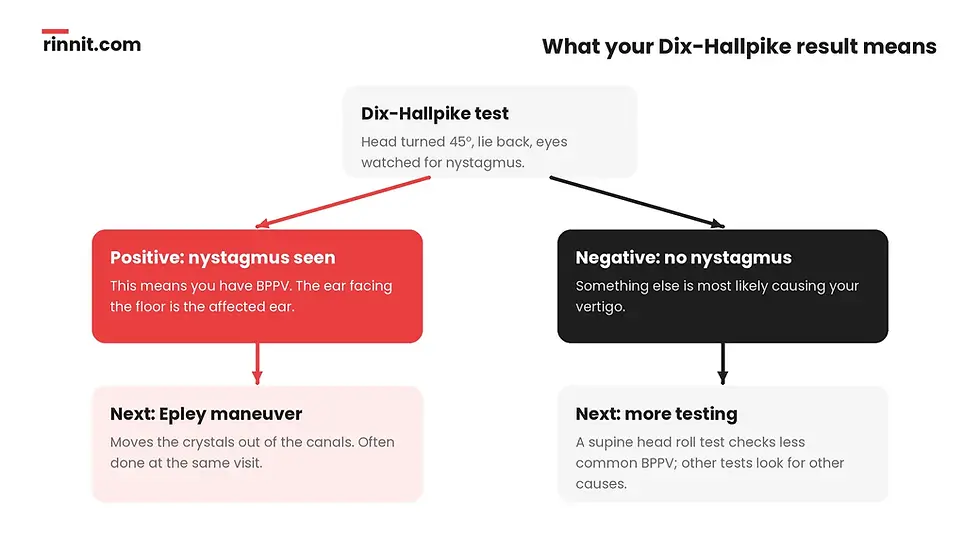
Result | What it means | What usually comes next |
Positive (nystagmus seen) | You have benign paroxysmal positional vertigo. | The Epley maneuver, which moves the crystals out of the semicircular canals. It can usually be done at the same appointment. |
Negative (no nystagmus) | Something else is most likely causing your vertigo. | A supine head roll test, which also uses simple head movements, to check for less common forms of BPPV. Your provider will run more tests to find the cause. |
Source: [1]
The two tests check different parts of the inner ear. The Dix-Hallpike test is used for posterior canal BPPV, while the head roll test is used for lateral canal BPPV. [5]
If BPPV is ruled out, other causes of spinning are considered. Our guides to dizziness and vertigo and vestibular migraine explain some of them.
How does the Dix-Hallpike test show which ear has BPPV?
The Dix-Hallpike test shows which ear has BPPV by the ear that faces the floor when nystagmus appears. [1]
For example, if nystagmus starts while your right ear points toward the floor, the crystals are in your right ear. [1]
What is the difference between the Dix-Hallpike and Epley maneuvers?
The Dix-Hallpike maneuver diagnoses BPPV, while the Epley maneuver treats it. [1]
Dix-Hallpike maneuver | Epley maneuver | |
Purpose | Diagnoses BPPV | Treats BPPV |
How it works | Head movements that shift crystals and trigger nystagmus | Head movements that guide the crystals back to where they belong |
Type | Diagnostic test | One of several canalith (crystal) repositioning procedures |
Works for | Finding BPPV | Classic BPPV only |
Who does it | A healthcare provider | A provider; they can also teach you to do it at home |
Source: [1]
Because the Epley maneuver only works for classic BPPV, a provider needs to diagnose the problem first so it can be treated properly. [1]
Can you do the Dix-Hallpike maneuver at home?
No. Only a healthcare provider can do diagnostic tests like the Dix-Hallpike maneuver. [1]
Your provider can, however, show you how to treat BPPV at home with the Epley maneuver. [1]
Conclusion
The Dix-Hallpike maneuver is a fast, well-established office test that answers one key question: is BPPV behind your vertigo? Your provider turns your head 45 degrees, lays you back with your head supported just off the table, and watches your eyes. If nystagmus appears, you have BPPV, and the ear facing the floor is the affected one. Treatment with the Epley maneuver can often start at the same visit. If the test is negative, your provider looks further, starting with a head roll test and then other causes.
Your next step: If head movements make the room spin, book a visit with your healthcare provider and bring this guide with you. Tell them about any neck or back problems, pregnancy, or a recent stroke before the test. To understand the condition behind the test, read our full guide to vertigo (BPPV).
FAQ
What is the Dix-Hallpike maneuver used for?
The Dix-Hallpike maneuver is used to diagnose benign paroxysmal positional vertigo (BPPV), a common type of vertigo. It cannot treat BPPV, but it tells your provider whether you have it. [1]
Does the Dix-Hallpike test hurt?
The test is noninvasive and generally safe. You may feel dizzy while lying back, but the dizziness usually does not last long. [1]
How long does the Dix-Hallpike test take?
The test takes only a few minutes in your healthcare provider's office, and you do not need to prepare for it. [1]
What does a positive Dix-Hallpike test mean?
A positive Dix-Hallpike test means you have benign paroxysmal positional vertigo. Your provider may then do the Epley maneuver, often at the same appointment. [1]
What does a negative Dix-Hallpike test mean?
A negative Dix-Hallpike test most likely means something else is causing your vertigo. Your provider may do a supine head roll test for less common forms of BPPV and run other tests. [1]
Who should not have the Dix-Hallpike test?
Providers may avoid or modify the test if you have neck or back problems, are pregnant, or recently had a stroke. A pillow behind the shoulders can keep strain off the neck. [1]
Is the Dix-Hallpike maneuver the same as the Epley maneuver?
No. The Dix-Hallpike maneuver diagnoses BPPV, and the Epley maneuver treats it by moving the crystals back where they belong. [1]
Can I do the Dix-Hallpike test on myself?
No. Only a healthcare provider can do the Dix-Hallpike test, but they can teach you to treat BPPV at home with the Epley maneuver. [1]
Do I need to prepare for the Dix-Hallpike test?
No special preparation is needed. The test takes only a few minutes and is done in your provider's office.
How does the Dix-Hallpike test show which ear is affected?
The affected ear is the one facing the floor when the eye movements (nystagmus) appear. For example, if nystagmus starts while your right ear points down, the loose crystals are likely in your right ear.
Trusted external resources
Related Reading
Vertigo (BPPV): Symptoms, Causes, and How It Is Treated explains BPPV symptoms, causes and treatment.
Canalith Repositioning Procedure (Epley Maneuver): How It Treats BPPV Vertigo explains how the Epley maneuver moves ear crystals to stop vertigo.
Vestibular Testing (Vestibular Test Battery): Types, How to Prepare, What to Expect and Results describes the tests used to check the inner ear balance system.
Vestibular Rehabilitation Therapy: Managing Dizziness and Balance explains exercises that retrain balance and reduce dizziness.
References
Cleveland Clinic. Dix-Hallpike Maneuver: Test, Purpose & Results. Cleveland Clinic. Last updated September 1, 2025. https://my.clevelandclinic.org/health/treatments/24859-dix-hallpike-maneuver
Hilton MP, Pinder DK. The Epley (canalith repositioning) manoeuvre for benign paroxysmal positional vertigo. Cochrane Database Syst Rev. 2014;2014(12):CD003162. PMID 25485940. https://doi.org/10.1002/14651858.CD003162.pub3
Hizal E, Jafarov S, Erbek SH, et al. Clinical Interpretation of Positional Nystagmus Provoked by both Dix-Hallpike and Supine Head-Roll Tests. J Int Adv Otol. 2022;18(4):334-339. PMID 35894530. https://doi.org/10.5152/iao.2022.21461
Alkhalefah F, Alhazmi W, Alkhalefah F, et al. Epley-Type Maneuvers Versus Brandt-Daroff Exercises for Posterior-Canal Benign Paroxysmal Positional Vertigo: A Systematic Review and Meta-Analysis. Cureus. 2026;18(7):e112282. PMID 42569660. https://doi.org/10.7759/cureus.112282
Imai T, Inohara H. Benign paroxysmal positional vertigo. Auris Nasus Larynx. 2022;49(5):737-747. PMID 35387740. https://doi.org/10.1016/j.anl.2022.03.012
Medical disclaimer
This article is for general educational purposes only and is not a substitute for professional medical advice, diagnosis, or treatment. Always seek the advice of a qualified healthcare provider about any medical condition or symptom.



Comments