Rinne Test: Tuning Fork Hearing Check and What Results Mean

Updated: 2 days ago
Written and medically reviewed by Dr. Baraa Alnahhal, MD · Last reviewed: November 2026 · How we review
Quick Answer
The Rinne test is a hearing screening that uses a tuning fork to compare how well you hear sound through the air versus through the bone behind the ear. Hearing it better through the bone may point to conductive hearing loss. It takes a minute or two and is painless. An audiogram is used to confirm hearing loss.
What the research says
Accuracy varies: a systematic review of 17 studies with 3,158 participants found the Rinne test detected conductive hearing loss with sensitivity of 43% to 91% and specificity of 50% to 100% using a 256-Hz tuning fork (Kelly EA et al., Otolaryngology--Head and Neck Surgery, 2018) [2]
It's a clue, not a screening tool: a JAMA review found an abnormal Rinne result makes conductive hearing loss more likely, but tuning fork tests shouldn't replace formal hearing tests for general screening (Bagai A et al., JAMA, 2006) [3]
Key takeaways
The Rinne test compares air conduction with bone conduction using a tuning fork.
A positive result (louder by the ear) is normal.
A negative result (louder on the bone) suggests conductive hearing loss.
It's often paired with the Weber test.
A full hearing test confirms any hearing loss.
How hearing works
Sound normally travels through the ear canal, vibrates the eardrum and passes through three tiny middle ear bones to the inner ear. That's air conduction. Sound can also vibrate the skull bones and reach the inner ear directly, which is bone conduction. Air conduction is usually more efficient. When the outer or middle ear is blocked, air conduction drops, so bone conduction may sound louder. Sources: [1]
Types of hearing loss

The Rinne and Weber tests help tell them apart.
Type | Where the problem is | Common causes |
Conductive | Outer or middle ear | Earwax, fluid or ear infections, eardrum hole, otosclerosis |
Sensorineural | Inner ear or hearing nerve | Aging, noise exposure, some medicines, acoustic neuroma |
Sources: [1]
How the Rinne test is done

The test takes a minute or two for each ear.
You sit in a quiet room.
Your provider taps a tuning fork to make it vibrate.
The base of the fork is placed on the bone behind your ear, and you say when you can no longer hear it.
Without striking it again, the provider holds the fork just outside your ear and asks when you stop hearing it.
The test is repeated on the other ear. Sources: [1]
What the results mean
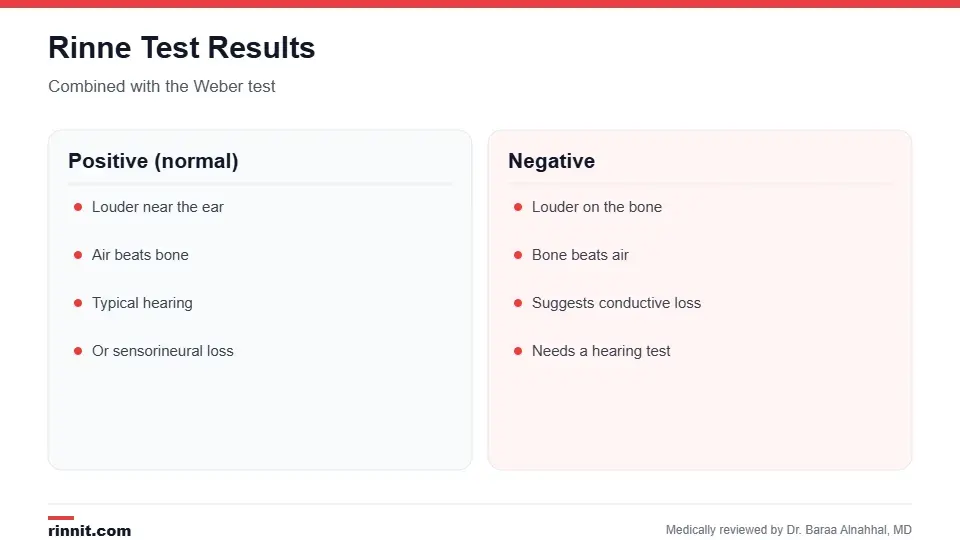
Results are combined with the Weber test.
Result | What you notice | What it suggests |
Positive | Sound lasts longer and is louder near the ear | Typical hearing or sensorineural hearing loss |
Negative | Sound is louder on the bone | Conductive hearing loss in that ear |
Results are known right away. Your provider may also do a Weber test, where the fork is placed on top of your head, to check for sensorineural hearing loss, or refer you to an audiologist. Sources: [1]
Accuracy and limits
The Rinne test is quick and useful at the bedside, but it can miss mild conductive hearing loss and results vary with the tuning fork used and the examiner. That's why it's used as a screening test and confirmed with formal audiometry. Sources: [1, 2, 3]
Conclusion
The Rinne test is a simple, fast way to check whether hearing loss might come from a blockage in the outer or middle ear. Combined with the Weber test and a full hearing exam, it helps your provider find the cause and the right treatment.
Keep learning: read about the Weber test and hearing loss.
Frequently asked questions
What does the Rinne test check?
Whether you hear better through air or through bone.
What is a positive Rinne test?
Sound is louder near the ear than on the bone, which is normal.
What is a negative Rinne test?
Sound is louder on the bone, suggesting conductive hearing loss.
Does the Rinne test hurt?
No. It's painless.
How long does it take?
A minute or two per ear.
What is conductive hearing loss?
Hearing loss from a blockage in the outer or middle ear.
What is the Weber test?
A tuning fork test on top of the head that helps detect sensorineural loss.
Is the Rinne test accurate?
It's a useful screen but can miss mild hearing loss.
What happens after an abnormal result?
You may have a full hearing test with an audiologist.
When should I see a provider?
Right away for any sudden change in hearing.
Related Reading
Weber Test for Hearing Loss: How It's Done and What Results Mean the tuning fork test often done with the Rinne test.
Hearing Test: What It Is, Why It's Done, Types, What to Expect and Results a full test of your hearing.
Hearing Loss: Symptoms, Causes, and Treatment Options causes and treatment of hearing loss.
Tympanometry: What It Is, How It's Done and What Tympanogram Results Mean a test of the eardrum and middle ear.
Ear Infections: Symptoms, Causes, and Treatment a common cause of conductive hearing loss.
References
Cleveland Clinic. What Is a Rinne Test? Cleveland Clinic. Last updated October 31, 2025. https://my.clevelandclinic.org/health/diagnostics/rinne-test
Kelly EA, Li B, Adams ME. Diagnostic accuracy of tuning fork tests for hearing loss: a systematic review. Otolaryngology--Head and Neck Surgery. 2018;159(2):220-230. PMID 29661046. https://doi.org/10.1177/0194599818770405
Bagai A, Thavendiranathan P, Detsky AS. Does this patient have hearing impairment? JAMA. 2006;295(4):416-428. PMID 16434632. https://doi.org/10.1001/jama.295.4.416
Medical disclaimer
This article is for general education only and does not replace advice from a qualified healthcare professional. Talk to your doctor about your own diagnosis and treatment, and seek emergency care right away for severe or sudden symptoms.



Comments