Weber Test for Hearing Loss: How It's Done and What Results Mean

Updated: 2 days ago
Written and medically reviewed by Dr. Baraa Alnahhal, MD · Last reviewed: November 2026 · How we review
Quick Answer: What is a Weber test?
A Weber test is a hearing check that uses a tuning fork placed on the middle of the forehead or the top of the head. If the sound is louder in the ear with hearing loss, that points to conductive hearing loss; if it's quieter there, that points to sensorineural hearing loss. It's often paired with a Rinne test. [1]
What the research says
The Weber test is sensitive to small differences between ears, but accuracy varies. A systematic review of 17 studies with 3,158 adults and children found the Weber test shifted from normal to abnormal with only 2.5 to 4 dB of difference between ears, while tuning fork test methods and accuracy varied widely between studies. (Kelly et al., Otolaryngology–Head and Neck Surgery, 2018) [2]
It is less reliable in young children with fluid in the ear. In 58 children aged 2 to 11 with otitis media with effusion, Weber results were not linked to the measured hearing gap with either a 256 Hz or 512 Hz fork, and the authors judged tuning fork accuracy poor in this group. (Behn et al., The Journal of Otolaryngology, 2007) [3]
Key takeaways
The Weber test uses a tuning fork to help tell conductive from sensorineural hearing loss. [1]
It's most useful when hearing loss is in one ear. [1]
Louder in the weaker ear suggests conductive loss; quieter in the weaker ear suggests sensorineural loss. [1]
It's quick, painless and needs no preparation. [1]
It isn't a formal hearing test, so your provider may add a Rinne test or refer you to an audiologist. [1]
What is a Weber test?
A Weber test is one of the ways providers check your hearing. It shows how sound travels to your inner ear and helps identify the type of hearing loss you may have. A tuning fork is a two-pronged metal instrument that makes a tone when tapped. [1]
You may have the test as part of a routine hearing screening or if your provider thinks you have hearing loss in one ear. [1]
Types of hearing loss the Weber test checks
Type | What happens | Common causes |
Conductive hearing loss | Sound can't travel through your outer or middle ear to your inner ear | Lots of earwax, chronic ear infections, a ruptured eardrum |
Sensorineural hearing loss | Hair cells in your inner ear or the hearing nerve are damaged | Damage to the inner ear hair cells or the vestibulocochlear nerve |
Sources: [1]
How does hearing work?
Sound waves turn into vibrations that pass from your eardrum to the tiny bones in your middle ear. From there, the vibrations reach tiny hair cells deep in your inner ear. These hair cells send signals to your auditory nerve and on to your brain. The Weber test uses the vibration of a tuning fork to see how sound reaches your inner ear through the bones of your skull. [1]
How is a Weber test done?
A primary care provider or an ear, nose and throat specialist (otolaryngologist) may do the test. It takes only a minute: [1]
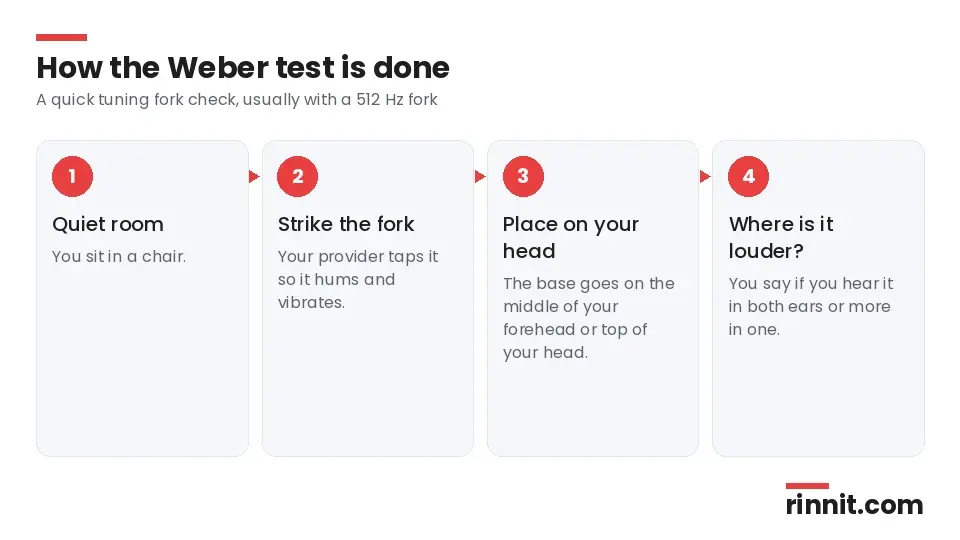
You sit in a chair in a quiet room.
Your provider taps the tuning fork, usually a 512 Hz fork, on their knee so it hums and vibrates.
They place the base of the fork on the middle of your forehead or the top of your head.
They ask whether you hear the sound in both ears or in only one ear.
No preparation is needed, and the test doesn't hurt. [1]
What do Weber test results mean?
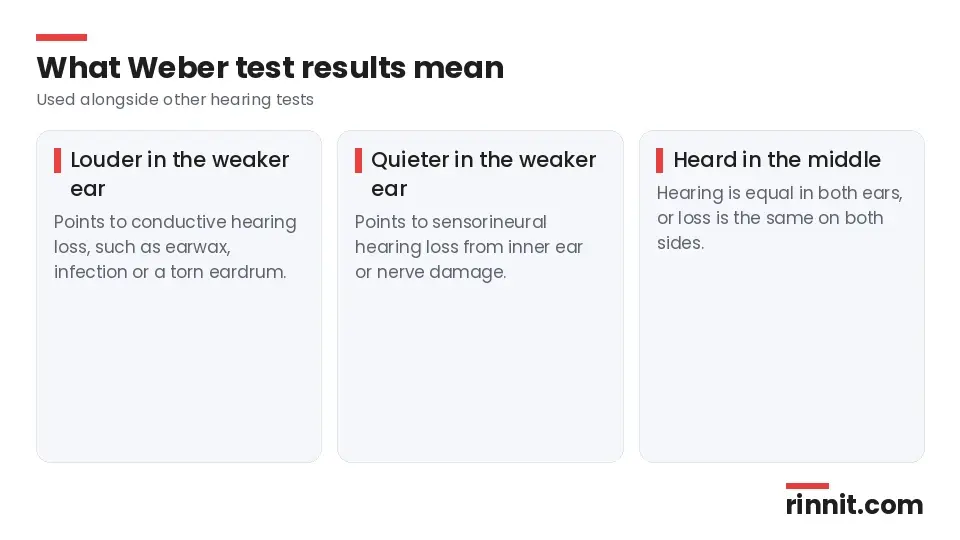
If your provider says the test is positive, it means you have conductive or sensorineural hearing loss. Where you hear the sound helps show which: [1]
Where the sound is heard | What it suggests |
Louder in the ear with hearing loss | Conductive hearing loss |
Quieter in the ear with hearing loss | Sensorineural hearing loss |
Loudest in the middle of your forehead | Hearing is equal, or hearing loss is the same in both ears |
Sources: [1]
Your provider will explain your results and may combine them with other tests to recommend treatment. [1] Research shows the Weber test can pick up small differences between ears, but its accuracy varies, especially in young children with fluid behind the eardrum. [2] [3]
What happens next?
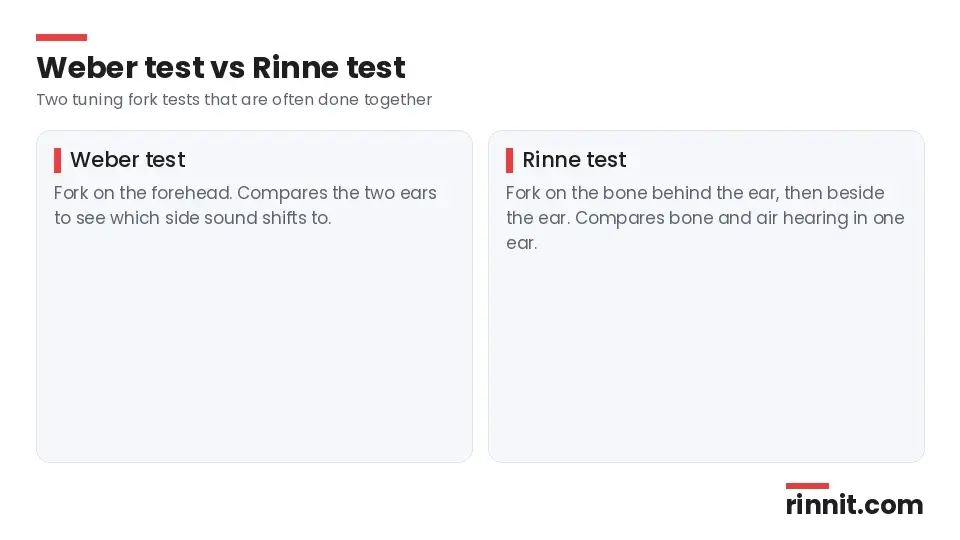
Your provider may also do a Rinne test, which uses the same tuning fork placed against your head and then next to your ear to compare how you hear in each position. They may also refer you to an audiologist for formal hearing tests. [1]
Test | Where the fork goes | What it compares |
Weber test | Middle of the forehead or top of the head | Which ear the sound shifts to |
Rinne test | Against your head, then next to your ear | Hearing through bone vs through the air in one ear |
Sources: [1]
Why do providers still use the Weber test?
Providers have used the Weber test for almost 200 years. Back then it was the only way to diagnose hearing loss. Today it isn't a formal hearing loss test, but it's a simple way to learn what may be causing hearing problems, which can be the first step toward better hearing. [1]
Conclusion
The Weber test takes about a minute and needs nothing more than a tuning fork. Where you hear the tone helps your provider sort out whether hearing loss comes from a blockage in the ear or from inner ear or nerve damage. [1]
Because it's a quick screening check, follow up with formal hearing tests if your provider recommends them, and don't ignore new or one-sided hearing loss.
Keep learning: Read our guide to hearing tests or our article on conductive hearing loss. For more background, see MedlinePlus: Hearing loss.
FAQ
What is a Weber test?
A tuning fork hearing test that helps tell conductive hearing loss from sensorineural hearing loss. [1]
How is the Weber test performed?
A vibrating tuning fork is placed on the middle of your forehead or top of your head, and you say where you hear the sound. [1]
What tuning fork is used for the Weber test?
Usually a 512 Hz tuning fork. [1]
What does a positive Weber test mean?
It means you likely have conductive or sensorineural hearing loss. [1]
What if the sound is louder in my bad ear?
That points to conductive hearing loss, such as from earwax, an ear infection or a torn eardrum. [1]
What if the sound is quieter in my bad ear?
That points to sensorineural hearing loss from inner ear or nerve damage. [1]
What is a normal Weber test result?
Hearing the sound in the middle or equally in both ears. [1]
What is the difference between the Weber and Rinne tests?
The Weber test compares both ears; the Rinne test compares hearing through bone and air in one ear. [1]
Does the Weber test hurt?
No. It's quick, painless and needs no preparation. [1]
Is the Weber test enough to diagnose hearing loss?
No. It isn't a formal hearing test, so you may be referred to an audiologist for more testing. [1]
Related Reading
Rinne Test: Tuning Fork Hearing Check and What Results Mean explains the tuning fork test that checks for conductive hearing loss.
What Is Conductive Hearing Loss? Symptoms, Causes, Diagnosis & Treatment Explained explains the type of hearing loss that makes the Weber tone louder in the affected ear.
Hearing Loss: Symptoms, Causes, and Treatment Options gives an overview of hearing loss and how it's assessed.
Otosclerosis: Symptoms, Causes, and Management Strategies covers a common cause of conductive hearing loss that tuning fork tests can flag.
Ear Infections: Symptoms, Causes, and Treatment describes ear infections, a frequent cause of temporary conductive hearing loss.
References
Cleveland Clinic. Weber Test for Hearing Loss. Cleveland Clinic. Last updated October 31, 2025. https://my.clevelandclinic.org/health/diagnostics/weber-test
Kelly EA, Li B, Adams ME. Diagnostic Accuracy of Tuning Fork Tests for Hearing Loss: A Systematic Review. Otolaryngol Head Neck Surg. 2018;159(2):220-230. PMID 29661046. https://doi.org/10.1177/0194599818770405
Behn A, Westerberg BD, Zhang H, et al. Accuracy of the Weber and Rinne tuning fork tests in evaluation of children with otitis media with effusion. J Otolaryngol. 2007;36(4):197-202. PMID 17942032. https://doi.org/10.2310/7070.2007.0025
Medical disclaimer
This article is for general education only and does not replace advice from a qualified healthcare professional. Talk to your doctor about your own diagnosis and treatment, and seek emergency care right away for severe or sudden symptoms.



Comments