Auditory-Verbal Therapy: How It Helps Children Listen and Speak

Updated: 2 days ago
Written and medically reviewed by Dr. Baraa Alnahhal, MD · Last reviewed: November 2026 · How we review
Quick Answer
Auditory-verbal therapy (AVT) is an early intervention that teaches young children who are deaf or hard of hearing to listen and speak using their hearing aids or cochlear implants. Parents and caregivers are the main teachers, guided by trained specialists. It works best when started early and usually lasts three years or more.
What the research says
Early AVT led to age-appropriate speech: in an auditory-verbal program, 93% of children whose hearing loss was found early had normal speech and 95% had normal language by age 3, rising to 96% and 100% by age 5 (Fulcher A et al., International Journal of Pediatric Otorhinolaryngology, 2012) [2]
More AVT meant better language after cochlear implants: in 87 children with cochlear implants, 83% of those with 3 years of AVT had normal core language five years later, versus 47% of those with no AVT (Aaberg K et al., International Journal of Pediatric Otorhinolaryngology, 2025) [3]
Key takeaways
AVT teaches deaf or hard-of-hearing children to listen and speak.
It works with hearing aids or cochlear implants.
Parents are the main teachers at home.
It works best when started very early.
Most AVT children speak like their hearing peers by first grade.
What is auditory-verbal therapy?
Hearing aids and cochlear implants make sound audible, but children must learn what sounds mean. AVT teaches that through natural, playful interaction. It's relatively new, with just over 1,000 certified specialists worldwide in 2022. Sources: [1]
Who it helps

It can start as young as two to three months.
Babies and young children with any level of hearing loss.
Children born with hearing loss or who develop it later.
Children with hearing aids or cochlear implants. Sources: [1]
Cochlear implants may be evaluated as early as nine months if hearing aids aren't enough. Sources: [1]
How it works
The brain is most adaptable in the first three and a half years.
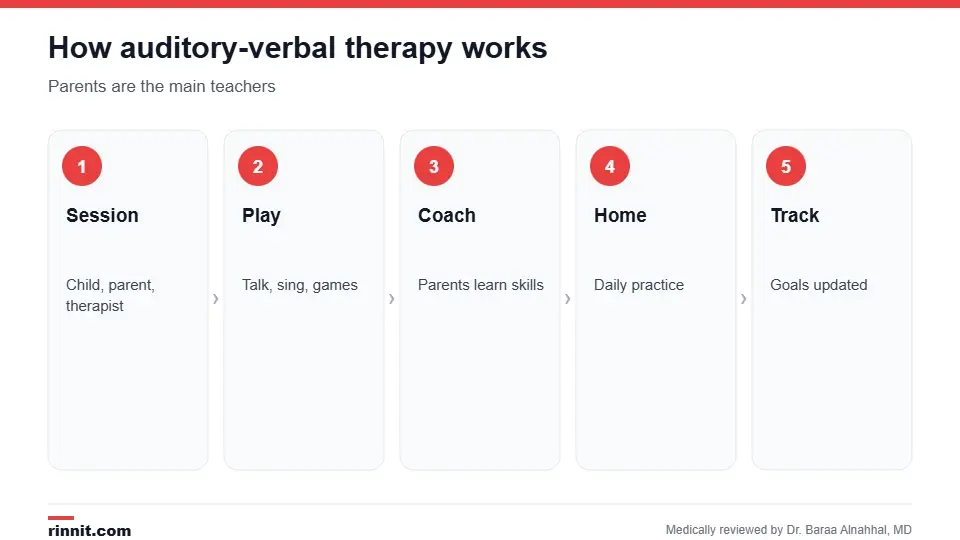
You and your child attend sessions with the therapist.
Sessions use play, talking, singing and games.
The therapist coaches you on how to teach at home.
You build listening and talking into everyday routines.
Progress is assessed and the plan is updated. Sources: [1]
The brain is especially adaptable in the first three and a half years. Sources: [1]
Tips for parents

Keep a notebook of goals and progress.
Check hearing aids or implants before each session and through the day.
Speak close to the device's microphone.
Talk slowly but naturally, at normal volume.
Turn off background noise.
Repeat as needed and speak with expression.
Keep a notebook of goals, activities and progress. Sources: [1]
AVT vs. other approaches
Sign language and lip-reading rely on visual cues. AVT focuses on listening and spoken language, so most graduates don't need sign language. Families can discuss which approach fits them with their care team. Sources: [1]
Risks
AVT has no risks for the child or family. It isn't a quick fix and requires consistent work and play. Sources: [1]
Outlook
The outlook is very positive. Most AVT graduates do well in mainstream schools, aren't limited in career choices and live independently. Benefits are lifelong. Sources: [1, 2, 3]
When to start
Reach out to AVT resources as soon as you learn your baby has hearing loss, since therapy can begin right away. Insurance coverage varies. Sources: [1]
Conclusion
Auditory-verbal therapy gives children with hearing loss the chance to listen and talk like their hearing peers. Starting early and practicing at home make the biggest difference.
Keep learning: read about cochlear implants and pediatric hearing tests.
Frequently asked questions
What is auditory-verbal therapy?
Therapy that teaches deaf or hard-of-hearing children to listen and speak.
Who provides AVT?
Audiologists or speech-language pathologists trained in listening and spoken language.
Does my child need hearing devices?
Yes, usually hearing aids or cochlear implants.
How early can AVT start?
As young as two to three months.
What happens in sessions?
Play, talking, singing and games with you and the therapist.
Do parents take part?
Yes. Parents are the main teachers at home.
How long does AVT last?
Usually three years or more.
Does it work for profound hearing loss?
Yes, with the right hearing technology.
Will my child need sign language?
Most AVT graduates don't.
Are there risks?
No, but it takes consistent effort.
Related Reading
Pediatric Hearing Tests: Hearing Checks for Babies and Children by Age hearing tests for children.
Hearing Loss: Symptoms, Causes, and Treatment Options an overview of hearing loss.
Speech Therapy: What It Is, Who Needs It, and How It Works speech and language therapy.
References
Cleveland Clinic. Auditory-Verbal Therapy: What It Is & Treatment. Cleveland Clinic. Last updated April 5, 2022. https://my.clevelandclinic.org/health/treatments/16767-auditory-verbal-therapy
Fulcher A, Purcell AA, Baker E, et al. Listen up: children with early identified hearing loss achieve age-appropriate speech/language outcomes by 3 years-of-age. International Journal of Pediatric Otorhinolaryngology. 2012;76(12):1785-1794. PMID 23084781. https://doi.org/10.1016/j.ijporl.2012.09.001
Aaberg K, Friis IJ, Slynge CB, et al. Differences in language outcomes after cochlear implantation in children: exploring the impact of auditory verbal therapy duration (0, 1, or 3 years). International Journal of Pediatric Otorhinolaryngology. 2025;194:112371. PMID 40334637. https://doi.org/10.1016/j.ijporl.2025.112371
Medical disclaimer
This article is for general education only and does not replace advice from a qualified healthcare professional. Talk to your doctor about your own diagnosis and treatment, and seek emergency care right away for severe or sudden symptoms.



Comments