Evoked Potential Test: VEP, BAER and SSEP for MS and Nerve Problems

Updated: 3 days ago
Written and medically reviewed by Dr. Baraa Alnahhal, MD · Last reviewed: November 2026 · How we review
Quick Answer
An evoked potential test measures how quickly and strongly the brain and spinal cord respond to signals from the eyes, ears or skin. Electrodes on the scalp and body record the responses. It can find subtle damage in nerve pathways and is most often used to help diagnose multiple sclerosis. It's noninvasive and takes 60 to 90 minutes.
What the research says
Evoked potentials can predict long-term MS disability: in 28 people with MS followed for 20 years, combined visual and motor evoked potential delays at the start correlated strongly with disability at 20 years, better than baseline disability scores or MRI lesion counts (Schlaeger R et al., Multiple Sclerosis Journal, 2014) [2]
They also help forecast short-term change: in 221 people with MS who had 908 evoked potential tests over 20 years, a model using evoked potential and disability scores predicted disability 1 year later, with 72% of estimates within half a point (Margaritella N et al., Neurological Sciences, 2012) [3]
Key takeaways
Evoked potentials measure how fast signals travel to your brain.
The main types test vision (VEP), hearing (BAER) and touch (SSEP).
They're most often used to help diagnose MS.
The test is noninvasive and takes about 60 to 90 minutes.
Come with clean hair, free of sprays, oils and gels.
What is an evoked potential test?
When your eyes see something, your ears hear a sound or your skin feels a touch, nerves carry the signal to your brain. An evoked potential test repeats a stimulus many times and averages the brain's responses to measure how long the signal takes to arrive. Damage to the protective covering of nerves, called myelin, slows signals down. Unlike an EEG, which records ongoing brain activity, evoked potentials record the response to a specific trigger. Sources: [1]
Types of evoked potential tests
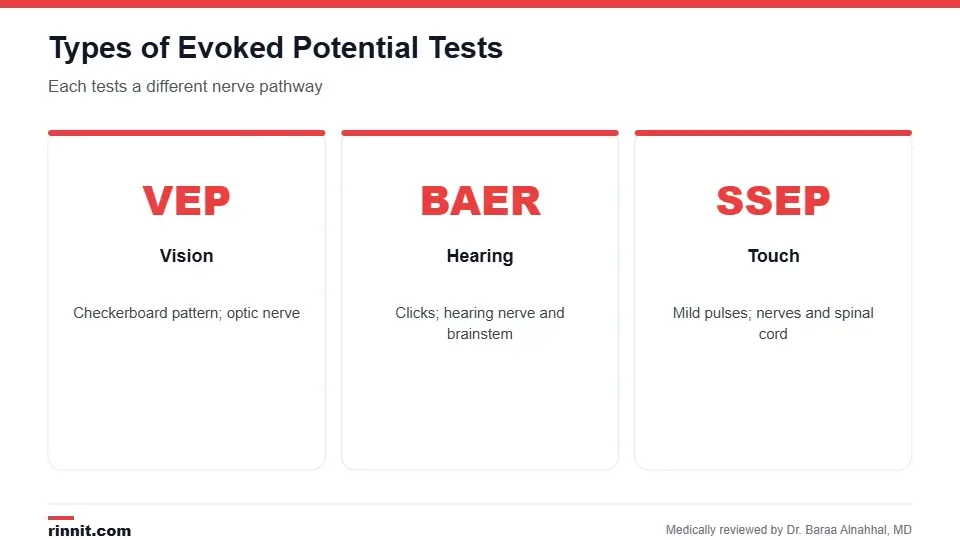
Each type tests a different nerve pathway.
Type | Stimulus | What it checks |
Flashing checkerboard on a screen | Optic nerve and visual pathway | |
Brainstem auditory evoked response (BAER) | Clicks through headphones | Hearing nerve and brainstem |
Somatosensory evoked potential (SSEP) | Mild electrical pulses on the wrist or leg | Nerves, spinal cord and brain |
SSEPs are also used during some surgeries to monitor nerve function. Sources: [1]
Why it's done
Help diagnose multiple sclerosis.
Check for optic nerve problems, such as optic neuritis, optic neuropathy or optic nerve tumors.
Assess hearing, especially in infants who can't respond to sounds.
Look for brainstem problems, such as tumors.
Monitor nerve function during surgery. Sources: [1]
How to prepare
Wash your hair the night before or morning of the test.
Don't use hair spray, oils, gels or conditioner.
Follow any other instructions from your provider.
Bring your glasses if you wear them, for a VEP. Sources: [1]
What happens during the test
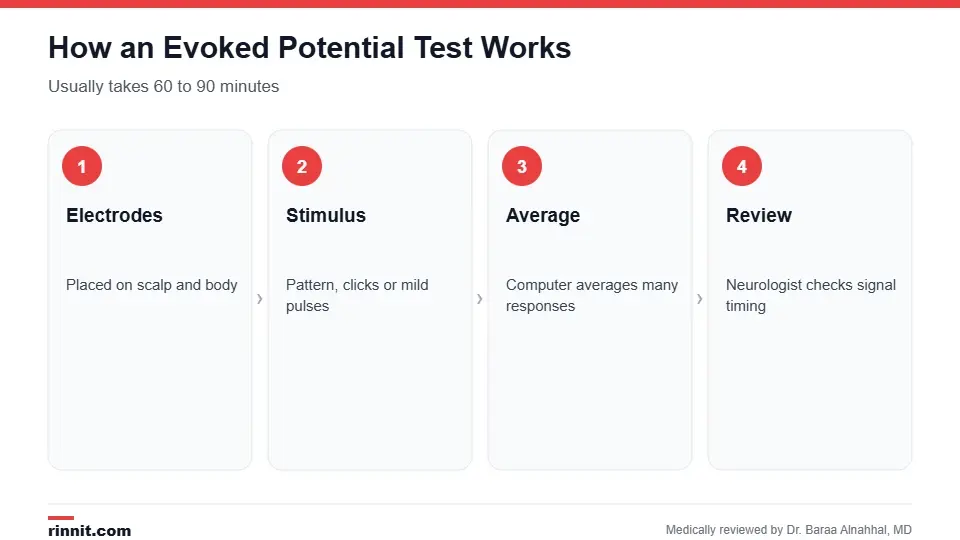
The test usually takes 60 to 90 minutes.
A technologist attaches small electrodes to your scalp and, depending on the test, your earlobes, wrists, back of the knees or spine.
VEP: you cover one eye and watch a checkerboard pattern on a screen, then switch eyes.
BAER: you hear clicks through headphones, one ear at a time.
SSEP: you feel mild electrical pulses on your wrist or leg.
A computer averages the responses from many repeats. Sources: [1]
You'll need to relax and stay still. The electrical pulses in an SSEP may tingle, but the test isn't painful. Sources: [1]
Risks
Evoked potential tests are noninvasive and very safe. The electrodes only record signals; they don't send electricity into your brain. Some people find the SSEP pulses mildly uncomfortable. Sources: [1]
Results
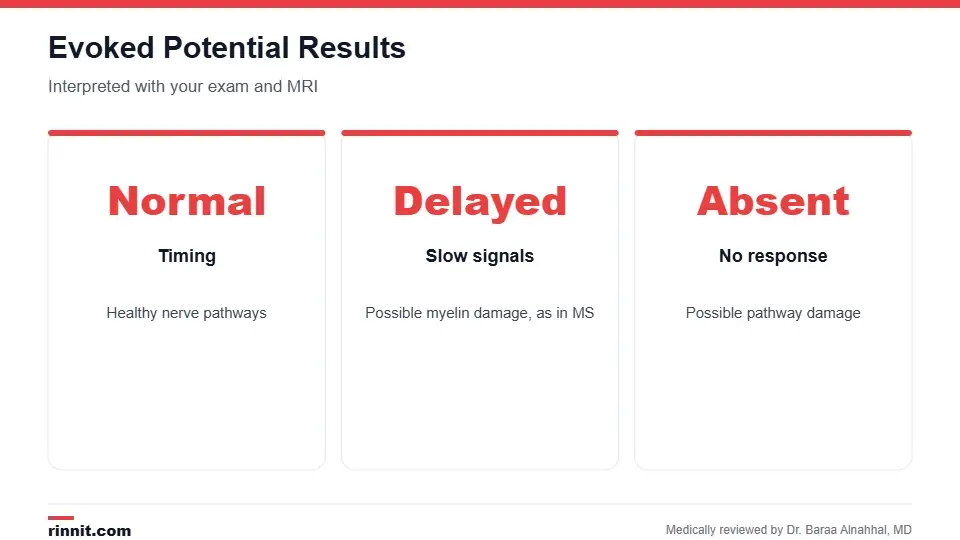
A neurologist interprets the results with other tests.
A neurologist or neurophysiologist reviews the timing and size of your responses and sends a report to your provider. Delayed responses suggest slowed nerve signals, which can happen when myelin is damaged, as in MS. Results are interpreted together with your neurological exam and tests such as an MRI. Sources: [1]
Conclusion
Evoked potential tests measure how well your vision, hearing and touch pathways carry signals to your brain. They can detect hidden nerve damage and are a valuable tool for diagnosing and monitoring conditions like MS.
Keep learning: read about multiple sclerosis and the EEG.
Frequently asked questions
What is an evoked potential test?
A test that measures how your brain responds to signals from your eyes, ears or skin.
What are the types of evoked potentials?
Visual (VEP), brainstem auditory (BAER) and somatosensory (SSEP).
Why is it done?
Most often to help diagnose multiple sclerosis.
Does it hurt?
No. SSEP pulses may tingle, but the test isn't painful.
How long does it take?
Usually 60 to 90 minutes.
How do I prepare?
Wash your hair and skip sprays, oils and gels.
Is it the same as an EEG?
No. An EEG records ongoing activity; evoked potentials record responses to a trigger.
Can babies have this test?
Yes. BAER is often used to test hearing in infants.
What do delayed responses mean?
Signals are traveling more slowly, which can happen with nerve damage.
Who reads the results?
A neurologist or neurophysiologist.
Related Reading
Pediatric Hearing Tests: Hearing Checks for Babies and Children by Age explains the hearing tests used for babies and children of each age.
Visual Evoked Potential (VEP) Test: Why It's Done, What to Expect and Results a detailed look at the vision version of this test.
What Is Multiple Sclerosis? A Plain-Language Guide to Symptoms, Types, and How It's Treated the main condition evoked potentials help diagnose.
Electroencephalogram (EEG): Types, How to Prepare and What Results Mean a test of ongoing brain activity.
Optic Neuritis: Symptoms, Causes, and Treatment an optic nerve condition VEP can detect.
EMG (Electromyography): What It Tests, What to Expect and Results a test of nerve and muscle function.
References
Cleveland Clinic. Evoked Potential Test: What It Is, Purpose, Procedure & Types. Cleveland Clinic. Last updated February 3, 2023. https://my.clevelandclinic.org/health/diagnostics/12393-evoked-potential-test
Schlaeger R, Schindler C, Grize L, et al. Combined visual and motor evoked potentials predict multiple sclerosis disability after 20 years. Multiple Sclerosis Journal. 2014;20(10):1348-1354. PMID 24574192. https://doi.org/10.1177/1352458514525867
Margaritella N, Mendozzi L, Garegnani M, et al. Sensory evoked potentials to predict short-term progression of disability in multiple sclerosis. Neurological Sciences. 2012;33(4):887-892. PMID 22120189. https://doi.org/10.1007/s10072-011-0862-3
Medical disclaimer
This article is for general education only and does not replace advice from a qualified healthcare professional. Talk to your doctor about your own diagnosis and treatment, and seek emergency care right away for severe or sudden symptoms.



Comments