Preparing for Your Colonoscopy: A Guide to the Bowel Prep Kit

Updated: 3 days ago
Medically reviewed by Dr. Baraa Alnahhal, MD · Last reviewed: October 2026
Quick Answer: What is a bowel prep kit containing polyethylene glycol (PEG), electrolytes and bisacodyl?
A bowel prep kit containing polyethylene glycol (PEG), electrolytes and bisacodyl is a laxative treatment that thoroughly cleans the bowel before a colonoscopy [1]. It softens stool and stimulates intestinal contractions so the colon is clear for an accurate examination. Bowel movements usually begin 1 to 6 hours after the first dose and become frequent and watery [1].
What the research says
Low-volume PEG with bisacodyl cleaned as well as 4 L PEG, with less nausea. A meta-analysis of six randomized trials (1,540 patients) found no significant difference between 2 L of PEG plus bisacodyl and 4 L of PEG in satisfactory (OR 0.86; 95% CI 0.45–1.63), excellent (OR 1.08; 0.78–1.50), or poor (OR 0.68; 0.35–1.34) preparations. The low-volume regimen caused less nausea (OR 0.57; 0.36–0.89), vomiting (OR 0.57; 0.40–0.81), and bloating (OR 0.65; 0.49–0.87), with no difference in abdominal pain. The literature search ended in June 2012 (PubMed: Clark et al., Ann Gastroenterol, 2013) [2].
Splitting the PEG dose improved preparation quality. A meta-analysis of five randomized trials (1,232 patients) found that split-dose PEG raised the odds of a satisfactory preparation (OR 3.70; 95% CI 2.79–4.91) and of patients being willing to repeat the same preparation (OR 1.76; 1.06–2.91), while lowering the odds of stopping the preparation early (OR 0.53; 0.28–0.98) and of nausea (OR 0.55; 0.38–0.79). The authors noted that few studies were available. Always follow the dosing schedule your own provider gives you (PubMed: Kilgore et al., Gastrointest Endosc, 2011) [3].
Poor preparation is still common and can hide findings. A narrative review reports that almost a quarter of colonoscopies are still done with suboptimal bowel preparation, leading to longer procedures, a higher risk of complications, and a higher likelihood of missed lesions. This is a review of the literature rather than a pooled analysis (PubMed: Shahini et al., World J Gastroenterol, 2023) [4].
How does a colonoscopy bowel prep kit work?
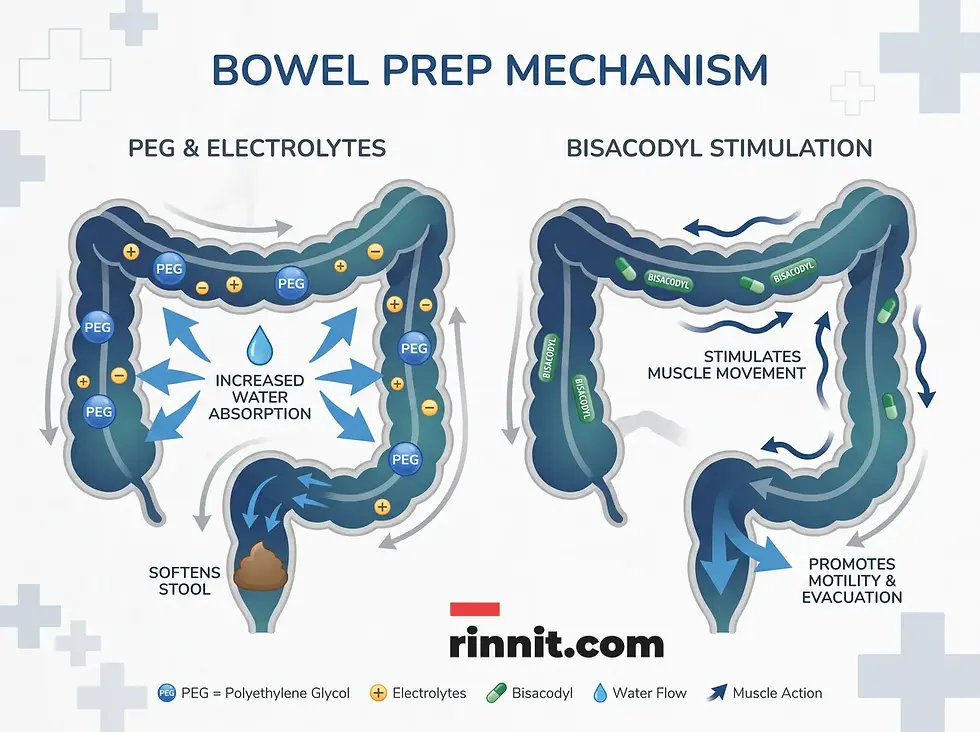
The effectiveness of a bowel prep kit lies in its multi-action formula. Polyethylene glycol and electrolytes work together to increase the volume of water in the intestinal tract, which significantly softens stool [1]. Simultaneously, bisacodyl acts as a stimulant laxative, encouraging the muscles of the intestines to move waste through the system more efficiently [1].
This combination is specifically chosen to provide a thorough cleansing of the colon. A clear colon is vital for a colonoscopy, as it allows healthcare providers to clearly see the intestinal walls and identify any abnormalities, such as polyps or signs of disease [4].
How do you take a colonoscopy bowel prep kit, and what can you eat?
Proper administration of the bowel prep kit is critical for its success. The process typically begins with swallowing bisacodyl tablets whole with water [1]. It is important not to crush or chew these tablets [1], as they have a protective coating that must remain intact until they reach the appropriate part of the digestive tract.
Step | Action | Important Notes |
Tablets | Swallow whole with a full glass of water | Do not crush, chew, or take with dairy/antacids |
Solution | Prepare powder with water as directed | Shake well; can be chilled for better taste |
Diet | Follow a clear liquid or restricted diet | Consult your care team for specific restrictions |
Timing | Start at the exact time advised by your provider | Expect movements 1–6 hours after the first dose |
Once the liquid solution is started, patients should expect frequent, watery bowel movements [1]. To improve the taste, the prepared solution can be chilled in the refrigerator, but it should not be frozen [1]. Any unused solution must be discarded 48 hours after mixing [1].

What precautions and side effects come with a colonoscopy bowel prep kit?
Using a colonoscopy bowel prep kit safely means avoiding certain foods and medicines around doses and knowing which side effects are common and which need prompt care. For instance, antacids and dairy products should be avoided within one hour of taking the tablets, as they can break down the tablet's coating prematurely and lead to stomach upset [1].
Common side effects that typically do not require immediate medical attention include bloating, nausea, and stomach cramping [1]. If bloating becomes uncomfortable, it is often recommended to temporarily pause drinking the solution or to space out the doses until the discomfort subsides [1]. However, severe symptoms such as heart rhythm changes, seizures, or bloody diarrhea should be reported to a healthcare provider immediately [1].
Medication Timing: Do not take other oral medications within one hour of starting the prep [1].
Safety First: Report allergic reactions, such as skin rashes or facial swelling, to your care team right away [1].
Kidney Health: Watch for signs of kidney injury, such as decreased urination or swelling in the ankles and feet [1].
Conclusion
A successful bowel preparation is the foundation of a clear and accurate colonoscopy. While the process requires careful attention to timing and dietary restrictions, following the provided instructions ensures the best possible outcome for the medical procedure. By understanding how the kit works and what to expect, patients can navigate the preparation process with confidence.
Frequently Asked Questions
1. What is a bowel prep kit used for?
A bowel prep kit is used to thoroughly clean the intestines before medical procedures like a colonoscopy so the doctor can clearly see the colon walls.
2. How does the PEG solution work?
Polyethylene glycol (PEG) and electrolytes increase the amount of water in your intestines, which softens the stool and helps clear the bowel.
3. Can I add flavor to the bowel prep solution?
You should only use the flavor packs provided in the kit. Do not add any additional ingredients or flavors to the solution.
4. When will the bowel movements start?
Typically, the first bowel movement occurs between 1 and 6 hours after taking the initial tablets.
5. Why can't I have dairy products with the prep?
Dairy products can destroy the protective coating on the tablets, which may lead to increased stomach upset and cramping.
6. What should I do if I feel very bloated?
If bloating becomes uncomfortable, you can temporarily stop drinking the solution or drink it more slowly until the symptoms improve.
7. How should I store the prepared solution?
Once mixed, the solution should be stored in the refrigerator to improve its taste. It should be discarded after 48 hours.
8. Are there medications that interact with the prep kit?
Yes, antacids, diuretics, and certain blood pressure or stomach medications can interact with the kit. Always provide a full list of your meds to your doctor.
9. What are the common side effects?
Common side effects include bloating, nausea, stomach cramping, and temporary rectal discomfort.
10. When should I contact my care team during bowel prep?
If you experience severe stomach pain, bloody diarrhea, fever, or signs of an allergic reaction, you should contact your care team immediately.
References
Cleveland Clinic. Polyethylene Glycol; Electrolytes and Bisacodyl Bowel Prep Kit. Cleveland Clinic. Accessed October 30, 2026. https://my.clevelandclinic.org/health/drugs/19635-polyethylene-glycol-electrolytes-and-bisacodyl-bowel-prep-kit
Clark RE, Godfrey JD, Choudhary A, et al. Low-volume polyethylene glycol and bisacodyl for bowel preparation prior to colonoscopy: a meta-analysis. Ann Gastroenterol. 2013;26(4):319-324. PMID 24714413. https://pubmed.ncbi.nlm.nih.gov/24714413/
Kilgore TW, Abdinoor AA, Szary NM, et al. Bowel preparation with split-dose polyethylene glycol before colonoscopy: a meta-analysis of randomized controlled trials. Gastrointest Endosc. 2011;73(6):1240-1245. PMID 21628016. https://doi.org/10.1016/j.gie.2011.02.007
Shahini E, Sinagra E, Vitello A, et al. Factors affecting the quality of bowel preparation for colonoscopy in hard-to-prepare patients: evidence from the literature. World J Gastroenterol. 2023;29(11):1685-1707. PMID 37077514. https://doi.org/10.3748/wjg.v29.i11.1685
Medical Disclaimer
This article is for informational purposes only and does not constitute medical advice. Always seek the advice of your physician or other qualified health provider with any questions you may have regarding a medical condition. Never disregard professional medical advice or delay in seeking it because of something you have read here.


Comments