Minimally Invasive Mitral Valve Repair: Procedure, Benefits, Risks & Recovery

Updated: 6 days ago
Written and medically reviewed by Dr. Baraa Alnahhal, MD · Last reviewed: October 2026 · How we review
Quick Answer: What is minimally invasive mitral valve repair?
Minimally invasive mitral valve repair is surgery that fixes a leaky or narrowed mitral valve through one or more small chest incisions rather than a long incision down the front of the chest. Surgeons use a camera and small tools, sometimes with a surgical robot. The operation typically takes two to four hours; hospital stays last up to five days. [1]
What the research says
Patients leave hospital about two days sooner. A review of 119 studies covering 38,106 patients found the minimally invasive approach shortened hospital stays by about 2.2 days in randomized trials, with no difference in leftover valve leakage compared with a traditional chest opening. (Eqbal et al., Journal of Cardiac Surgery, 2022) [2]
The repair is just as good as with a full chest opening. In a 330-patient randomized trial, about 96% of valves were successfully repaired in both groups, 92% had no or only mild leakage at one year, and serious problems by one year were similar (5.4% vs 6.1%). Physical function at 12 weeks was not better with the small-incision approach. (Akowuah et al., JAMA, 2023) [3]
People get moving again sooner. Among 230 trial patients who wore activity trackers, those who had the small-incision operation logged about 15 more minutes per day of moderate-to-vigorous activity six weeks after surgery. (Wagnild et al., Circulation, 2025) [4]
Key takeaways
The mitral valve keeps blood moving forward from the upper left heart chamber to the lower left chamber. [1]
The minimally invasive approach repairs the valve through a 4- to 6-centimeter incision along the ribs on one side, not a long incision down the chest. [1]
It treats mitral valve regurgitation (a leaky valve) and mitral valve stenosis (a narrowed valve). [1]
Repair keeps your own valve; replacement swaps it for a mechanical or animal-tissue valve. [1]
Expect one to two days in intensive care and up to five days in hospital in total. [1]
Benefits include faster healing, less pain, less scarring and shorter hospital stays. [1]

What does the mitral valve do, and why does it need repair?
The mitral valve is the heart valve that keeps blood flowing in the right direction between the upper left heart chamber (left atrium) and the lower left heart chamber (left ventricle). [1] When its flaps stop opening or closing properly, blood flow through the heart is disrupted, and repair surgery may be needed.
Two problems most often lead to mitral valve repair: [1]
Condition | What goes wrong | Effect on blood flow |
Mitral valve regurgitation | The valve flaps don't close properly between heartbeats | Blood leaks backward |
Mitral valve stenosis | The valve flaps stiffen and may even fuse together | The valve narrows and blood flow drops |
Read our full guides to mitral valve disease and mitral valve stenosis for symptoms and diagnosis.
How is minimally invasive mitral valve repair different from open-heart surgery?
Minimally invasive mitral valve repair differs from traditional open-heart surgery mainly in the size and position of the incision. [1] Instead of one long incision down the front of the chest, the surgeon works through one or more small incisions on the side of the chest, using a camera to see the valve.
Feature | Minimally invasive repair | Traditional open-heart surgery |
Incision | One or more small incisions; main incision 4–6 cm along the ribs on one side | One long incision down the front of the chest |
How the surgeon sees the valve | A camera on a thin tube (endoscope), sometimes with a surgical robot | — |
Tools | Tiny surgical instruments passed through the incisions | — |
Typical advantages | Faster healing, less pain, fewer opioids, lower infection and blood-loss risk, less scarring, shorter hospital stay | — |
Source: [1]
Is mitral valve repair the same as mitral valve replacement?
Mitral valve repair is not the same as mitral valve replacement. [1] In a repair, the surgeon fixes the problem and keeps your own valve. In a replacement, the surgeon removes your valve and puts in a new one.
Mitral valve repair | Mitral valve replacement | |
Your own valve | Kept and fixed | Removed |
What's used instead | Nothing — the valve is reshaped or reinforced | A mechanical valve, or a valve made from pig or cow tissue |
Source: [1]
What techniques are used in minimally invasive mitral valve repair?
Minimally invasive mitral valve repair uses several techniques, and the surgeon chooses based on what is wrong with the valve. [1] A common one is annuloplasty: tightening a leaky valve by placing a mesh or metal ring around it.
The surgeon may also: [1]
Connect the valve flaps more securely.
Fix a hole in the heart valve.
Remove extra tissue that stops the flaps from closing properly.
Separate valve flaps that have joined together.
Who is a candidate for minimally invasive mitral valve repair?
People with mitral valve regurgitation or stenosis may be candidates for minimally invasive mitral valve repair, but not everyone qualifies. [1] Your surgical team weighs several factors:
Factor | What the team looks at |
Heart condition | The overall state of your heart and valve |
Other procedures | Whether you need other heart surgery at the same time |
Lifestyle | People who smoke or have a body mass index (BMI) above 30 may not be good candidates |
Medical history | Severe coronary artery disease or aortic valve disease may rule out the approach |
Source: [1]
What happens before minimally invasive mitral valve repair?
Before minimally invasive mitral valve repair, your surgeon gives you preparation instructions and orders tests to plan the operation. [1] These may include:
Echocardiogram — an ultrasound that shows blood flow through the heart and gives a close look at the valves.
Cardiac catheterization — a test that examines the arteries on the heart.
Cardiac CT (CAT) scan — detailed images of the heart. [1]
What happens during minimally invasive mitral valve repair?
During minimally invasive mitral valve repair, the cardiac surgeon follows four main steps, and the whole operation typically takes two to four hours. [1]
Incision — makes a 4- to 6-centimeter incision along the ribs on one side of the chest.
Camera — inserts an endoscope (a thin tube with a camera on the end) to view the mitral valve.
Repair — uses small surgical tools to fix the valve.
Closing — closes the incisions with stitches. [1]

What happens after minimally invasive mitral valve repair?
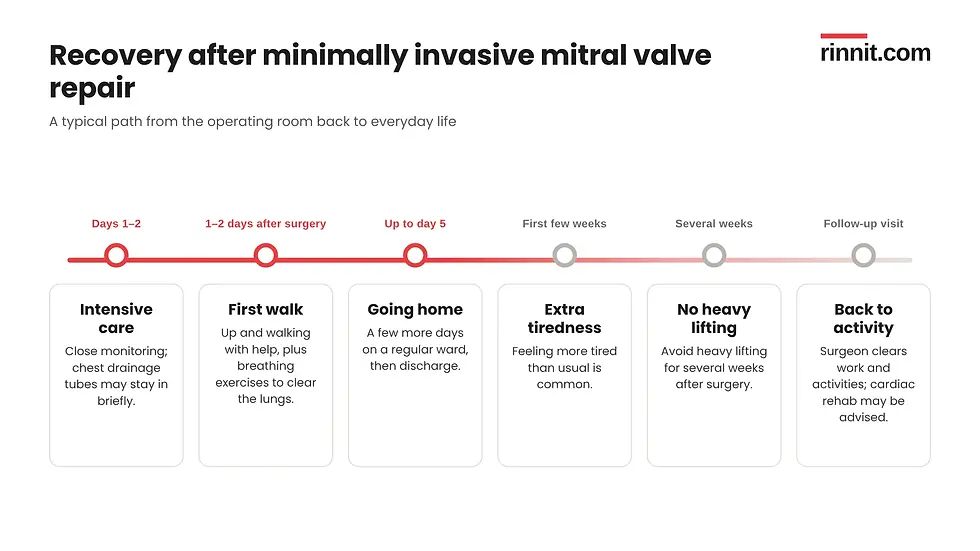
After minimally invasive mitral valve repair, you spend one to two days in the intensive care unit (ICU), then move to a regular hospital ward for a few more days. [1] Drainage tubes may sit in your chest for a short time to stop fluid from building up around the heart.
The care team helps you get up and walk a day or two after surgery and may teach you breathing exercises to clear fluid from your lungs. [1] Most people stay up to five days in hospital before going home.
What is the recovery time after minimally invasive mitral valve repair?
Recovery after minimally invasive mitral valve repair takes a few weeks, and you may feel more tired than usual during that time. [1] Your surgeon tells you at your follow-up visit when you can return to work and other activities.
Time after surgery | What to expect |
Days 1–2 | Intensive care; drainage tubes may be in place; getting up and walking with help; breathing exercises |
A few more days | Recovery on a regular hospital ward |
Up to day 5 | Discharge home |
First few weeks | Feeling more tired than usual |
Several weeks | No heavy lifting |
Follow-up visit | Surgeon clears you for work and other activities |
Source: [1]
Your provider may also recommend cardiac rehabilitation, a supervised program that helps you raise your activity level safely and build healthier habits such as a nutritious diet and regular exercise. [1] Our plain-language heart health guide covers these habits in more detail.
What are the benefits of minimally invasive mitral valve repair?
Minimally invasive mitral valve repair can treat mitral valve problems successfully while offering several advantages over a long chest incision: [1]
Faster healing and recovery.
Less pain and less need for opioid pain medicine.
Lower risk of infection or blood loss.
Less scarring.
Shorter hospital stays.
What are the risks of minimally invasive mitral valve repair?
Minimally invasive mitral valve repair carries risks, as any heart surgery does. [1] These include:
Risk | What it means |
Bleeding and blood clots | Blood loss during or after surgery, or clots forming in the blood vessels |
Infection | Usually at the incision site |
Irregular heart rhythms | Arrhythmias such as atrial fibrillation |
Stroke | Interrupted blood flow to the brain |
Source: [1]
Learn more about rhythm problems in our heart arrhythmia guide and our atrial fibrillation guide.
When should you call your doctor after mitral valve surgery?
Call your healthcare provider right away after mitral valve surgery if you notice any of these warning signs: [1]
Drainage or pus around the incision.
Excessive swelling or redness around the incision.
Fever or chills.
Heart palpitations.
Unusual swelling or fluid retention (edema) in the legs or feet.
Weight gain of more than 3 pounds in one week.
If palpitations are new to you, our heart palpitations guide explains what they feel like. Sudden swelling and quick weight gain can also be signs of fluid build-up — see our heart failure guide.
Can the mitral valve be repaired without opening the chest?
The mitral valve can sometimes be repaired with a catheter-based procedure instead of surgery through the chest. [1] A long, thin, hollow tube (catheter) is passed through a blood vessel in the groin and guided up to the heart, and repair tools are threaded through it to fix the valve. Whether this or a minimally invasive operation fits you depends on your diagnosis and the condition of your heart and valve.
Minimally invasive mitral valve repair at a glance
Question | Answer |
What it treats | Mitral valve regurgitation and mitral valve stenosis |
Incision | 4–6 cm along the ribs on one side |
Operation time | Typically 2–4 hours |
ICU stay | 1–2 days |
Total hospital stay | Up to 5 days |
First walk | 1–2 days after surgery |
Heavy lifting | Avoid for several weeks |
Main risks | Bleeding, blood clots, infection, arrhythmias, stroke |
Source: [1]
Conclusion
Minimally invasive mitral valve repair fixes a leaky or narrowed mitral valve through a small side incision instead of a long cut down the chest. It keeps your own valve, typically takes two to four hours, and is linked to shorter hospital stays, less pain and less scarring. Research shows the repair quality matches traditional surgery, with patients leaving hospital sooner and getting active earlier. [1][2][3][4]
Not everyone is a candidate, so the right choice depends on your heart, your other health conditions and whether you need additional procedures.
Next step: If you've been told you have a mitral valve problem, write down your questions and ask your cardiologist or heart surgeon whether a minimally invasive repair is an option for you. To understand your diagnosis first, start with our heart valve disease guide and our guide to heart murmurs.
FAQ
Is minimally invasive mitral valve repair open-heart surgery?
Minimally invasive mitral valve repair avoids the long incision down the front of the chest used in traditional open-heart surgery. Instead, the surgeon works through one or more small incisions along the ribs, using a camera and small tools to fix the valve. [1]
How long does minimally invasive mitral valve repair take?
Minimally invasive mitral valve repair typically takes between two and four hours. The exact time depends on how much repair the valve needs. [1]
How long will I stay in hospital after minimally invasive mitral valve repair?
Most people stay in hospital for up to five days after minimally invasive mitral valve repair. The first one to two days are spent in intensive care, followed by a few days on a regular ward. [1]
What conditions does minimally invasive mitral valve repair treat?
Minimally invasive mitral valve repair treats mitral valve regurgitation, where the valve leaks blood backward, and mitral valve stenosis, where stiff or fused valve flaps narrow the opening and reduce blood flow. [1]
Who may not be a good candidate for minimally invasive mitral valve repair?
People who smoke, have a BMI above 30, or have severe coronary artery disease or aortic valve disease may not be good candidates for minimally invasive mitral valve repair. The need for other heart procedures at the same time also affects the decision. [1]
What are the risks of minimally invasive mitral valve repair?
The risks of minimally invasive mitral valve repair include bleeding, blood clots, infection, irregular heart rhythms (arrhythmias) and stroke. Your surgical team will explain how these risks apply to you. [1]
When should I call my doctor after mitral valve surgery?
Call your doctor right away after mitral valve surgery if you have pus or drainage at the incision, excessive swelling or redness, fever or chills, heart palpitations, new swelling in your legs or feet, or weight gain of more than 3 pounds in one week. [1]
Can the mitral valve be repaired without surgery through the chest?
The mitral valve can sometimes be repaired with a catheter-based procedure, where a thin tube is passed through a blood vessel in the groin up to the heart. Whether this suits you depends on your diagnosis and the condition of your heart and valve. [1]
How long is recovery after minimally invasive mitral valve repair?
Recovery after minimally invasive mitral valve repair usually takes a few weeks, often faster than after standard open-heart surgery. Your care team will tell you when you can drive, work and lift again.
How long does a mitral valve repair last?
A mitral valve repair often lasts many years, and most people do not need another operation. You will have regular checkups and heart ultrasounds to watch how the valve is working.
Related Reading
Mitral Valve Repair: Surgery Steps, Recovery Time, Risks and How Long It Lasts explains standard mitral valve repair surgery, risks and recovery.
What Is Mitral Valve Regurgitation? A Plain-Language Guide to This Common Heart Valve Problem explains mitral valve regurgitation symptoms, causes and treatment.
Robotically Assisted Heart Surgery describes how robotic arms help surgeons operate through small incisions.
Transcatheter Mitral Valve Replacement (TMVR): Procedure, Risks and Recovery covers catheter-based mitral valve replacement for high-risk patients.
References
Cleveland Clinic. Minimally Invasive Mitral Valve Repair. Cleveland Clinic. Last updated June 23, 2022. https://my.clevelandclinic.org/health/treatments/17234-minimally-invasive-mitral-valve-repair
Eqbal AJ, Gupta S, Basha A, et al. Minimally invasive mitral valve surgery versus conventional sternotomy mitral valve surgery: A systematic review and meta-analysis of 119 studies. J Card Surg. 2022;37(5):1319-1327. PMID 35170791. https://doi.org/10.1111/jocs.16314
Akowuah EF, Maier RH, Hancock HC, et al. Minithoracotomy vs Conventional Sternotomy for Mitral Valve Repair: A Randomized Clinical Trial. JAMA. 2023;329(22):1957-1966. PMID 37314276. https://doi.org/10.1001/jama.2023.7800
Wagnild JM, Bayliss C, Maier RH, et al. Accelerometer-Measured Physical Activity After Mitral Valve Surgery: An Analysis of the UK Mini Mitral Randomized Controlled Trial. Circulation. 2025;152(17):1234-1245. PMID 40910189. https://doi.org/10.1161/CIRCULATIONAHA.125.074651
Medical disclaimer
This article is for general educational purposes only and does not replace professional medical advice, diagnosis or treatment. Always talk to your cardiologist, heart surgeon or another qualified healthcare provider about your own condition and treatment options. If you have chest pain, trouble breathing or signs of a stroke, call your local emergency number right away.



Comments