Right Heart Catheterization: Why It's Done, Procedure, Risks and Recovery

Updated: 2 days ago
Written and medically reviewed by Dr. Baraa Alnahhal, MD · Last reviewed: November 2026 · How we review
Quick Answer: What is right heart catheterization?
Right heart catheterization is an invasive test that shows how well the heart is pumping. A cardiologist guides a thin, flexible catheter from a vein through the right side of the heart into the pulmonary artery, then measures blood pressure and oxygen in the heart and lungs. It helps diagnose and manage pulmonary hypertension and heart failure. [1]
What the research says
Serious complications are uncommon in experienced centers. Across 7,218 right heart catheter procedures in people with pulmonary hypertension, serious adverse events occurred in 1.1%, mostly mild problems at the vein access site, and procedure-related deaths were 0.055%. (Hoeper et al., Journal of the American College of Cardiology, 2006) [2]
Healthy lungs keep pulmonary artery pressure low at rest. Pooling right heart catheter data from 1,187 healthy people in 47 studies, the average resting mean pulmonary artery pressure was 14.0 mmHg and rarely went above 20 mmHg. (Kovacs et al., European Respiratory Journal, 2009) [3]
Key takeaways
Right heart catheterization measures pressure in your right atrium, right ventricle and pulmonary artery, plus oxygen in your heart and lungs. [1]
It's also called pulmonary artery catheterization or a Swan-Ganz catheter. [1]
It helps diagnose and manage pulmonary hypertension, heart failure, cardiomyopathy, cardiogenic shock, heart valve disease and congenital heart disease. [1]
You're usually awake, and most people go home after a couple of hours of monitoring. [1]
It's generally safe, with a low rate of serious complications in experienced centers. [1] [2]
What is right heart catheterization?
Right heart catheterization is an invasive test that measures blood pressure and oxygen in your lungs and the right side of your heart. It's also called pulmonary artery catheterization, and you may hear it called a Swan-Ganz catheter. [1]
Your provider inserts a thin, flexible tube called a catheter into a blood vessel in your neck, groin or arm. They then thread it through the right side of your heart into your pulmonary artery, the main artery that carries blood to your lungs. [1]
Why is right heart catheterization done?
Providers use it to diagnose and manage many conditions, including: [1]
Pulmonary hypertension
Heart failure
Cardiomyopathy
Cardiogenic shock
Heart valve disease
Congenital heart disease
You may also need it before or after an organ transplant or placement of a left ventricular assist device (LVAD). [1]
Right vs left heart catheterization
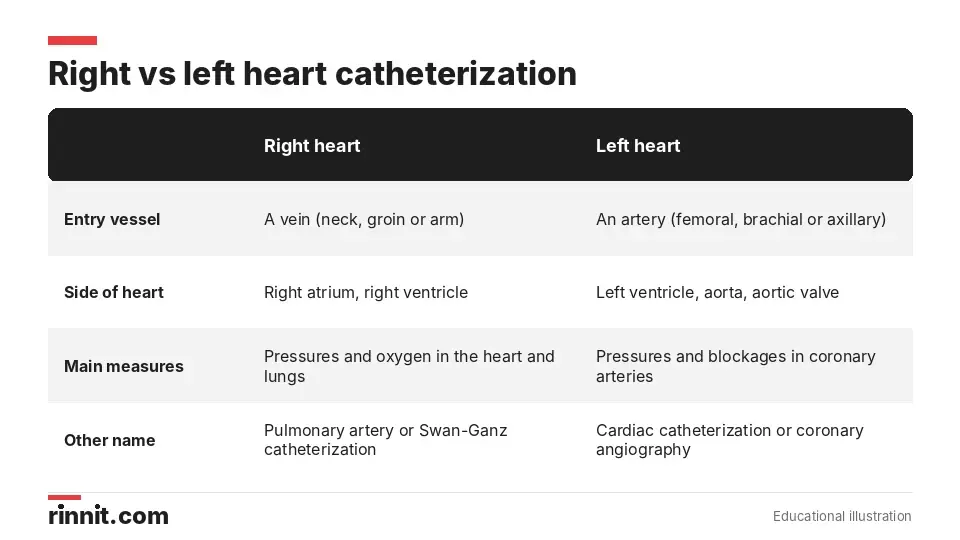
The two tests reach opposite sides of the heart through different blood vessels.
Feature | Right heart catheterization | Left heart catheterization |
Entry vessel | A vein | An artery (femoral, brachial or axillary) |
Side of the heart | Right side, out to the pulmonary artery | Left side |
What it measures | Pressure in the right atrium, right ventricle and pulmonary artery | Pressure in the left ventricle, the aorta and aortic valve, and blockages in the coronary arteries |
Other names | Pulmonary artery catheterization, Swan-Ganz catheter | Cardiac catheterization, coronary angiography |
Sources: [1]
To learn about the left-sided test, read our cardiac catheterization guide.
Who performs it?
It takes place in a cardiac catheterization laboratory, or cath lab, with a team usually led by an advanced heart failure cardiologist or an interventional cardiologist. [1]
How do you prepare for right heart catheterization?
Your provider will give you specific instructions, which may include: [1]
Telling your care team about all medicines you take, including supplements and over-the-counter drugs. You may need to pause some, such as blood thinners (anticoagulants).
Arranging for someone else to drive you home.
Removing jewelry and nail polish.
Not eating or drinking anything for 6 to 12 hours beforehand.
Just before the procedure, you'll change into a hospital gown, empty your bladder and lie on an exam table. Electrodes on your chest record your heart's activity. Most of the time the procedure is quick enough that you don't need sedation, but some people get an IV for fluids and sedative medicine. [1]
How is right heart catheterization done?

The catheter travels from a vein through the right heart chambers into the pulmonary artery.
The procedure takes about an hour, though preparation and recovery can take several hours in total. You'll be awake while your provider: [1]
Cleans and shaves the area where the catheter will enter (groin, arm or neck).
Numbs the area with a local anesthetic.
Punctures the vein with a special needle or cutting tool, such as the femoral vein in your leg, the jugular vein in your neck or a vein in your arm.
Inserts the catheter and slowly advances it to different positions in your heart and blood vessels.
Takes measurements or tissue samples as needed.
Asks you to hold still, change position or breathe in certain ways.
In some cases, asks you to exercise with a foot pedal to see how the pressures in your heart respond.
Gives IV medicines to see how your heart responds.
Removes the catheter and closes the incision.
Does right heart catheterization hurt?
You may feel pain from the numbing injection and when the catheter goes in. Tell your provider what you're feeling throughout. You may also notice: [1]
Flutters or skipped beats when the catheter touches your heart walls
Pressure as the catheter moves through your veins
Headache, lightheadedness or nausea
An urge to cough
Warmth or flushing from medicines
What are the risks of right heart catheterization?
Right heart catheterization is generally safe, but as an invasive procedure it has risks, including: [1]
Allergic reactions to medicines or materials
Arrhythmia
Artery damage
Bleeding or bruising at the insertion site
Blood clots
Cardiac tamponade, heart attack or stroke
Infection
Collapsed lung
In a large study from experienced centers, serious complications affected about 1 in 100 procedures, and most were mild problems at the vein access site. [2]
Recovery after right heart catheterization
Afterward, your team removes the electrodes and IV and moves you to a recovery room to watch for bleeding and check your blood pressure, heart rate and temperature. Most people go home after a couple of hours, but you may need someone to drive you. If the test shows a severe problem, you may stay for more tests or treatment. [1]
Your provider will likely discuss results before you leave or at a follow-up visit. At home, they may ask you to: [1]
Avoid bending, lifting, pushing or pulling for several hours or days
Avoid driving or using heavy machinery if you received a sedative
Drink plenty of fluids
Keep the bandage on for one or two days and use an ice pack for soreness or swelling
Wait 24 to 48 hours to shower, and skip baths until the incision heals completely
When should you get medical help?
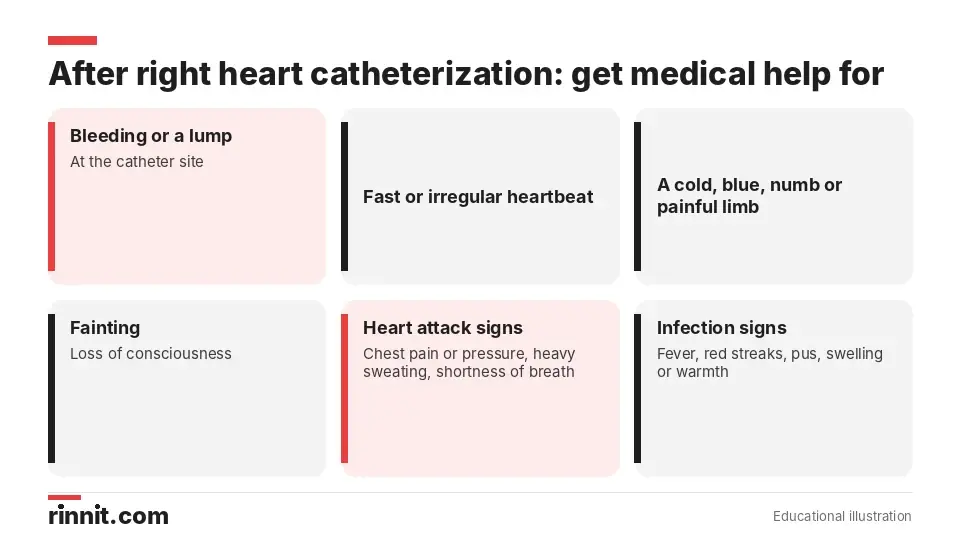
Call for help quickly if any of these signs appear after the procedure.
Seek medical attention if you have: [1]
Bleeding or a lump at the catheter site
A fast or irregular heartbeat
A leg, arm or hand that hurts, looks blue, feels cold or seems numb
Loss of consciousness
Heart attack signs: chest pain or pressure, heavy sweating or shortness of breath
Infection signs: fever, red streaks, pus, swelling or warmth near the site
Conclusion
Right heart catheterization gives your care team direct measurements of pressure and oxygen on the right side of your heart and in your lungs. That makes it one of the most precise ways to diagnose and manage pulmonary hypertension, heart failure and related conditions. [1]
It's an invasive test, but serious complications are uncommon. Follow your preparation instructions, plan a ride home, and know the warning signs to watch for during recovery. [1] [2]
Keep learning: Read our pulmonary hypertension guide or our heart failure guide.
FAQ
What is right heart catheterization?
An invasive test that threads a thin catheter through a vein into the right side of your heart and pulmonary artery to measure pressure and oxygen. [1]
Why is right heart catheterization done?
To diagnose and manage conditions like pulmonary hypertension, heart failure, cardiomyopathy, cardiogenic shock, heart valve disease and congenital heart disease. [1]
What is the difference between right and left heart catheterization?
Right heart catheterization goes through a vein to the right side of the heart; left heart catheterization goes through an artery to the left side and checks the coronary arteries. [1]
Is right heart catheterization the same as a Swan-Ganz catheter?
Yes. It's also called pulmonary artery catheterization or a Swan-Ganz catheter. [1]
Are you awake during right heart catheterization?
Yes. You usually get a local anesthetic, and many people don't need sedation. [1]
How long does right heart catheterization take?
About an hour, though preparation and recovery can take several hours in total. [1]
Does right heart catheterization hurt?
You may feel pain from the numbing shot and when the catheter goes in, plus pressure, skipped beats or warmth from medicines. [1]
What are the risks of right heart catheterization?
Bleeding or bruising, arrhythmia, blood clots, infection, collapsed lung and, rarely, heart attack or stroke. [1]
How long is recovery after right heart catheterization?
Most people go home after a couple of hours of monitoring and avoid heavy lifting for several hours or days. [1]
When should I call my doctor after the procedure?
For bleeding or a lump at the site, an irregular heartbeat, a cold or numb limb, fainting, or signs of heart attack or infection. [1]
Related Reading
Pulmonary Hypertension: Complete Guide to Symptoms, Causes, Diagnosis, and Treatment explains the condition right heart catheterization is used to confirm.
Heart Failure: Symptoms, Causes & Treatment Guide covers a condition this test helps diagnose and manage.
Cardiogenic Shock: The Heart-Failure Emergency Where Minutes Matter — Plain-English Guide explains an emergency where heart pressures guide care.
Congenital Heart Disease (CHD): Types, Symptoms, Treatment & Survival — Complete Guide covers heart defects that may need this test.
Heart Valve Disease: Symptoms, Causes & Treatment explains valve problems that right heart catheterization can help assess.
References
Cleveland Clinic. Right Heart Catheterization: Procedure Details and Results. Cleveland Clinic. Last updated July 24, 2022. https://my.clevelandclinic.org/health/diagnostics/21045-right-heart-catheterization
Hoeper MM, Lee SH, Voswinckel R, et al. Complications of right heart catheterization procedures in patients with pulmonary hypertension in experienced centers. J Am Coll Cardiol. 2006;48(12):2546-2552. PMID 17174196. https://doi.org/10.1016/j.jacc.2006.07.061
Kovacs G, Berghold A, Scheidl S, et al. Pulmonary arterial pressure during rest and exercise in healthy subjects: a systematic review. Eur Respir J. 2009;34(4):888-894. PMID 19324955. https://doi.org/10.1183/09031936.00145608
Medical disclaimer
This article is for general education only and does not replace advice from a qualified healthcare professional. Talk to your doctor about your own diagnosis and treatment, and seek emergency care right away for severe or sudden symptoms.



Comments