BNP Test (B-Type Natriuretic Peptide): Normal Levels and What High BNP Means

Updated: 3 days ago
Written and medically reviewed by Dr. Baraa Alnahhal, MD · Last reviewed: November 2026 · How we review
Quick Answer
A BNP test (B-type natriuretic peptide test) is a blood test that measures a hormone the heart releases when it's stretched and working too hard. It helps diagnose heart failure, judge how severe it is and check whether treatment is working. A BNP below 100 pg/mL is generally normal. It's a simple blood draw with no special preparation.
What the research says
BNP helps sort out sudden shortness of breath: in the Breathing Not Properly study of 1,586 emergency patients with acute shortness of breath, rapid BNP testing helped diagnose or exclude heart failure; a BNP below 50 pg/mL had a 96% negative predictive value, and BNP added independent value to other clinical information (Maisel AS et al., N Engl J Med, 2002) [2]
Natriuretic peptides are best at ruling heart failure out: a systematic review and meta-analysis in acute care found BNP, NT-proBNP and MR-proANP all had excellent ability to exclude acute heart failure, but specificity varied, so imaging is still needed to confirm the diagnosis; BNP and NT-proBNP performed similarly (Roberts E et al., BMJ, 2015) [3]
Key takeaways
BNP is released when the heart's walls stretch from extra strain.
It helps diagnose heart failure and track its severity.
Normal BNP is generally below 100 pg/mL.
NT-proBNP has different, age-based cutoffs.
Kidney disease, lung clots and obesity can affect results.
What is BNP?
BNP is a hormone made mainly by the heart's lower left chamber, the left ventricle. When the heart works harder and stretches, it releases more BNP. BNP tells the kidneys to get rid of extra salt and water and relaxes blood vessels, which lowers blood pressure and eases the heart's workload. It was first found in brain tissue, so it's also called brain natriuretic peptide. Sources: [1]
Why it's done

BNP gives a quick read on heart strain.
Help diagnose heart failure in people with shortness of breath, swelling or fatigue.
Gauge how severe heart failure is.
Check whether treatment is working.
Screen heart health in people at higher risk. Sources: [1, 2]
Normal ranges
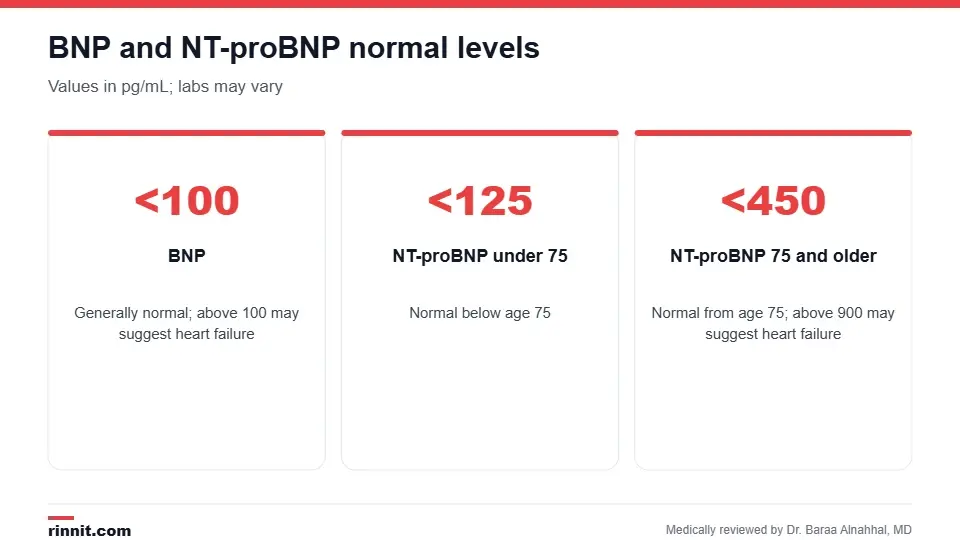
Normal values differ between BNP and NT-proBNP.
Test | Typically normal | May suggest heart failure |
BNP | Below 100 pg/mL | Above 100 pg/mL |
NT-proBNP, under age 75 | Below 125 pg/mL | Above 900 pg/mL |
NT-proBNP, age 75 and older | Below 450 pg/mL | Above 900 pg/mL |
Higher levels generally mean more serious heart failure. A high result needs other tests to confirm the diagnosis. Sources: [1, 3]
How the test is done
A provider draws blood from a vein in your arm. You may feel a brief pinch, and you may have slight soreness or a small bruise afterward. No fasting or other preparation is usually needed. In the emergency room, results can be ready in about 15 minutes; otherwise they take 1 to 2 days. Sources: [1]
What can affect results
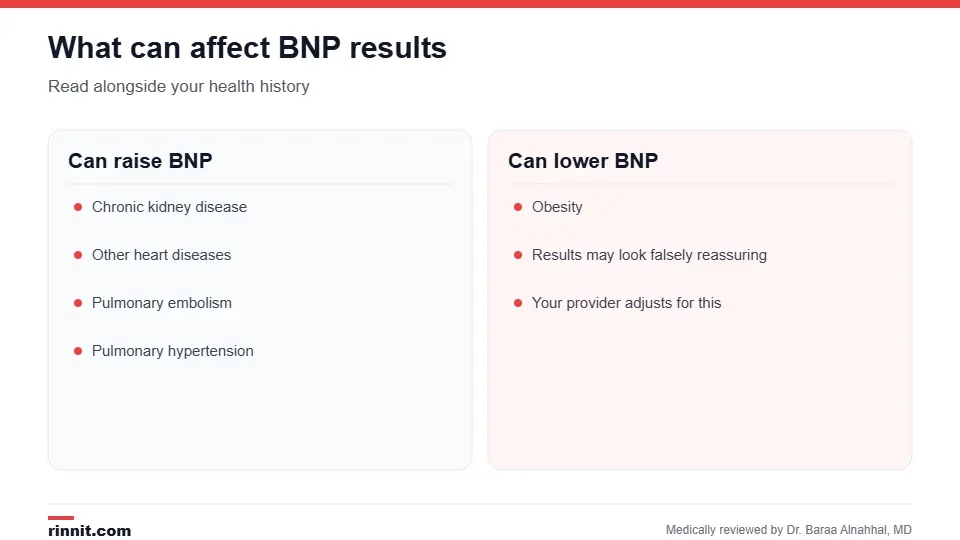
Your provider reads BNP alongside your health history.
Can raise BNP: chronic kidney disease, other heart diseases, a pulmonary embolism or pulmonary hypertension.
Can lower BNP: obesity. Sources: [1]
If your result is high, your provider may order an electrocardiogram (EKG) or an echocardiogram to look at how your heart is working. Sources: [1, 3]
Conclusion
The BNP test is a fast, simple way to check for heart strain. A normal result makes heart failure unlikely, while a high result points your provider toward more tests and the right treatment.
Keep learning: read about congestive heart failure and the echocardiogram.
Frequently asked questions
What does BNP stand for?
B-type (or brain) natriuretic peptide.
What is a normal BNP level?
Generally below 100 pg/mL.
What is the difference between BNP and NT-proBNP?
NT-proBNP is a related piece of the same hormone with different normal ranges.
What does a high BNP mean?
It may mean heart failure; other tests are needed to confirm.
Do I need to fast?
Usually not.
How fast are results?
About 15 minutes in the emergency room, or 1 to 2 days.
Can kidney disease raise BNP?
Yes, chronic kidney disease can raise it.
Why can BNP be low in obesity?
Obesity tends to lower BNP levels, so results are interpreted with care.
Can BNP track treatment?
Yes, falling levels can show treatment is working.
What test comes next if BNP is high?
Often an EKG and an echocardiogram.
Related Reading
Cardiac Blood Tests: Heart Disease Risk Tests and Ideal Levels explains the blood tests used to estimate heart disease risk.
Heart Failure: Symptoms, Causes & Treatment Guide the condition a BNP test helps diagnose.
Congestive Heart Failure: Symptoms, Stages, and How It's Treated what happens when fluid builds up from a weak heart.
Echocardiogram: Types, What to Expect, Results and Risks the scan that confirms heart failure after a high BNP.
Heart Failure Medications: Types, Benefits, Side Effects, and How to Take Them Safely treatments that can lower BNP over time.
Left-Sided Heart Failure: Types, Causes, and Management the type of heart failure most linked to BNP.
References
Cleveland Clinic. B-Type Natriuretic Peptide (BNP) Test: Normal Levels & Purpose. Cleveland Clinic. Last updated September 12, 2025. https://my.clevelandclinic.org/health/diagnostics/22629-b-type-natriuretic-peptide
Maisel AS, Krishnaswamy P, Nowak RM, et al. Rapid measurement of B-type natriuretic peptide in the emergency diagnosis of heart failure. N Engl J Med. 2002;347(3):161-167. PMID 12124404. https://doi.org/10.1056/NEJMoa020233
Roberts E, Ludman AJ, Dworzynski K, et al. The diagnostic accuracy of the natriuretic peptides in heart failure: systematic review and diagnostic meta-analysis in the acute care setting. BMJ. 2015;350:h910. PMID 25740799. https://doi.org/10.1136/bmj.h910
Medical disclaimer
This article is for general education only and does not replace advice from a qualified healthcare professional. Talk to your doctor about your own diagnosis and treatment, and seek emergency care right away for severe or sudden symptoms.



Comments