Digoxin: Uses, Normal Levels and Toxicity

Updated: 2 days ago
Written and medically reviewed by Dr. Baraa Alnahhal, MD · Last reviewed: November 2026 · How we review
Quick Answer
Digoxin is a heart medicine made from the foxglove plant that helps the heart pump more strongly and slows the heart rate. It treats heart failure, atrial fibrillation and atrial flutter. The helpful amount is close to the toxic amount, so too much can cause dangerous heart rhythms. Warning signs include nausea, vomiting and yellow, green or blurry vision.
What the research says
Lower digoxin levels were linked to better survival: in an analysis of 3,782 men with heart failure, deaths rose with blood digoxin level, from 29.9% at 0.5 to 0.8 ng/mL to 48.0% at 1.2 ng/mL or higher, and the lowest range had 6.3% lower mortality than placebo (Rathore SS et al., JAMA, 2003) [2]
Digoxin didn't change survival but slightly cut hospital stays: a review of 52 studies with 621,845 people found digoxin had a neutral effect on death in randomized trials and a small reduction in hospital admissions (risk ratio 0.92) (Ziff OJ et al., BMJ, 2015) [3]
Key takeaways
Digoxin helps the heart pump harder and beat slower.
It treats heart failure, Afib and atrial flutter.
It's usually added when other medicines aren't enough.
Regular blood tests check your level.
Too much can cause dangerous heart rhythms.
What is digoxin?
Digoxin limits an enzyme that moves sodium and potassium in and out of heart cells. This lets calcium build up so the heart pumps more blood. It also slows electrical signals through the AV node, lowering your heart rate. Sources: [1]
What it treats

Providers usually try other medicines first.
Atrial flutter. Sources: [1]
Benefits include fewer hospital admissions, eased heart failure symptoms, better quality of life and a slower heart rate in certain arrhythmias. Learn about other heart failure medicines. Sources: [1, 3]
How to take digoxin
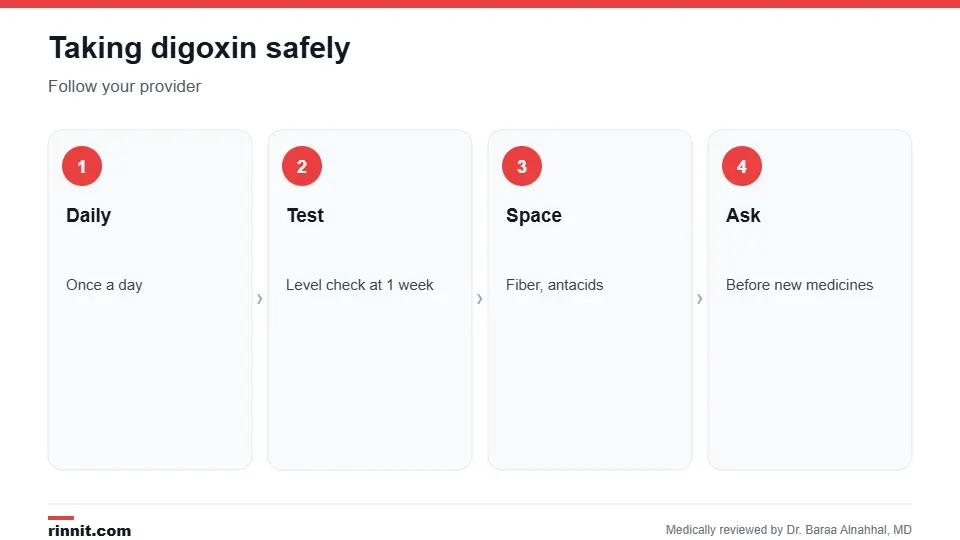
Normal blood levels are 0.5 to 2 ng/mL; for heart failure, providers often aim for about 0.5 to 0.9 ng/mL.
Take it once a day as directed.
Get your level checked a week after starting, six to eight hours after a dose, then regularly.
Fiber, antacids, macrolide antibiotics, metoclopramide and some cholesterol medicines may affect absorption.
Ask before taking any new medicine, including over-the-counter drugs.
Tell your provider if you have kidney disease, which affects your dose. Sources: [1]
Digoxin levels and toxicity
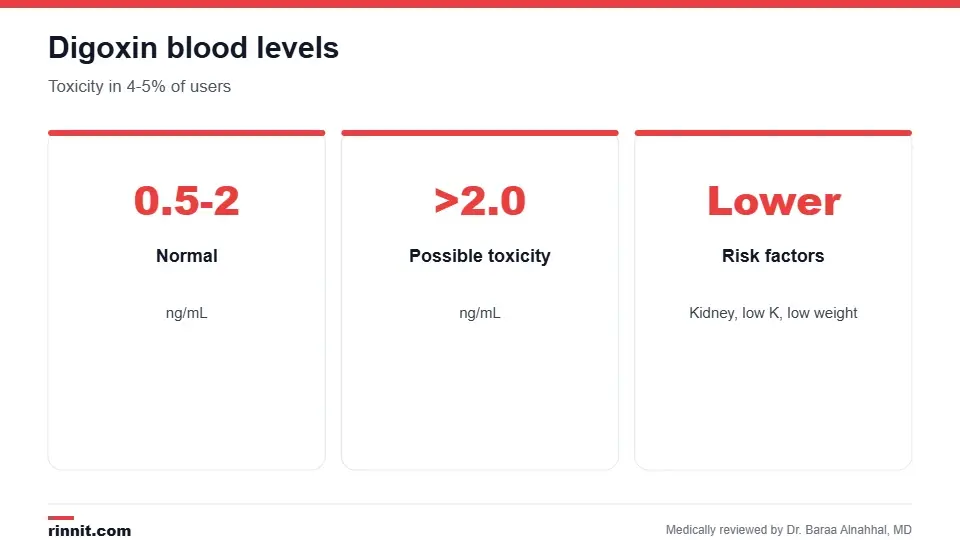
About 4% to 5% of people taking digoxin develop toxicity.
Level | What it means |
0.5 to 2 ng/mL | Normal range |
Above 2.0 ng/mL | May mean toxicity |
Below 2.0 with risk factors | Toxicity still possible with poor kidney function, low weight or low potassium |
About 4% to 5% of people taking digoxin develop toxicity, and it's fatal for 9% of them. Older adults clear the drug more slowly. Some heart medicines and antibiotics raise digoxin levels, so your dose may be cut by half. Sources: [1, 2]
Side effects
Upset stomach.
Yellow, green or blurry vision.
Dizziness, lightheadedness or sleepiness.
Headache or rash.
A fast or abnormally slow heart rhythm.
Breast enlargement (gynecomastia). Sources: [1]
Treating toxicity
Toxicity needing hospital care often improves quickly with IV fluids and electrolytes. A medicine called digoxin immune fab can reverse an overdose. An EKG helps detect too much digoxin. Overdose may also cause high potassium. Sources: [1]
Outlook
Heart failure symptoms may take a few weeks or months to improve. Keeping your level in the target range helps you get the benefits safely. Sources: [1, 2]
When to call your provider
Trouble breathing.
Loss of appetite.
Vomiting or diarrhea.
Swelling in your hands or feet.
Changes in your vision. Sources: [1]
Conclusion
Digoxin can ease heart failure symptoms and slow a racing heart, but it needs careful dosing. Regular blood tests and checking before new medicines help keep it safe.
Keep learning: read about heart failure medicines and atrial fibrillation.
Frequently asked questions
What is digoxin?
A heart medicine from the foxglove plant.
What does digoxin treat?
Heart failure, atrial fibrillation and atrial flutter.
How does it work?
It helps the heart pump harder and slows the heart rate.
What is a normal digoxin level?
0.5 to 2 ng/mL.
What are signs of digoxin toxicity?
Nausea, vomiting, vision changes and an irregular heartbeat.
How common is toxicity?
About 4% to 5% of people taking it.
Can I take antacids with digoxin?
Ask your provider; antacids can affect absorption.
Why does kidney function matter?
Your kidneys clear digoxin, so poor function raises levels.
Can an overdose be reversed?
Yes. Digoxin immune fab can reverse its effects.
How long until it helps?
Heart failure symptoms may take weeks to months to improve.
Related Reading
Chemical Cardioversion: Medicines, Procedure and Risks explains chemical cardioversion.
Heart Failure Medications: Types, Benefits, Side Effects, and How to Take Them Safely other heart failure medicines.
Atrial Fibrillation (AFib): Symptoms, Causes & Treatment Guide a rhythm problem digoxin treats.
Atrial Flutter: Symptoms, Causes, Diagnosis & Treatment — Complete Guide another rhythm it treats.
Heart Failure: Symptoms, Causes & Treatment Guide an overview of heart failure.
Heart Arrhythmia: Symptoms, Types, Causes, Diagnosis & Treatment — Complete Guide abnormal heart rhythms.
References
Cleveland Clinic. Digoxin: What It Is & Normal Levels. Cleveland Clinic. Last updated April 14, 2023. https://my.clevelandclinic.org/health/treatments/24910-digoxin-levels
Rathore SS, Curtis JP, Wang Y, et al. Association of serum digoxin concentration and outcomes in patients with heart failure. JAMA. 2003;289(7):871-878. PMID 12588271. https://doi.org/10.1001/jama.289.7.871
Ziff OJ, Lane DA, Samra M, et al. Safety and efficacy of digoxin: systematic review and meta-analysis of observational and controlled trial data. BMJ. 2015;351:h4451. PMID 26321114. https://doi.org/10.1136/bmj.h4451
Medical disclaimer
This article is for general education only and does not replace advice from a qualified healthcare professional. Talk to your doctor about your own diagnosis and treatment, and seek emergency care right away for severe or sudden symptoms.



Comments