Cardiac Resynchronization Therapy (CRT): Procedure and Results

Updated: 2 days ago
Written and medically reviewed by Dr. Baraa Alnahhal, MD · Last reviewed: November 2026 · How we review
Quick Answer
Cardiac resynchronization therapy (CRT) uses a special pacemaker to help both lower heart chambers (ventricles) beat at the same time. It treats heart failure when the ventricles beat out of sync, usually after medicines and lifestyle changes aren't enough. CRT helps most people breathe easier and live longer, though it doesn't help 2 to 3 in 10.
What the research says
CRT cut deaths in heart failure: in the CARE-HF trial of 813 people with moderate to severe heart failure and out-of-sync ventricles, CRT lowered death from any cause to 20% versus 30% with medicine alone over about 29 months (Cleland JG et al., New England Journal of Medicine, 2005) [2]
CRT with a defibrillator lowered deaths by more than a third: in the COMPANION trial of 1,520 people with advanced heart failure, CRT with a pacemaker-defibrillator cut death from any cause by 36%, and CRT lowered death or heart failure hospital stays by 34% to 40% (Bristow MR et al., New England Journal of Medicine, 2004) [3]
Key takeaways
CRT helps both ventricles beat together.
It treats heart failure with out-of-sync ventricles.
CRT-P is a pacemaker; CRT-D adds a defibrillator.
Placement takes several hours.
It helps most people, but not 2 to 3 in 10.
What is cardiac resynchronization therapy?
CRT uses a biventricular pacemaker. When the ventricles beat out of sync (ventricular dyssynchrony), the heart pumps less blood. CRT restores coordination so the heart works more efficiently. Sources: [1]
Who it's for
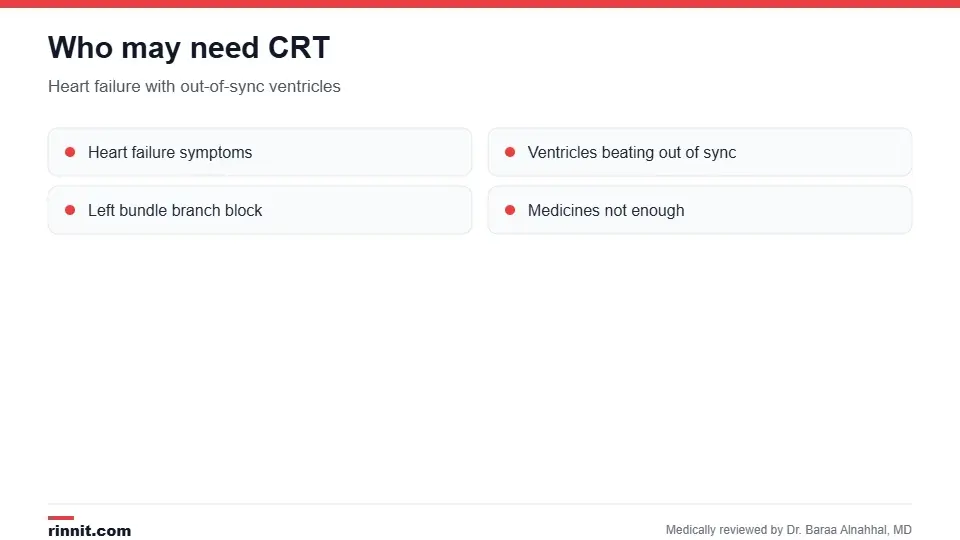
It can help the heart pump more blood.
Heart failure with ventricles beating out of sync.
A rhythm problem such as left bundle branch block.
Symptoms that continue despite medicine and lifestyle changes. Sources: [1]
Benefits
The heart pumps more blood and works more efficiently.
Less shortness of breath.
Lower risk of dangerous ventricular rhythms.
Less mitral valve regurgitation.
More energy for physical activity.
A longer life with heart failure. Sources: [1, 2, 3]
Types of CRT devices

Many people need a CRT-D.
Device | What it does |
CRT-P | Biventricular pacemaker with three leads: one to each ventricle and one to the right atrium |
CRT-D | Biventricular pacemaker plus a defibrillator that stops dangerous fast rhythms |
Learn more about implantable cardioverter-defibrillators. Sources: [1]
How to prepare
Imaging, such as a heart MRI or echocardiogram, and blood tests.
Don't eat or drink for at least six hours before.
You'll get medicine so you don't feel pain. Sources: [1]
What happens during the procedure
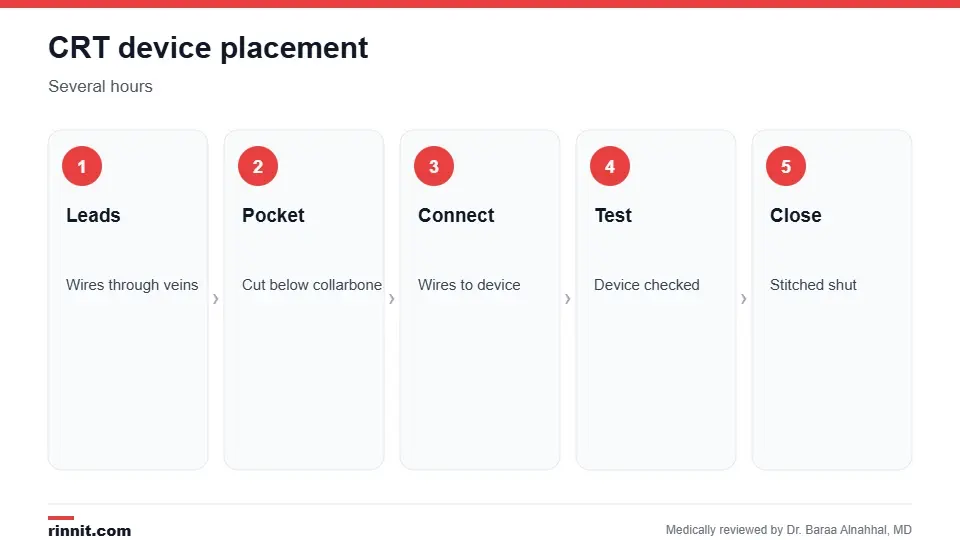
The procedure takes several hours.
Three wires are threaded through veins in your upper body or thigh to your heart.
A small cut is made below your collarbone or in your belly.
The wires are connected to the device.
The device is tested.
It's placed under your skin, and the incision is closed. Sources: [1]
Risks
Wires breaking or moving out of place.
Infection or bleeding.
Blood clots.
Allergic reaction.
Heart attack or other heart problems.
Collapsed lung. Sources: [1]
Recovery
You'll stay a few hours or overnight; arrange a ride home.
Keep your left arm still for about 12 hours.
Carry your device ID card.
Return to normal activities in a few days.
Avoid driving and heavy lifting for about a week.
Cardiac rehab can help you get active. Sources: [1]
You'll have a check one month after placement, then once or twice a year, plus remote device checks. The device usually lasts several years. Sources: [1]
Outlook
CRT has a high success rate and should improve your quality of life, but researchers estimate it doesn't help 2 to 3 out of 10 people. In major trials, it lowered deaths and hospital stays. Sources: [1, 2, 3]
When to call your provider
Call if you get a fever, even weeks or months after placement, because it may mean an infection around the device. Sources: [1]
Conclusion
Cardiac resynchronization therapy gets your heart's chambers back in sync, easing heart failure symptoms and helping many people live longer. Regular device checks keep it working well.
Keep learning: read about biventricular pacemakers and permanent pacemakers.
Frequently asked questions
What is cardiac resynchronization therapy?
A pacemaker treatment that helps both ventricles beat together.
Who needs CRT?
People with heart failure whose ventricles beat out of sync.
What's the difference between CRT-P and CRT-D?
CRT-D adds a defibrillator to the pacemaker.
How long does the procedure take?
Several hours.
Will I stay in the hospital?
A few hours or overnight.
Why keep my arm still?
To help the leads stay in place, for about 12 hours.
When can I drive?
Usually after about a week.
How long does the device last?
Several years.
Does CRT always work?
No. It doesn't help 2 to 3 in 10 people.
Does CRT help people live longer?
Yes. Trials show it lowers the risk of death.
Related Reading
Biventricular Pacemaker: How It Works, Who Needs One, Benefits, Risks and Daily Life the device used in CRT.
Ventricular Dyssynchrony: Symptoms, Causes, and Resynchronization Therapy out-of-sync ventricles.
Understanding Left Bundle Branch Block (LBBB): Causes, Symptoms, and Support a rhythm problem CRT may treat.
Understanding Implantable Cardioverter Defibrillators (ICD) the defibrillator in CRT-D.
Heart Failure: Symptoms, Causes & Treatment Guide an overview of heart failure.
References
Cleveland Clinic. Cardiac Resynchronization Therapy (CRT). Cleveland Clinic. Last updated August 4, 2025. https://my.clevelandclinic.org/health/treatments/22936-cardiac-resynchronization-therapy
Cleland JG, Daubert JC, Erdmann E, et al. The effect of cardiac resynchronization on morbidity and mortality in heart failure. New England Journal of Medicine. 2005;352(15):1539-1549. PMID 15753115. https://doi.org/10.1056/NEJMoa050496
Bristow MR, Saxon LA, Boehmer J, et al. Cardiac-resynchronization therapy with or without an implantable defibrillator in advanced chronic heart failure. New England Journal of Medicine. 2004;350(21):2140-2150. PMID 15152059. https://doi.org/10.1056/NEJMoa032423
Medical disclaimer
This article is for general education only and does not replace advice from a qualified healthcare professional. Talk to your doctor about your own diagnosis and treatment, and seek emergency care right away for severe or sudden symptoms.



Comments