Biventricular Pacemaker: How It Works, Who Needs One, Benefits, Risks and Daily Life

Updated: 7 days ago
Written and medically reviewed by Dr. Baraa Alnahhal, MD · Last reviewed: October 2026 · How we review
Quick Answer: What is a biventricular pacemaker?
A biventricular pacemaker is a small implanted device for moderate to severe heart failure in which the two lower heart chambers no longer pump together. It uses three leads to send tiny electrical signals so both ventricles squeeze at the same time, a treatment called cardiac resynchronization therapy (CRT). Many feel better, but about 3 in 10 don't improve. [1]
What the research says
Resynchronization cut deaths and heart failure hospital stays in advanced heart failure. In a trial of 1,520 people with severe heart failure (NYHA class III–IV) and a wide QRS on their ECG, a biventricular pacemaker lowered the risk of death or heart failure hospitalization by 34%. Adding a built-in defibrillator lowered that risk by 40% and reduced death from any cause by 36%. (Bristow et al., N Engl J Med, 2004)
Fewer people died when CRT was added to medicines. Among 813 people followed for an average of about 29 months, 20% of those with a resynchronization device died, compared with 30% of those on medicines alone. The device also improved symptoms, quality of life and how well the heart pumped. (Cleland et al., N Engl J Med, 2005)
The wider the QRS, the bigger the benefit. A pooled analysis of five randomized trials covering 3,782 people found that QRS width on the ECG was the strongest predictor of who benefits. The benefit became clear when the QRS was longer than about 140 milliseconds. (Cleland et al., Eur Heart J, 2013)
Key takeaways
A biventricular pacemaker treats heart failure in which the two ventricles beat out of step.
It has three leads, while a standard pacemaker has one or two.
It helps both ventricles pump together, so more oxygen-rich blood reaches the body.
A combined version, CRT-D, also includes a defibrillator that can shock a dangerously fast rhythm.
Possible benefits include fewer symptoms, better quality of life, fewer hospital stays and longer survival.
You'll need regular check-ups, often with monthly remote device checks, and you should keep strong magnets at least 6 inches (about 15 cm) away.
What is a biventricular pacemaker?
A biventricular pacemaker is an implanted device for people with advanced heart failure that, like other pacemakers, helps with abnormal heart rhythms (arrhythmias).
The key difference is the number of wires.
Your heart has four chambers. The two lower chambers, the ventricles, do the heavy pumping. When they squeeze at slightly different times, the heart has a hard time pushing enough oxygen-rich blood out to the body.
A biventricular pacemaker fixes that timing. Doctors call this treatment cardiac resynchronization therapy (CRT).
How is a biventricular pacemaker different from a standard pacemaker?
A biventricular pacemaker has three leads, while a standard pacemaker has one or two.
Feature | Standard pacemaker | Biventricular pacemaker |
Number of leads | 1 or 2 | 3 |
Where the leads go | — | Right upper chamber + right ventricle + left ventricle |
Main goal | Treat abnormal heart rhythms | Make both ventricles pump at the same time |
Typical user | People with rhythm problems | People with moderate to severe heart failure symptoms |
Other name | — | Cardiac resynchronization therapy (CRT) device |
For a broader look at standard devices, see our guide to permanent pacemakers and our explainer on the wire-free leadless pacemaker.
How does a biventricular pacemaker work?
A biventricular pacemaker works by sending electrical impulses through three leads with each heartbeat, so the two ventricles pump at the same moment.

The device has two main parts.
1. The pulse generator. This is a small case that holds a battery and a tiny computer. It is placed during an invasive procedure.
2. Three leads. These thin wires connect to the pulse generator and carry its signals into the heart:
One lead goes to the right atrium (the upper right chamber).
One lead goes to the right ventricle.
One lead goes to the left ventricle.
Most people don't feel these impulses.
What is the difference between CRT-P and CRT-D?
A CRT-P is a biventricular pacemaker alone, while a CRT-D combines a biventricular pacemaker with an implantable cardioverter defibrillator (ICD) that can shock a dangerously fast rhythm. The combined version is for people with heart failure who also face a risk of life-threatening fast heart rhythms.
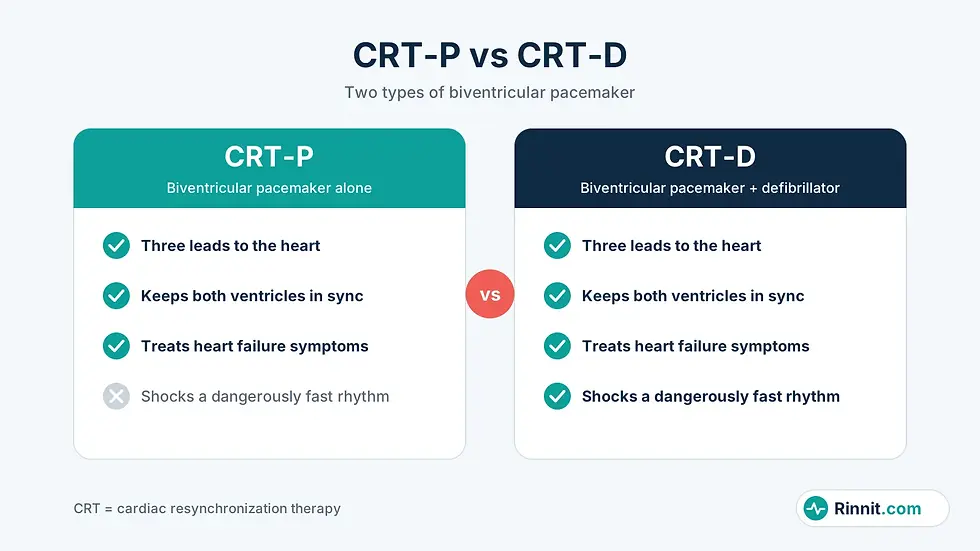
CRT-P | CRT-D | |
What it is | Biventricular pacemaker alone | Biventricular pacemaker + defibrillator |
Keeps both ventricles in sync | Yes | Yes |
Shocks a dangerously fast rhythm | No | Yes |
Main extra purpose | — | May protect against sudden death from dangerous arrhythmias |
Typical candidate | Heart failure with out-of-sync ventricles | Same, plus a high risk of life-threatening rhythms |
When the defibrillator part of a CRT-D detects a dangerously fast rhythm, it delivers a shock to stop it. Learn more about these rhythms in our guides to ventricular arrhythmia and sudden cardiac arrest.
Who may need a biventricular pacemaker?
Your heart team may recommend a biventricular pacemaker when heart failure medicines aren't controlling your symptoms and your heart chambers don't beat together. Other reasons include:
Fatigue and shortness of breath hold you back during daily activities.
Your heart isn't pumping as much blood as it should.
You may be at high risk for cardiac arrest.
One common reason the ventricles fall out of step is a delay in the heart's wiring, such as left bundle branch block. You can read more in our overview of bundle branch block.
Who may not be able to get a biventricular pacemaker?
A biventricular pacemaker may not be an option if you have an active infection, a bleeding disorder (trouble forming blood clots), dementia, a serious illness that may be fatal within a year, or abnormalities in your central veins. Your heart team will weigh these factors before recommending the device.
What are the benefits and risks of a biventricular pacemaker?
A biventricular pacemaker can ease heart failure symptoms, improve quality of life and reduce hospital stays, but it carries procedure risks and doesn't help about 3 in 10 people.
Possible benefits
Fewer and milder heart failure symptoms
Better quality of life
Fewer heart-related hospital stays
Improved heart function
Longer survival with heart failure
Possible risks
The implant procedure carries risks, as any procedure does. After the device is in place, complications can also happen:
A lead can move out of place or disconnect from the heart tissue or the pulse generator.
The device may not work as it should.
Heart failure symptoms don't improve in about 3 out of 10 people who get the device.
Benefits | Risks |
Improved symptoms | Risks of the implant procedure |
Better quality of life | A lead can shift or disconnect |
Fewer heart-related hospital stays | The device may malfunction |
Better heart function | About 3 in 10 people don't feel better |
Longer survival | — |
How often do you need follow-up care with a biventricular pacemaker?
People with a biventricular pacemaker usually see their heart care provider several times a year and most likely send remote device check-ups about once a month from home. These visits check your health and make sure the device is working well.
Because it's a machine, your device may sometimes need:
A software update
A new battery
When should you call your provider about a biventricular pacemaker?
Call your provider if you feel dizzy, faint or short of breath, or if you get shocks from the defibrillator in a CRT-D. A device problem might also show up as beeping sounds or be picked up during a remote or in-person check, and you may notice symptoms you had before the implant.
Call your provider if you feel:
Dizzy
Faint
Short of breath
Shocks from your defibrillator (if you have a CRT-D)
What devices should you keep away from a biventricular pacemaker?
Strong magnetic fields can interfere with a biventricular pacemaker, so keep magnets and similar sources at least 6 inches (about 15 cm) away. Being closer than that can stop your device's signals.

You might not notice right away if your device isn't working properly. If you do notice something, step away from the source. Even an electric dog fence can cause a problem.
Item | What to do |
Cell phones | Use speakerphone, or hold the phone to the ear on the side away from your device |
Phones and headphones in pockets | Don't carry them in your shirt pocket |
Metal detectors | Show your pacemaker ID card and ask for a special screening |
Surgery or MRI scans | Talk to your heart care provider first |
Kidney stone treatment | Talk to your provider first |
TENS units for pain | Talk to your provider first |
Radiation therapy for cancer | Talk to your provider first |
Electric dog fences and strong magnets | Keep at least 6 inches away |
How long can you live with a biventricular pacemaker?
Life expectancy with a biventricular pacemaker has no single answer and depends on several factors, including:
Your age
Other health conditions you may have
How well the device is working for you
Your heart care provider is the best person to give you a personal estimate.
Conclusion
Hearing that medicine alone isn't enough for your heart failure can feel hard. But a biventricular pacemaker can help your two lower chambers work as a team again, and for many people that means fewer symptoms, a better quality of life and fewer hospital stays.
It isn't right for everyone, and it doesn't help every person who receives one. Ask your heart team why they're recommending it, what it will do for you and how it may change your daily routine.
Want to understand the bigger picture? Read our complete heart failure guide next, and explore more trusted, easy-to-read heart health articles on Rinnit.com.
Frequently asked questions
What is the difference between a pacemaker and a biventricular pacemaker?
The main difference is the number of leads. A standard pacemaker has one or two leads, while a biventricular pacemaker has three: one to the right atrium and one to each ventricle. This lets it make both ventricles pump at the same time.
Is a biventricular pacemaker the same as CRT?
Yes. Using a biventricular pacemaker to make both ventricles beat together is called cardiac resynchronization therapy, or CRT.
What is the difference between CRT-P and CRT-D?
A CRT-P is a biventricular pacemaker alone. A CRT-D combines a biventricular pacemaker with a defibrillator that can shock a dangerously fast heart rhythm back to normal.
Will I feel the biventricular pacemaker working?
Most people don't feel the electrical impulses the device sends to the heart.
Does a biventricular pacemaker work for everyone?
No. Heart failure symptoms don't improve in about 3 out of 10 people who receive the device.
How often does a biventricular pacemaker need to be checked?
You'll usually see your provider several times a year and will most likely send remote device checks about once a month.
Can I use a cell phone with a biventricular pacemaker?
Yes. Use speakerphone or hold the phone to the ear on the side away from your device, and don't carry your phone or headphones in your shirt pocket.
Can I go through airport security with a biventricular pacemaker?
Your device can set off metal detectors. Show security staff your pacemaker ID card and ask for a special screening.
What are the warning signs of a pacemaker problem?
Call your provider if you feel dizzy, faint or short of breath, or if you receive shocks from your defibrillator. Some devices may also beep when there's a problem.
Who should not get a biventricular pacemaker?
It may not be suitable for people with an active infection, a bleeding disorder, dementia, a serious illness likely to be fatal within a year, or abnormalities in the central veins.
Related reading on Rinnit.com
Helpful external resources
Related Reading
Cardiac Resynchronization Therapy (CRT): Procedure and Results explains cardiac resynchronization therapy.
References
Cleveland Clinic. Biventricular Pacemaker: Device & How It Works. Cleveland Clinic. Last updated May 21, 2025. https://my.clevelandclinic.org/health/treatments/16784-biventricular-pacemaker
American Heart Association. Cardiac Resynchronization Therapy (CRT). heart.org. Last reviewed June 17, 2025. https://www.heart.org/en/health-topics/heart-failure/treatment-options-for-heart-failure/cardiac-resynchronization-therapy-crt
National Heart, Lung, and Blood Institute. Living With a Pacemaker. NHLBI Health Topics. Last updated March 24, 2022. https://www.nhlbi.nih.gov/health/pacemakers/living-with
Vajapey R, Chung MK. Emerging technologies in cardiac pacing. Annual Review of Medicine. 2024;75:475-492. PMID: 37989145. https://doi.org/10.1146/annurev-med-051022-042616
Bristow MR, Saxon LA, Boehmer J, et al. Cardiac-resynchronization therapy with or without an implantable defibrillator in advanced chronic heart failure. New England Journal of Medicine. 2004;350(21):2140-2150. PMID: 15152059. https://doi.org/10.1056/NEJMoa032423
Cleland JG, Daubert JC, Erdmann E, et al. The effect of cardiac resynchronization on morbidity and mortality in heart failure. New England Journal of Medicine. 2005;352(15):1539-1549. PMID: 15753115. https://doi.org/10.1056/NEJMoa050496
Cleland JG, Abraham WT, Linde C, et al. An individual patient meta-analysis of five randomized trials assessing the effects of cardiac resynchronization therapy on morbidity and mortality in patients with symptomatic heart failure. European Heart Journal. 2013;34(46):3547-3556. PMID: 23900696. https://doi.org/10.1093/eurheartj/eht290
Medical disclaimer
This article is for general educational purposes and is not a substitute for professional medical advice, diagnosis or treatment. Always talk with your cardiologist or heart care team about whether a biventricular pacemaker is right for you and how to live safely with your device.



Comments