Ventricular Dyssynchrony: Symptoms, Causes, and Resynchronization Therapy

Updated: 3 days ago
Medically reviewed by Dr. Baraa Alnahhal, MD · Last reviewed: October 2026
Ventricular dyssynchrony is a disorganized contraction of the heart's lower chambers (the ventricles) that keeps the heart from pumping as well as it should. It is most often linked to heart failure and electrical conduction delays such as bundle branch blocks [1], and it can worsen symptoms such as fatigue and shortness of breath [1]. Medicines treat the underlying conditions, while cardiac resynchronization therapy (CRT), also called a biventricular pacemaker, paces both ventricles so they contract together and can mean fewer hospital stays and a longer life [1].
Quick Answer
Ventricular dyssynchrony is a condition in which the heart's ventricles do not contract at the same time, so the heart pumps less efficiently [1]. A delay as small as 40 milliseconds can be enough [1]. It mainly affects people with heart failure or conduction problems [1]. An ECG and echocardiogram diagnose it, and a biventricular pacemaker (CRT) can help the heart pump better [1].
What the research says
CRT lowers deaths in selected heart failure patients. A JAMA review reported that in an individual patient-level meta-analysis of 5 randomized trials (3,872 patients), biventricular pacing was associated with lower all-cause mortality than medical therapy or an implantable defibrillator over a median of 23.7 months (13.7% vs 20.8%; HR 0.66, 95% CI 0.57-0.77), and that dyssynchrony from conduction disease occurs in 20% to 30% of patients with heart failure and reduced ejection fraction (Ternes et al., JAMA, 2026) [2].
A wide QRS or LBBB on the ECG predicts worse outcomes. A meta-analysis of 11 studies (83,698 patients with chronic heart failure and no pacing or CRT) found that a prolonged QRS was associated with higher all-cause mortality (HR 1.20, 95% CI 1.13-1.28) and heart failure hospitalization (HR 1.42, 95% CI 1.33-1.51), with similar results for left bundle branch block (Herrán-Fonseca et al., J Electrocardiol, 2026) [3].
Newer left bundle branch pacing may match or beat standard CRT. A meta-analysis of 24 randomized and cohort studies (9,278 patients) found that, compared with biventricular pacing, left bundle branch pacing was associated with lower all-cause mortality (OR 0.57, 95% CI 0.48-0.68) and fewer heart failure hospitalizations (OR 0.50, 95% CI 0.43-0.57), with similar procedural success (Jahangir et al., Expert Rev Med Devices, 2026) [4].
What Is Ventricular Dyssynchrony?
Your heart works best when the muscles of both ventricles contract at the same time. Normally, electrical signals travel through the heart in an organized way. The left ventricle, the main pumping chamber, needs to contract in a coordinated way, with both sides of the chamber squeezing toward the middle. When the signal cannot reach both ventricles at the same time, the muscles cannot contract together [1]. That is dyssynchrony.
Ventricular dyssynchrony affects the body in three main ways:

Types and Prevalence
Dyssynchrony can be grouped into three types, depending on which parts of the heart are out of step:
As many as one-third of people with a certain type of heart failure develop ventricular dyssynchrony [1]. About 2% of adults in developed nations have heart failure, and about 6% to 10% of people older than 65 do [1], so dyssynchrony affects a large number of people.
Causes and Who Is Affected
Several heart problems can cause ventricular dyssynchrony:
Electrical conduction delay: including left bundle branch block (LBBB) and right bundle branch block (RBBB) [1].
Scar tissue: scarring left by a heart attack can disrupt the path of electrical signals [1].
Diseased heart muscle and ventricular dysfunction. [1]
Ischemia: not enough blood flow to the heart muscle [1].
It affects people who have heart failure, LBBB, RBBB, cardiomyopathy, high blood pressure or coronary artery disease.
Symptoms and Warning Signs
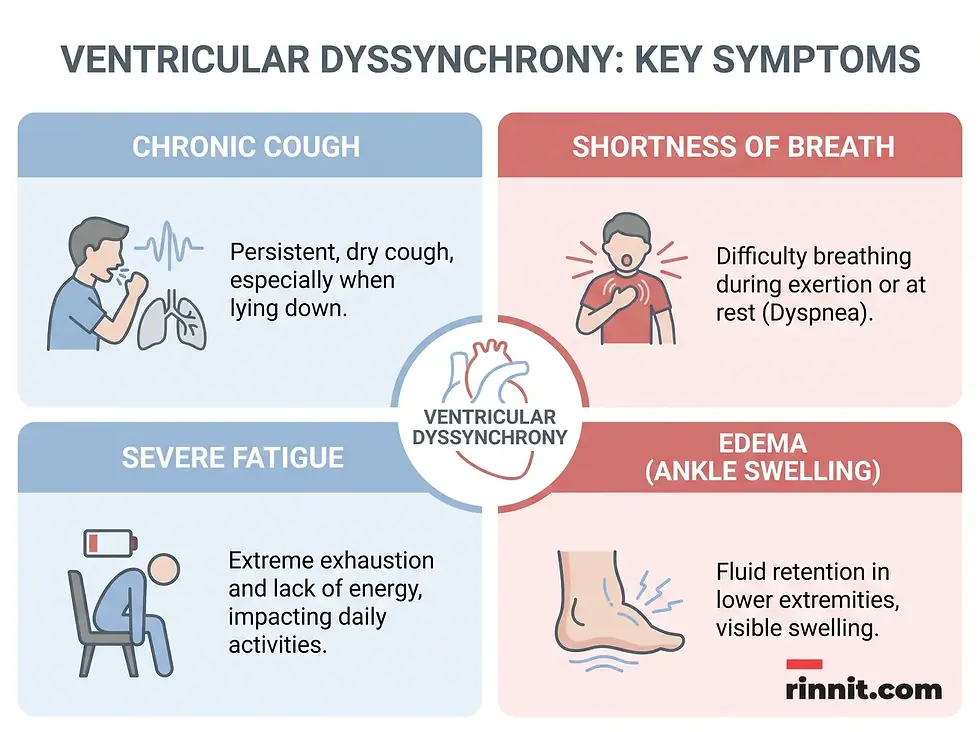
Ventricular dyssynchrony can make the symptoms of heart failure more severe, or it can cause symptoms of its own [1].
These symptoms overlap with many other heart conditions, so a professional evaluation is needed to find the cause.
Diagnosis and Tests
Your provider starts with your history and a physical exam. Listening to your heart with a stethoscope can uncover ventricular dyssynchrony [1]. An electrocardiogram (ECG) is the most common test for finding problems with the heart's conduction system, such as right or left bundle branch block [1], and these findings prompt further testing. Providers often use an echocardiogram to diagnose ventricular dyssynchrony [1].
Other tests that may be used include:
Positron emission tomography (PET)
Multigated acquisition (MUGA) scan
Heart magnetic resonance imaging (MRI)
Computed tomography (CT)
Single photon emission computed tomography (SPECT) [1]
Management and Treatment
Providers may treat the condition that is causing the dyssynchrony [1]. In many cases, cardiac resynchronization therapy (CRT) can help your heart pump better by pacing it from both sides [1].
Cardiac Resynchronization Therapy (CRT)
CRT, often called a biventricular pacemaker, paces both the left and right ventricles so they contract together [1]. It improves symptoms in 50% to 70% of the people who get it, and success is more likely in people with severe dyssynchrony [1]. CRT reduces dyssynchrony right away, and some people feel better a few weeks after implantation [1]. Long-term benefits include better cardiac output, fewer mitral valve leaks, a better quality of life and a longer distance walked in six minutes [1]. In people with heart failure, CRT can mean fewer hospital stays and a longer life [1] [2].
Possible complications of implanting a CRT device include a collapsed lung (pneumothorax), blood between the chest wall and lung (hemothorax), a heart puncture, stimulation of muscles other than the heart, and leads that move out of place [1].
Medication and Lifestyle
For conditions that cause dyssynchrony, such as heart failure, cardiomyopathy or high blood pressure, providers may prescribe ACE inhibitors, angiotensin II receptor blockers (ARBs), beta-blockers or diuretics [1]. These medicines improve how well the heart works, but they do not by themselves reverse dyssynchrony caused by abnormal electrical conduction, so they are used alongside CRT when it is needed.

Outlook
You are likely to have a poor outcome if left ventricular dyssynchrony is not treated, and people who have it face a higher risk of cardiac events [1]. The left ventricle is the pump that sends oxygen-rich blood to the body [1], so its coordination matters a great deal. The underlying cause also affects the outlook, and some people will have a worse outlook than others [1].
Prevention and Living With Dyssynchrony
The best way to lower your risk is to take good care of your heart, which may help prevent some of the conditions that cause dyssynchrony [1]. Ways to do that include:
If you have a biventricular pacemaker, go to your follow-up appointments so your provider can check that it is working correctly. Some hospitals have CRT clinics, where heart rhythm doctors and heart failure specialists work together to help you get the most from your device [1]. Contact your provider if your medicines are not working or you have trouble with your pacemaker [1].
When to Get Emergency Help
Get medical help right away if you feel:
Chest pain or discomfort
Lightheadedness
Shortness of breath
Sickness to your stomach
Pain in your back, neck or jaw [1]
Conclusion
Ventricular dyssynchrony is a complication of heart failure and electrical conduction problems that makes the heart pump less efficiently and can worsen fatigue and breathlessness. Finding the cause and choosing the right treatment matter, and for many people CRT helps the heart work together again. If you have symptoms or conduction findings on an ECG, ask your provider what caused your dyssynchrony and whether you are a candidate for CRT.
Frequently Asked Questions
What exactly is dyssynchrony in the heart?
Dyssynchrony means a lack of coordination. In the heart, the muscles of the lower pumping chambers (ventricles) do not contract at the same time, which makes the heart less efficient.
Can dyssynchrony be treated?
Yes. Providers may treat the condition that is causing it, and cardiac resynchronization therapy (CRT) can help the heart pump better by pacing it from both sides. CRT reduces dyssynchrony right away, but it improves symptoms in only 50% to 70% of people who receive it.
How do I know if I need a biventricular pacemaker?
Your provider decides based on your symptoms, your heart failure and the results of tests such as an ECG and echocardiogram. A good question to ask your doctor is whether you are a candidate for CRT.
What are the benefits of CRT?
Long-term benefits include better cardiac output, fewer mitral valve leaks, a better quality of life and a longer distance you can walk in six minutes. It can also mean fewer hospital stays and a longer life for people with heart failure.
Are there risks with biventricular pacemaker surgery?
Possible complications include a collapsed lung (pneumothorax), blood between the chest wall and lung (hemothorax), a heart puncture, stimulation of muscles other than the heart, and pacemaker leads that move out of place.
Can medication alone fix dyssynchrony?
No. Medicines such as ACE inhibitors, ARBs, beta-blockers and diuretics improve heart function and treat conditions like heart failure and high blood pressure, but they do not reverse dyssynchrony caused by abnormal electrical conduction.
Is ventricular dyssynchrony serious?
Yes. You are likely to have a poor outcome if left ventricular dyssynchrony is not treated, and people who have it have a higher risk of cardiac events. The left ventricle is the pump that sends oxygen-rich blood to the body.
How soon will I feel better after treatment?
CRT reduces dyssynchrony right away, and some people notice an improvement just a few weeks after the device is implanted.
What is the difference between a standard pacemaker and a CRT device?
A CRT device (biventricular pacemaker) paces the heart from both sides so the two ventricles contract together, while a standard pacemaker typically paces only one chamber.
Can I exercise if I have ventricular dyssynchrony?
Ask your provider what level of activity is safe for you. General heart-health advice is to exercise for 30 minutes on most days, eat foods low in saturated fat, keep a healthy weight and take your prescribed medicines.
Related Reading
Cardiac Resynchronization Therapy (CRT): Procedure and Results explains cardiac resynchronization therapy.
References
Cleveland Clinic. Ventricular Dyssynchrony. Cleveland Clinic. Last updated October 10, 2022. https://my.clevelandclinic.org/health/diseases/24279-ventricular-dyssynchrony
Ternes CM, Kim JA, Basu A, et al. Cardiac Resynchronization Therapy: A Review. JAMA. 2026;335(20):1796-1807. PMID 42043915. https://doi.org/10.1001/jama.2026.4893
Herrán-Fonseca C, Gomes Batista P, Vasconcelos Montenegro M, et al. Prognostic impact of prolonged QRS duration or LBBB morphology on cardiovascular outcomes in chronic heart failure without ventricular pacing or cardiac resynchronization therapy: A systematic review and meta-analysis. J Electrocardiol. 2026;99:154430. PMID 42628296. https://doi.org/10.1016/j.jelectrocard.2026.154430
Jahangir MA, Hassan A, Mahmood A, et al. Left bundle branch pacing vs biventricular pacing in heart failure patients undergoing cardiac resynchronization therapy: an updated systematic review and meta-analysis. Expert Rev Med Devices. 2026;23(9):1069-1087. PMID 42524756. https://doi.org/10.1080/17434440.2026.2711869
Medical disclaimer
The information provided in this article is for educational purposes only and should not be used as a substitute for professional medical advice, diagnosis, or treatment. Always seek the advice of your physician or other qualified health provider with any questions you may have regarding a medical condition.



Comments