Inotropes: Types, Uses and Side Effects

Updated: 2 days ago
Written and medically reviewed by Dr. Baraa Alnahhal, MD · Last reviewed: November 2026 · How we review
Quick Answer
Inotropes are medicines that change how forcefully the heart muscle squeezes. Positive inotropes, such as dobutamine and milrinone, make the heart pump harder and are used for cardiogenic shock, septic shock and severe heart failure. Negative inotropes, such as verapamil and atenolol, make the heart squeeze less forcefully and treat high blood pressure, angina and arrhythmias.
What the research says
Two inotropes had similar survival: in the SURVIVE trial of 1,327 people with acute heart failure needing inotropes, 180-day death rates were similar with levosimendan (26%) and dobutamine (28%) (Mebazaa A et al., JAMA, 2007) [2]
Routine milrinone didn't reduce hospital days: in a trial of 951 people hospitalized for worsening heart failure, a 48-hour milrinone infusion didn't reduce days in the hospital for heart problems over the next 60 days (6 vs. 7 days) but caused more low blood pressure (10.7% vs. 3.2%) and new atrial arrhythmias (4.6% vs. 1.5%) (Cuffe MS et al., JAMA, 2002) [3]
Key takeaways
Inotropes change how hard the heart squeezes.
Positive inotropes strengthen the heartbeat in shock and heart failure.
Negative inotropes treat high blood pressure, angina and arrhythmias.
Positive inotropes are usually given by IV in the ICU.
They're used at the lowest dose for the shortest time.
What are inotropes?
Inotropes act on your heart muscle cells. Positive inotropes raise cardiac output, the amount of blood your heart pumps. Negative inotropes lower the force of each beat. Learn more about inotropic medicines. Sources: [1]
Why they're used

Positive inotropes help organs get enough blood and oxygen.
Type | Used for |
Positive inotropes | Cardiogenic shock, septic shock, heart failure, pulmonary hypertension, after open-heart surgery, slow heart rate, major surgery or trauma, allergic reactions |
Negative inotropes | High blood pressure, angina, arrhythmias, hypertrophic obstructive cardiomyopathy |
Sources: [1]
Types of inotropes

Your provider chooses the right medicine for your condition.
Type | Examples |
Positive | Epinephrine, norepinephrine, dopamine, dobutamine, levosimendan, milrinone, digoxin, amrinone, enoximone |
Negative | Flecainide, verapamil, atenolol, disopyramide, clonidine, cibenzoline |
Some medicines, such as sunitinib and itraconazole, can also have negative inotropic effects. Sources: [1]
How they're given
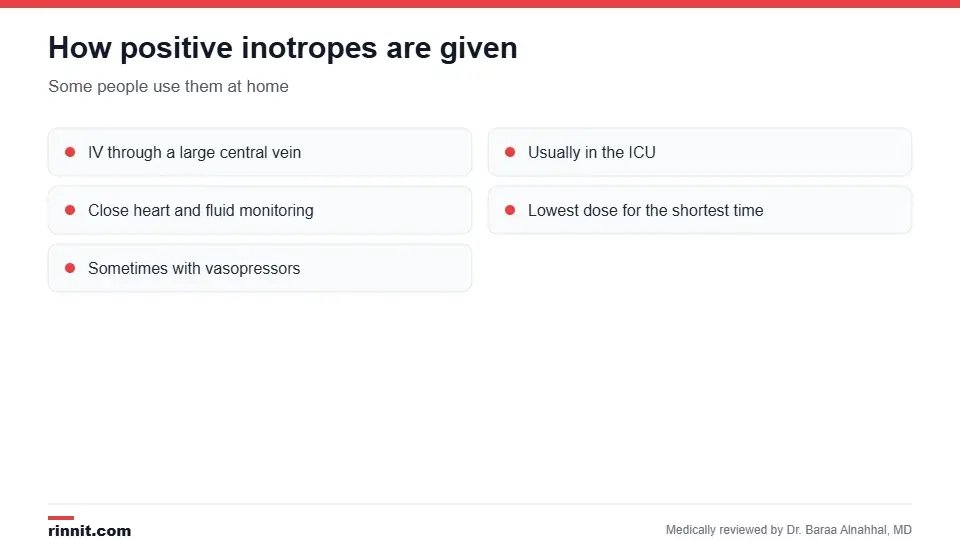
Some people with end-stage heart failure receive IV inotropes at home.
Positive inotropes are usually given by IV through a large central vein in the ICU.
Your team watches your heart rhythm, vital signs and fluids closely.
They're usually used at the smallest dose that works for the shortest time.
They may be combined with vasopressors.
Some people with end-stage heart failure go home on IV inotropes.
Negative inotropes are usually pills taken regularly. Sources: [1]
Side effects
Type | Possible side effects |
Positive inotropes | Irregular or fast heartbeat, low or high blood pressure, anxiety, fever, headache, reduced blood flow to the heart, fluid in the lungs; higher risk of death with long-term use |
Negative inotropes | Dizziness, weakness, headache, constipation, dry mouth, nausea, blurry vision, diarrhea, sweating |
Sources: [1, 2, 3]
Recovery and outlook
Positive inotropes are lowered gradually as your condition improves. Some people get worse when they stop and need them until a heart transplant or mechanical heart pump. Negative inotropes may be needed long term. Positive inotropes can save lives, and negative inotropes can help control blood pressure, chest pain and heart rhythm. Sources: [1]
When to call your provider
Your symptoms come back or get worse after you leave the hospital.
You have a bad reaction to a new medicine.
Your medicine isn't helping or causes bad side effects.
Don't skip doses or follow-up visits, and check before taking herbs, supplements or over-the-counter drugs. Sources: [1]
Conclusion
Inotropes are powerful heart medicines that can save lives in shock and severe heart failure or help control blood pressure and rhythm problems. Close monitoring and following your care plan keep them as safe as possible.
Keep learning: read about heart failure and heart failure medicines.
Frequently asked questions
What are inotropes?
Medicines that change how forcefully the heart squeezes.
What's the difference between positive and negative inotropes?
Positive inotropes strengthen heartbeats; negative inotropes weaken them.
When are positive inotropes used?
For shock, severe heart failure and after heart surgery.
What are examples of positive inotropes?
Dobutamine, milrinone, epinephrine, dopamine and digoxin.
What are negative inotropes used for?
High blood pressure, angina and arrhythmias.
How are positive inotropes given?
Usually by IV in an intensive care unit.
Can inotropes be used at home?
Some people with end-stage heart failure use IV inotropes at home.
What are the side effects?
Irregular heartbeat and blood pressure changes are common.
Are inotropes used long term?
Positive inotropes usually aren't; negative inotropes may be.
Is digoxin an inotrope?
Yes, a positive inotrope.
Related Reading
Heart Failure: Symptoms, Causes & Treatment Guide an overview of heart failure.
Cardiogenic Shock: The Heart-Failure Emergency Where Minutes Matter — Plain-English Guide a condition treated with inotropes.
Understanding Vasopressors: Life-Support Medications for Critical Care related ICU medicines.
Heart Failure Medications: Types, Benefits, Side Effects, and How to Take Them Safely everyday heart failure medicines.
Inotropic Medications: Enhancing and Regulating Heart Performance more on inotropic medicines.
References
Cleveland Clinic. Inotropes: Types, Purpose and Side Effects. Cleveland Clinic. Last updated May 17, 2022. https://my.clevelandclinic.org/health/treatments/23032-inotropes
Mebazaa A, Nieminen MS, Packer M, et al. Levosimendan vs dobutamine for patients with acute decompensated heart failure: the SURVIVE randomized trial. JAMA. 2007;297(17):1883-1891. PMID 17473298. https://doi.org/10.1001/jama.297.17.1883
Cuffe MS, Califf RM, Adams KF, et al. Short-term intravenous milrinone for acute exacerbation of chronic heart failure: a randomized controlled trial. JAMA. 2002;287(12):1541-1547. PMID 11911756. https://doi.org/10.1001/jama.287.12.1541
Medical disclaimer
This article is for general education only and does not replace advice from a qualified healthcare professional. Talk to your doctor about your own diagnosis and treatment, and seek emergency care right away for severe or sudden symptoms.



Comments