Cardiac Output: What It Is, Normal Range, How It's Measured and What Affects It

Updated: 5 days ago
Written and medically reviewed by Dr. Baraa Alnahhal, MD · Last reviewed: November 2026 · How we review
Quick Answer: What is cardiac output?
Cardiac output is how many liters of blood your heart pumps in one minute. It equals stroke volume (blood pumped per beat) multiplied by heart rate. A normal cardiac output is 5 to 6 liters per minute at rest. Providers measure it to look for problems such as heart failure or to check whether a treatment is working. [1]
What the research says
Fully non-invasive monitors don't yet match the standard catheter method. In a meta-analysis of 37 studies and 1,543 patients, non-invasive cardiac output devices had a percentage error of 47% compared with bolus thermodilution, above the accepted 30% limit. (Joosten et al., British Journal of Anaesthesia, 2017) [2]
Low output adjusted for body size signals higher risk in pulmonary hypertension. In 215 patients with pulmonary hypertension, a cardiac index below 2.5 L/min/m² measured by thermodilution significantly predicted death within 1 year. (Yağmur et al., Anatolian Journal of Cardiology, 2023) [3]
Key takeaways
Cardiac output = stroke volume × heart rate. [1]
Normal cardiac output is 5 to 6 liters per minute at rest. [1]
It rises with exercise and during pregnancy. [1]
Heart failure, valve disease, abnormal rhythms and stiff heart walls can lower it. [1]
The most accurate measurement is done during right heart catheterization. [1]
What is cardiac output?
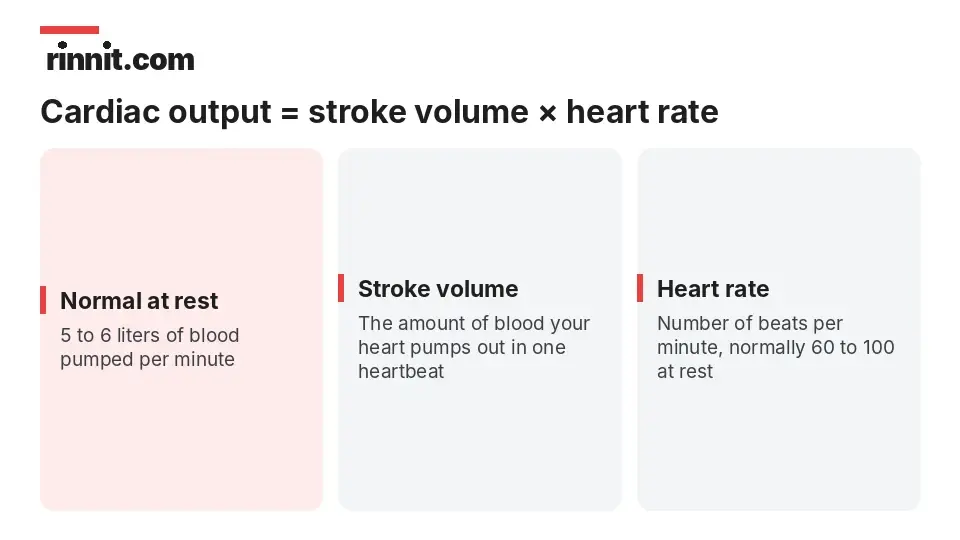
Your body raises cardiac output when it needs more oxygen.
Cardiac output is how many liters of blood your heart pumps in one minute. Your provider calculates it by multiplying stroke volume by heart rate. [1]
Part of the formula | What it means |
Stroke volume | The amount of blood your heart sends to your body in one heartbeat. It changes with your heart health and whether you're resting or moving |
Heart rate | The number of heartbeats per minute, normally 60 to 100 at rest |
Sources: [1]
When you exercise, your body needs more oxygen. Because blood delivers oxygen to your cells, your body raises cardiac output by adjusting heart rate and stroke volume. [1]
Why would you need your cardiac output measured?
Your provider may measure cardiac output to: [1]
Find out why you're having trouble exercising
Check for heart failure, especially if you can't exercise as much as you used to
Make a diagnosis
See whether a medicine, device or procedure is working
Symptoms of decreased cardiac output
Not being able to exercise much
Feeling very tired
Swelling in your arms and legs
Shortness of breath
Nausea and vomiting
Abdominal pain
Sources: [1]
How is cardiac output measured?
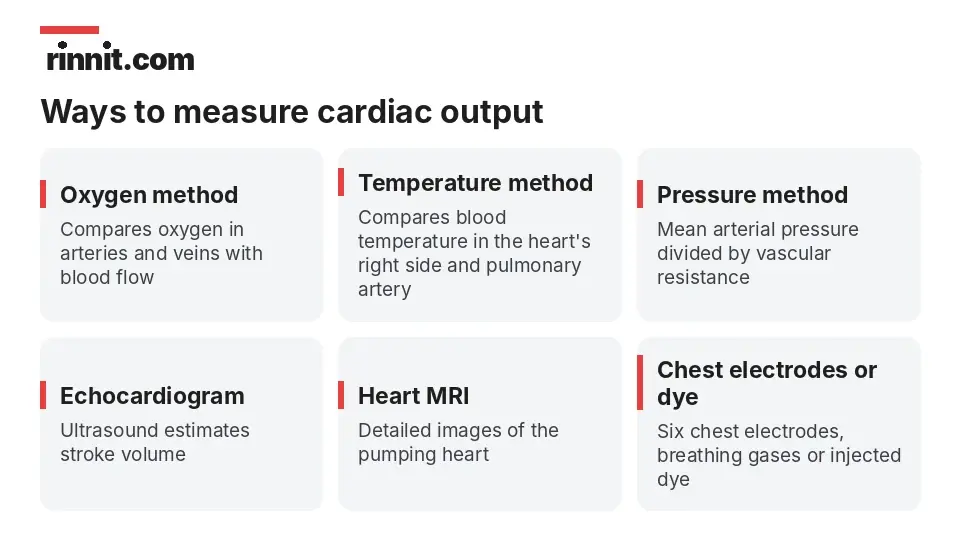
Some methods are more invasive than others.
Providers can use several methods. Some are more invasive than others. [1]
Measuring how much oxygen an organ or tissue uses (oxygen in your arteries minus oxygen in your veins) and multiplying by blood flow rate
Comparing the temperature of blood in your vena cava or right atrium with blood in your pulmonary arteries
Dividing mean arterial pressure by systemic vascular resistance
Using a portable device that involves breathing certain gases through a mouthpiece
Placing six electrodes on your chest to measure heart rate and stroke volume
Echocardiography through the chest wall to estimate stroke volume
Heart MRI
Injecting dye as blood enters the right side of your heart and measuring how much leaves the left side
Sources: [1]
What happens during the most accurate test?
For the most accurate method, your provider measures how much oxygen you breathe in and takes blood samples from an artery and from a catheter in your pulmonary artery. This is done during right heart cardiac catheterization. You'll get your cardiac output the same day, along with the pressures inside your heart. [1]
What is a normal cardiac output?
Situation | Cardiac output |
Adult at rest | 5 to 6 liters per minute |
Athlete during exercise | More than 35 liters per minute |
Non-athlete during exercise | Higher than at rest, but lower than an athlete |
Pregnancy | Goes up |
Sources: [1]
What affects cardiac output?
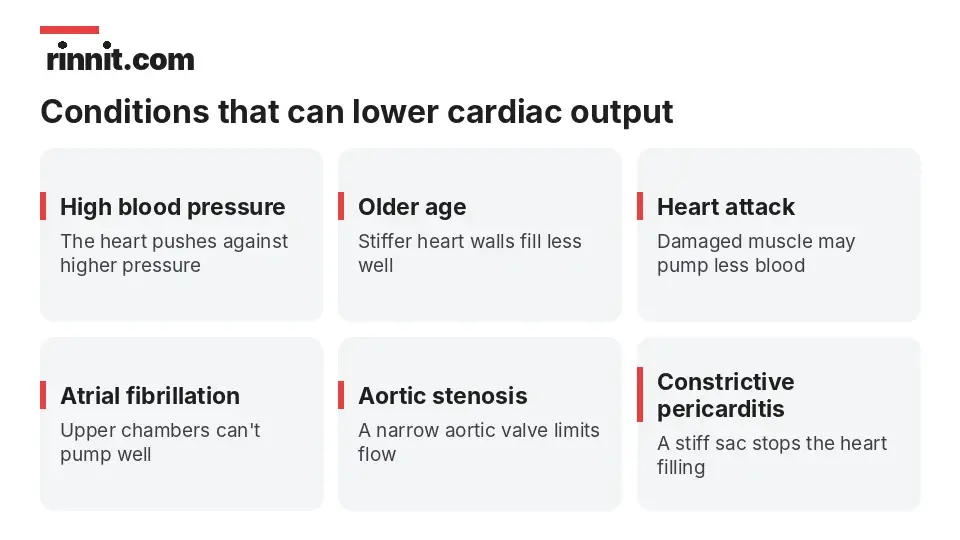
Exercise and pregnancy raise cardiac output naturally.
Factor | How it lowers cardiac output |
High blood pressure | Your heart must pump harder to push blood against higher pressure in your arteries or lungs |
Older age | Stiffer heart walls fill with blood less quickly and less fully |
Heart attack or myocarditis | Damaged heart muscle may not pump as much blood |
Atrial fibrillation | The upper chambers can't pump enough blood into the lower chambers |
Aortic stenosis | A narrow aortic valve limits blood flow into the aorta |
Constrictive pericarditis | A stiff sac around the heart stops it from relaxing and filling |
Sources: [1]
How can you improve cardiac output?
Getting more blood to your body depends on a strong heart and healthy blood vessels. You can help your heart and blood vessels work better if you: [1]
Exercise regularly
Keep your cholesterol numbers low, except HDL ("good") cholesterol
Follow your treatment plan if you have diabetes
Avoid fried foods and other high-fat foods
Stay at a healthy weight
Don't use tobacco products
Control your blood pressure, with medicine if needed
Conclusion
Knowing how much blood your heart can pump helps your provider make a diagnosis or check whether a treatment is working. Cardiac output depends on both how strongly your heart pumps and how fast it beats. [1]
If your provider measures your cardiac output, ask what the number means for you and which options fit your situation. [1]
Keep learning: Read our heart failure guide or our guide to cardiac catheterization. For more background, see the NHLBI page on heart failure.
FAQ
What is cardiac output?
The number of liters of blood your heart pumps in one minute.
How do you calculate cardiac output?
Multiply stroke volume by heart rate.
What is a normal cardiac output?
5 to 6 liters per minute at rest.
What is stroke volume?
The amount of blood your heart pumps to your body in one heartbeat.
What lowers cardiac output?
Heart attack damage, atrial fibrillation, aortic stenosis, constrictive pericarditis, high blood pressure and older age.
What are symptoms of low cardiac output?
Tiredness, trouble exercising, swelling, shortness of breath, nausea and belly pain.
How is cardiac output measured most accurately?
With oxygen measurements and blood samples during right heart catheterization.
Does exercise increase cardiac output?
Yes. An athlete's output can exceed 35 liters per minute during exercise.
Does pregnancy change cardiac output?
Yes. Cardiac output goes up during pregnancy.
How can I improve my cardiac output?
Exercise, avoid tobacco, eat less high-fat food and control blood pressure, cholesterol and diabetes.
Related Reading
Heart Failure: Symptoms, Causes & Treatment Guide explains the condition most often linked to low cardiac output.
Congestive Heart Failure: Symptoms, Stages, and How It's Treated covers how a weak pump leads to fluid buildup.
Cardiogenic Shock: The Heart-Failure Emergency Where Minutes Matter describes a dangerous drop in the heart's output.
High-Output Heart Failure: Symptoms, Causes, and Recovery Outlook explains heart failure when the body demands too much blood flow.
Echocardiogram and Cardiac Catheterization explain two tests used to measure how well the heart pumps.
Hemodynamic Test: Checking Heart Output and Circulation for Fainting explains the heart output and circulation test used to find causes of fainting.
References
Cleveland Clinic. Understanding Cardiac Output and What It Means. Cleveland Clinic. Last updated June 17, 2022. https://my.clevelandclinic.org/health/diagnostics/23344-cardiac-output
Joosten A, Desebbe O, Suehiro K, et al. Accuracy and precision of non-invasive cardiac output monitoring devices in perioperative medicine: a systematic review and meta-analysis. Br J Anaesth. 2017;118(3):298-310. PMID 28203792. https://doi.org/10.1093/bja/aew461
Yağmur B, Şimşek E, Kayıkçıoğlu M, et al. Could Impedance Cardiography be a Non-Invasive Alternative Method of Measuring Cardiac Output in Patients with Pulmonary Hypertension? Anatol J Cardiol. 2023;27(11):650-656. PMID 37466025. https://doi.org/10.14744/AnatolJCardiol.2023.2820
Medical disclaimer
This article is for general education only and does not replace advice from a qualified healthcare professional. Talk to your doctor about your own diagnosis and treatment, and seek emergency care right away for severe or sudden symptoms.



Comments