Marfan Syndrome: Symptoms, Causes, and Management Strategies

Updated: 3 days ago
Medically reviewed by Dr. Baraa Alnahhal, MD · Last reviewed: October 2026
Quick Answer
Marfan syndrome is an inherited condition caused by a mutation in the FBN1 gene, which affects the strength and elasticity of connective tissue. It often shows as a tall, thin build with long limbs, with risks like aortic enlargement and eye lens dislocation. It is not curable but is manageable with routine monitoring, medications like beta-blockers, and exercise plans.
What the research says
Blood pressure medicines slow the widening of the aorta. In a pooled analysis of individual patient data from 7 trials (1,442 patients), angiotensin receptor blockers roughly halved the yearly growth of the aortic root Z score compared with control (0.07 vs 0.13 per year), and beta-blockers worked about as well (Pitcher et al., Lancet, 2022 [2]).
Combining the two drug types may work better than a beta-blocker alone. A meta-analysis of 9 trials (1,449 patients) found that an angiotensin receptor blocker plus a beta-blocker slowed aortic root dilation more than a beta-blocker alone, with no significant difference in aortic dissection, aortic surgery, or death (Wang et al., Ann Vasc Surg, 2022 [3]).
Marfan syndrome (MFS) is a genetic condition that fundamentally alters the body's connective tissue, the material that provides strength and flexibility to various structures. In individuals with this syndrome, the connective tissue is too loose and elastic, which can impact the heart, blood vessels, eyes, bones, and joints. As a "variable expression" condition, Marfan syndrome affects each individual differently; symptoms can range from mild to severe and may appear at different stages of life, though the condition is present from birth.
What are the common physical features and symptoms of Marfan syndrome?
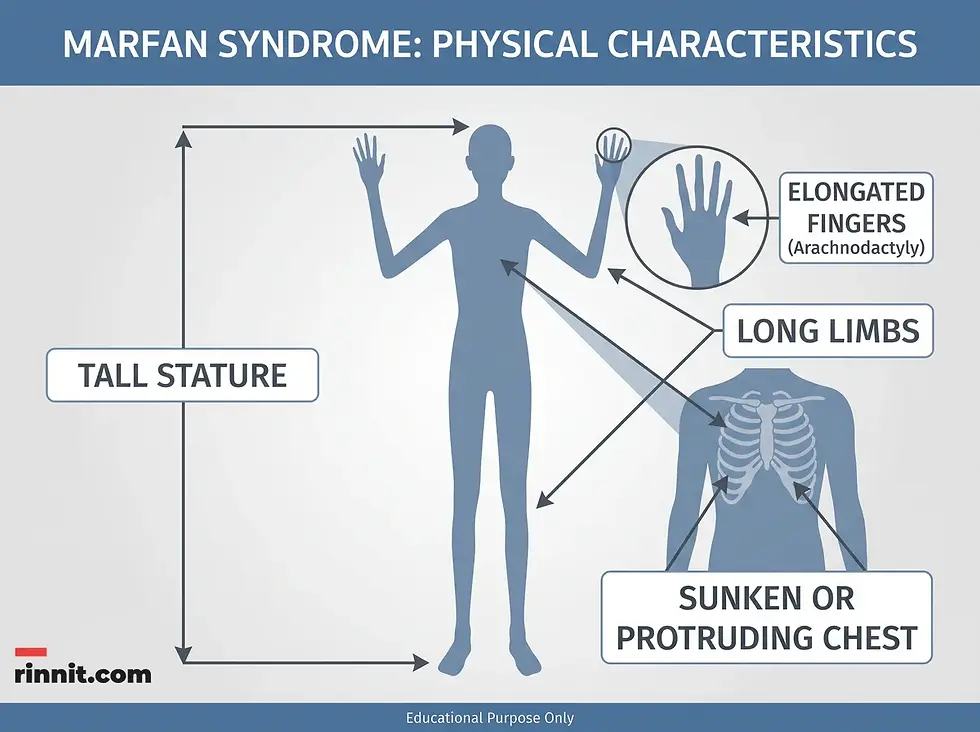
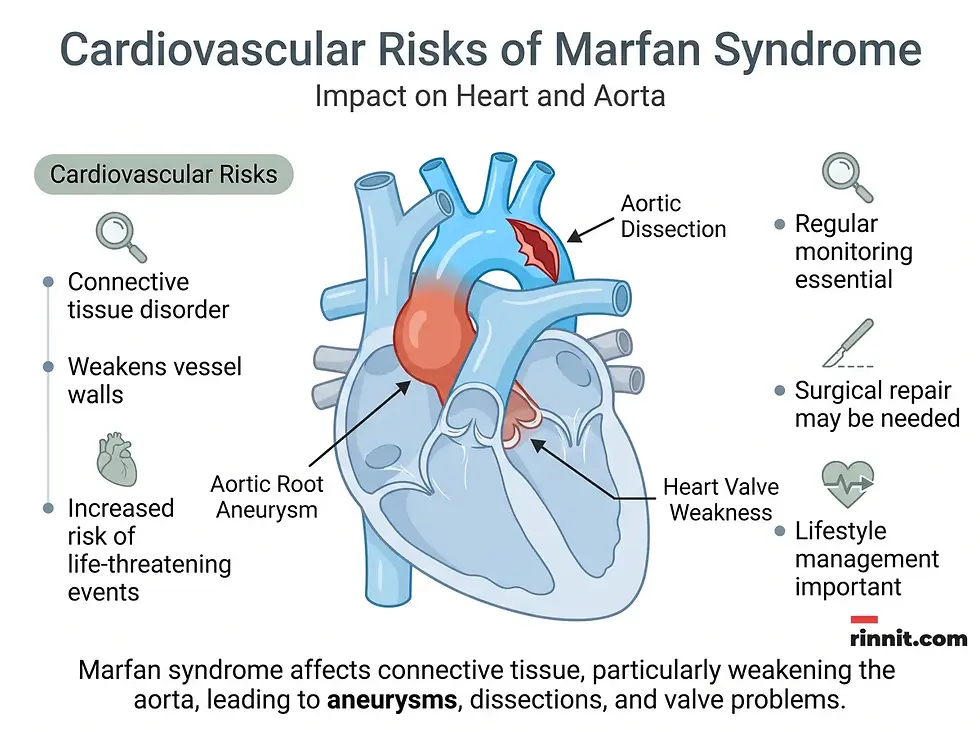
Marfan syndrome is often first recognized by its distinctive physical characteristics. The two hallmark features are aortic root aneurysm—a bulging of the aorta near the heart—and ectopia lentis, which refers to the dislocation of the eye's lens. Beyond these internal markers, many individuals exhibit a unique skeletal profile.
Feature Category | Common Physical Signs |
Skeletal Build | Tall and thin stature; long arms, legs, fingers, and toes. |
Facial & Dental | Long, narrow face; crowded teeth. |
Chest & Spine | Sunken or protruding chest; curved spine (scoliosis). |
Joints & Feet | Weak or easily dislocated joints; flat feet. |
What causes Marfan syndrome, and how is it inherited?
The root cause of Marfan syndrome is a mutation in the FBN1 gene, which provides the instructions for producing fibrillin-1. This protein is a critical component of the elastic fibers in connective tissue. The disorder follows an autosomal dominant inheritance pattern, meaning that an individual only needs to inherit the mutated gene from one biological parent to have the condition.
While approximately 75% of cases are inherited from a parent, about 25% of individuals develop Marfan syndrome due to a new, spontaneous genetic mutation. Regardless of how the condition is acquired, an individual with MFS has a 50% chance of passing the altered gene to each of their children.
What health complications can Marfan syndrome cause?
Because connective tissue is found throughout the body, Marfan syndrome can lead to complications in several organ systems. Cardiovascular issues are the most significant concern, as the weakening of the aortic wall can lead to life-threatening tears known as aortic dissections.
Complications by System
Cardiovascular: Heart valve disease, enlarged heart, abnormal heart rhythms (arrhythmias), and brain aneurysms.
Vision: Increased risk of cataracts, glaucoma, and retinal detachment.
Respiratory: Higher susceptibility to asthma, bronchitis, pneumonia, and collapsed lungs (pneumothorax).
How is Marfan syndrome diagnosed?
Diagnosing Marfan syndrome involves a multidisciplinary approach, often utilizing a set of standardized criteria known as the Ghent nosology. Healthcare providers evaluate medical history, conduct physical exams, and perform specialized imaging tests.
Common diagnostic tools include:
Imaging: Echocardiograms, CT scans, and MRIs to monitor the heart and blood vessels.
Vision Exams: To check for lens dislocation and other eye-related changes.
Genetic Testing: Blood tests to identify mutations in the FBN1 gene, though results are sometimes interpreted alongside clinical findings.
How is Marfan syndrome managed and treated?
Marfan syndrome has no cure, but it is highly manageable with a combination of medication, lifestyle adjustments and surgery. The primary goal of treatment is to prevent the aorta from enlarging or tearing.
Treatment Options
Strategy | Description |
Medications | Beta-blockers and ARBs are used to slow the rate of aortic enlargement. |
Routine Monitoring | Regular imaging of the heart and eyes to catch changes early. |
Activity Guidance | Avoiding contact sports and high-intensity exercise to protect the heart. |
Surgical Repair | Procedures to repair or replace the aortic valve or ascending aorta. |

What is the long-term outlook for Marfan syndrome?
The prognosis for individuals with Marfan syndrome has significantly improved with modern medical care. By working closely with a team of specialists and adhering to a personalized management plan, most people with the condition can live a full and healthy life. Continuous advancements in surgical techniques and pharmacological treatments continue to enhance the quality of life for the Marfan community.
Conclusion
Marfan syndrome is a complex genetic condition that requires a proactive and lifelong approach to health. Through early identification of physical signs and consistent cardiovascular monitoring, the most serious risks associated with the disorder can be effectively mitigated.
Frequently Asked Questions
What is the most common cause of Marfan syndrome?
The condition is caused by a mutation in the FBN1 gene, which affects the body's production of fibrillin-1.
Is Marfan syndrome always inherited?
No, while 75% of cases are inherited, about 25% occur due to a new, spontaneous genetic mutation.
What are the hallmark signs of the condition?
The two main features are aortic root aneurysm and a dislocated eye lens (ectopia lentis).
How common is Marfan syndrome?
Marfan syndrome affects approximately 1 in 3,000 to 5,000 people worldwide.
Can people with Marfan syndrome play sports?
Low- to moderate-intensity exercise is encouraged, but contact sports and high-intensity activities should be avoided.
What medications are used to manage the condition?
Beta-blockers and angiotensin II receptor blockers (ARBs) are commonly prescribed to slow aortic enlargement.
Does Marfan syndrome affect life expectancy?
With proper monitoring and treatment, many individuals can live a normal and healthy life span.
What is Ghent nosology?
Ghent nosology is a standardized set of clinical criteria used by healthcare providers to diagnose Marfan syndrome.
Can Marfan syndrome affect the lungs?
Yes, it can increase the risk of conditions like asthma, bronchitis, and collapsed lungs.
Is heart surgery always necessary?
Not always; surgery is typically reserved for cases where the aorta has enlarged significantly or valve issues are present.
Related Reading
Aortic Root Replacement: Bentall vs. Valve-Sparing Surgery explains aortic root replacement surgery.
Learn more in our guide to Beighton Score: How Joint Hypermobility Is Measured and What Your Score Means.
References
Cleveland Clinic. Marfan Syndrome: Symptoms & Treatment. Cleveland Clinic. September 4, 2026. https://my.clevelandclinic.org/health/diseases/17209-marfan-syndrome
Pitcher A, Spata E, Emberson J, et al. Angiotensin receptor blockers and β blockers in Marfan syndrome: an individual patient data meta-analysis of randomised trials. Lancet. 2022;400(10355):822-831. PMID: 36049495. DOI: https://doi.org/10.1016/S0140-6736(22)01534-3
Wang Z, Deng X, Kang X, Hu A. Angiotensin receptor blockers vs. beta-blocker therapy for Marfan syndrome: a systematic review and meta-analysis. Ann Vasc Surg. 2022;82:347-361. PMID: 34998935. DOI: https://doi.org/10.1016/j.avsg.2021.12.073
Medical disclaimer
This article is for informational purposes only and is not a substitute for professional medical advice, diagnosis, or treatment. The clinical information in this guide reflects source material last reviewed in September 2026.



Comments