Beighton Score: How Joint Hypermobility Is Measured and What Your Score Means

Updated: 2 days ago
Written and medically reviewed by Dr. Baraa Alnahhal, MD · Last reviewed: November 2026 · How we review
Quick Answer: What is the Beighton score?
The Beighton score is a painless exam that measures how flexible the joints are, using a 9-point scale. A provider checks the thumbs, fingers, elbows, knees and spine. A score of 4 or more, with pain in 4 or more joints for at least 3 months, suggests joint hypermobility syndrome. It can't diagnose conditions like Ehlers-Danlos syndrome on its own. [1]
What the research says
Different examiners usually get the same score. A systematic review of 24 studies with 1,333 people found the Beighton score had substantial to almost perfect agreement between raters in most studies (5 of 8 intraclass correlation values and 12 of 19 kappa values), even when raters had different backgrounds and experience. (Bockhorn et al., Orthopaedic Journal of Sports Medicine, 2021) [2]
The score can miss hypermobility in joints it doesn't test. A review notes that the Beighton score mostly checks upper-limb joints and leaves out many major joints. The authors advise against using it alone to rule out generalized joint hypermobility and stress the clinician's overall judgment. (Malek et al., Rheumatology International, 2021) [3]
Key takeaways
The Beighton score measures joint flexibility on a 9-point scale.
It checks the thumbs, pinky fingers, elbows, knees and spine.
The higher your score, the more flexible your joints.
It takes a few minutes, doesn't hurt and has no risks.
A positive score suggests joint hypermobility syndrome, but further testing may be needed to look for an underlying cause.
What is the Beighton score?
The Beighton score is a test of joint hypermobility, meaning joints that move more than usual. It uses simple movements, such as bending your pinky finger backward to check the joint angle. Each movement you can do earns a point on a 9-point scale. [1]
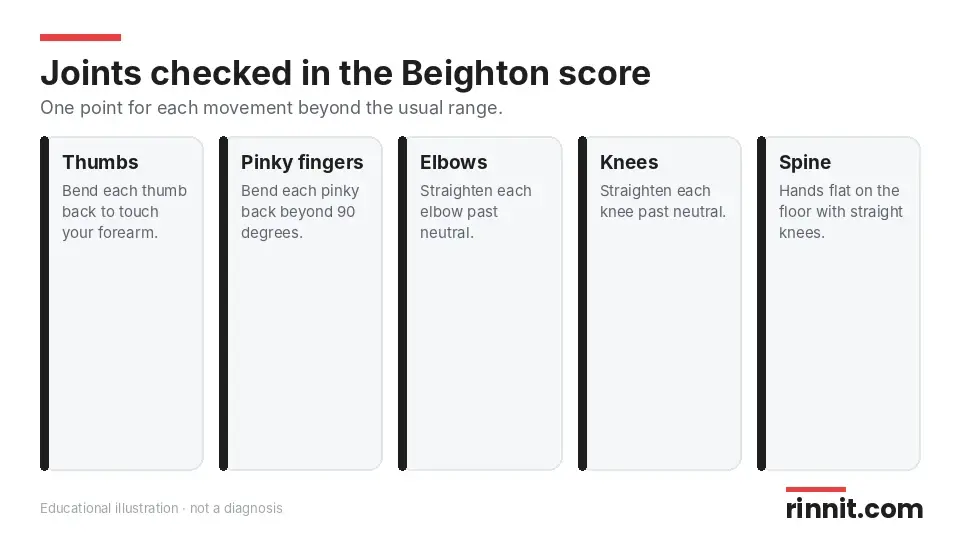
The test looks at these joints: [1]
The base of both thumbs
Both elbows
Both knees
The knuckles of both pinky fingers
Your spine
When is the Beighton score used?
It is a standard test to help diagnose joint hypermobility syndrome, a common condition that affects about 3% of the general population. [1]
Many healthy people have very flexible joints. But joint hypermobility syndrome may come from an underlying condition. It is linked with heritable connective tissue disorders, including: [1]
Ehlers-Danlos syndrome (EDS)
Marfan syndrome
Osteogenesis imperfecta
How is the Beighton score calculated?
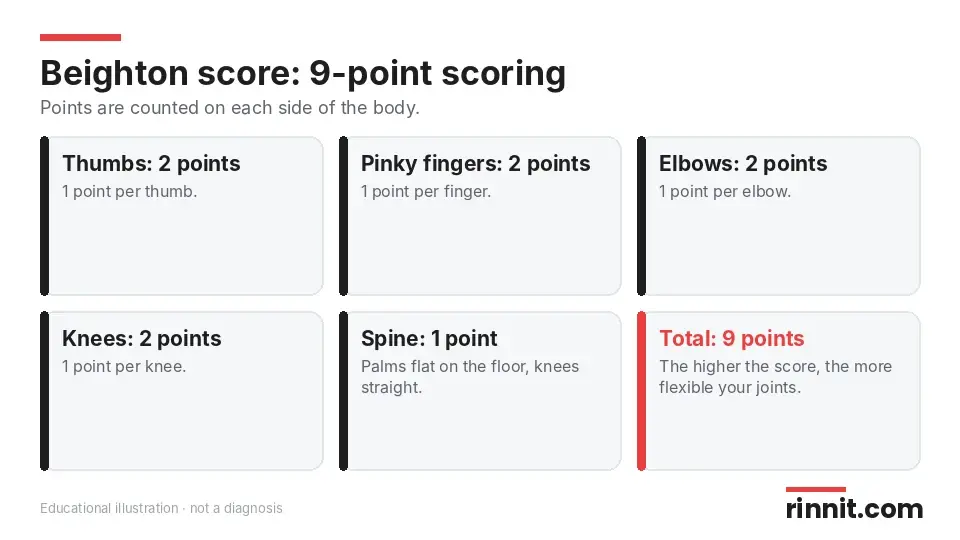
Your provider gently moves your joints into certain positions. You get one point for each of the following you can do: [1]
Movement | Points possible |
Bend forward and place your hands flat on the floor without bending your knees | 1 |
Straighten each elbow past a neutral position (hyperextend) | 2 (1 per elbow) |
Straighten each knee past a neutral position (hyperextend) | 2 (1 per knee) |
Bend each pinky finger back beyond 90 degrees | 2 (1 per finger) |
Bend each thumb back to touch your forearm | 2 (1 per thumb) |
Total | 9 |
Sources: [1]
The history questions
The second part of the test asks about your history of joint movement and joint pain. Each "yes" is one point: [1]
Can you now (or could you ever) put your hands flat on the floor while keeping your knees straight?
Can you now (or could you ever) bend your thumb to touch your lower arm?
When you were younger, did you entertain friends by twisting into different positions, or could you do the splits?
As a child or teenager, did you dislocate your shoulder or kneecap more than once?
Do you think of yourself as double-jointed?
What should you expect during the test?
Your provider asks you to move your joints into certain positions. You may lie down or sit in a chair for some movements. The test takes only a few minutes and shouldn't hurt. [1]
Are there risks or side effects?
No. There are no risks or side effects linked with the Beighton score. [1]
What does a positive Beighton score mean?
The higher your number, the looser your joints. A positive result for joint hypermobility syndrome is either: [1]
Part of the test | Positive result |
Flexibility movements | 4 or more points, plus pain in 4 or more joints for at least 3 months |
History questions | 2 or more "yes" answers |
Sources: [1]

A positive score means you likely have joint hypermobility syndrome. Because this syndrome can come from another condition, your provider will talk with you about next steps, which often include more testing. [1]
The Beighton score alone can't diagnose EDS, Marfan syndrome or osteogenesis imperfecta. It is one part of a series of tests to find the cause of your symptoms. [1]
When will you know your score?
Right away. Your provider adds up your points as you complete each part of the test. [1]
Questions to ask your provider
Do I need more testing after the Beighton score?
How is joint hypermobility syndrome treated?
What can I do to improve my joint health?
What is the outlook for joint hypermobility syndrome?
Conclusion
The Beighton score is a simple in-office test of how flexible your joints are. The closer your score is to 9, the more flexible your joints. A positive result suggests joint hypermobility syndrome, which sometimes points to an underlying connective tissue condition.
If your score is positive, talk with your provider about the best next steps and any extra tests you may need.
Keep learning: Read our guides to differential diagnosis, genetic testing and the McMurray test. For more on this condition, see NHS: Joint hypermobility syndrome.
FAQ
What is the Beighton score?
It is a 9-point test that measures how flexible your joints are to check for joint hypermobility syndrome. [1]
What is a positive Beighton score?
4 or more points on the movements with pain in 4 or more joints for at least 3 months, or 2 or more "yes" answers on the history questions. [1]
Which joints does the Beighton score test?
The base of the thumbs, the elbows, the knees, the pinky finger knuckles and the spine. [1]
What is the maximum Beighton score?
The maximum score is 9 points. [1]
Does the Beighton test hurt?
No. It takes a few minutes and shouldn't be painful. [1]
How common is joint hypermobility syndrome?
About 3% of the general population has joint hypermobility syndrome. [1]
Can the Beighton score diagnose Ehlers-Danlos syndrome?
No. It can't diagnose EDS, Marfan syndrome or osteogenesis imperfecta on its own. [1]
When do I get my Beighton score results?
Right away, because your provider adds up the points during the exam. [1]
Are there risks to the Beighton score?
No. There are no risks or side effects. [1]
What happens after a positive score?
Your provider will discuss next steps, which most likely include more testing for an underlying condition. [1]
Related Reading
Learn more in our guide to What is Joint Hypermobility Syndrome?
Learn more in our guide to Ehlers-Danlos Syndrome: Symptoms, Causes, and Treatment.
Learn more in our guide to Marfan Syndrome: Symptoms, Causes, and Management Strategies.
Learn more in our guide to Osteogenesis Imperfecta (Brittle Bone Disease): Symptoms, Causes, Types, and Management — What You Need to Know.
Learn more in our guide to Connective Tissue Diseases: Types, Symptoms, and Treatment Options.
References
Cleveland Clinic. Beighton Score: How It’s Used to Measure Joint Hypermobility. Cleveland Clinic. Last updated September 14, 2022. https://my.clevelandclinic.org/health/diagnostics/24169-beighton-score
Bockhorn LN, Vera AM, Dong D, et al. Interrater and Intrarater Reliability of the Beighton Score: A Systematic Review. Orthop J Sports Med. 2021;9(1):2325967120968099. PMID 33786328. https://doi.org/10.1177/2325967120968099
Malek S, Reinhold EJ, Pearce GS. The Beighton Score as a measure of generalised joint hypermobility. Rheumatol Int. 2021;41(10):1707-1716. PMID 33738549. https://doi.org/10.1007/s00296-021-04832-4
Medical disclaimer
This article is for general education only and does not replace advice from a qualified healthcare professional. Talk to your doctor about your own diagnosis and treatment, and seek emergency care right away for severe or sudden symptoms.



Comments