McMurray Test: How Doctors Check for a Torn Meniscus and What Results Mean

Updated: 2 days ago
Written and medically reviewed by Dr. Baraa Alnahhal, MD · Last reviewed: November 2026 · How we review
Quick Answer: What is the McMurray test?
The McMurray test is a physical exam to check for a torn meniscus, the cartilage cushion inside the knee. With you lying on your back, the provider bends, rotates and straightens your knee while feeling and listening for a pop and asking about pain. It's a first step; imaging such as an MRI is needed to confirm a tear. [1]
What the research says
The McMurray test alone cannot confirm or rule out a tear. A meta-analysis of 18 studies found a pooled sensitivity of 70% and specificity of 71% for the McMurray test, with no single exam test accurately diagnosing a torn meniscus. (Hegedus et al., Journal of Orthopaedic & Sports Physical Therapy, 2007) [2]
Later pooled data showed a similar picture. In nine studies with 1,234 people, the McMurray test had a sensitivity of 61% and a specificity of 84%; the authors concluded that special knee tests remain of limited accuracy. (Smith et al., Evidence-Based Medicine, 2015) [3]
Key takeaways
The McMurray test checks for a torn meniscus during a routine knee exam. [1]
It needs no equipment, preparation or separate appointment. [1]
It has no risks, though it can cause mild discomfort. [1]
A negative result does not rule out a tear. [1]
Imaging such as X-ray, MRI or ultrasound usually follows. [1]
What is the McMurray test used for?
Providers use the McMurray test when they suspect a torn meniscus, one of the most common knee injuries, especially in athletes. The meniscus is a wedge of cartilage between the thigh bone (femur) and shin bone (tibia) that cushions the joint like a shock absorber. Sudden, forceful twisting, falls and car accidents can tear it. [1]
You may need a McMurray test if you have symptoms of a torn meniscus, such as: [1]
Feeling or hearing a pop in the knee
Instability, or feeling like the knee might give out
Pain
Stiffness
Swelling
Not being able to fully bend or straighten the knee
The test can also help your provider check for damage to knee ligaments or other connective tissue. [1]
How is the McMurray test done?
The McMurray test is a series of movements that check your symptoms and range of motion. [1]
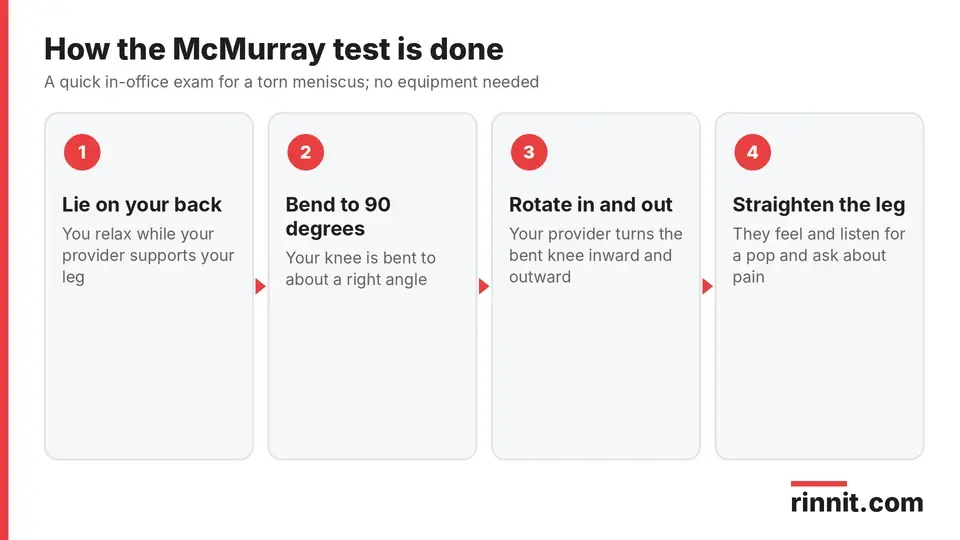
The test takes only a few moments during a knee exam.
You lie on your back.
Your provider bends your knee to 90 degrees, about where it would be if you were sitting.
They rotate the bent knee in, toward your body, and out, away from it.
They straighten your leg.
Sources: [1]
These positions put mild stress on the meniscus, similar to the strain your knee gets in daily life. Throughout, your provider asks about pain and feels and listens for popping, which helps show where, and how badly, the meniscus may be torn. [1]
How should I prepare, and what should I do during the test?
No preparation is needed. During the test, try to relax and tell your provider everything you feel, especially if a movement hurts. Your feedback helps locate the tear or identify a different injury. [1]
Does the McMurray test have any risks?
There are no risks to your knee. You may feel a little pain or discomfort, but even with a torn meniscus, the test should not cause intense pain. [1]
What do McMurray test results mean?
Instead of a number, the McMurray test works more like a true-or-false question. [1]
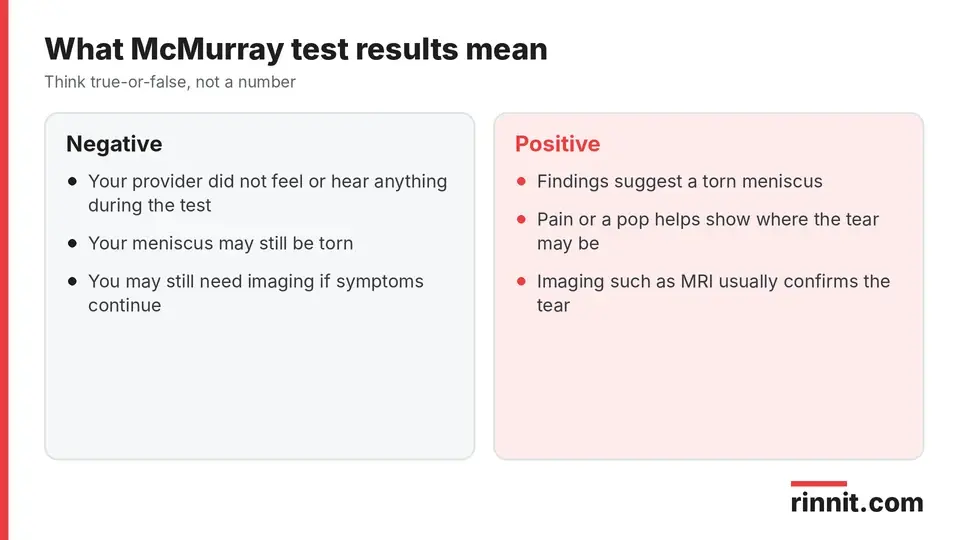
A negative result does not always mean the meniscus is healthy.
Result | What it means |
Positive | Your provider found signs that your meniscus is torn |
Negative | Your provider did not feel or hear anything during the test |
Sources: [1]
Some studies show the McMurray test may not be very accurate on its own. A negative result does not mean you will not need other tests, because the meniscus may still be torn or there may be other damage in the knee. [1]
What happens after a McMurray test?
If your provider finds signs of injury, they will recommend imaging or treatment to relieve your symptoms. Imaging confirms damage inside the joint. Common tests are: [1]
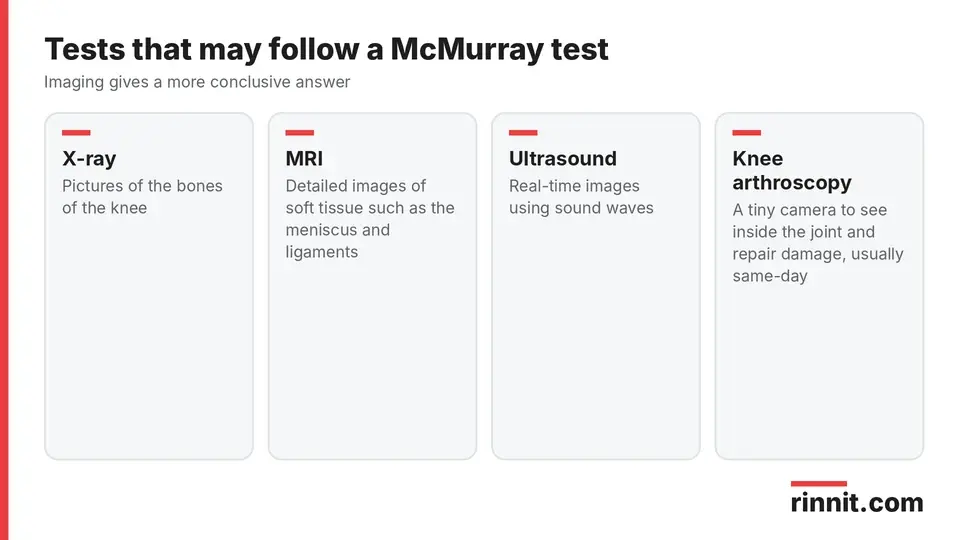
Imaging gives a more conclusive answer than the exam alone.
X-rays
Magnetic resonance imaging (MRI)
Ultrasound
You may also need a knee arthroscopy, a minimally invasive procedure in which a surgeon uses a tiny camera to see inside the joint and diagnose or repair damage. Most are outpatient, so you can go home the same day. [1]
When should you call your doctor?
See your provider if pain or swelling gets worse after a few days. Go to the emergency room right away if you have: [1]
Extreme pain
Swelling that is getting worse
Discoloration
No ability to move your knee, or less movement than usual
Conclusion
The McMurray test is a quick, safe, no-equipment knee exam and often the first step in checking for a torn meniscus. Because it is not very accurate on its own, most people also need imaging to confirm the diagnosis.
If your knee hurts or you cannot use it normally after an injury, see your provider soon rather than waiting.
Keep learning: Read our torn meniscus guide or our guide to meniscus surgery. For more background, see the AAOS OrthoInfo page on meniscus tears.
FAQ
What is the McMurray test?
It is a series of knee and leg movements a provider uses in the office to check for a torn meniscus.
How is the McMurray test done?
You lie on your back while your provider bends your knee to 90 degrees, rotates it in and out, then straightens your leg.
What does a positive McMurray test mean?
Your provider felt, heard or saw signs, such as pain or a pop, that suggest a torn meniscus.
Does a negative McMurray test rule out a tear?
No. Your meniscus may still be torn, so you may need other tests.
Does the McMurray test hurt?
You may feel a little pain or discomfort, but it should not cause intense pain.
Is the McMurray test accurate?
Studies show it is not very accurate on its own, so imaging such as MRI usually confirms the diagnosis.
Do I need to prepare for a McMurray test?
No preparation is needed.
What tests come after a McMurray test?
X-rays, MRI or ultrasound, and sometimes knee arthroscopy.
What are the symptoms of a torn meniscus?
A pop in the knee, instability, pain, stiffness, swelling and trouble fully bending or straightening the knee.
When should I go to the ER for a knee injury?
Go for extreme pain, worsening swelling, discoloration or if you cannot move your knee.
Related Reading
Torn Meniscus: Symptoms, Causes, Treatment, and Recovery — Complete Guide explains the injury the McMurray test is designed to detect.
What Is a Bucket Handle Meniscus Tear? Symptoms, Causes, and Treatment Options covers a severe tear type that can lock the knee.
Knee Pain: Symptoms, Causes, Diagnosis, and Treatment Guide reviews other causes of knee pain your provider considers during the exam.
Anterior Drawer Test: How It's Done, Positive vs Negative Results and Accuracy explains the hands-on knee exam used to check for an ACL tear.
Thessaly Test: How It's Done, What Results Mean and How Accurate It Is explains the standing knee exam used to check for a torn meniscus.
Apley Test: How It Checks for a Torn Meniscus and What Results Mean explains the face-down knee exam used to check for a torn meniscus.
References
Cleveland Clinic. McMurray Test: What It Is & How It's Performed. Cleveland Clinic. Last updated June 13, 2022. https://my.clevelandclinic.org/health/diagnostics/23442-mcmurray-test
Hegedus EJ, Cook C, Hasselblad V, et al. Physical examination tests for assessing a torn meniscus in the knee: a systematic review with meta-analysis. J Orthop Sports Phys Ther. 2007;37(9):541-550. PMID 17939613. https://doi.org/10.2519/jospt.2007.2560
Smith BE, Thacker D, Crewesmith A, Hall M. Special tests for assessing meniscal tears within the knee: a systematic review and meta-analysis. Evid Based Med. 2015;20(3):88-97. PMID 25724195. https://doi.org/10.1136/ebmed-2014-110160
Medical disclaimer
This article is for general education only and does not replace advice from a qualified healthcare professional. Talk to your doctor about your own diagnosis and treatment, and seek emergency care right away for severe or sudden symptoms.



Comments