Meniscus Surgery: Types, Recovery Time, Risks, and What to Expect

Updated: 6 days ago
Written and medically reviewed by Dr. Baraa Alnahhal, MD · Last reviewed: October 2026 · How we review
Quick Answer: What is meniscus surgery?
Meniscus surgery is a minimally invasive knee operation that repairs, trims, or replaces a torn meniscus, a piece of cartilage inside the knee. It usually takes about an hour through a few small incisions, and most people go home the same day. Recovery ranges from about six weeks to several months, depending on the surgery type. [1]
What the research says
Repairs need more repeat surgery but protect the knee better long term. A systematic review found long-term reoperation rates of 20.7% after isolated meniscus repair versus 3.9% after partial meniscectomy, yet repair was linked to higher knee-function scores and less joint degeneration on imaging. (Paxton et al., Arthroscopy, 2011) [2]
For wear-related tears without arthritis, trimming did no better than a placebo operation. In a double-blind trial of 146 adults aged 35 to 65 with a degenerative medial meniscus tear, partial meniscectomy and sham surgery improved knee scores by similar amounts at 12 months (Lysholm score +21.7 vs. +23.3 points). (Sihvonen et al., N Engl J Med, 2013) [3]
In adults over 45 with knee arthritis, physical therapy and surgery gave similar pain relief. Among 351 people followed for 5 years, pain scores dropped from about 46 to about 18 (on a 0–100 scale) in both the physical therapy and partial meniscectomy groups. (Katz et al., Arthritis Rheumatol, 2020) [4]

Key takeaways
Meniscus surgery treats a torn meniscus by repairing, removing, or replacing the damaged cartilage. [1]
There are three types: meniscus repair, partial meniscectomy, and meniscus replacement. [1]
Most procedures use knee arthroscopy, take about an hour, and allow same-day discharge. [1]
Recovery is about six weeks after meniscectomy, up to three months after repair, and several months after replacement. [1]
Removing part of the meniscus can raise the risk of knee arthritis later in life. [1]
Call your surgeon right away for fever above 101°F (38.3°C), pus, heavy drainage, worsening swelling, or trouble breathing. [1]
Meniscus surgery at a glance
Feature | Details |
What it treats | A torn meniscus (damage inside the knee) [1] |
Who performs it | An orthopaedic surgeon [1] |
Technique | Usually minimally invasive knee arthroscopy through a few small incisions [1] |
Anesthesia | General (asleep) or regional (numb from the waist down, with a sedative) [1] |
Operation time | About 1 hour [1] |
Hospital stay | Usually outpatient, home the same day [1] |
Full recovery | A few weeks to a few months, depending on the type [1] |
Who needs meniscus surgery?
People with a serious (high-grade) meniscus tear, or a tear whose symptoms do not improve with nonsurgical treatment, are the usual candidates for meniscus surgery. [1]
Many people choose surgery because the injured cartilage causes problems in daily life. [1] These include:
A knee that feels unstable, buckles, or gives way.
Pain and swelling.
A knee that "locks up" or gets stuck. [1]
If you are still trying to understand your injury, start with our guides to the knee joint and to bucket handle meniscus tears.
What are the three types of meniscus surgery?
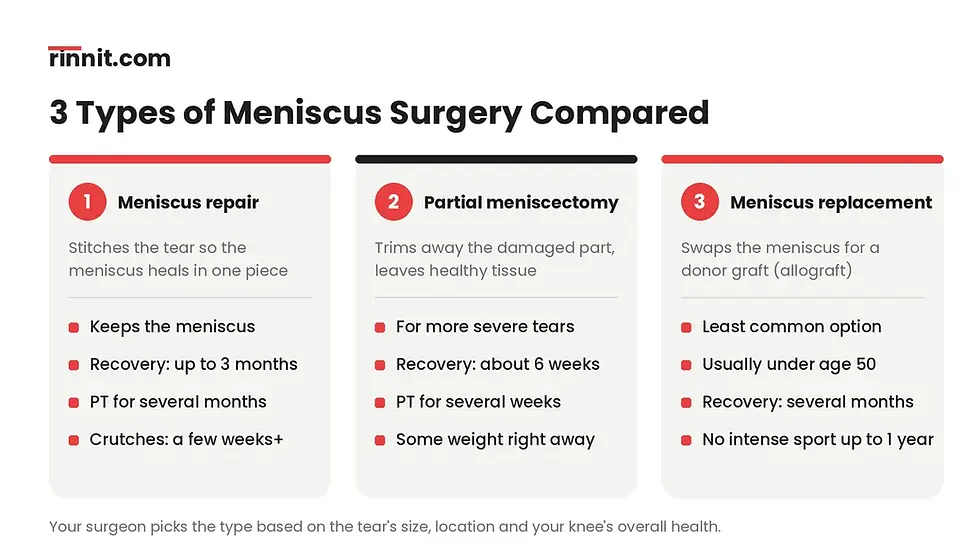
The three types of meniscus surgery are meniscus repair, partial meniscectomy, and meniscus replacement. [1] Your surgeon chooses based on how severe the tear is and the condition of your knee.
Meniscus repair
Meniscus repair stitches (sutures) the tear together so the meniscus heals back into one piece. [1] The surgeon also repairs any other damage in the meniscus. Your body absorbs the stitches as the tear heals. [1]
Partial meniscectomy
Partial meniscectomy is the removal of the damaged part of the meniscus. [1] The surgeon trims away the torn cartilage and leaves healthy tissue in place.
This option suits more severe tears. Higher-grade tears are often too damaged to heal back together completely, even with a repair. [1]
Meniscus replacement
Meniscus replacement, also called meniscus transplantation, swaps the damaged meniscus for an allograft, a meniscus from a human donor. [1]
It is much less common than the other two types. It is usually only an option for people younger than 50 who have knee arthritis or a severely torn meniscus. [1]
How do the three types compare?
Meniscus repair | Partial meniscectomy | Meniscus replacement | |
What happens | Tear is stitched together | Damaged part is trimmed away | Meniscus is replaced with a donor graft |
Best suited for | Tears that can heal back together | More severe, higher-grade tears | People under 50 with knee arthritis or a severe tear |
How common | Common | Common | Much less common |
Typical recovery | Up to 3 months | About 6 weeks | Several months |
Physical therapy | Several months | Several weeks | Several months |
Return to intense sport | A few months | About 1 month | Up to 1 year |
Source for table: [1]
How should you prepare for meniscus surgery?
Preparing for meniscus surgery involves pre-operative tests, a medication review, fasting, and arranging a ride home. [1]
Tests you may need [1]:
Physical exam
Blood tests
EKG (heart tracing)
Chest X-ray
Knee X-ray
MRI
Other steps [1]:
Share your medication list. Tell your provider about all prescriptions, over-the-counter medicines, and herbal supplements. You may need to stop some before surgery.
Fast as instructed. Most people stop eating several hours before surgery and may be allowed clear liquids until about 2 hours before. Follow your surgeon's exact timing.
Arrange transport. You cannot drive yourself home, so plan for someone to pick you up.
What happens during meniscus surgery?
During meniscus surgery, an anesthesiologist keeps you pain-free while the surgeon treats the tear through small incisions using a camera and tiny tools. [1]
Anesthesia. You receive either general anesthesia, which puts you to sleep, or regional anesthesia, which numbs you from the waist down. Regional anesthesia comes with a sedative to help you relax. [1]
Small incisions. The surgeon makes a few small cuts in the skin around your knee. [1]
Arthroscopy. A small camera and tiny instruments go into the knee joint to repair, trim, or replace the meniscus. [1]
Closing. The procedure usually takes around an hour. [1]
The time can be a little shorter or longer depending on the surgery type, how severe the tear is, and whether other injuries need treatment at the same time, such as knee ligament tears. [1] If your knee was also hurt in other ways, see our guide to ACL injury.
What happens right after meniscus surgery?
Meniscus surgery is usually an outpatient procedure, so most people go home the same day. [1] Your team watches you in a recovery room until the anesthesia wears off. When it is safe to leave, someone needs to drive you home. [1]
What are the benefits of meniscus surgery?
Meniscus surgery can relieve pain and other symptoms of a torn meniscus and help you move normally again. [1] The main benefits include:
Reduced or fully relieved pain and other symptoms.
Better mobility.
A more stable knee.
A return to sports and other physical activities. [1]
What are the risks and complications of meniscus surgery?
Meniscus surgery is safe and effective, but like any operation it carries some risk of complications. [1]
Possible complication | What it means |
Blood clots | A clot can form in a blood vessel (see our deep vein thrombosis guide) [1] |
Bleeding inside the knee | Blood can collect in the joint [1] |
Infection | An infection can develop after surgery [1] |
Nerve or blood vessel damage | Nearby nerves (neuropathy) or vessels can be injured [1] |
Knee stiffness | The joint can stay stiff even after recovery [1] |
Does meniscus surgery increase the risk of arthritis?
Meniscus surgery can increase the risk of knee arthritis in the treated knee later in life, especially after a partial meniscectomy. [1] You can use your knee safely without your whole meniscus. However, removing a section raises stress and friction inside that knee for the rest of your life. [1]
For most people, the benefits of treating the tear and its symptoms outweigh the risks. [1] Ask your surgeon about your personal risk.
How long does recovery from meniscus surgery take?
Full recovery from meniscus surgery usually takes from a few weeks up to a few months. [1] Repairs take longer than meniscectomies, and replacement has the longest recovery. [1]

Surgery type | Typical recovery | Why |
Partial meniscectomy | About 6 weeks | Only the surgery itself needs to heal [1] |
Meniscus repair | Up to 3 months | The stitched meniscus must also heal inside the knee [1] |
Meniscus replacement | Several months; intense activity may wait up to 1 year | The donor graft needs the longest time to heal [1] |
Your surgeon gives you a specific timeline based on your knee and your needs. [1]
When can you walk after meniscus surgery?
Walking returns fastest after a meniscectomy. [1]
After partial meniscectomy: You can usually put some weight on your knee right away. Expect a few weeks before walking and light activity, and about a month before intense activity. [1]
After repair or replacement: You need crutches for at least a few weeks. Once you walk without crutches, it takes a few more weeks before light activity without support. Intense activity may take a few months. [1]
What will you need during recovery?
Recovery after meniscus surgery relies on support, rest, and rehabilitation. [1] You will likely need:
Crutches to take weight off the knee.
A knee brace to stabilize the joint.
Pain medicines.
The RICE method: rest, ice, compression, and elevation.
Physical therapy with home exercises to restore movement, range of motion, and strength. Expect several months after a repair, or several weeks after a meniscectomy. [1]
For day-by-day home care tips, see this meniscus tear aftercare guide. [5]
How painful is meniscus surgery recovery?
Some pain right after meniscus surgery and for several weeks while you heal is normal. [1]
Your surgeon may suggest a mix of prescription pain medicine, over-the-counter NSAIDs (if they are safe for you), and acetaminophen. [1] Follow the exact doses and timing you are given. Tell your surgeon if the pain feels like too much, or if you worry about side effects from pain medicine. [1]
Will your knee be the same after meniscus surgery?
Most people return to all their usual activities, including sports, after recovering from meniscus surgery. [1] Do not return to intense activity until your surgeon says it is safe. Your surgeon and physical therapist will tell you when you can walk without crutches or a brace. [1]
Regaining confidence can take longer than physical healing. [1] Nagging worries about the injury are common, especially after a work or sports injury. Talk to your surgeon or physical therapist about how you feel. They can help you rebuild trust in your knee. [1]
When should you call your doctor after meniscus surgery?
Call your surgeon right away if you notice any of these warning signs after meniscus surgery [1]:
Fever higher than 101°F (38.3°C).
A lot of blood or fluid draining from the surgery site.
Pus or foul-smelling drainage from the surgery site.
Pain or swelling that does not improve with rest or elevation.
Trouble breathing.
Seek emergency care for sudden trouble breathing. Learn the emergency signs of blood clots.
Conclusion
Meniscus surgery is a safe, effective way to treat a torn meniscus and get you moving again. [1] Repair saves the meniscus but takes longer to heal. Partial meniscectomy offers the fastest recovery but may raise long-term arthritis risk. Replacement is reserved for select younger patients. [1]
Recovery takes patience. You may miss games, training, or work, and it is normal to feel nervous when you return to activity. [1] Lean on your surgeon and physical therapist, follow your rehab plan, and watch for warning signs.
Keep learning about your knee health. Read our complete guide to a torn meniscus, explore knee osteoarthritis, and bookmark this page to track your recovery milestones. Have a question about your recovery? Bring this guide to your next appointment and discuss it with your surgeon.
For a broader overview of meniscus injuries, see the orthopaedic patient guide to meniscus tears. [6]
FAQ
What is meniscus surgery?
Meniscus surgery is an operation to treat a torn meniscus by repairing, removing, or replacing the damaged cartilage inside the knee. An orthopaedic surgeon usually performs it through small incisions using knee arthroscopy.
How long does meniscus surgery take?
Meniscus surgery usually takes around an hour. The time can vary with the surgery type, the severity of the tear, and whether other injuries, such as ligament tears, are treated at the same time.
Is meniscus repair better than a partial meniscectomy?
Meniscus repair keeps the meniscus and is linked to better long-term knee function, while partial meniscectomy has a faster recovery. Removing part of the meniscus can increase the risk of knee arthritis later, but repairs need repeat surgery more often. Your surgeon decides based on the tear's severity.
How long after meniscus surgery can you walk?
Walking after meniscus surgery depends on the type. After a partial meniscectomy, you can usually put some weight on the knee right away and walk within a few weeks. After repair or replacement, you need crutches for at least a few weeks.
How long is recovery from meniscus surgery?
Recovery from meniscus surgery takes about six weeks after a partial meniscectomy, up to three months after a repair, and several months after a replacement. Intense sports may need to wait up to a year after replacement.
Is meniscus surgery painful?
Meniscus surgery recovery causes some pain right after the operation and for several weeks during healing, which is normal. Surgeons usually combine prescription pain medicine, over-the-counter NSAIDs when safe, and acetaminophen.
What are the warning signs after meniscus surgery?
Warning signs after meniscus surgery include fever over 101°F (38.3°C), heavy drainage, pus or foul-smelling drainage, pain or swelling that does not improve with rest, and trouble breathing. Call your surgeon right away if any of these appear.
Can you play sports again after meniscus surgery?
Most people return to sports after recovering from meniscus surgery. Intense activity usually resumes after about a month following meniscectomy, a few months after repair, and up to a year after replacement, once the surgeon gives clearance.
Do all meniscus tears need surgery?
No. Many meniscus tears, especially small or wear-related ones, improve with rest, ice and physical therapy. Surgery is usually considered when the knee locks, gives way or stays painful despite treatment.
Will I need physical therapy after meniscus surgery?
Most people do physical therapy after meniscus surgery. It helps restore knee motion and strength and lowers the chance of stiffness.
Related Reading
Arthroscopy: Joint Surgery Procedure, Uses and Recovery explains how arthroscopy repairs joints through small incisions.
Thessaly Test: How It's Done, What Results Mean and How Accurate It Is explains the standing knee exam used to check for a torn meniscus.
Apley Test: How It Checks for a Torn Meniscus and What Results Mean explains the face-down knee exam used to check for a torn meniscus.
References
Cleveland Clinic. Meniscus Surgery: Meniscus Repair & Meniscectomy. Cleveland Clinic. Last updated August 9, 2024. https://my.clevelandclinic.org/health/treatments/21508-meniscus-surgery
Paxton ES, Stock MV, Brophy RH. Meniscal repair versus partial meniscectomy: a systematic review comparing reoperation rates and clinical outcomes. Arthroscopy. 2011;27(9):1275-1288. PMID 21820843. https://doi.org/10.1016/j.arthro.2011.03.088
Sihvonen R, Paavola M, Malmivaara A, et al. Arthroscopic partial meniscectomy versus sham surgery for a degenerative meniscal tear. N Engl J Med. 2013;369(26):2515-2524. PMID 24369076. https://doi.org/10.1056/NEJMoa1305189
Katz JN, Shrestha S, Losina E, et al. Five-Year Outcome of Operative and Nonoperative Management of Meniscal Tear in Persons Older Than Forty-Five Years. Arthritis Rheumatol. 2020;72(2):273-281. PMID 31429198. https://doi.org/10.1002/art.41082
U.S. National Library of Medicine. Meniscus tears - aftercare. MedlinePlus Medical Encyclopedia. Last updated June 4, 2025. https://medlineplus.gov/ency/patientinstructions/000684.htm
American Academy of Orthopaedic Surgeons. Meniscus Tears. OrthoInfo. Accessed October 31, 2026. https://www.orthoinfo.org/diseases--conditions/meniscus-tears
Medical disclaimer
This article is for educational purposes only and does not replace professional medical advice, diagnosis, or treatment. Always talk to a qualified healthcare provider about your symptoms and treatment options. If you have a medical emergency, call your local emergency number right away.



Comments