Apley Test: How It Checks for a Torn Meniscus and What Results Mean

Updated: 2 days ago
Written and medically reviewed by Dr. Baraa Alnahhal, MD · Last reviewed: November 2026 · How we review
Quick Answer
The Apley test is a quick physical exam that checks for a torn meniscus, the C-shaped cartilage cushion in the knee. You lie face down with the knee bent while the provider twists and presses on your foot. Pain, catching or popping suggests a meniscus tear. It's not perfectly accurate, so MRI is often the next step.
What the research says
No single knee test is reliable alone: a diagnostic study of 255 patients, 188 of whom had a meniscus tear confirmed at surgery, found that none of 6 common meniscus tests was accurate enough on its own, and combining the McMurray and Apley tests gave the best accuracy (Rinonapoli G et al., Acta Orthopaedica, 2025) [2]
Body weight changes how the test performs: in 210 people who had knee arthroscopy, the McMurray, Apley grind and Thessaly tests were more sensitive but less specific in people with a higher body mass index (Gilat R et al., International Orthopaedics, 2022) [3]
Key takeaways
A hands-on exam for a torn meniscus, done lying face down with the knee bent to 90 degrees.
Pain, catching, locking or popping with downward pressure suggests a tear.
A negative test doesn't rule out a tear.
No risks; takes a few minutes.
Usually combined with other tests and followed by MRI if needed.
What is the Apley test?
The meniscus sits between the thighbone and shinbone and absorbs shock. When it's torn, grinding the joint surfaces together while twisting can trap the torn piece and cause pain. The Apley test uses this idea, and also compares it with pulling the joint apart, which stresses ligaments rather than the meniscus. Sources: [1]
Why is it done?
Your provider may use it if you have knee pain, swelling, stiffness, locking or catching after a twisting injury, or gradual pain from wear, all signs of a torn meniscus. It's often done with the McMurray test and Thessaly test. Sources: [1, 2]
How is it done?
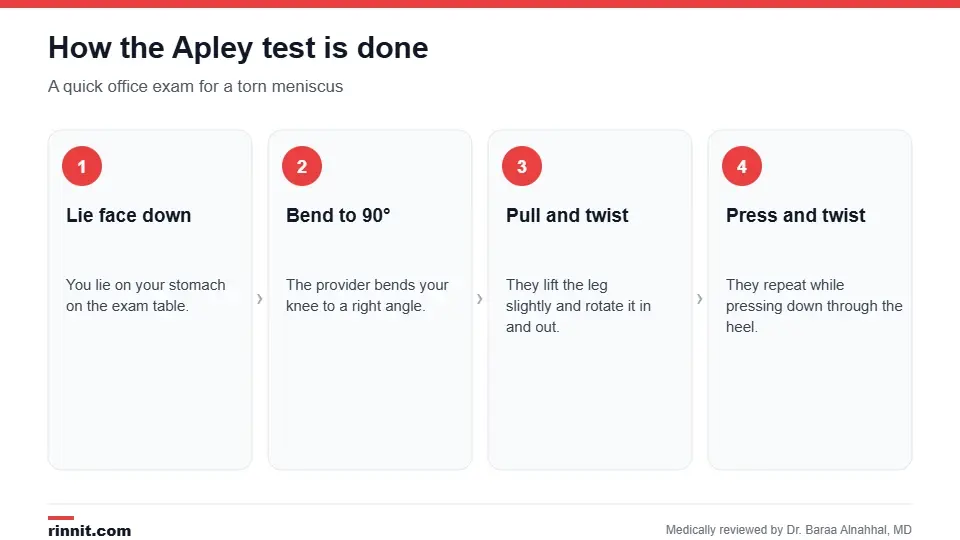
The provider tests your uninjured leg first for comparison.
You lie face down on the exam table.
The provider usually tests your uninjured leg first for comparison.
They bend your knee to 90 degrees and may rest their knee on the back of your thigh to steady it.
Distraction: they pull your foot gently upward while rotating it out and in.
Compression: they press your foot downward toward the table while rotating it out and in.
Tell them about any pain, catching or popping. Sources: [1]
What do the results mean?
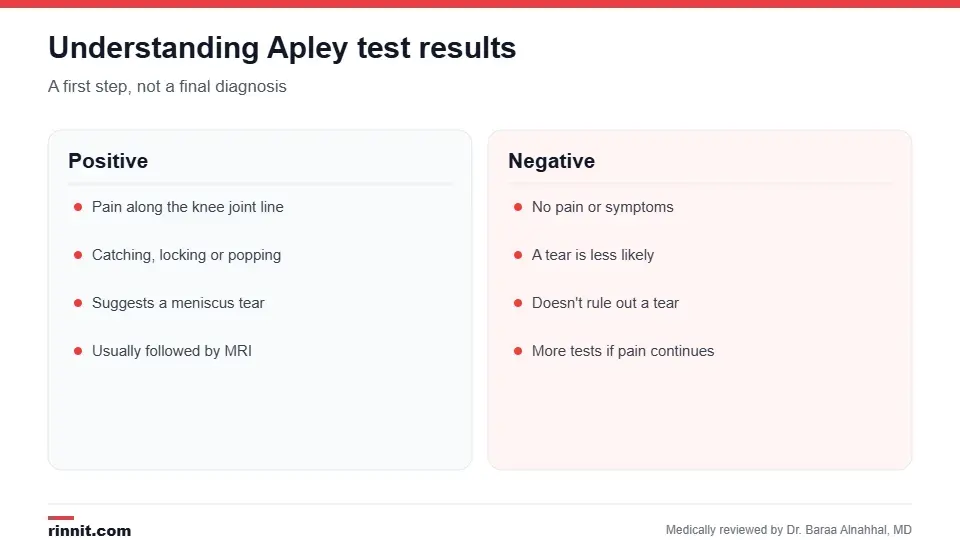
Pain with pressure points toward the meniscus.
Finding | What it may mean |
Pain, catching, locking or popping when pressing down | Positive: possible meniscus tear |
Pain mainly when pulling up | Possible ligament injury rather than meniscus |
No pain | Negative, but a tear isn't ruled out |
Sources: [1, 2, 3]
Is it accurate?
The Apley test isn't perfectly accurate. Results depend on the examiner, the tear type and factors such as body weight. That's why providers combine several tests with your history and use imaging to confirm. Sources: [1, 2, 3]
Risks
There are no real risks. The test may briefly cause pain if you have a tear, but it doesn't cause further injury. Sources: [1]
What happens next?
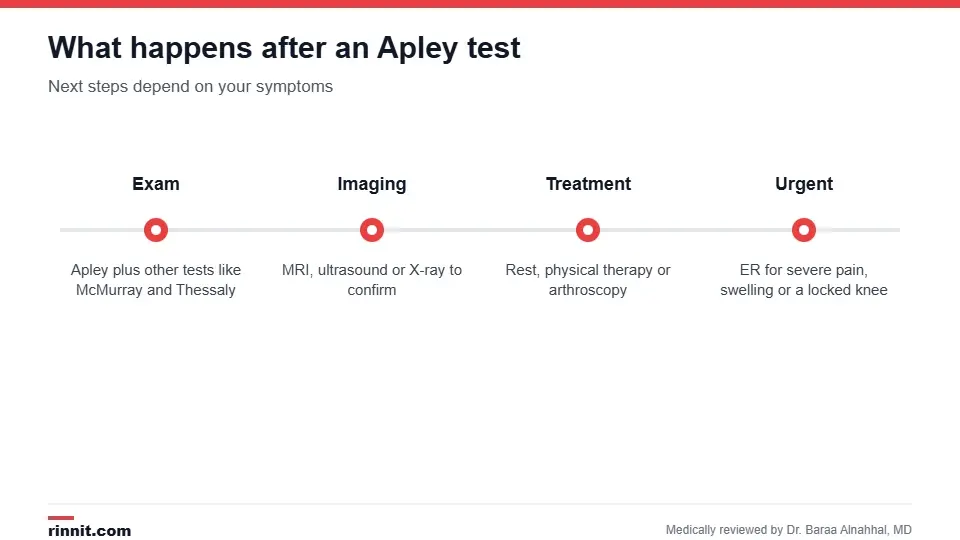
Imaging usually confirms the diagnosis.
MRI: the best imaging test to see the meniscus.
Ultrasound: may be used in some settings.
Knee X-ray: to rule out fractures or arthritis.
Arthroscopy: a small camera inserted into the knee to confirm and sometimes repair the tear, such as a bucket-handle tear. Sources: [1]
Go to the emergency room if you have extreme knee pain, major swelling, discoloration or can't move or bear weight on your knee. Sources: [1]
Conclusion
The Apley test is a quick, safe first step in checking for a torn meniscus. It gives useful clues but can't confirm a tear by itself, so it's combined with other exam tests and, when needed, MRI.
Keep learning: read about the torn meniscus and meniscus surgery.
Frequently asked questions
What does the Apley test check for?
A torn meniscus in the knee.
How is it done?
You lie face down with your knee bent while the provider pulls, presses and twists your foot.
What is a positive Apley test?
Pain, catching or popping when the provider presses down and twists.
Does the Apley test hurt?
It may cause brief pain if you have a tear.
Is the Apley test accurate?
Not on its own; it's combined with other tests and imaging.
Can a negative test rule out a tear?
No.
What's the difference between Apley and McMurray?
Both check the meniscus; McMurray is done lying on your back, Apley face down.
Are there risks?
No significant risks.
What test comes after a positive Apley test?
Usually an MRI.
When should I go to the ER for knee pain?
For extreme pain, major swelling, discoloration or inability to move the knee.
Related Reading
McMurray Test: How Doctors Check for a Torn Meniscus and What Results Mean another exam test for a torn meniscus.
Thessaly Test: How It's Done, What Results Mean and How Accurate It Is a standing twist test for meniscus tears.
Torn Meniscus: Symptoms, Causes, Treatment, and Recovery — Complete Guide the injury the Apley test checks for.
Meniscus Surgery: Types, Recovery Time, Risks, and What to Expect treatment options for meniscus tears.
Knee Pain: Symptoms, Causes, Diagnosis, and Treatment Guide common causes of knee pain.
References
Cleveland Clinic. Apley's Test: What It Is & How It's Performed. Cleveland Clinic. Last updated August 29, 2022. https://my.clevelandclinic.org/health/diagnostics/24092-apley-test
Rinonapoli G, Lucchetta L, Ancillai G, et al. Clinical reliability of 6 meniscal tests: a diagnostic accuracy study of 255 patients. Acta Orthop. 2025;96:452-458. PMID 40557851. https://doi.org/10.2340/17453674.2025.43906
Gilat R, Mitchnik IY, Moriah A, et al. The impact of body mass index on the accuracy of the physical examination of the knee. Int Orthop. 2022;46(4):831-836. PMID 34993555. https://doi.org/10.1007/s00264-021-05277-x
Medical disclaimer
This article is for general education only and does not replace advice from a qualified healthcare professional. Talk to your doctor about your own diagnosis and treatment, and seek emergency care right away for severe or sudden symptoms.



Comments