Thessaly Test: How It's Done, What Results Mean and How Accurate It Is

Updated: 2 days ago
Written and medically reviewed by Dr. Baraa Alnahhal, MD · Last reviewed: November 2026 · How we review
Quick Answer
The Thessaly test is a quick, in-office knee exam for a torn meniscus, the C-shaped cartilage cushions inside the knee. You stand on the painful leg, bend the knee slightly and twist your body inward and outward. Pain along the joint line, catching, locking or a click suggests a tear. MRI is usually used to confirm the diagnosis.
What the research says
Thessaly performs well against other bedside tests: a meta-analysis of 9 studies and 1,234 people found the Thessaly test at 20 degrees of knee bend had 75% sensitivity and 87% specificity for meniscal tears, compared with 61% and 84% for the McMurray test and 83% and 83% for joint line tenderness, although study quality was generally poor (Smith BE et al., Evidence-Based Medicine, 2015) [2]
No single knee test is enough on its own: an overview of 17 systematic reviews concluded that, among individual physical exam tests for common knee disorders, only the Lachman test for ACL tears was diagnostically valid by itself, which is why meniscus tests such as Thessaly are combined with history, other tests and imaging (Décary S et al., Physical Therapy in Sport, 2017) [3]
Key takeaways
Checks for a torn meniscus by loading and twisting the knee while you stand on one leg.
Done at a slight bend (about 5 degrees) and a deeper bend (about 20 degrees), three twists each way.
Positive: joint-line pain, catching, locking or a click; negative: no symptoms.
A negative test does not rule out a tear; MRI or arthroscopy confirms.
Mild discomfort is possible, but severe pain is not expected.
What is the Thessaly test?
Each knee has two menisci, the medial (inner) and lateral (outer), that cushion the joint and spread load between the thigh bone and shin bone. Tears often happen when the knee twists while the foot is planted, or slowly with age. The Thessaly test recreates that twisting load in a controlled way so your provider can see whether it reproduces your symptoms. It is named after the Greek region where it was first described. Sources: [1]

The Thessaly test takes only a minute or two in the clinic.
Why is it done?
Your provider may use it during a knee exam if you have pain along the inside or outside of the knee, swelling, stiffness, a catching or locking feeling, or the knee giving way, especially after a twisting injury. It is usually one of several tests, alongside the McMurray test and checking for tenderness along the joint line. Sources: [1]
How is the test performed?
You stand on the leg being tested with your foot flat on the floor.
Your provider holds your outstretched hands to keep you balanced.
You bend the standing knee slightly, about 5 degrees.
You rotate your knee and body inward and outward three times.
You repeat the twists with the knee bent more deeply, about 20 degrees.
Your provider usually tests the uninjured leg first so you learn the movement and they can compare. Sources: [1]
The provider watches for pain at the joint line, a locking or catching sensation, or a popping sound. Sources: [1]
Thessaly vs other meniscus tests
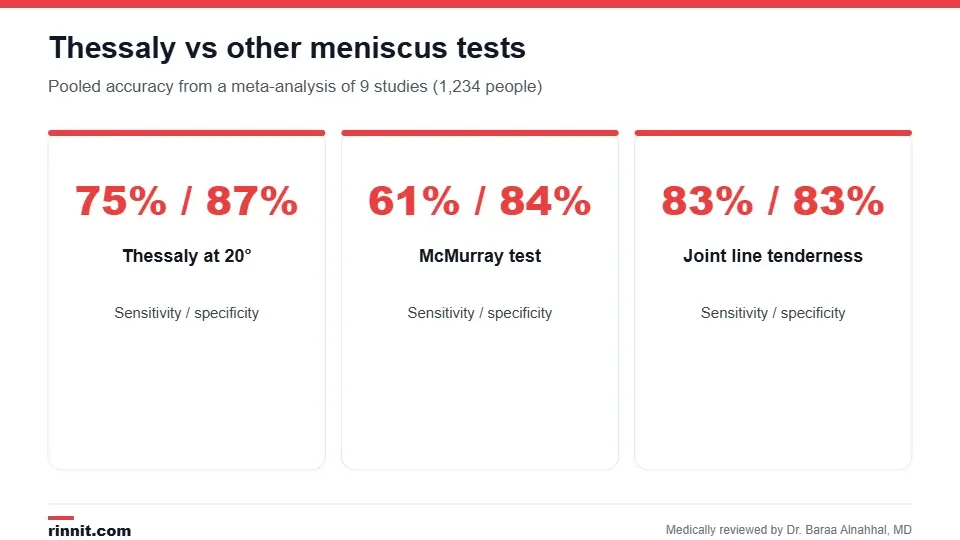
Pooled accuracy from a meta-analysis of 9 studies.
Test | Position | Sensitivity | Specificity |
Thessaly (20 degrees) | Standing on one leg, twisting | 75% | 87% |
McMurray | Lying on your back while the provider bends and rotates the knee | 61% | 84% |
Joint line tenderness | Provider presses along the joint line | 83% | 83% |
The Thessaly test is done standing, which loads the knee the way daily activity does. Studies suggest it is at least as accurate as other bedside tests, but none is accurate enough to be used alone. Sources: [1, 2, 3]
Understanding your results
Positive: pain along the joint line, a catching or locking feeling, or a click during the twists suggests a meniscus tear.
Negative: no symptoms during the test. This makes a tear less likely but does not rule it out, so further tests may still be needed. Sources: [1]
Risks
There are no significant risks. You may feel mild pain or discomfort, but intense pain is not expected even with a tear. Tell your provider if you feel unsteady or the pain is too much, and the test will stop. Sources: [1]
What happens next?
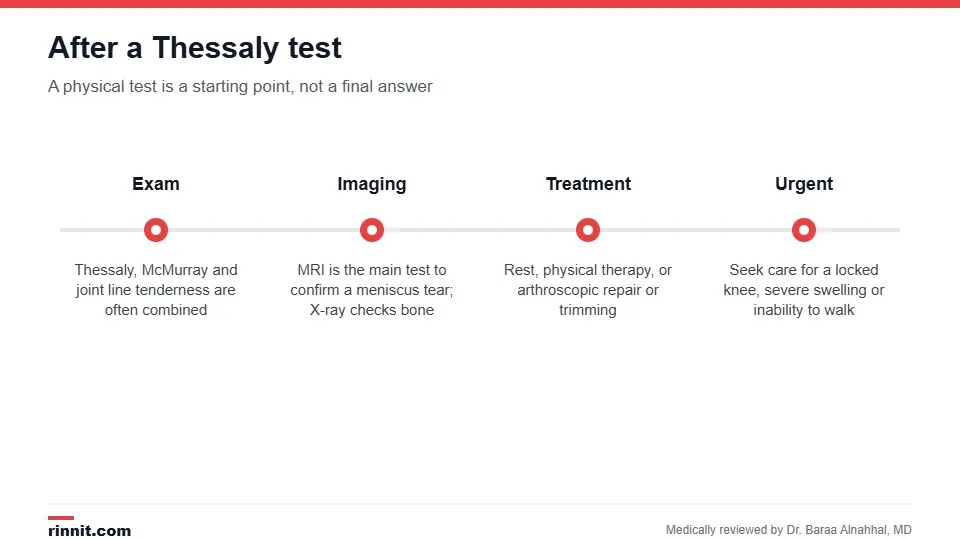
A physical test is a starting point, not a final answer.
If your test is positive or your symptoms continue, your provider may order an X-ray to check the bones and an MRI to confirm the tear and see its type and location. Treatment ranges from rest, ice and physical therapy to meniscus surgery by arthroscopy. A torn meniscus raises the long-term risk of knee osteoarthritis, so it is worth having it assessed. Sources: [1]
See a provider if pain or swelling gets worse after a few days. Go to the emergency room for severe pain, rapidly increasing swelling, discoloration or a knee you cannot move normally. Sources: [1]
Conclusion
The Thessaly test is a simple, standing check that helps your provider decide whether a meniscus tear is likely. It works best combined with other tests and, when needed, an MRI. If your knee catches, locks or keeps hurting after a twist, ask to be examined.
Keep learning: read our guide to a torn meniscus and the bucket handle meniscus tear.
Frequently asked questions
What does a positive Thessaly test mean?
Pain along the joint line, catching, locking or a click during the twists, which suggests a torn meniscus.
How accurate is the Thessaly test?
In a meta-analysis it had about 75% sensitivity and 87% specificity at 20 degrees of knee bend, slightly better than the McMurray test.
Does the Thessaly test hurt?
It can cause mild discomfort if you have a tear, but it should not cause intense pain.
What is the difference between the Thessaly and McMurray tests?
The Thessaly test is done standing on one leg while you twist; the McMurray test is done lying down while the provider bends and rotates your knee.
Can a negative test rule out a meniscus tear?
No. A negative result makes a tear less likely, but MRI may still be needed if symptoms continue.
Why is the good knee tested first?
It lets you learn the movement and gives your provider a normal comparison.
Do I need an MRI after the test?
Often yes, to confirm the tear and plan treatment, especially if symptoms persist or surgery is being considered.
Is the Thessaly test safe for everyone?
Most people can do it, but it may not be suitable if you can't stand on the injured leg or have severe pain or instability.
What causes a meniscus tear?
A twist with the foot planted, deep squatting, or gradual wear with age.
When should I seek urgent care for a knee injury?
For severe pain, fast swelling, discoloration, a locked knee or inability to bear weight.
Related Reading
McMurray Test: How Doctors Check for a Torn Meniscus and What Results Mean the lying-down companion test for a torn meniscus.
Torn Meniscus: Symptoms, Causes, Treatment, and Recovery — Complete Guide the injury the Thessaly test is designed to detect.
What Is a Bucket Handle Meniscus Tear? Symptoms, Causes, and Treatment Options a large tear that can lock the knee.
Meniscus Surgery: Types, Recovery Time, Risks, and What to Expect treatment when a tear needs repair or trimming.
Knee Pain: Symptoms, Causes, Diagnosis, and Treatment Guide the broader work-up of knee pain.
Apley Test: How It Checks for a Torn Meniscus and What Results Mean explains the face-down knee exam used to check for a torn meniscus.
References
Cleveland Clinic. Thessaly Test: What It Is & How It's Performed. Cleveland Clinic. Last updated June 14, 2022. https://my.clevelandclinic.org/health/diagnostics/23437-thessaly-test
Smith BE, Thacker D, Crewesmith A, et al. Special tests for assessing meniscal tears within the knee: a systematic review and meta-analysis. Evidence-Based Medicine. 2015;20(3):88-97. PMID 25724195. https://doi.org/10.1136/ebmed-2014-110160
Décary S, Ouellet P, Vendittoli PA, et al. Diagnostic validity of physical examination tests for common knee disorders: an overview of systematic reviews and meta-analysis. Physical Therapy in Sport. 2017;23:143-155. PMID 27693100. https://doi.org/10.1016/j.ptsp.2016.08.002
Medical disclaimer
This article is for general education only and does not replace advice from a qualified healthcare professional. Talk to your doctor about your own diagnosis and treatment, and seek emergency care right away for severe or sudden symptoms.



Comments